The Norse god Thor Myth Meaning & Symbolism
The thunder god's epic struggles defend the ordered world from chaos, embodying the raw, protective, and transformative power of the indomitable human spirit.
The Tale of The Norse god Thor
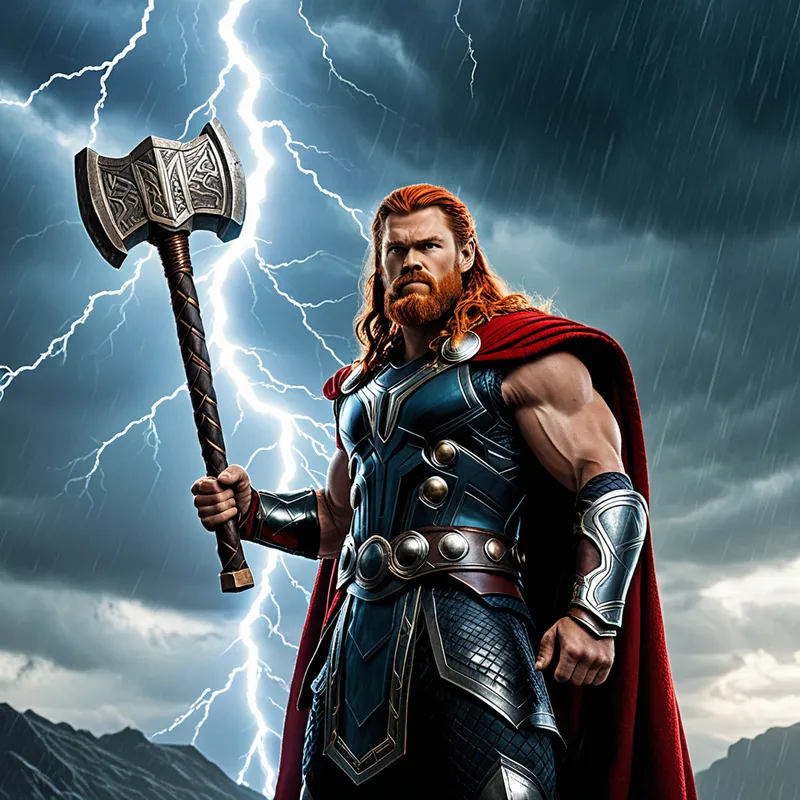
Hear now the rumble in the deep mountains, the crack that splits the quiet sky. It is the sound of his chariot, drawn by goats whose teeth spark on the stone, whose hooves beat the rhythm of coming fury. He is Thor, son of Odin, and the defender of Asgard and Midgard. His fists are wrapped in iron, and in his grip rests Mjölnir, the forge-heart of the world, a weapon that returns to his hand like a loyal thought.
The air grows thick with the smell of ozone and pine. Thor’s laughter is a booming echo, but his eyes are watchful, for the world is ringed with frost and fire. From the east, from the land of Jötunheimr, the threat ever comes. Not with armies, but with trickery, with illusions that test the very substance of reality.
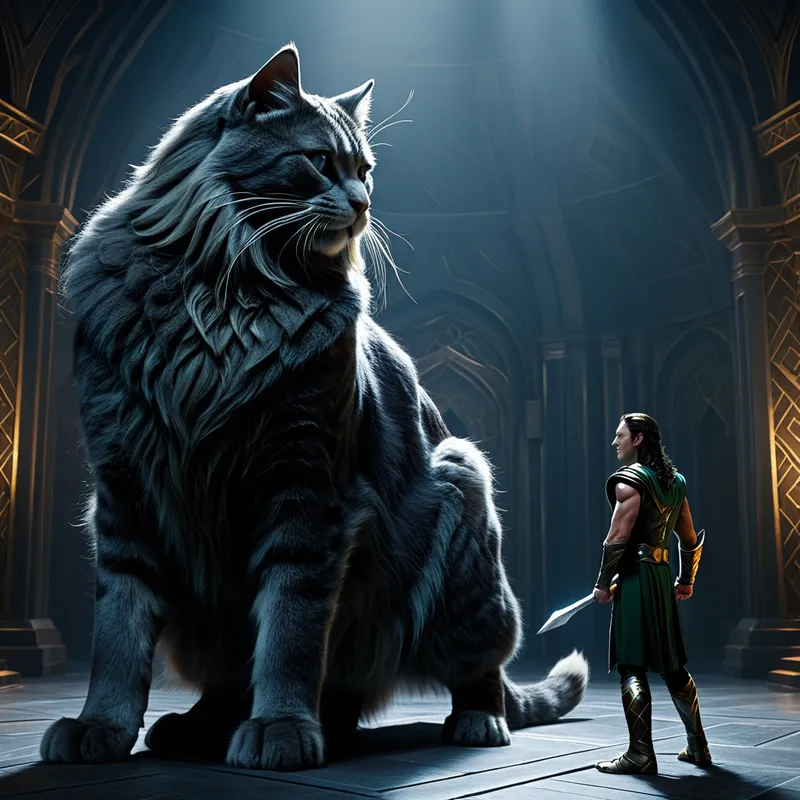
One day, the giant Útgarða-Loki challenges the thunder god to contests in his hall. Thor is given a drinking horn, its end lost in shadow. He drinks mightily, three great gulps that would drain a sea, yet the mead barely sinks. He is asked to lift a grey cat from the floor. His back bends, his veins stand like cords, he lifts with all the strength that holds up the sky—yet only one paw leaves the stone. Finally, he is told to wrestle an old crone, Elli. He strains, he sweats, he plants his feet like tree roots, but he is brought to one knee.
The hall echoes with the giants’ mocking laughter. They see a god diminished. But as the illusions fade with the giant’s fleeing form, the truth is revealed: the horn’s tip was in the ocean itself, and Thor’s draughts created the tides. The cat was the Midgard Serpent in disguise, and he had shifted the weight of the world. The crone was Old Age, whom none can ever truly throw. In his seeming failure was his greatest proof: he stood against the ocean, the serpent, and time itself, and did not break.
His final battle is foretold. At Ragnarök, the sky will bleed and the earth tremble. Thor will face the Midgard Serpent, Jörmungandr, in a duel of fated endings. He will swing Mjölnir one last, glorious time, crushing the serpent’s skull, cleansing the world with thunder. And as the poison of the dying beast fills the air, the protector, the unwavering pillar, will take nine steps and fall. His struggle ends, but his stand defines the space in which a new world can be born.
Cultural Origins & Context
These stories are not mere fantasy, but the vital breath of a people shaped by a harsh, magnificent world. They are the poetic legacy of the Norse, recorded primarily in 13th-century Iceland from a much older oral tradition, in texts like the Poetic Edda and the Prose Edda. Thor was not a distant, philosophical god, but the most popular deity among common people, farmers, and warriors. His myths were told in smoky longhouses, a bulwark against the cold and the dark, against the chaos of storms, famine, and encroaching wilderness.
The societal function was one of psychological and cultural reinforcement. Thor’s constant battles with the giants—embodiments of untamed nature, chaos, and the “other”—modeled resilience. He was the divine archetype of the hardy homesteader defending his land, the principle of ordered, fertile culture (innangard) holding the line against the destructive, wild chaos (utangard). To worship Thor was to align oneself with strength, protection, and the fruitful struggle of life.
Symbolic Architecture
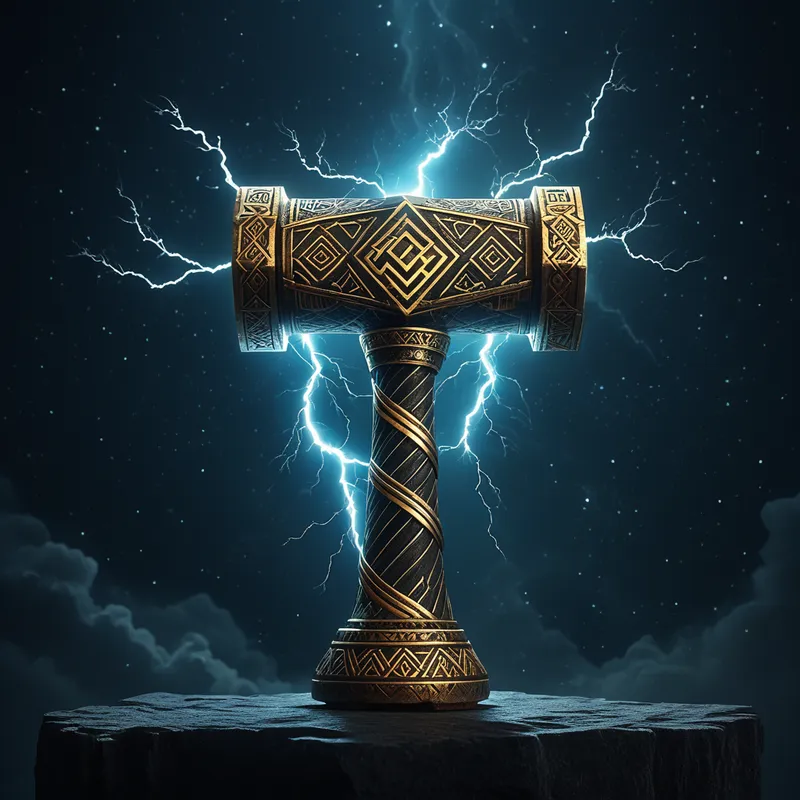
Thor is the archetype of the Solar Hero. He does not dwell in shadowy wisdom like Odin, but acts in the bright, brutal realm of consequence. His hammer, Mjölnir, is the ultimate symbol of focused, creative-destructive force. It is not just a weapon; it hallows, it consecrates, it defends the sacred space. It is the will made manifest, the tool that shapes reality.
The hammer is the concentrated point where intention becomes action, where chaos is given form, and where the boundary between self and not-self is decisively drawn.
His struggles are never purely physical. The contests in Útgarða-Loki’s hall are a profound psychological allegory. They represent the ego’s confrontation with projections and illusions—the feeling that one’s efforts are futile (the horn), that one’s burdens are cosmic (the cat), and that one’s vitality is doomed to decay (the crone). Thor’s “failure” is the revelation that the true battle is not for absolute victory over these forces, but for the dignity and strength to meet them fully.
The Dreamer’s Resonance
When the thunder god strides into modern dreams, he arrives not with a cape, but as a somatic charge—a feeling of immense, frustrated strength. You may dream of trying to lift something crucially important that is rooted to the ground, or of swinging a weapon that moves with impossible slowness. You may hear deafening thunder with no storm in sight.
This is the psyche signaling a confrontation with a “giant” in your life: a seemingly insurmountable obstacle, a systemic injustice, or a deep, chronic burden that saps your vitality. The dream is an enactment of the ego’s protective function straining against a force that feels chaotic and overwhelming. The trembling muscles in the dream are the felt sense of a will being tested to its limit. It is not a call to magical victory, but a profound acknowledgment of the weight you are carrying and the raw power you are mustering to bear it.
Alchemical Translation
The alchemical journey modeled by Thor is the nigredo of the will. It is the process of confronting the sheer, brute mass of the unconscious and the world’s resistance. His myth teaches that individuation is not a serene ascent, but a series of mighty labors.
The first step is to take up the hammer—to consciously accept the responsibility of your own strength and your role as a protector of your own psychic space. The second is to journey into Jötunheimr—to willingly face the projected giants of your life (the overwhelming job, the toxic relationship, the inner critic) not as abstract problems, but as encounters that demand your full presence. The final, most crucial transmutation is learning the lesson of the illusions: that your struggle itself is sacred.
The true alchemy is in the straining of the muscle, not the lifting of the weight. The transformation occurs in the nine steps taken after the fatal blow, in the space between the effort and the outcome.
You integrate Thor not by “winning” every battle, but by developing a will that is resilient, directed, and honorable—a will that can face the serpent of existential dread, deliver its blow for truth and order, and, in its passing, leave the world cleared for new growth. The thunder god’s legacy is the courage to be a steadfast force in a chaotic universe, to make your stand, and in doing so, to hallow the ground upon which you stand.
Associated Symbols
Explore related symbols from the CaleaDream lexicon: