
The Naga Serpent Spirits
Powerful serpent spirits in Tibetan Buddhism who guard treasures, control natural forces, and embody both protective and wrathful aspects.
The Tale of The Naga Serpent Spirits
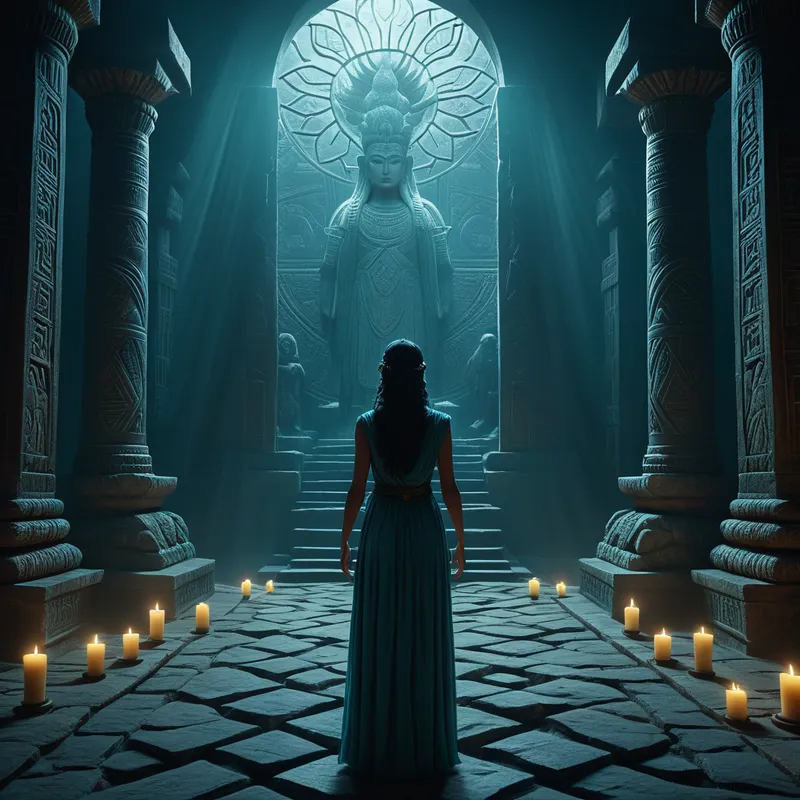
Beneath the surface of [the world](/myths/the-world “Myth from Tarot culture.”/), in the cool, dark spaces where earth meets [water](/myths/water “Myth from Chinese culture.”/) and stone cradles hidden springs, they dwell. The Naga are not mere beasts, but ancient, sentient powers, serpentine lords of the subterranean realms. Their bodies, coiled in the secret arteries of the mountain, are the very sinews of [the earth](/myths/the-earth “Myth from Hindu culture.”/), and their jeweled scales catch the faint, phosphorescent light of buried wisdom.
The tale is told of a great sage, meditating in a mountain cave, seeking the ultimate truth. His concentration was so profound it generated a heat that disturbed the Naga king whose domain lay beneath. In wrath, the serpent spirit unleashed storms, flooding the sage’s retreat with icy water and venomous mist. Yet the sage, undisturbed, met this fury not with battle, but with the boundless compassion of the bodhicitta. He saw not a monster, but a suffering being, a powerful consciousness bound by its own turbulent nature. From his meditation, he manifested a profound healing warmth that soothed the Naga’s rage and purified its venom.
Transformed, the Naga king emerged not as a destroyer, but as a protector. He offered to the sage the ultimate treasure: not gold or gems, but the safeguarding of the gter-ma, the secret [Dharma](/myths/dharma “Myth from Hindu culture.”/) treasures. From that day, the Naga became the sworn guardian of hidden knowledge, their coils the living vaults for texts, relics, and profound instructions meant for future generations of practitioners. They are the keepers of what is too potent to be left in the open light of day, ensuring it is found only by those whose minds are prepared, whose hearts are pure.
Yet their nature remains dual. Cross them, pollute their waters, or break an oath, and their wrath is the wrath of nature itself—sudden illness, drought, or devastating flood. They are the psychopomps of [the underworld](/myths/the-underworld “Myth from Greek culture.”/), holding the keys to both fertile abundance and primordial [chaos](/myths/chaos “Myth from Greek culture.”/), reminding all that the deepest protectors are often those who know the contours of darkness intimately.
Cultural Origins & Context
The Naga tradition in Tibet is a profound synthesis, weaving indigenous pre-Buddhist animism with the imported cosmology of Indian Buddhism. Before the Dharma’s arrival, the Tibetan landscape was understood as alive with sadak and lu—spirits of place, of rocks, trees, and waters. These numinous forces, often serpentine, governed the health of the land and its people. With Buddhism’s advent, these powerful local genii were not eradicated but subsumed and transformed through the lens of Dharma.
From Indian lore came the elaborate Naga mythology: semi-divine beings dwelling in splendid underwater or subterranean palaces (naga-lokas), capable of shape-shifting into human form, and possessing great wisdom and magical power. In the Tibetan synthesis, these beings became integral to the spiritual ecology. They are part of the “eight classes of gods and demons” (lha srin sde brgyad), a [pantheon](/myths/pantheon “Myth from Roman culture.”/) of worldly spirits who interact with humanity. Their conversion by great adepts like [Padmasambhava](/myths/padmasambhava “Myth from Buddhist culture.”/) is a central theme, symbolizing the taming and integration of the raw, chthonic powers of the land into the service of enlightenment. They are the psychological and environmental “old gods” who must be acknowledged and respected, their energies redirected rather than denied.
Symbolic Architecture
The Naga represents the [psyche](/myths/psyche “Myth from Greek culture.”/)’s foundational, pre-personal layers—the instinctual, emotional, and karmic substrata that underpin conscious [life](/symbols/life “Symbol: The symbol of ‘Life’ represents a journey of growth, interconnectedness, and existential meaning, encompassing both the joys and challenges that define human experience.”/). They dwell in the “waters” of the unconscious, guarding the treasures of latent potential and the poisons of unresolved [trauma](/symbols/trauma “Symbol: A deeply distressing or disturbing experience that overwhelms the psyche, often manifesting in dreams as unresolved emotional wounds or psychological injury.”/). Their dual [nature](/symbols/nature “Symbol: Nature symbolizes growth, connectivity, and the primal forces of existence.”/)—benevolent bestower of [wealth](/symbols/wealth “Symbol: Wealth in dreams often represents abundance, security, or inner resources, but can also symbolize burdens, anxieties, or moral/spiritual values.”/) and wrathful bringer of [disease](/symbols/disease “Symbol: Disease represents turmoil, issues of control, or unresolved personal conflicts manifesting as physical or emotional suffering.”/)—mirrors the dual potential of our own unconscious contents: they can nourish the [soul](/symbols/soul “Symbol: The soul represents the essence of a person, encompassing their spirit, identity, and connection to the universe.”/) or erupt in neurosis.
To honor the Naga is to honor the shadowed, moist, and fertile ground of being from which consciousness itself springs. Their protection is not granted through domination, but through respectful dialogue with the depths.
Their [role](/symbols/role “Symbol: The concept of ‘role’ in dreams often reflects one’s identity or how individuals perceive their place within various social structures.”/) as guardians of terma is particularly potent. This symbolizes how the deepest insights and most transformative wisdom are often hidden in the psyche’s own recesses, protected by our own resistances and complexes (the wrathful Naga). The “[treasure](/symbols/treasure “Symbol: A hidden or valuable object representing spiritual wealth, inner potential, or divine reward.”/) revealer” (tertön) must, through compassionate and skillful means, pacify these inner guardians to access the concealed teaching. Thus, the Naga embodies the very process of [depth](/symbols/depth “Symbol: Represents profound layers of consciousness, hidden truths, or the unknown aspects of existence, often symbolizing introspection and existential exploration.”/) [psychology](/symbols/psychology “Symbol: Psychology in dreams often represents the exploration of the self, the subconscious mind, and emotional conflicts.”/): confronting what is hidden and charged within us to liberate its encapsulated value.
Their [connection](/symbols/connection “Symbol: Connection symbolizes relationships, communication, and bonds among individuals.”/) to [water](/symbols/water “Symbol: Water symbolizes the subconscious mind, emotions, and the flow of life, representing both cleansing and creation.”/) and weather systems externalizes an internal [truth](/symbols/truth “Symbol: Truth represents authenticity, honesty, and the quest for knowledge beyond mere appearances.”/): when the deep, emotional-psychic ecology is disturbed (by broken samaya, or spiritual vows, symbolizing self-[betrayal](/symbols/betrayal “Symbol: A profound violation of trust in artistic or musical contexts, often representing broken creative partnerships or artistic integrity compromised.”/)), the result is inner “bad weather”—afflictive emotions, sickness of [spirit](/symbols/spirit “Symbol: Spirit symbolizes the essence of life, vitality, and the spiritual journey of the individual.”/), and existential [drought](/symbols/drought “Symbol: Drought signifies a period of emotional scarcity, lack of resources, or feelings of deprivation leading to anxiety or intense longing.”/).
The Dreamer’s Resonance
To encounter a Naga in [the imaginal realm](/myths/the-imaginal-realm “Myth from Various culture.”/)—be it dream, vision, or active imagination—is to be called to a profound reckoning with one’s foundational energies. It signals a stirring in the psychic [underworld](/myths/underworld “Myth from Greek culture.”/). A benevolent, jewel-offering Naga may indicate a readiness to access buried talents, intuitive wisdom, or creative riches that have been latent. It is an invitation to delve into one’s own depths with respect.
Conversely, a wrathful, storm-bringing Naga is a stark personification of neglected aspects of [the self](/myths/the-self “Myth from Jungian culture.”/) rising in protest. It may represent repressed rage, venomous guilt, or a flooded emotional state that can no longer be contained. The Naga’s wrath is the psyche’s immune response to psychic pollution—to inauthenticity, broken inner vows, or the toxic neglect of the soul’s needs. The encounter demands not extermination, but recognition, dialogue, and the application of the “healing warmth” of compassionate awareness to transmute the poison.
The Naga’s serpentine form itself resonates with the [kundalini](/myths/kundalini “Myth from Hindu culture.”/) energy of yogic traditions—the coiled, primal life force at the base of the spine that, when awakened and guided with wisdom, leads to enlightenment, but when forced or disturbed, can cause immense psychic and physical disruption. They are the custodians of this raw, evolutionary power.

Alchemical Translation
The alchemical work with the Naga archetype is the opus of reconciliation with the chthonic soul. It is the process of [nigredo](/myths/nigredo “Myth from Alchemical culture.”/)—the blackening, the descent into the moist, dark earth of the unconscious—to retrieve the lapsit exillis, the stone of value. The Naga is both the guardian of [the prima materia](/myths/the-prima-materia “Myth from Alchemical culture.”/) and the transformative agent itself.
The Naga’s venom, when alchemically processed by the heat of meditative awareness (tapas), becomes the elixir of wisdom. Its wrath, when fully met and understood, reveals itself as a fierce form of protection for the integrity of the soul.
The practice is one of sacred reciprocity. One does not conquer the inner Naga; one establishes a mudra of relationship with it. This is enacted through rituals of offering (clear water, milk, sang smoke), symbolic acts of environmental care, and, most crucially, through inner ethics. It is the psychological equivalent of keeping one’s vows to the deepest self. The goal is integration, where the chthonic power of the Naga and the luminous awareness of [the Buddha](/myths/the-buddha “Myth from Buddhist culture.”/)-nature become non-dual. The protector of treasures becomes the treasure itself—the fully embodied, earth-rooted wisdom that knows both the darkness below and the light above.
Associated Symbols
Explore related symbols from the CaleaDream lexicon:
- Water — The primordial element of the unconscious, emotion, and psychic fluidity, representing the native realm of the Naga and the medium through which they exert their influence.
- Serpent — The universal symbol of transformative life force, cyclical renewal, and primal wisdom, embodying the Naga’s essential form and dynamic energy.
- Cave — The hidden, subterranean chamber of the psyche where secret treasures are stored and profound inner work occurs, mirroring the Naga’s underground palaces.
- Treasure — The concealed value, whether spiritual insight, psychological wholeness, or creative potential, that is guarded until the seeker is ready to receive it.
- Duality Mask — The archetypal representation of the Naga’s dual capacity for benevolent protection and destructive wrath, a single consciousness wearing two faces.
- Bridge — The mediating structure between the conscious world and the unconscious depths, symbolizing the necessary connection to the Naga realms for healing and knowledge.
- Poison — The unintegrated shadow, repressed trauma, or afflictive emotion that, when consciously worked with, can be transmuted into medicine.
- Mirror — The Naga’s domain reflects the state of the seeker’s own psyche; calm waters indicate peace, while turbulent waves reveal inner conflict.
- [Rainbow Serpent](/myths/rainbow-serpent “Myth from Australian Aboriginal culture.”/) — A cross-cultural cognate representing the bridge between heaven and earth, water and light, echoing the Naga’s role as connector of cosmic and chthonic realms.
- Healing — The ultimate outcome of a right relationship with the Naga archetype, transforming psychic disturbance into wholeness and disease into vitality.
- Ritual — The structured, respectful engagement required to honor and communicate with the deep, instinctual powers of the self and the world.
- Shadow — The totality of the unconscious personal and collective psyche, the dwelling place of the Naga, containing both feared contents and hidden gold.