The Muses of Greek myth Myth Meaning & Symbolism
Nine divine daughters of Memory who govern the arts and sciences, offering inspiration to mortals from their sacred springs and mountains.
The Tale of The Muses of Greek myth
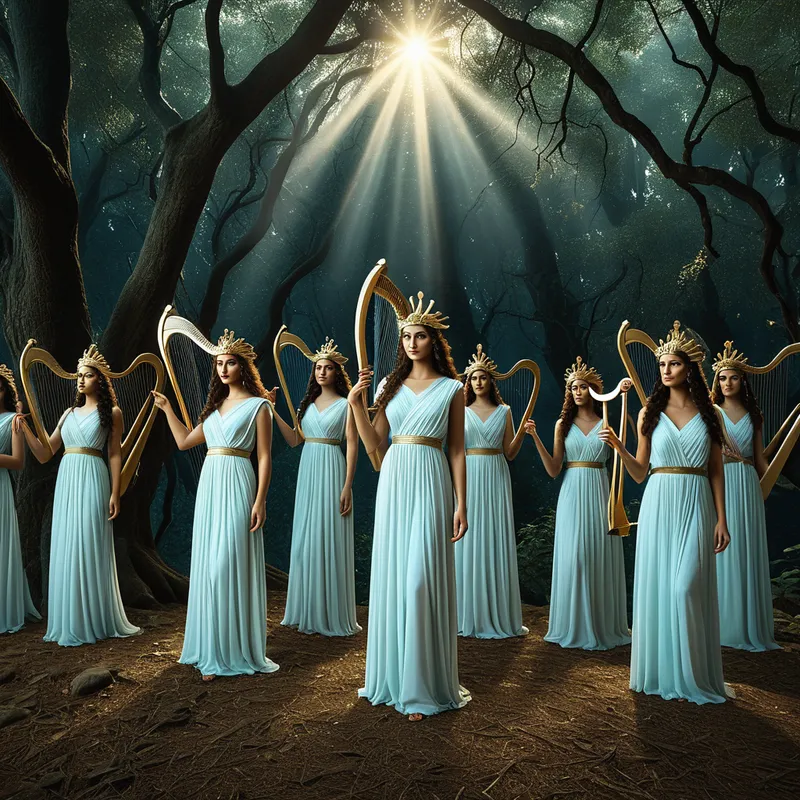
Listen. Before history was written, it was sung. Before cities rose, there was a sound—a hum beneath the world’s crust. It came from a place where the air is thin and the water remembers everything. They call it Helicon, or sometimes Olympus. Here, in the high, clear light, dwell the Nine.
Their mother is Mnemosyne, she whose mind is a perfect, unclouded lake holding every star, every sigh, every fallen leaf. Their father is Zeus, the thunderer, he who commands the raw power of the sky. From this union of perfect memory and sovereign will, the sisters were born—not in a single cry, but over nine nights, each birth a new note in a celestial scale.
They do not force their gifts. They wait. They haunt the misty clefts of the mountain, the groves where the laurel trees whisper old secrets. They gather by the Hippocrene spring, its waters born from the strike of Pegasus’s hoof, water so pure it holds the blueprint of song.
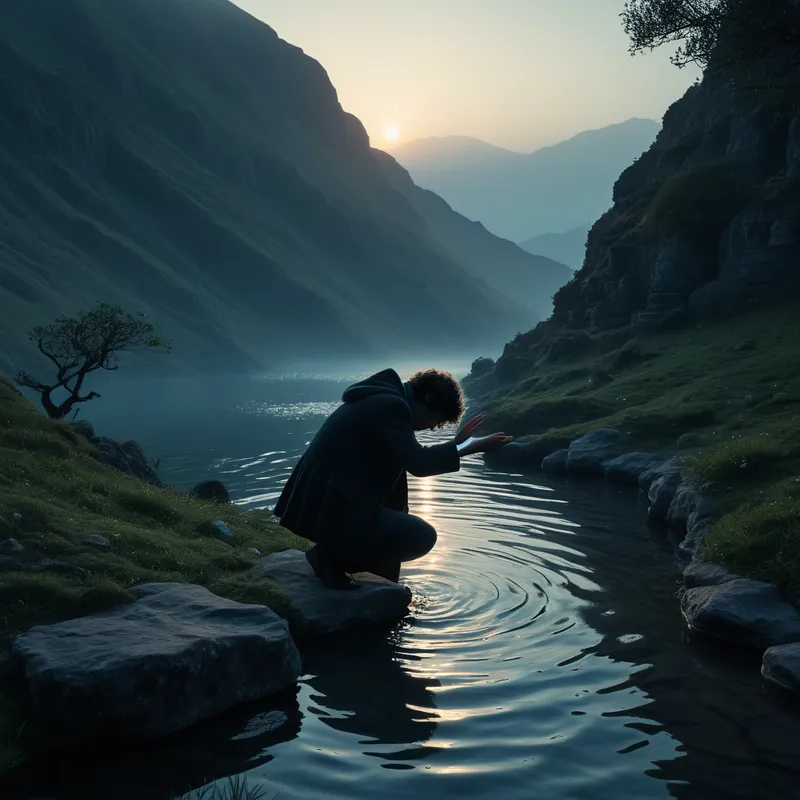
A mortal, hollowed out by longing or grief, climbs the treacherous path. The air grows cold. His own thoughts become a deafening silence. He kneels by the spring, parched in soul. This is the moment. A rustle not of wind, but of robe. A scent of ozone and old parchment. He does not see them fully—perhaps a flash of white arm, the curve of a cheek, the glint of a lyre’s pearl inlay.
Then, it comes. Not as words, but as a pressure in the chest, a tuning of the inner ear. For the poet, a cascade of rhythms that must be shaped. For the astronomer, a vision of the dance of lights in the vault. For the historian, the sudden, vivid taste of a forgotten battle’s dust. It is an invasion of grace. The mortal becomes a vessel, and through him flows the wine of the gods—epic, lyric, dance, comedy, tragedy, music, history, astronomy, sacred hymn. The work is born. It is his, and yet it is theirs. He is both creator and scribe, blessed and burdened. To forget the source, to claim the divine whisper as one’s own cleverness, is to invite a silence more profound than any he has ever known. But to honor them, to sing their names—Calliope, Clio, Euterpe, Melpomene, Polyhymnia, Terpsichore, Thalia, Urania, Erato—is to keep the conduit open. The song ends. The vision fades. On the mountain, the sisters turn away, their eternal work of inspiration already seeking its next fragile, human instrument.
Cultural Origins & Context
The veneration of the Muses is not merely a poetic fancy but a foundational pillar of Hellenic civilization. Their origins are pre-Olympian, likely springing from older, animistic cults of springs and mountains—places where the veil between the mundane and the numinous was perceived as thin. By the time of Hesiod’s Theogony (c. 700 BCE), they were fully integrated into the Olympian pantheon as the nine daughters of Zeus and Mnemosyne. This genealogy is itself a profound cultural statement: authoritative power (Zeus) wedded to collective memory (Mnemosyne) produces the ordered arts that define a culture.
They were the patron deities of the Mousike—a concept far broader than “music,” encompassing all arts and sciences overseen by the mind. No serious intellectual or artistic endeavor began without an invocation to the Muses, a ritual acknowledgment that human creativity is a collaborative act with a transpersonal source. Their primary cult centers were on Mount Helicon in Boeotia and near the Pierian Spring in Macedonia. Festivals, poetic competitions, and philosophical symposia were held in their name. They functioned as the psychological and spiritual infrastructure for Greek paideia (education), framing the pursuit of knowledge and beauty as a sacred, rather than a purely profane, activity.
Symbolic Architecture
The Muses represent the archetypal structure of inspiration itself. They are not a singular, vague force but a differentiated pantheon within the psyche. Their plurality signifies that creativity is not monolithic; it has distinct modes, channels, and energies. Calliope’s epic scope differs from Erato’s intimate focus, just as Melpomene’s cathartic gravity differs from Thalia’s liberating laughter.
Inspiration is not the generation of something from nothing, but the conscious alignment with a pre-existing, patterned field of potential—the realm of Memory.
Their mother, Mnemosyne, is the key. True creativity is presented as an act of anamnesis—not forgetfulness, but profound remembrance. It is a dipping into the well of the collective unconscious, the cultural and psychic inheritance of humanity. The Muses are the personified gates to this treasury. The spring created by Pegasus symbolizes the sudden, startling, often painful strike (the “aha!” moment) that releases the buried waters of insight. Thus, the artist or thinker is a midwife, not a manufacturer. The ego must humble itself to become a conduit for what is greater than itself.
The Dreamer’s Resonance
To dream of the Muses is to dream of a call to create, but often in a state of blockage or profound longing. Common motifs include: hearing beautiful, indistinct music from behind a door you cannot open; finding a room with nine different musical instruments, all out of tune; standing before nine mirrors, each reflecting a different, fragmented aspect of yourself; or desperately trying to drink from a spring that constantly recedes.
Somatically, this dream often accompanies a feeling of pressure in the chest or throat—the unsung song, the unspoken truth. Psychologically, it signals a confrontation with the creative Self. The dreamer is at the threshold between the personal unconscious and the archetypal realm of the collective. The “nine-ness” can feel overwhelming, representing the anxiety of choice: Which path of expression is mine? The dream highlights a psychic tension between the desire for inspired, effortless flow and the ego’s fear of inadequacy or its arrogant claim to sole authorship. It is a dream of invitation and warning, urging the dreamer to acknowledge the source.
Alchemical Translation
The myth of the Muses provides a complete alchemical map for the process of psychic individuation, where the base metal of the ego is transmuted into the gold of the creative Self. The journey begins with the nigredo—the ascent up the lonely mountain, the feeling of emptiness and aridity. This is the necessary dissolution of old, rigid identities.
The encounter at the spring is the albedo, the washing in the lunar, reflective waters of Mnemosyne. Here, one must remember who one truly is, beyond social masks. This is not passive recall but an active engagement with the inner plurality—dialoguing with the inner Clio (the personal past), the inner Urania (the longing for cosmic order), the inner Melpomene (the buried grief).
The creative act is the primary ritual of individuation; in giving form to the formless, we give form to ourselves.
The final stage, the rubedo, is the return. The inspired one must descend from the mountain and incarnate the vision into the stubborn materials of the world—clay, word, note, law. This is the sacred labor. The Muse-inspired work becomes the lapis philosophorum, the philosopher’s stone that transforms not only the creator but the culture that receives it. The modern individual, often feeling spiritually orphaned, is called to perform this same ritual: to climb to the heights of introspection, to drink deeply from the springs of memory and the unconscious, and to return bearing a new, coherent expression that bridges the divine pattern and the human experience. In doing so, one does not become a Muse, but becomes museful—a living vessel for the eternal process of creation.
Associated Symbols
Explore related symbols from the CaleaDream lexicon: