The Moa and the Haast's Eagle Myth Meaning & Symbolism
A myth of primal balance where the giant eagle's creation ensures the moa's sacrifice, weaving a cycle of life, death, and cosmic order from the bones of the earth.
The Tale of The Moa and the Haast’s Eagle
Listen. In the time before time, when the world was young and damp with the breath of the gods, the great forests of Aotearoa were silent. Not with emptiness, but with a deep, green waiting. From the rich, dark soil, the Moa arose. They were the children of the earth itself—tall as small trees, their feathers the color of dried fern and twilight, their legs pillars of strength. They moved through the primordial groves with a slow, deliberate grace, cropping the tender shoots, their low calls a rumble that shook the morning dew from the leaves. They knew no fear, for they knew no enemy. The sky was a blank canvas, a vacant throne.
But the forest, in its abundance, grew heavy. The moa multiplied, their footsteps pressing the earth flat, their hunger a constant, gentle tide. The balance, the sacred mauri of the land, began to tilt. The earth-mother, Papatūānuku, felt the strain. She whispered to the sky-father, [Ranginui](/myths/ranginui “Myth from Maori culture.”/), of a coming stillness, a green death from too much life.
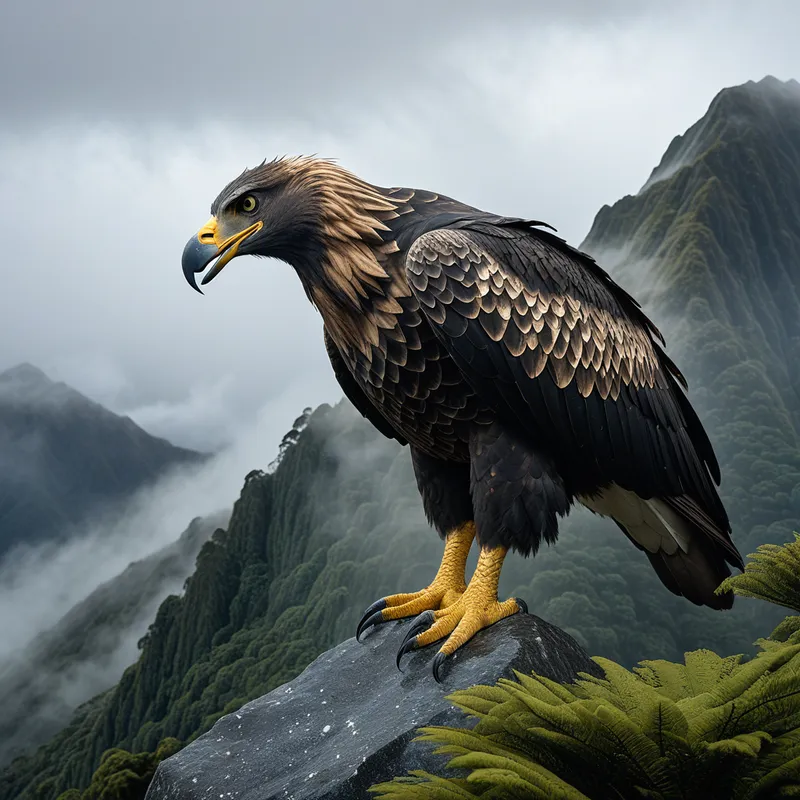
And so, from the aching bones of the mountains, from the sharp flints of the highest peaks where the wind screams, the sky-father fashioned a reply. He took the fury of the storm, the piercing clarity of the sun at its zenith, and the unblinking judgment of the void. He forged the Haast’s Eagle. It was not born; it was unleashed.
Its wings were the thunder that precedes the gale, dark and vast enough to blot out the sun for a heartbeat that felt like an eternity. Its eyes were chips of black obsidian, seeing the frantic pulse of life from a height that turned rivers into threads. Its talons were curved like the crescent moon, hard as pounamu and sharp as broken star-shards. Its cry was the sound of the sky tearing.
The first shadow fell. The moa, browsing in a sunlit clearing, felt the world grow cold before it heard the wind-rush. It was a descent like a falling spear, a divine violence made flesh. The strike was swift, final, a terrible gift. The forest’s silent waiting was over, replaced by a new rhythm: the beat of mighty wings, the brief, thunderous struggle, and then the return to quiet—a different quiet, now laced with awe and respect.
So it went, season upon season. The moa lived, and the eagle lived through it. The earth was fed by both—by the moa’s grazing and fertilizing, and by the eagle’s leavings, returning strength to the soil. The great balance was restored, not through peace, but through a sacred, dreadful pact. The moa’s existence gave purpose to the eagle; the eagle’s hunger gave meaning to the moa’s life. They were two notes in a single chord struck by the gods, a perfect, brutal song of utu—reciprocity. One could not be without the other. They were a single story written in feather, bone, and blood.

Cultural Origins & Context
This narrative exists in the oral tapestry of Maori whakapapa and pūrākau. It is not merely a story of predator and prey, but an etiological myth explaining the natural order of Aotearoa before human arrival. The moa and the Haast’s Eagle were real, co-existing megafauna, and their fossil records tell a truth that the mythopoetic mind translated into cosmic principle.
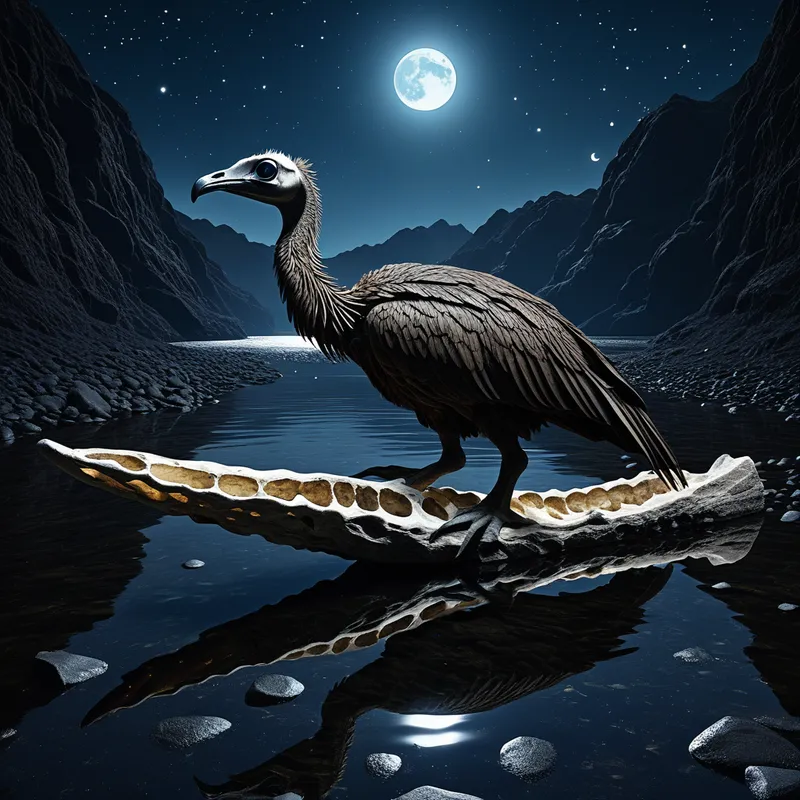
The story was likely told by tohunga and elders to explain the presence of massive bird bones found in caves and swamps, and to articulate a fundamental spiritual law. Its societal function was pedagogical, instilling an understanding of ecological and spiritual balance. It taught that abundance unchecked leads to stagnation, that death is not an end but a transformative agent in the cycle of life, and that even the most terrifying forces have a place in the tapu order of the world. The eagle, though a killer, was not a monster; it was a necessary, sacred instrument.
Symbolic Architecture
At its [heart](/symbols/heart “Symbol: The heart symbolizes love, emotion, and the core of one’s existence, representing deep connections with others and self.”/), this myth is a profound [allegory](/symbols/allegory “Symbol: A narrative device where characters, events, or settings represent abstract ideas or moral qualities, conveying deeper meanings through symbolic storytelling.”/) of complementary opposites and the necessity of limitation. The Moa represents the grounded, fertile, and proliferating principle of [life](/symbols/life “Symbol: The symbol of ‘Life’ represents a journey of growth, interconnectedness, and existential meaning, encompassing both the joys and challenges that define human experience.”/). It is the unconscious, instinctual world of growth and potential. The Haast’s [Eagle](/symbols/eagle “Symbol: The eagle is a symbol of power, freedom, and transcendence, often representing a person’s aspirations and higher self.”/) symbolizes the penetrating, focused, and limiting principle of [consciousness](/symbols/consciousness “Symbol: Consciousness represents the state of awareness and perception, encompassing thoughts, feelings, and experiences.”/). It is the necessary force that defines, shapes, and gives context to existence by imposing boundaries.
The gift of life is only meaningful within the frame of death; boundless potential finds its form only through defining limitation.
The myth presents a [universe](/symbols/universe “Symbol: The universe symbolizes vastness, interconnectedness, and the mysteries of existence beyond the individual self.”/) where these two forces are not at war, but in a sacred, dynamic [marriage](/symbols/marriage “Symbol: Marriage symbolizes commitment, partnership, and the merging of two identities, often reflecting one’s feelings about relationships and social obligations.”/). The eagle does not hate the moa; it completes it. The moa’s [fate](/symbols/fate “Symbol: Fate represents the belief in predetermined outcomes, suggesting that some aspects of life are beyond human control.”/) is not a tragedy but a fulfillment of its [role](/symbols/role “Symbol: The concept of ‘role’ in dreams often reflects one’s identity or how individuals perceive their place within various social structures.”/) in a larger order. This reflects a worldview that does not sanitize [nature](/symbols/nature “Symbol: Nature symbolizes growth, connectivity, and the primal forces of existence.”/) but sees the raw processes of predation, [death](/symbols/death “Symbol: Symbolizes transformation, endings, and new beginnings; often associated with fear of the unknown.”/), and recycling as inherently sacred and intelligent.
Psychologically, the moa can be seen as the untamed contents of the psyche—instincts, drives, and potentials that, left unchecked, can overgrow and stifle the individual. The eagle is the differentiating function of the ego or the Self, which must “prey upon” this undifferentiated [mass](/symbols/mass “Symbol: Mass often symbolizes a gathering or collective experience, representing shared beliefs, burdens, or the weight of emotions within a community.”/) to extract meaning, focus, and conscious [identity](/symbols/identity “Symbol: Identity represents the sense of self, encompassing personal beliefs, cultural background, and social roles.”/).

The Dreamer’s Resonance
When this myth stirs in the modern dreamer, it often manifests as dreams of being pursued by a vast, shadowy bird, or of witnessing a majestic but terrifying hunt. One might dream of being a large, grounded creature suddenly aware of a looming presence in the sky, or conversely, of soaring high with a predatory clarity, looking down upon one’s own life.
Somatically, this can feel like a tightening in the chest, a chill, or a surge of adrenaline—the body remembering a primordial contract. Psychologically, this dream pattern signals a critical moment of differentiation. The dreamer is undergoing a process where some burgeoning, perhaps overwhelming, aspect of their inner life (a talent, an emotion, a complex) must be “killed” or shaped by a higher, more conscious authority. It is the psyche’s way of initiating a necessary sacrifice for the sake of greater order and purpose. The terror is real, for part of the self must yield; the awe is also real, for a greater, more focused power is being born.
Alchemical Translation
The alchemical journey modeled here is the transmutation of undifferentiated mass into focused spirit. In the vessel of the individual psyche, we all contain our “moa”—the raw, fertile, but often clumsy and excessive material of our nature. Our desires, our potential, our unprocessed history. Individuation requires the arrival of the “Haast’s Eagle”—the fierce, discerning function of consciousness that must descend and make a sacrifice.
This is not an act of cruelty, but of love. The eagle’s strike is the moment of insight, the difficult decision, the painful truth we must accept, the limitation we must embrace to give our lives definition.
The Self, in its wholeness, is both the nourishing earth that grows the moa and the piercing sky that sends the eagle. The conflict is contained within a greater unity.
The process is one of sacred reciprocity. We sacrifice boundless, aimless possibility (“I could be anything”) for the power and clarity of a defined existence (“I am this”). The moa’s flesh feeds the eagle’s flight; our surrendered illusions fuel our conscious evolution. The goal is not to eradicate the moa, but to establish the eternal, dynamic relationship between the two. The integrated individual learns to honor both the grounded creature of their earthy instincts and the soaring creature of their spiritual aspiration, understanding that each gives life to the other in an endless, regenerative cycle.
Associated Symbols
Explore related symbols from the CaleaDream lexicon:
- Eagle — The divine force of consciousness, piercing insight, and the necessary, terrifying agent of limitation that gives shape to existence.
- Bird — The broader archetype of spirit, message, and transcendence, here specifically manifesting as a predatory force that connects heaven and earth.
- Sacrifice — The core transaction of the myth; the voluntary or destined offering of one form of life to nourish and validate another, higher order.
- Balance — The ultimate purpose of the dynamic between moa and eagle, representing the cosmic and psychological principle of equilibrium through tension.
- Shadow — The Haast’s Eagle embodies the necessary, fearsome aspect of the Self that must be integrated, the predator in the psyche that performs essential work.
- Bone — The enduring structure left after the sacrifice; the foundational truth, the lesson learned, the unyielding framework of fate and consequence.
- Earth — The domain of the Moa, representing the unconscious, the fertile ground of potential, instinct, and undifferentiated life.
- Sky — The domain of the Haast’s Eagle, representing consciousness, spirit, law, and the overarching order that imposes itself upon the earthly realm.
- Forest — The liminal world where the drama unfolds; the psyche itself, dense with growth and hidden life, where the meeting of ground and sky occurs.
- Death — Not as an end, but as the transformative agent in the myth, the essential process that transmutes one state of being into another for the health of the whole.
- Giant Eagle — The mythic amplification of the eagle archetype, representing an overwhelming, non-negotiable force of destiny or a colossal psychological truth.
- Destiny — The inescapable roles played by both creatures, bound together in a pre-ordained cycle that serves a purpose greater than either individual.