The Middle Way Myth Meaning & Symbolism
A prince abandons extremes of luxury and austerity to find liberation in mindful balance, charting a path of profound psychological integration.
The Tale of The Middle Way
Listen. Before the world knew him as the Buddha, he was a prince named Siddhartha, cradled in a palace of perfumed silks and whispered assurances. His father, the king, had built him a world without shadow, a gilded cage where old age, sickness, and death were forbidden words, and every desire was a servant waiting to be summoned. He lived in the extreme of indulgence, where pleasure was a thick syrup that coated the senses and muffled the heart's deeper drumming.
But the truth, like a vine, finds its way through the most fortified walls. On secret chariot rides beyond the gates, the prince’s eyes were seared by visions his soul had always known: a body bent and withered by time, a form wracked with fever, a corpse being carried to the pyre. And then, a final vision: a wandering ascetic, his face a map of serene detachment. In that moment, the prince’s gilded world shattered. The extreme of pleasure revealed itself as a profound sleep, a denial of life’s fabric. So, in the dead of night, he severed his royal ties—cutting his hair, exchanging silk for rough cloth—and fled into the forest, seeking the opposite shore.
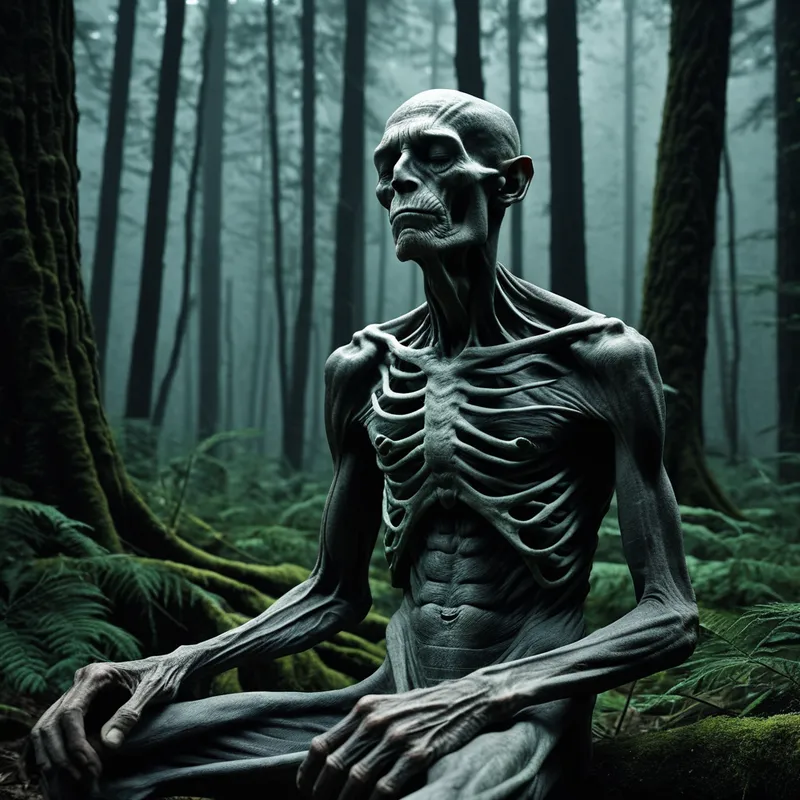
For six long years, he became a ghost of striving. He sat with the great teachers of Jhana, mastering the mind’s heights, yet finding no final answer. He then joined a band of five fierce ascetics. He pushed his body to the utter brink, starving it, holding his breath until the world swam, practicing austerities so severe his frame became a skeleton draped in skin. He lived in the extreme of denial, where every pang of hunger was a badge of honor and the world was an enemy to be conquered through will. But liberation did not come. Only dizziness, weakness, and a growing realization: this path of self-torture was as fruitless as the palace’s self-indulgence. Both were prisons, one of gold, the other of thorns.
Exhausted, hollow, and at the precipice of death, he remembered a moment from his childhood. Sitting under a rose-apple tree, he had fallen into a natural, joyful state of concentrated calm. That memory was a key. He accepted a simple offering of milk-rice from a village woman named Sujata, his body trembling with the basic sustenance. His fellow ascetics, seeing him break his fast, left in disgust, branding him a failure.
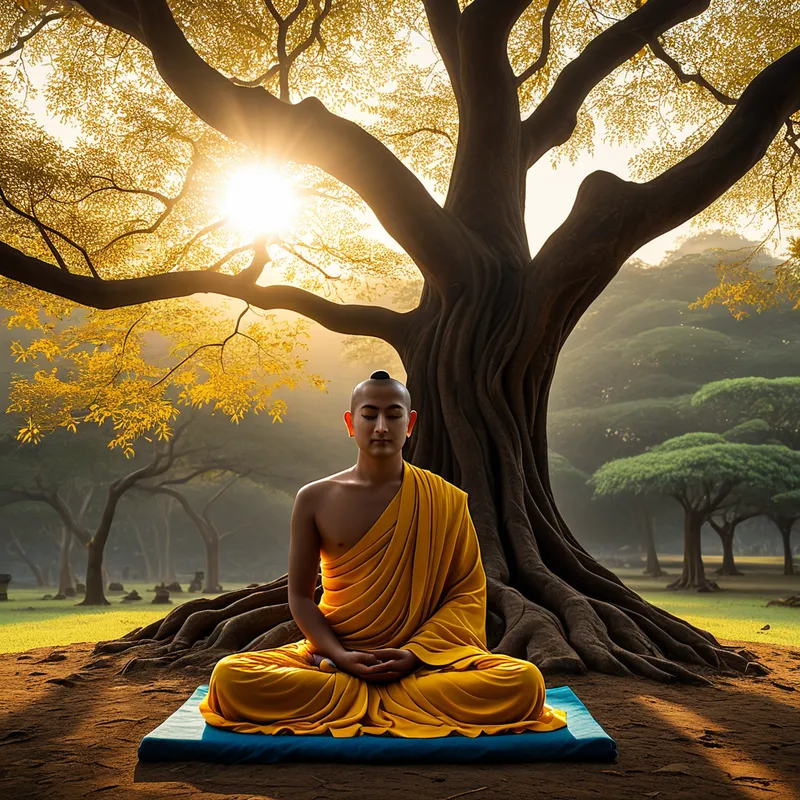
Alone, but with a newfound clarity, he walked to a quiet place near the Bodhi tree. He prepared a seat of grass, vowing not to rise until he had understood. As he sat, the temptations of the demon Mara arose—visions of terrifying armies, seductive daughters, and whispers of doubt. He touched the earth, calling it as his witness. The earth thundered its support, and Mara fled.
Then, in the deep watch of the night, navigating between the lure of sensual pleasure and the abyss of self-annihilation, he found it. Not a thing, but a way. The Middle Way. Through this balanced, mindful attention, his insight deepened. He saw the endless chain of his own past lives, he perceived the law of Karma, and finally, he understood the cause of suffering and the path to its cessation. As the morning star glittered in the dawn sky, his mind shattered the last fetter. He was awake. The Buddha had found the path that avoids all extremes.
Cultural Origins & Context
This is not a myth of distant gods, but the foundational biography of a historical figure, Siddhartha Gautama, who lived and taught in the Gangetic plain of India around the 5th century BCE. The story of the Middle Way is the narrative core of his awakening and the pragmatic heart of his teaching, the Dhamma. It was passed down orally by the Sangha for centuries before being committed to text in the Pali Canon.
Its societal function was revolutionary. In a culture deeply engaged in philosophical debates between eternalism and annihilationism, and religious practices ranging from lavish Vedic rituals to severe Jain asceticism, the Middle Way presented a radical, accessible alternative. It was a call to empirical investigation over blind belief, to personal responsibility over fate, and to a ethics of mind and action accessible to anyone, regardless of caste. It democratized the path to liberation, making it a matter of understanding and practice rather than birthright or extreme self-punishment.
Symbolic Architecture
The myth’s power lies in its stark, universal symbolism. The palace represents the unconscious identification with the persona—the comfortable, socially-approved self that seeks only pleasure and avoids all pain. The forest of asceticism represents the ego’s violent attempt to conquer the unconscious and the flesh through willpower, a rejection of life itself.
The Middle Way is not a compromise, but a transcendence. It is the conscious awareness that holds the tension of opposites without identifying with either pole.
Siddhartha is the nascent Self, the totality of the psyche, which must experience and reject the one-sidedness of both the conscious attitude (pleasure) and the unconscious shadow (mortification). The Bodhi tree is the axis mundi, the still point where this reconciliation occurs. Mara is the personification of the psyche’s own resistance—our attachments, fears, and doubts that arise when we dare to sit in that center and no longer cling to our familiar extremes.
The Dreamer's Resonance
When this myth stirs in the modern dreamer, it often manifests as a somatic experience of being pulled in two impossible directions. One might dream of being forced to choose between a suffocating, opulent job and a life of penniless isolation; of being in a relationship that is either cloying fusion or icy distance. The body in the dream feels the strain—stretched taut, dizzy, or starving amidst plenty.
This is the psyche signaling a critical impasse in a neurotic pattern. The dreamer is caught in what psychologists call an enantiodromia—the unconscious swing to the opposite extreme. The dream is the soul’s attempt to break the pendulum’s arc, to introduce the third, transcendent option. The psychological process is one of withdrawal of projection: realizing that the solution is not “out there” in a different circumstance (more luxury, more austerity), but in a fundamental reorientation of attention in here.
Alchemical Translation
The alchemy of the Middle Way is the opus of individuation. The prima materia is the conflicted psyche, identified with one half of a pair of opposites. The first stage, nigredo, is the dark night experienced both in the despair of the palace (meaninglessness of pleasure) and in the black despair of the failed ascetic (meaninglessness of denial).
The transmutation occurs not by choosing a side, but by developing the capacity to be the vessel that contains both.
The acceptance of Sujata’s offering is the crucial albedo—the whitening. It symbolizes the ego’s surrender of its heroic, willful project and its acceptance of simple, nourishing reality. It is humility. Sitting under the Bodhi tree is the citrinitas, the yellowing or illumination, where conscious awareness holds the tension. The final awakening at dawn is the rubedo, the reddening or completion—the birth of the integrated Self, which can engage with the world with compassion because it is no longer enslaved by it.
For the modern individual, this models the path from a life driven by compulsive seeking and avoiding to one of mindful presence. It is the shift from asking “Should I grasp this or reject that?” to a deeper inquiry: “What is the nature of the awareness to which both grasping and rejecting appear?” The Middle Way is the path of that inquiry, a walking of the razor’s edge between all opposites, where true freedom is found.
Associated Symbols
Explore related symbols from the CaleaDream lexicon: