
The Martian Myth Meaning & Symbolism
An astronaut, abandoned and presumed dead, must summon boundless ingenuity and primal will to survive alone on a hostile alien world.
The Tale of The Martian
Listen, then, to the tale of the one left behind.
In the age of iron birds and fire that crossed the void, a fellowship of wanderers set foot upon the rust-red sands of the Fourth World, Ares’ own domain. Their names were spoken with hope: the Ares III. But the sky of that world is a fickle and wrathful god. A storm, not of water but of razored dust and howling wind, descended with a fury to shatter mountains. The fellowship was broken, forced to flee the wrath of the planet. In the chaos of the retreat, a single wanderer was struck down by a spear of flying debris. His life-signs fell silent. With grief in their hearts, his companions ascended, leaving him to the barren embrace of the red desert.
He awoke.
He was Mark Watney, and he was alone. A shard of antenna pierced his side, the blood already frozen to his suit. Around him, only the endless, whispering rust of dunes and the oppressive silence of a world that has never known life. His habitat, a frail bubble of Earth, was breached. His food was counted in meals, his water in drops, his air in breaths. The next ship from the blue world would not come for four long years.
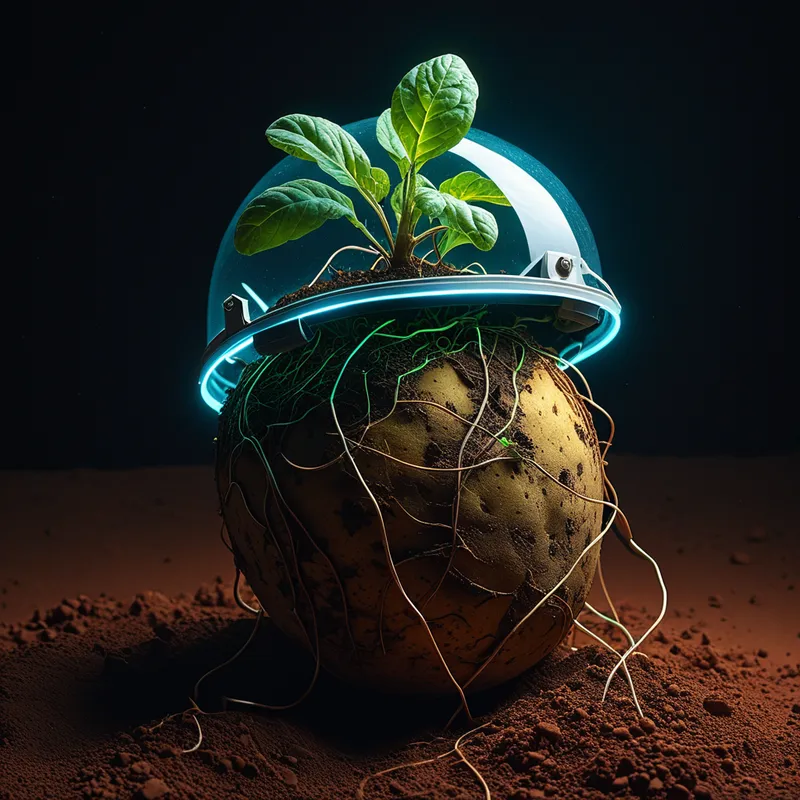
This is not a tale of immediate triumph, but of a slow, grinding calculus against entropy. He sealed his wound. He mended his home. With the cleverness of a Hermes and the patience of a Demeter, he performed a miracle: he made the dead soil live. In the sterile Martian earth, he planted potatoes, blessing them with water conjured from chemical fire and fertilized with the waste of his own body. He spoke to the cameras, his log entries a litany against the silence, a prayer to a future audience.
But the Fourth World is jealous. It tested him. A seal failed, freezing his garden. A rover journey across the vast plains nearly claimed him. Yet, he persisted, a single point of consciousness and will in a universe of indifferent stone. Meanwhile, in the heavens, his fellowship learned of his survival. A great and costly effort was launched across the gulf of space, a thread of hope woven between two worlds. In a final, desperate ballet of orbital mechanics and human courage, a hand reached out across the starry sea, and the one left behind was, against all odds, gathered back into the fellowship of humanity.

Cultural Origins & Context
This myth emerged not from campfires or clay tablets, but from the digital and celluloid hearths of the late 20th and early 21st centuries. Its primary scripture is the novel The Martian by Andy Weir (2011), a text that itself mimics the technical logs and problem-solving of its protagonist. The myth was then amplified into a global cultural touchstone by Ridley Scott’s 2015 cinematic adaptation. Its transmission is modern: passed through book clubs, streaming services, and online forums where enthusiasts dissect the “science” of the survival with religious fervor.
Its societal function is multifaceted. Born in an era of resurgent interest in space exploration (Mars rovers, private spaceflight) and profound anxiety about ecological and technological fragility, the myth serves as a narrative crucible. It tests the modern creed of rationalism, ingenuity, and international cooperation against the ultimate backdrop of absolute isolation. It is a myth for the engineer, the scientist, and the pragmatist, positing that the tools for salvation—mathematics, botany, chemistry—are the new sacred arts. The storytellers are not priests but programmers, astronauts, and writers who blend extreme research with primal narrative, offering a secular parable of resilience.
Symbolic Architecture
At its core, the myth of The Martian is a profound exploration of the individuation process under conditions of radical alienation. The red planet itself is the ultimate Shadow landscape—barren, hostile, and utterly Other. It represents those parts of the psyche we have neglected, deemed infertile, or fear to engage with: our isolation, our mortality, our raw, biological vulnerability.
To be cast onto the Martian desert is to be thrust into the alchemical nigredo, the blackening, where all former identity and social context are incinerated, leaving only the irreducible core of the Self.
Mark Watney is the Ego forced to become its own Senex (wise old man) and its own Anima (in its Demeter aspect as cultivator). His ingenuity is not mere cleverness; it is the psychic function of transcendence, the ability to fashion new wholes from broken parts. The potatoes are the ultimate symbol of this transmutation: life (the tuber) is planted in death (the sterile soil, fertilized by waste) and nurtured by consciousness (his scientific method) to yield new sustenance. It is a perfect symbol of the psychic loop where the rejected (waste, failure) becomes the fertilizer for new growth.
The distant Earth and the eventual rescue mission represent the Self—the totality of the psyche that, though seemingly disconnected, never fully abandons the struggling ego. The connection is maintained through the logs (a form of active imagination, speaking to the unconscious as if it listens) and the final, physics-defying handshake in orbit, symbolizing the miraculous reunion of the isolated consciousness with the greater, embracing whole.
The Dreamer's Resonance
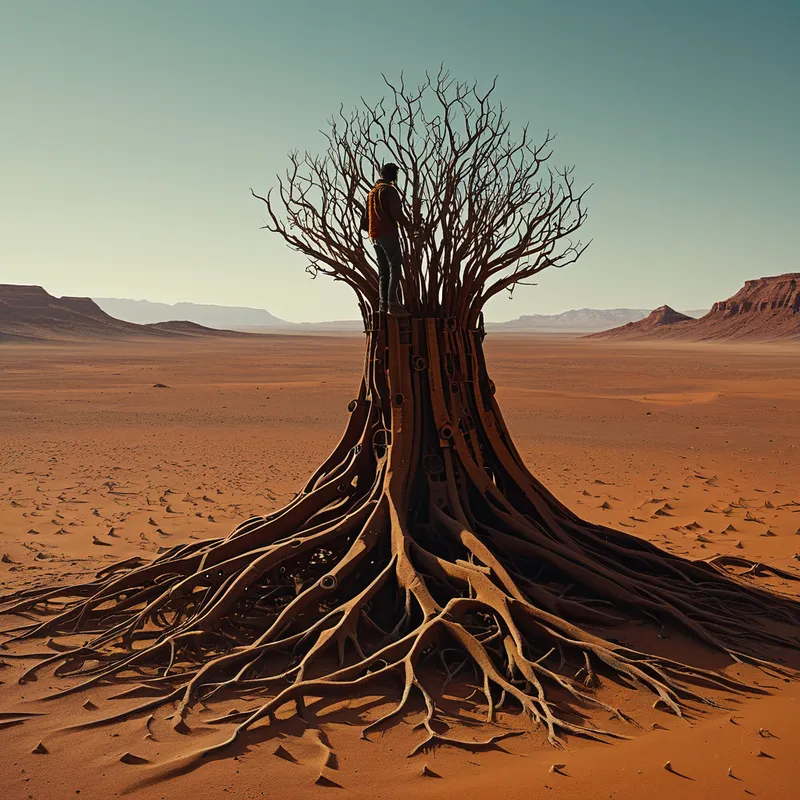
When this myth pattern erupts in the modern dreamscape, it rarely features literal Mars. Instead, the dreamer finds themselves in a stark, minimalist, and profoundly isolating environment—an empty skyscraper, a vast data center, a sealed laboratory, or an endless grey desert. The core somatic feeling is one of pressurized silence and acute, problem-solving anxiety. The dream ego is tasked with an impossible technical or logistical puzzle: repairing a vital machine with inadequate parts, generating food from inedible materials, or calculating a perilous escape route.
This dream signals a psyche undergoing a crucial phase of self-reliance. The dreamer is being initiated into their own inner “habitat.” The psychological process is one of ego-strengthening in the face of an emotional or spiritual “vacuum.” The dream says: You feel abandoned by your usual supports (family, tradition, career), and now you must learn to synthesize your own sustenance from the raw materials of your own mind and experience. The intense focus on practical problems in the dream is the unconscious compensating for a life situation that feels emotionally barren or intellectually stifling, forcing the dreamer to engage their neglected faculties of logic, creativity, and primal will.
Alchemical Translation
The alchemical journey of The Martian is a masterclass in the opus contra naturam—the work against nature, or rather, the work to create a new, conscious nature within the psyche. The process follows the classic stages:
- Calcinatio & Solutio (The Storm & The Wounding): The initial catastrophe is the burning away (calcinatio) of all social identity and the drowning (solutio) in the waters of isolation. The ego is purified in the fire of adversity and dissolved in the sea of loneliness.
- Coagulatio (Making the Habitat): The psyche begins to re-solidify, not in its old form, but in a new, conscious configuration. This is the mending of the habitat, the creation of a bounded, life-sustaining inner space—a conscious attitude capable of containing the conflict.
- Mortificatio & Putrefactio (The Death of the Garden): The freezing of the potato crop is a necessary death (mortificatio) and rotting (putrefactio). In psychological terms, it is the collapse of the first, naive solution, the failure that forces a deeper, more resilient adaptation. The ego must let its first hope die to find a truer one.
The alchemist’s vessel is not a flask, but the sealed habitat of the self; the prime matter is not lead, but despair; and the Philosopher’s Stone is the humble potato—the miraculous proof that life can be engineered from death and intellect.
- Sublimatio (The Rover Journeys): The long, perilous trek across the planet represents sublimation—the spirit (will to live, hope) rising above the base matter (despair, danger) to gain a new perspective. It is a directed, arduous movement of consciousness.
- Coniunctio (The Orbital Rescue): The final, breathtaking maneuver is the coniunctio oppositorum, the sacred marriage of opposites. The fast-moving Hermes (the rescue ship) embraces the heavy, soil-bound Demeter (the stranded rover). The isolated individual (ego) is reunited with the embracing totality (Self). This is the culmination of individuation: the once-abandoned part is recognized, valued, and reintegrated, not by chance, but by the concerted, creative effort of the entire psychic system.
For the modern individual, the myth does not promise rescue from without. Its deeper teaching is that the Martian desert exists within. Our task is to build our habitat there, to learn its brutal logic, to plant our garden in the most unlikely soil, and to begin, against all silence, to log our existence. In doing so, we perform the ultimate alchemy: transforming the red dust of our isolation into the green shoot of a self-created, and therefore unshakeable, meaning.
Associated Symbols
Explore related symbols from the CaleaDream lexicon: