The Many-Headed Hydra Myth Meaning & Symbolism
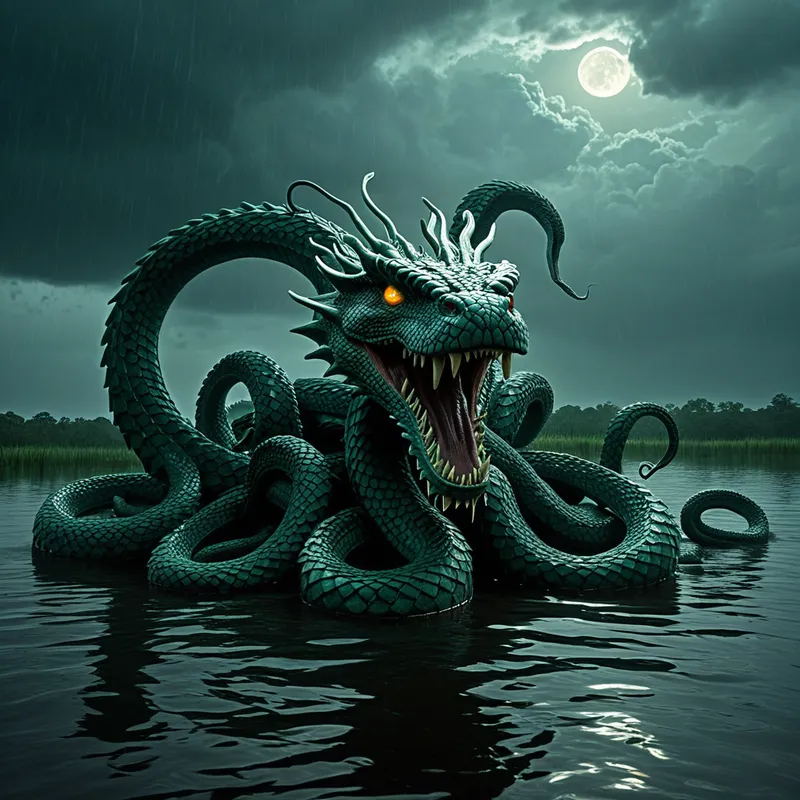
Hercules battles a monstrous, regenerating Hydra in a swamp, a primal myth symbolizing the struggle against the multiplying problems of the unconscious.
The Tale of The Many-Headed Hydra
Beneath the weeping willows and the stagnant breath of the Lernaean swamp, the [water](/myths/water “Myth from Chinese culture.”/) did not flow. It festered. It was a place where the sun’s light fractured into sickly green shards upon the surface, and the air hung thick with the perfume of decay and primal fear. Here, in the gnarled roots and sucking mud, she made her home. Not a beast, but a blight. [The Hydra](/myths/the-hydra “Myth from Greek culture.”/).
She was [the child](/myths/the-child “Myth from Alchemy culture.”/) of monstrous lineage, born of Gaia and the blood of the fallen sky, [Uranus](/myths/uranus “Myth from Greek culture.”/). Her body was that of a colossal hound, but from it sprouted a nest of serpents—nine, or fifty, or a hundred, the poets could not agree, for to look upon her was to lose count in a tide of dread. Each head bore a viper’s intelligence and a dragon’s venom, breath so foul it could wilt crops and choke the life from a man where he stood. And one head, central and terrible, was deathless. This was the horror of the [Hydra](/myths/hydra “Myth from Greek culture.”/): to wound her was to strengthen her. Sever one head, and from the bleeding stump, two more would writhe into being, hydra-headed vengeance.
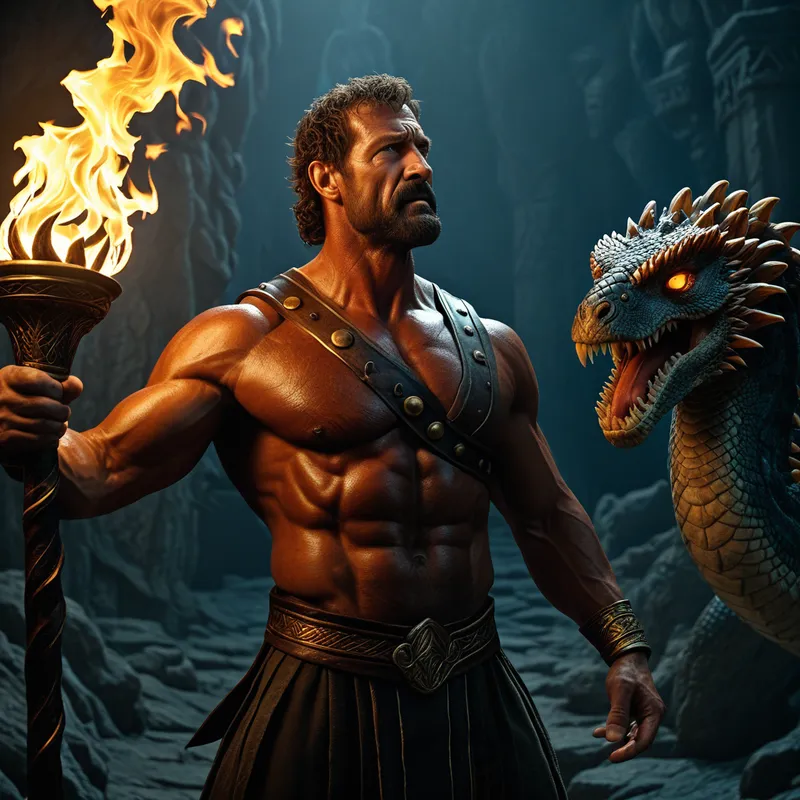
Into this miasma strode [Hercules](/myths/hercules “Myth from Greek culture.”/), the son of Zeus, his lion-skin cloak heavy on his shoulders, his great club of olive wood in hand. This was his second labor, a penance and a proving. The silence of the swamp was a physical pressure. He lured the monster from her den with flaming arrows, and the water boiled as she emerged, a symphony of hisses filling [the world](/myths/the-world “Myth from Tarot culture.”/).
The battle was chaos incarnate. Hercules swung his club, crushing a skull. Before the head hit the water, two new necks, slick and scaled, erupted from the wound, teeth bared. He crushed another. Four now hissed where one had been. He wrestled in the mud, the monster’s coils threatening to drag him into the deep, her multiplying strikes coming from all sides. For every advance, a greater setback. His strength, prodigious and legendary, was useless here. It fed the very [thing](/myths/thing “Myth from Norse culture.”/) he fought.
Despair was his true enemy. But then, from the reeds, came his nephew Iolaus, bearing a blazing torch. A spark of insight in the suffocating dark. A new strategy was born not from greater force, but from cunning transmutation. Hercules began to sever the heads, and as he did, Iolaus rushed forward, searing the bloody stumps with fire, cauterizing the wounds shut with a hiss of smoke and flesh. Head by terrible head, they turned regeneration to ash.
Finally, only [the immortal](/myths/the-immortal “Myth from Taoist culture.”/) head remained, thrashing and indomitable. Hercules laid aside his club. With hands that had strangled [the Nemean Lion](/myths/the-nemean-lion “Myth from Greek culture.”/), he wrenched the golden head from its body. He buried it deep beneath a colossal stone, a secret weight upon [the earth](/myths/the-earth “Myth from Hindu culture.”/). Then, in a final act of alchemy, he dipped his arrows into the Hydra’s own venomous blood. The poison that had been a source of terror was now a tool for the labors to come. The swamp fell silent, not in victory, but in a profound and uneasy resolution.
Cultural Origins & Context
This myth comes to us from the deep well of Greek oral epic, crystallized in texts like the Bibliotheca of Pseudo-Apollodorus and referenced by poets from Hesiod onward. It was not merely a fireside tale of a strongman, but a foundational episode in the cycle of the Twelve Labors of [Heracles](/myths/heracles “Myth from Greek culture.”/). As such, it was a narrative cornerstone, explaining the hero’s acquisition of his most feared weapon—the Hydra-poisoned arrows—and establishing a pattern of impossible adversity overcome through a blend of courage, assistance, and strategic innovation.
Societally, the myth functioned on multiple levels. It was an etiological story, explaining a fearsome feature of the Argolid landscape (the Lernaean swamp). More profoundly, it served as a parable for the polis. The Hydra represented the chaotic, multiplying threats to civic order—disease, social strife, external enemies—that could not be solved by brute force alone. The hero’s need for Iolaus underscored the Greek value of [xenia](/myths/xenia “Myth from Greek culture.”/) (guest-friendship) and alliance, while the clever solution modeled the intellectual virtue of [metis](/myths/metis “Myth from Greek culture.”/) (cunning intelligence) prized alongside physical arete (excellence). It was a lesson in confronting complex, systemic evil.
Symbolic Architecture
The [Hydra](/symbols/hydra “Symbol: A multi-headed serpent from Greek mythology that regenerates two heads when one is cut off, symbolizing persistent, multiplying challenges.”/) is the [archetypal image](/symbols/archetypal-image “Symbol: A universal, primordial symbol from the collective unconscious that transcends individual experience and carries profound spiritual or mythic meaning.”/) of the [problem](/symbols/problem “Symbol: Dreams featuring a ‘problem’ often symbolize internal conflicts or challenging situations that require resolution and self-reflection.”/) that grows when attacked directly. It is the perfect [symbol](/symbols/symbol “Symbol: A symbol can represent an idea, concept, or belief, serving as a powerful tool for communication and understanding.”/) for [the self](/myths/the-self “Myth from Jungian culture.”/)-replicating [nature](/symbols/nature “Symbol: Nature symbolizes growth, connectivity, and the primal forces of existence.”/) of neurosis, addiction, or entrenched negative thought patterns. Each head is a specific manifestation—[anxiety](/symbols/anxiety “Symbol: Anxiety in dreams reflects internal conflicts, fears of the unknown, or stress from waking life, often demonstrating the subconscious mind’s struggle for peace.”/), [resentment](/symbols/resentment “Symbol: A deep-seated emotional bitterness from perceived unfairness or injury, often festering silently and poisoning relationships.”/), fear—but they share a single, monstrous [body](/symbols/body “Symbol: The body in dreams often symbolizes the dreamer’s self-identity, personal health, and the relationship they have with their physical existence.”/): the unconscious [shadow](/symbols/shadow “Symbol: The ‘shadow’ embodies the unconscious, repressed aspects of the self and often represents fears or hidden emotions.”/).
The Hydra does not live in the swamp; the swamp lives in the Hydra. It is the externalized landscape of a festering, unresolved psyche.
Hercules represents the conscious ego, tasked with the labor of [integration](/symbols/integration “Symbol: The process of unifying disparate parts of the self or experience into a cohesive whole, often representing psychological wholeness or resolution of internal conflict.”/). His initial, forceful approach is [the ego](/myths/the-ego “Myth from Jungian culture.”/)’s [default](/symbols/default “Symbol: The baseline state, unaltered condition, or standard setting from which all variations and changes originate.”/): to suppress, to deny, to beat into submission. This is the futility of mere willpower against deep psychological patterns. The [regeneration](/symbols/regeneration “Symbol: The process of renewal, restoration, and growth following damage or depletion, often representing emotional healing, transformation, or a fresh start.”/) of the heads shows that suppression leads only to [proliferation](/symbols/proliferation “Symbol: Rapid multiplication or spread of elements, often representing uncontrolled growth, expansion, or the overwhelming presence of something in one’s life.”/); cut off a [symptom](/symbols/symptom “Symbol: A physical or emotional sign indicating an underlying imbalance, distress, or message from the unconscious mind.”/), and it returns in two new forms.
The crucial turn in the myth is the intervention of Iolaus with fire. Iolaus is the ally, the supportive function of [consciousness](/symbols/consciousness “Symbol: Consciousness represents the state of awareness and perception, encompassing thoughts, feelings, and experiences.”/)—perhaps [intuition](/symbols/intuition “Symbol: The immediate, non-rational understanding of truth or insight, often described as a ‘gut feeling’ or inner knowing that bypasses conscious reasoning.”/), or the therapeutic [alliance](/symbols/alliance “Symbol: A formal or informal union between individuals or groups for mutual benefit, support, or protection.”/), or a [moment](/symbols/moment “Symbol: The symbol of a ‘moment’ embodies the significance of transient experiences that encapsulate emotional depth or pivotal transformations in life.”/) of lucid [insight](/symbols/insight “Symbol: A sudden, deep understanding of a complex situation or truth, often arriving unexpectedly and illuminating hidden connections.”/). Fire is the element of transformation, of [alchemy](/symbols/alchemy “Symbol: A transformative process of purification and creation, often symbolizing personal or spiritual evolution through difficult stages.”/). It does not cut; it seals. It transmutes. The act of cauterization symbolizes the [application](/symbols/application “Symbol: An application symbolizes engagement, integration of knowledge, or the pursuit of goals, often representing self-improvement and personal development.”/) of conscious, transformative [awareness](/symbols/awareness “Symbol: Conscious perception of self, surroundings, or internal states. Often signifies awakening, insight, or heightened sensitivity.”/) to the root of the [pattern](/symbols/pattern “Symbol: A ‘Pattern’ in dreams often signifies the underlying structure of experiences and thoughts, representing both order and the repetitiveness of life’s situations.”/) after it has been exposed (severed). It is the process of making the unconscious conscious, not to destroy it, but to neutralize its autonomous, multiplying power.
The immortal head is the core complex, the primal wound that cannot be “killed” by any ordinary means. Its [burial](/symbols/burial “Symbol: A symbolic act of laying something to rest, often representing closure, transformation, or the release of past burdens.”/) under a heavy [stone](/symbols/stone “Symbol: In dreams, a stone often symbolizes strength, stability, and permanence, but it may also represent emotional burdens or obstacles that need to be acknowledged and processed.”/) signifies its integration—not elimination, but a conscious containing and weighing down within the foundations of the self. Finally, the [hero](/symbols/hero “Symbol: A hero embodies strength, courage, and the ability to overcome significant challenges.”/)’s use of the Hydra’s [venom](/symbols/venom “Symbol: Venom represents a potent, often hidden, toxic influence that can cause harm or transformation. It symbolizes both danger and potential healing.”/) as a tool is the ultimate alchemical victory: [the shadow](/myths/the-shadow “Myth from Jungian culture.”/)’s toxic power, once integrated, becomes a [source](/symbols/source “Symbol: The origin point of something, often representing beginnings, nourishment, or the fundamental cause behind phenomena.”/) of fierce [resilience](/symbols/resilience “Symbol: The capacity to recover quickly from difficulties, adapt to change, and maintain strength through adversity.”/) and discernment for future challenges.
The Dreamer’s Resonance
To dream of a hydra is to dream of a crisis of multiplicity. The dreamer may be facing a situation—a project, a relationship, a personal struggle—where every attempted solution spawns new, unexpected problems. The somatic feeling is one of drowning, of being entangled, of exhausting, futile effort. The dream landscape is often a swamp, a cluttered basement, or a tangled technological network, reflecting the “muddy” and confused state of the [psyche](/myths/psyche “Myth from Greek culture.”/).
The regenerating heads map directly onto life’s “wicked problems.” You discipline a child’s behavior, and two new behavioral issues emerge. You quit one anxiety-driven habit, and two others take its place. The dream is an accurate reflection of the psyche’s defensive, self-replicating architecture. It signals that the dreamer is engaged in a direct, forceful confrontation with their shadow material, and is losing ground. The dream calls not for more force, but for a change in strategy. Where is the “Iolaus” in your life—the supportive insight, the therapeutic tool, the trusted other? Where is the “fire” of transformative awareness that can seal the wound instead of leaving it open to regenerate?

Alchemical Translation
The Hydra myth is a precise map for the individuation process. The labor begins with a descent into the swamp of [the personal unconscious](/myths/the-personal-unconscious “Myth from Jungian Psychology culture.”/), a place of stagnation and forgotten fears. The ego, in its heroic but naïve guise, identifies a problem (a head) and attacks it with conscious judgment and will. This is a necessary, if painful, first step—the confrontation.
The inevitable regeneration is the critical lesson. It forces the ego to realize its one-sidedness. The [triumph](/myths/triumph “Myth from Roman culture.”/) of the myth is not Hercules’s strength, but his capacity to adapt, to accept help, and to employ a new principle: the coagulatio of alchemy, where the volatile (the multiplying heads) is fixed by fire. Psychologically, this is the sustained, focused application of consciousness to a complex. It is the work of sitting with the feeling, tracing the pattern to its origin, and understanding its function, thereby robbing it of its autonomous, multiplying power.
The ultimate goal is not a headless corpse, but a transformed hero. The poison becomes medicine. The monster’s power becomes the hero’s tool.
Burying the immortal head is the act of acknowledging the eternal, archetypal core of one’s struggle—the core wound of abandonment, shame, or fear—and giving it a sacred, contained place in one’s psychic topography. It is always there, a weight and a reminder, but it no longer rules from the swamp. The final alchemical translation is that the entire brutal engagement leaves the individual not just cleansed, but armed with a deeper, harder-won wisdom (the poisoned arrows) for the labors that life inevitably brings. The Hydra is not slain; it is integrated, and in doing so, the hero is remade.
Associated Symbols
Explore related symbols from the CaleaDream lexicon: