The Mantis Myth Meaning & Symbolism
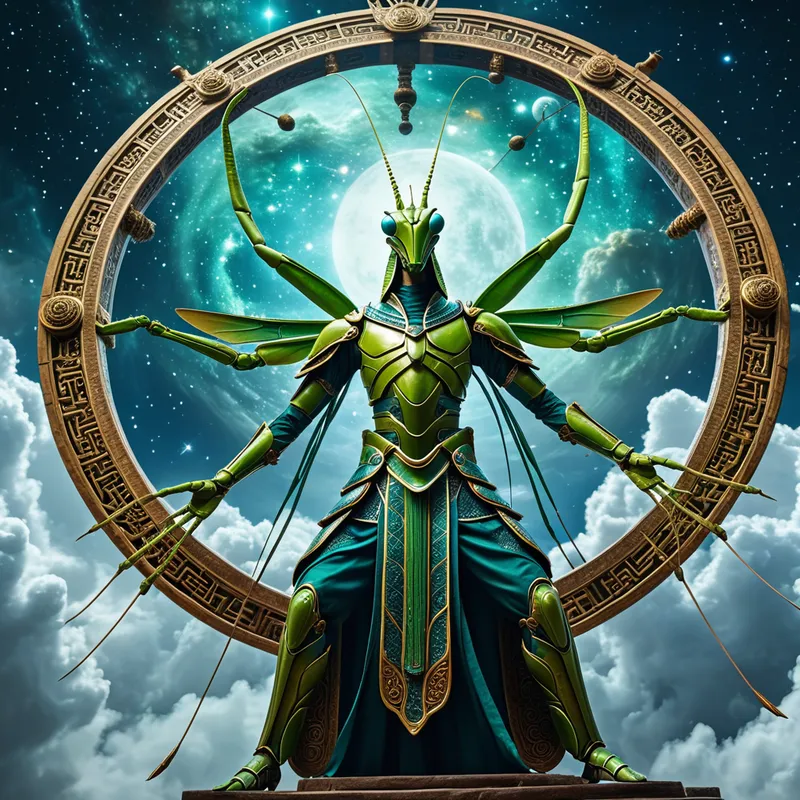
A celestial mantis, swollen with pride, challenges a mighty chariot's wheel, embodying the fatal folly of overreaching ambition against cosmic order.
The Tale of The Mantis
The air in the state of Qi was thick with the dust of ambition and the clatter of chariot wheels. Duke Zhuang was returning from a hunt, his spirit soaring higher than the hawks he had flown. His chariot, a masterpiece of lacquered wood and bronze, rumbled along the road, a symbol of human power carving its will upon the earth. The very ground trembled in deference to its passage.
It was then that the universe presented a lesson, small in form but vast in implication.
On the road ahead, a creature emerged from the wayside grass. It was a praying mantis, but not as we commonly see. This one seemed infused with the very essence of the wild hunt just concluded. Its body was a blade of living jade, its triangular head a helm of obsidian. It raised itself on its hind legs, and with a deliberate, terrifying grace, it lifted its saw-toothed forelimbs. It did not flee the thunderous approach of the duke’s chariot. Instead, it settled into a posture of pure, unadulterated defiance. It brandished its arms at the oncoming wheel—a mountain of wood and metal driven by the might of eight horses and the will of a king.
The driver saw it and gasped, reining in the team. “My lord! Look! A mantis dares to block the path of your great chariot!”
Duke Zhuang leaned forward, his hunter’s eyes narrowing. He saw not an insect, but a spirit. He saw the absolute conviction in its stance, the complete absorption in its own martial power. It believed, with every fiber of its being, that it could halt the inevitable. That it could win.
“Stay your hand,” the Duke commanded, his voice low. “This is no ordinary creature. This is a warrior. To advance now would be to dishonor its courage, however misplaced. Go around it.”
The chariot, a force that could shatter battle lines, gently veered to the side, giving a wide berth to the tiny, resolute defender. The mantis held its ground until the rumble faded, its victory absolute in its own mind. The tale was captured by the court scholars, a fragile, green-edged parable against the relentless bronze of history.
Cultural Origins & Context
This brief, potent story is not a myth of grand creation or pantheonic struggle, but a fable preserved within the Zhanguo Ce and later echoed in other historical compilations. Its origin is in the Spring and Autumn period, a time of constant warfare and shifting alliances between feudal states. Rhetoricians and advisors used such anecdotes to persuade rulers.
The story of the mantis was a political and philosophical tool. Told to a ruler like Duke Zhuang—a man of proven military might—it served as a warning against hubris. It asked the powerful to consider: Are you the mighty chariot, or are you, in the face of an even greater cosmic or moral force, the mantis? It was a lesson in measuring one’s strength, in recognizing forces larger than oneself, whether they be a rival state, the Mandate of Heaven, or the Dao itself. It passed from scholar to ruler, from text to memory, as a crystalline example of catastrophic misjudgment wrapped in an image of breathtaking, fatal bravery.
Symbolic Architecture
The myth’s power lies in its stark, almost absurd contrast of scale, which maps perfectly onto profound psychological and cosmic truths.
The Mantis represents the conscious ego at its peak of inflation. It is the part of us that, after a string of successes (the “hunt”), believes its own power is absolute and its perspective is the whole of reality. Its martial posture is not just biological; it is the posture of the inflated will, armed with intellect, skill, or authority, ready to challenge any obstacle.
The mantis does not see the chariot; it sees only an opponent worthy of its arms.
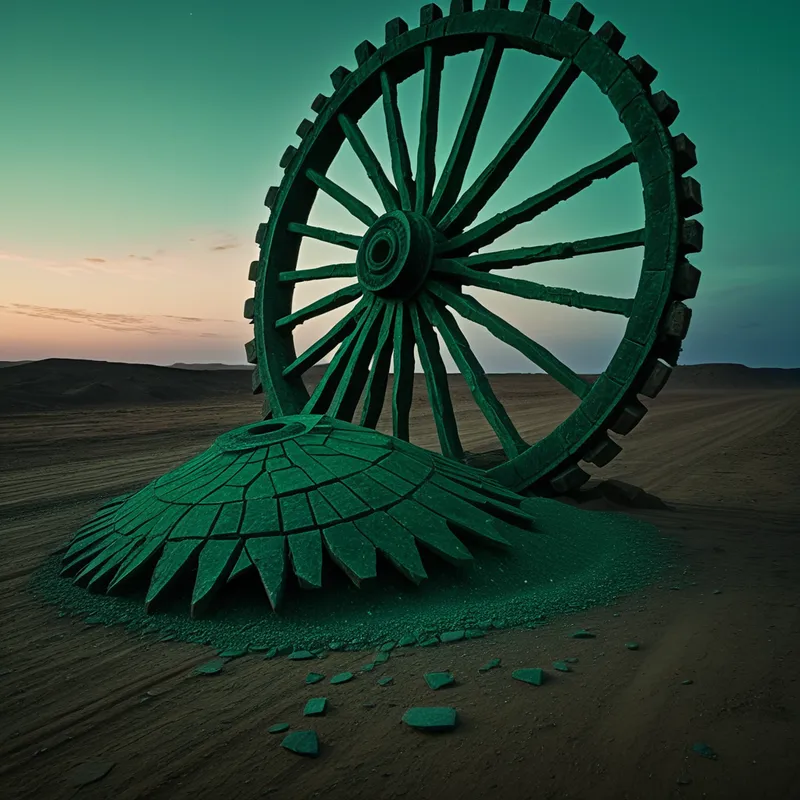
The Chariot Wheel symbolizes the inexorable movement of the Self or the Dao—the totality of the psyche or the unimpeded flow of cosmic reality. It is not malicious; it is simply immense, purposeful, and on its own path. It represents fate, consequence, the larger pattern of life that operates on a scale the ego cannot comprehend.
The true conflict is not between insect and wood, but between the partial and the whole, the temporary will and the eternal process. The mantis’s bravery is real, but its awareness is tragically limited. It fights a wheel, unaware of the chariot, the horses, the duke, and the entire state of Qi that propels it. The myth is a perfect portrait of how a strength, when divorced from wisdom and context, becomes the very agent of its own destruction.

The Dreamer's Resonance
When this myth stirs in the modern unconscious, it often surfaces in dreams of futile confrontation. You may dream of raising your arms against a slowly advancing wall, shouting at an unhearing authority figure, or preparing for a battle where the opponent’s form is vague but their presence is overwhelmingly vast.
Somatically, this can feel like tension in the shoulders and arms—the body preparing for a fight that cannot be won on its own terms. Psychologically, it signals a state of psychic inflation. The dreamer is in a “mantis phase”: they have perhaps achieved a promotion, mastered a skill, or solidified an identity, and now believe this new power can be applied to every problem. They are challenging the “chariot wheel” of a changing relationship, a shifting economy, an inner call for transformation, or simply the natural limits of human control.
The dream is not a condemnation of courage, but a critical message from the Self: You are using a strength against a force it cannot address. Your stance is perfect, but your battlefield is wrong. The crushing sensation in the dream is the necessary deflation of the ego, making space for a broader awareness.

Alchemical Translation
The alchemical process modeled here is not one of victory, but of sacrificial dissolution and re-contextualization. The heroic ego must be “crushed” not out of cruelty, but out of necessity, to be remade into something capable of participating in the larger movement.
The first stage is Recognition (Duke Zhuang’s order to halt). This is the moment of self-reflection, where a part of the psyche observes the futile confrontation and chooses not to blindly identify with it. It is the beginning of wisdom.
The second is Dissolution (the imagined, inevitable crushing). The inflated identity, the “martial mantis” self-image, must be broken apart by contact with reality. This is a painful but sacred humiliation, the nigredo of this myth.
The wheel does not destroy the mantis; it transmutes its courage. The bravery that was spent on defiance must be reclaimed for adaptation.
The final stage is Integration. The raw materials of the former ego—its courage, its resolve, its unique form—are not annihilated. They are gathered back into the psyche. The individual learns to apply their strength within the flow of the chariot’s path, not against it. They become a conscious participant in the larger journey, perhaps even the driver’s attentive eye, rather than an obstacle on the road. The shattered green limb becomes the jade in a new, more resilient psychic structure. The hero archetype transforms from the one who defiantly stands against, to the one who wisely moves within.
Thus, the myth of the mantis becomes an internal compass. It asks us, in our moments of greatest confidence: What chariot wheel are you raising your arms against? And are you prepared to learn not how to stop it, but how to understand its destination?
Associated Symbols
Explore related symbols from the CaleaDream lexicon: