The Loa Ceremony Myth Meaning & Symbolism
A myth of sacred invitation where the human and divine realms meet, forging identity through ritual, memory, and the transformative power of the crossroads.
The Tale of The Loa Ceremony
Listen. The world is not as solid as it seems. There are places where the veil thins, where the breath of the ancestors still stirs the dust, and where the great powers, the Loa, walk. This is the tale of such a place, of such a night.
It begins not with a person, but with a need. A hunger in the soul of the people, a feeling of being unmoored, adrift on a vast, salty ocean of forgetting. They remembered the feel of their own soil, the names of their rivers, only in the fading echoes of dreams. This forgetting was a cold wind in the heart. So, they called to the one who remembers the roads—Papa Legba. He is the old man at the gate, leaning on his crutch, his pipe smoke curling into the shape of forgotten languages.
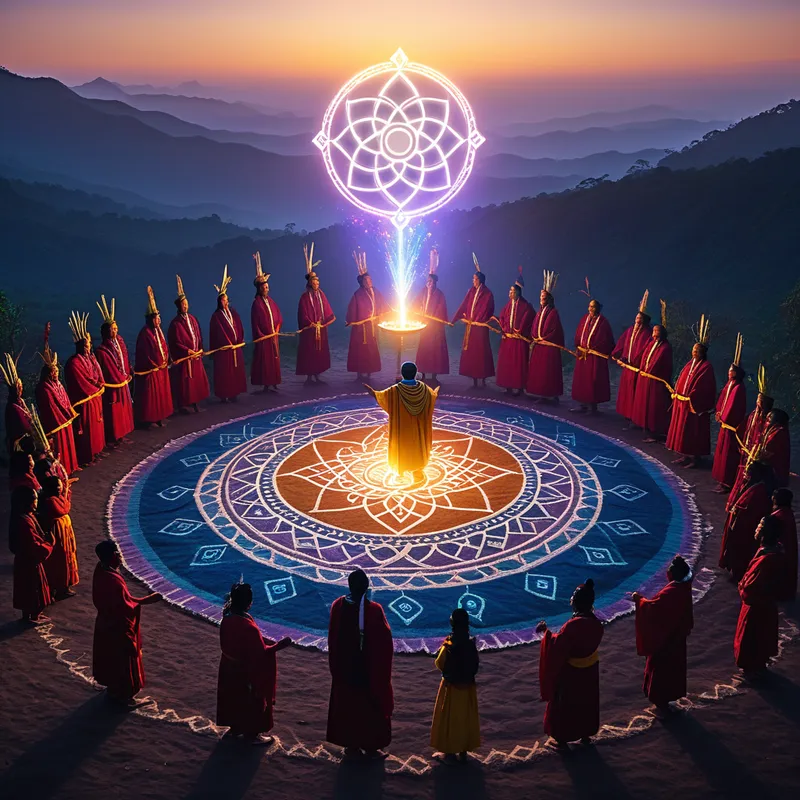
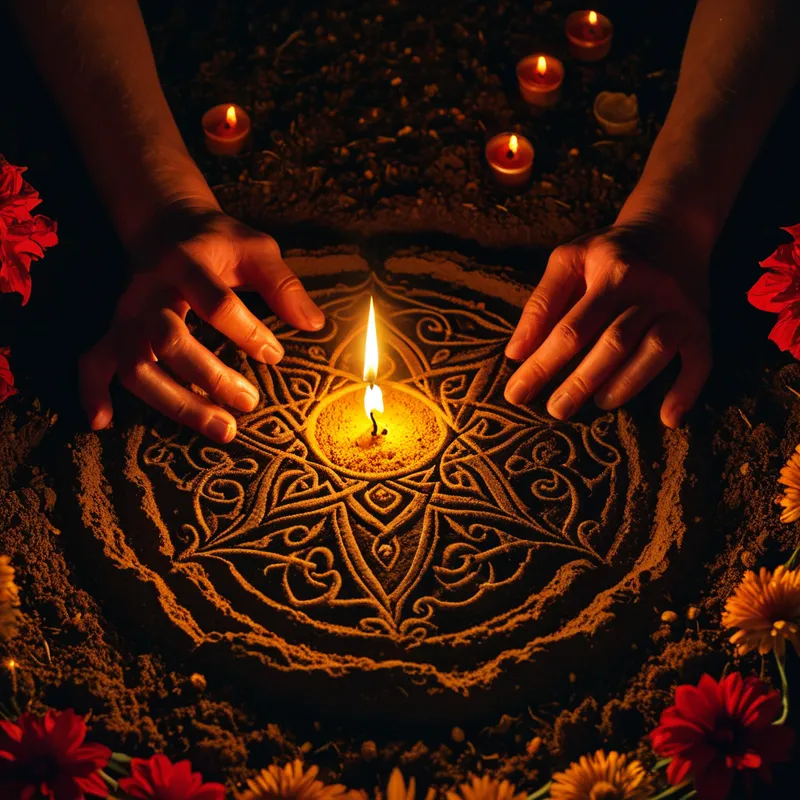
The community gathered where three paths met—the crossroads, the place of all possibilities. The air was thick with the scent of rum, strong coffee, and the earth after rain. The houngan began to draw. With careful hands, he scattered cornmeal upon the ground, his fingers tracing not a picture, but a prayer in lines and curves—a veve. This was no mere drawing; it was a door, a resonant frequency tuned to a specific divine presence. As the last line connected, a hum seemed to rise from the earth itself.
Then came the drums. Not a melody, but a heartbeat—the katabou, the maman—deep and insistent. It did not ask the body to move; it commanded the blood to remember its ancient rhythm. Feet began to stamp, not in dance, but in answer. The people formed a circle, their movements becoming a single, pulsing organism. They sang, their voices raw and full of a longing that had no name in any common tongue.
The energy built, a tangible pressure in the clearing. The drummers’ hands became a blur, the songs a cascade of invocation. And then, a shift. A dancer stumbles, their eyes rolling back. The community gathers close, supporting, guiding. A new presence enters the circle. The movements change—the gentle elder now moves with the aggressive, martial grace of Ogou; the shy woman holds herself with the regal, nurturing power of [Erzulie Freda](/myths/erzulie-freda “Myth from African Diaspora culture.”/). The Loa had arrived, “mounting” their horse—the human vessel.
Through this mounted servant, the Loa speaks. It offers counsel in a thickened voice, blesses the community, heals old wounds with a touch, and demands its due—a sip of rum, a puff of tobacco, a song sung just so. This is the exchange, the sacred contract. For a time, the veil is not just thin; it is gone. The ancestors are present in the laughter of Ghede; the storm’s power is felt in the charged silence after a message from Sobo.
As dawn’s first light touches the horizon, the drumming slows. The possessed ones are gently tended to, cooled with water, brought back to themselves, weary but transformed. The veve is swept away, the crossroads returns to being just dirt and paths. But nothing is the same. The people return to their homes carrying a piece of that night—a remembered touch, a resolved conflict, a name spoken from across the sea. The ceremony is over, but the connection remains. The world is still solid, but now they know the secret: it is also holy.
Cultural Origins & Context
This mythic narrative is not a single story from a single book, but the living, breathing core of religious traditions like Haitian Vodou, Louisiana Voodoo, and related practices born from the crucible of the African Diaspora. Forged in the unspeakable trauma of the Transatlantic Slave Trade, these traditions performed a miraculous act of spiritual synthesis and resistance. Enslaved Africans, ripped from diverse ethnic and spiritual backgrounds (Yoruba, Fon, Kongo, and more), found their gods and ancestors silenced by colonial oppression. The “Loa Ceremony” as a mythic pattern represents their profound response: the clandestine preservation and recombination of these divine forces under the guise of Catholic saint veneration, creating a resilient, hidden theology.
The myth was passed down not in scrolls, but in bodies—through the rhythms of the drums, the steps of the dance, the recipes for offerings, and the oral instructions of priests and priestesses (houngan and mambo). Its societal function was, and is, multifaceted: it is a system of community medicine (physical and psychological), a court of justice and conflict resolution, a direct line to ancestral guidance, and a powerful reaffirmation of identity and autonomy in the face of forces that sought to erase both. The ceremony is the engine of cultural memory, ensuring that the Bondye and the myriad Loa did not die on the Middle Passage, but were reborn in the New World.
Symbolic Architecture
At its [heart](/symbols/heart “Symbol: The heart symbolizes love, emotion, and the core of one’s existence, representing deep connections with others and self.”/), the myth of the Loa [Ceremony](/symbols/ceremony “Symbol: Ceremonies in dreams often symbolize transitions, rituals of passage, or significant life events.”/) is about the [architecture](/symbols/architecture “Symbol: Architecture in dreams often signifies structure, stability, and the framing of personal identity or life’s journey.”/) of [relationship](/symbols/relationship “Symbol: A representation of connections we have with others in our lives, often reflecting our emotional state.”/) between the [human](/symbols/human “Symbol: The symbol of a human represents individuality, complexity of emotions, and social relationships.”/) and the numinous. It maps a [cosmos](/symbols/cosmos “Symbol: The entire universe as an ordered, harmonious system, often representing the totality of existence, spiritual connection, and the unknown.”/) where divinity is not a distant monarch, but a pantheon of accessible, personified forces that require reciprocal exchange.
The ceremony is the crossroads where the self meets the Other, and in that meeting, discovers a forgotten part of its own soul.
The central [symbol](/symbols/symbol “Symbol: A symbol can represent an idea, concept, or belief, serving as a powerful tool for communication and understanding.”/) is the veve. It is a [sigil](/symbols/sigil “Symbol: A magical symbol designed to represent a specific intent, often used in ritual and personal empowerment to manifest desires or protection.”/), a psychic [antenna](/symbols/antenna “Symbol: A symbol of reception, transmission, and connection to unseen forces or information. It represents the ability to tune into frequencies beyond ordinary perception.”/), and a contract all in one. It represents the human [capacity](/symbols/capacity “Symbol: A measure of one’s potential, limits, or ability to contain, process, or achieve something, often reflecting self-assessment or external demands.”/) to create a focused point of [invitation](/symbols/invitation “Symbol: An ‘Invitation’ symbolizes opportunities, connections, or decisions awaiting the dreamer.”/) for forces larger than the individual ego. The act of “mounting” or possession is the ultimate [symbol](/symbols/symbol “Symbol: A symbol can represent an idea, concept, or belief, serving as a powerful tool for communication and understanding.”/) of ego surrender for a transcendent [purpose](/symbols/purpose “Symbol: Purpose signifies direction, meaning, and intention in life, often reflecting personal ambitions and core values.”/). The human [vessel](/symbols/vessel “Symbol: A container or structure that holds, transports, or protects something essential, representing the self, emotions, or life journey.”/) (the “horse”) temporarily relinquishes control so that a greater archetypal [energy](/symbols/energy “Symbol: Energy symbolizes vitality, motivation, and the drive that fuels actions and ambitions.”/) (the Loa, the “rider”) may act in the world. This is not [loss](/symbols/loss “Symbol: Loss often symbolizes change, grief, and transformation in dreams, representing the emotional or psychological detachment from something or someone significant.”/) of self, but enlargement of self through sacred service.
The Loa themselves represent the personified complexities of [life](/symbols/life “Symbol: The symbol of ‘Life’ represents a journey of growth, interconnectedness, and existential meaning, encompassing both the joys and challenges that define human experience.”/): love, war, [death](/symbols/death “Symbol: Symbolizes transformation, endings, and new beginnings; often associated with fear of the unknown.”/), healing, mischief, justice. They are the fragmented, approachable faces of the ultimate divine, modeling a [psychology](/symbols/psychology “Symbol: Psychology in dreams often represents the exploration of the self, the subconscious mind, and emotional conflicts.”/) where the psyche is not a unified monolith, but a [community](/symbols/community “Symbol: Community in dreams symbolizes connection, support, and the need for belonging.”/) of powerful, sometimes conflicting, sub-personalities that must be honored and negotiated with.
The Dreamer’s Resonance
When this mythic pattern stirs in the modern dreamer, it signals a profound somatic and psychological process: the call to ritualize a deep, often disowned, part of the self. To dream of a chaotic, powerful gathering where you are asked to dance to an unfamiliar rhythm may reflect the psyche’s attempt to integrate unconscious contents that feel “other” and overwhelming.
Dreams of being “mounted” or taken over by a powerful force—a wave of grief (Erzulie’s tears), a righteous anger (Ogou’s fire), or the cynical humor of mortality (Ghede)—suggest an archetypal energy breaking through the ego’s usual controls. The body in the dream may feel electrified, heavy, or moved against its will. This is not pathology, but the psyche’s native ceremony beginning. The dream is drawing its own veve, preparing the dreamer for an encounter with an inner Loa that demands acknowledgment. The somatic resonance is key; the transformation is not just intellectual, but embodied.
Alchemical Translation
For the modern individual navigating the diaspora of their own fragmented psyche—the exiled emotions, the forgotten talents, the ancestral wounds—the Loa Ceremony offers a precise model for psychic transmutation, or individuation.
Individuation is not about becoming a solitary king, but about becoming a skilled houngan of your own inner world, capable of calling forth and respectfully negotiating with the powerful spirits within.
The first alchemical stage is Invitation (Drawing the Veve). This is the conscious work of creating a sacred, focused space—through journaling, therapy, art, or meditation—to call a specific inner content (e.g., repressed rage, stifled creativity) out of the shadow. You must name it and invite it formally.
The second is Synchronization (The Drumming and Dance). This is the surrender of the ego’s rigid control through embodied practice. It might be authentic movement, breathwork, or any practice that allows the body’s intelligence to bypass the mind’s censorship and align with the emerging energy.
The climax is Integration (The Mounting). This is the temporary, contained allowance of that archetypal energy to “speak” or express itself. In a therapeutic setting, this could be role-playing the angry part, letting the grief wail through you, or allowing the trickster’s insight to dismantle a rigid belief. The conscious ego does not disappear; it becomes the witnessing, caring community that holds the space safely.
The final stage is Offering & Return (The Exchange and Dawn). After the expression, a reciprocal exchange is made. What does this integrated energy need to be honored? Perhaps a change in lifestyle (an offering), a new creative outlet, or simply acknowledgment. Then, with gratitude, the energy is allowed to recede, leaving the ego enriched, wiser, and more whole. The individual returns to daily life, but the inner crossroads remains active, a permanent gateway to a more complete self.
Associated Symbols
Explore related symbols from the CaleaDream lexicon:
- Crossroads — The central axis of the ceremony, representing choice, potential, and the liminal point where the human world intersects with the spiritual realms.
- Drum — The heartbeat of the ritual, symbolizing the call to remembrance, the synchronization of community, and the rhythmic key that unlocks the door to the divine.
- Veve — The sacred drawn symbol, representing a focused prayer, a psychic antenna, and the contractual blueprint for inviting a specific archetypal force into manifestation.
- Spirit — The essential nature of the Loa themselves, representing the personified, accessible forces of nature, emotion, and destiny that interact with humanity.
- Ancestor — The foundational presence within the ceremony, symbolizing the living memory, guidance, and cultural DNA that flows through the ritual and the community.
- Horse — The human vessel in possession, representing the ego’s surrender for a transcendent purpose, becoming the vehicle for a power greater than itself.
- Dance — The embodied prayer and engine of the ceremony, symbolizing the loss of individual separation and the movement into a collective, ecstatic state of connection.
- Offerings — The rum, food, and tobacco given to the Loa, symbolizing the sacred reciprocity at the heart of the relationship—a gift for a gift, energy for energy.
- Mask — The metaphorical “face” worn by the Loa when mounting a servant, representing the archetypal persona that temporarily overlays the individual identity.
- Circle — The shape of the ritual gathering and dance, symbolizing containment, community, wholeness, and the cyclical nature of the relationship with the divine.
- Fire — Representing the transformative energy of Loa like Ogou, the light of the ritual space, and the alchemical process of burning away the old to make way for the new.
- Community — The essential container for the ceremony, symbolizing the shared identity, support, and collective memory that makes the sacred exchange safe and potent.