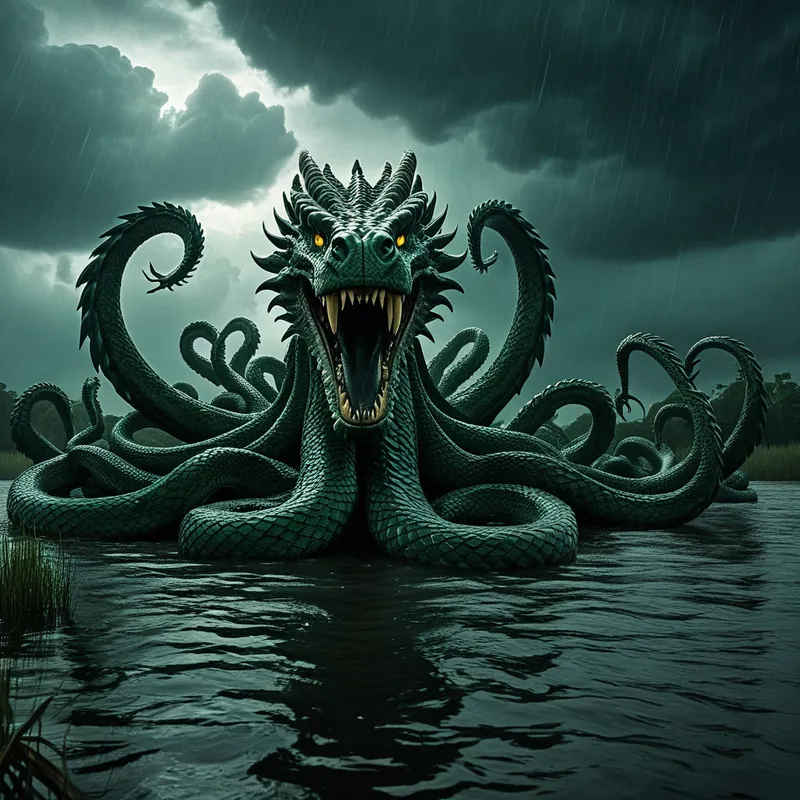
The Lernean Hydra Myth Meaning & Symbolism
Heracles battles a serpentine horror in the swamps of Lerna, where each severed head births two more, in a primal struggle of wit against chaos.
The Tale of The Lernean Hydra
Hear now of the second labor, a trial born not of earth, but of divine spite. The great Heracles, bound in servitude to a lesser king, was sent to a place where the very air was a curse. Not to sun-drenched plains or mountain fastnesses, but to the Lernaean marshes. Here, the water did not sparkle but lay stagnant, a broth of rot and forgotten things. The reeds whispered secrets that choked the light, and from the center of this festering wound rose the Hydra.
It was a child of monsters, born of Echidna and Typhon, a creature of the old, chaotic world. Its body was that of a monstrous hound, but from it sprouted not one, but nine serpentine necks, each crowned with a head that held death in its fangs. Its breath was a poison mist, and its blood a venom so potent it could wither the land. One head was immortal, a golden core of undying malice. The Hydra was not merely a beast; it was an infestation, a living plague upon the land of Argos.
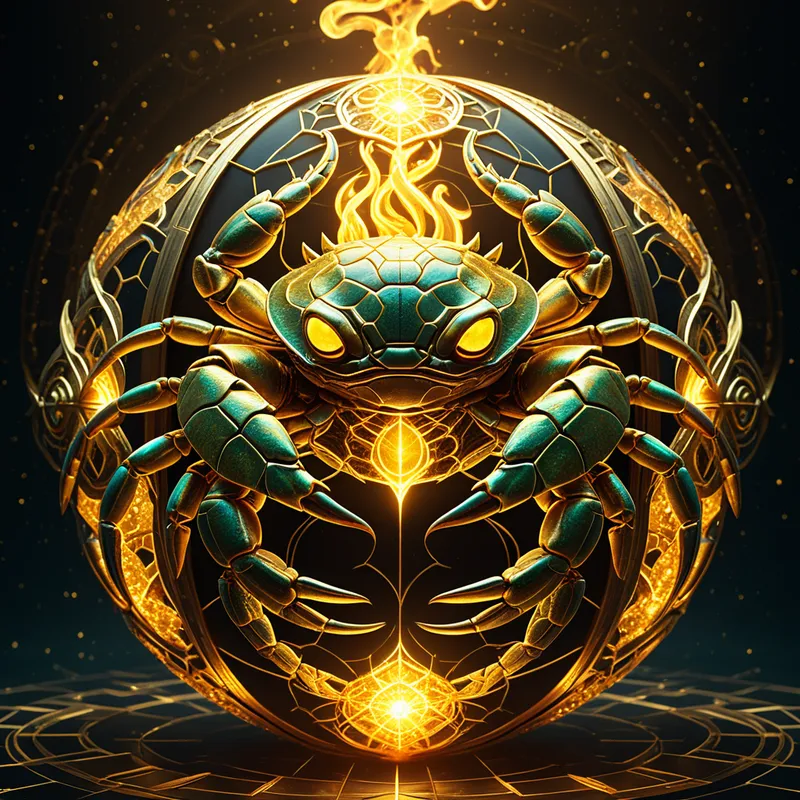
Heracles came with his nephew, Iolaus, his club heavy in his hand. He drove the monster from its reeking den with flaming arrows, the hiss of fire meeting the hiss of hate. As it emerged, vast and dripping, he closed. With a roar, he brought his club down, crushing a skull. But as the head fell, from the bleeding stump, two new heads erupted, snapping and spitting. He severed another; two more grew. For every solution, a double curse. The swamp itself seemed to aid the horror, as a giant crab, sent by Hera, scuttled from the muck to bite his foot, adding distraction to despair.
This was no contest of strength, but a nightmare of arithmetic. The hero was being overwhelmed by the very act of fighting. Then, a flash of insight, born of partnership. Heracles called to Iolaus. As the hero grappled, heaving the hydra’s body into the open, Iolaus seized a burning brand. Heracles would lop a head, and before the blood could birth its twins, Iolaus seared the stump with fire, cauterizing the wound shut. Head after ghastly head, they turned the monster’s power against itself, using the element of purification to halt the multiplication of corruption. Finally, only the immortal head remained. Heracles severed it with his golden sword, and beneath a great rock, he buried it, a seed of chaos forever imprisoned. He dipped his arrows in the Hydra’s toxic blood, a final, dreadful harvest from his victory.

Cultural Origins & Context
This myth was not a fireside ghost story but a foundational pillar of the Hellenic heroic canon. It was codified in epic poems like the now-lost Heracleia and recounted by poets such as Hesiod. As one of the Labours of Heracles, it served a crucial societal function: it illustrated the archetypal journey of the culture hero who ventures into the untamed, chaotic margins (the swamp) to secure the safety and order of the civilized world (Argos). The telling reinforced the values of metis (cunning intelligence) alongside bie (physical force), and the necessity of faithful companionship (Iolaus) in overcoming divine opposition (Hera). It was a myth of containment, teaching that some primordial threats cannot be destroyed, only managed and buried.
Symbolic Architecture
The Hydra is the ultimate symbol of the problem that grows when attacked directly. It represents any vicious cycle—addiction, anxiety, systemic corruption, or a pattern of self-sabotage—where our initial, forceful attempts to eliminate it only compound its power.
The Hydra is the shadow of linear thinking; it thrives on direct confrontation and punishes the uncreative solution.
Psychologically, the many heads are the hydra-headed nature of a core complex in the unconscious. Confront one manifestation (a fear of failure), and two more related anxieties (fear of judgment, fear of success) sprout in its place. The immortal head is the archetypal root of the complex itself, the core wound or pattern that cannot be “killed” but must be acknowledged and contained. The crab, sent by Hera, symbolizes the unexpected, pinching distractions that arise when we engage our deepest struggles, often representing petty ego-defenses or ancillary crises. Heracles’ shift in strategy—from brute force to creative, collaborative containment—models the necessary psychic move from ego-driven repression to a more conscious, differentiated engagement with the unconscious.
The Dreamer’s Resonance
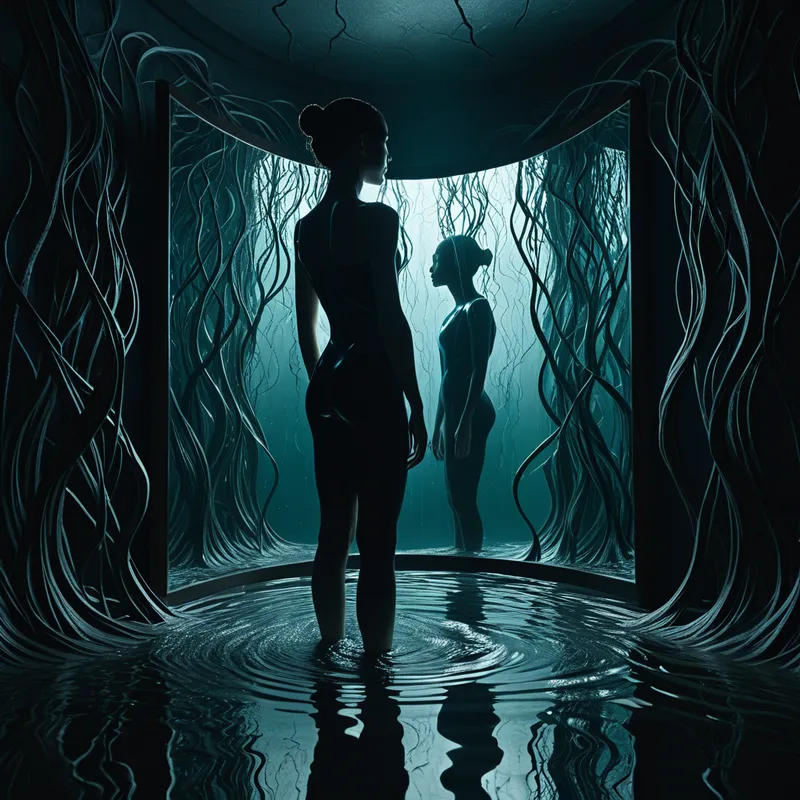
To dream of a hydra is to dream of a somatic truth: the feeling of being overwhelmed by a problem that multiplies. The dreamer may be battling a tangle of serpents in a basement (the personal unconscious) or a flooded office (the overwhelmed psyche). The sensation is one of futility and escalating dread. This dream pattern emerges when an individual is attempting to solve a deep, systemic life issue—a toxic relationship pattern, a financial morass, a health crisis—with the same ineffective, though forceful, methods. The body feels the strain: the exhaustion, the shortness of breath, the heavy limbs of the dream. The dream is the psyche’s dramatic enactment of a stalled process, insisting that the current approach is creating more of the problem it seeks to solve. It is a call to step back, to seek a “Iolaus”—a supportive insight or ally—and to find the “fire,” the transformative principle that can cauterize the cycle of regeneration.
Alchemical Translation
The alchemical journey is one of solve et coagula—dissolve and coagulate. The Hydra myth is a perfect map for the solve stage, the dark night of the soul where the individual’s old structures and defenses are broken down, often in a terrifyingly prolific manner. The hero’s initial, solitary club-swinging represents the ego’s attempt to forcibly integrate or eliminate shadow content. This fails spectacularly, leading to a psychic inflation of the very content it sought to defeat.
The triumph is not in the beheading, but in the change of principle—from blade to brand, from severing to sealing.
The arrival of Iolaus with fire is the crucial intervention of the transcendent function—the emergence of a new, reconciling symbol (fire as spirit, consciousness, purifying will) from the tension of opposites (hero vs. monster, force vs. proliferation). The collaborative act symbolizes the ego aligning with a deeper, guiding principle (the Self) to enact transformation. Cauterization is the alchemical coagulation: the application of intense conscious heat to fix the volatile, ever-multiplying shadow material into a manageable form. The burial of the immortal head is not its destruction, but its integration as a lapis, a cornerstone of the new personality. The poisoned arrows Heracles creates afterward signify that the conquered complex, once integrated, leaves a residue of potent insight—a “toxic wisdom”—that can be used as a tool for navigating future challenges, a permanent change in the individual’s psychic arsenal.
Associated Symbols
Explore related symbols from the CaleaDream lexicon: