The Lares Myth Meaning & Symbolism
The Lares were the protective spirits of the Roman household, embodying the sacred bond between the living, the dead, and the land they inhabited.
The Tale of The Lares
Listen. Before the city’s great stone forums rose, before the legions marched, there was [the threshold](/myths/the-threshold “Myth from Folklore culture.”/). There was [the hearth](/myths/the-hearth “Myth from Norse culture.”/). And there were They.
In the deep quiet of the Roman home, when the sun had fled and the embers in the hearth sighed their last red breath, They were present. You did not see Them with the eyes of day, but you knew. A warmth that was not from the fire. A sense of watchfulness in an empty corner. A faint, comforting scent of laurel and old, well-tended wood. These were the [Lares](/myths/lares “Myth from Roman culture.”/).
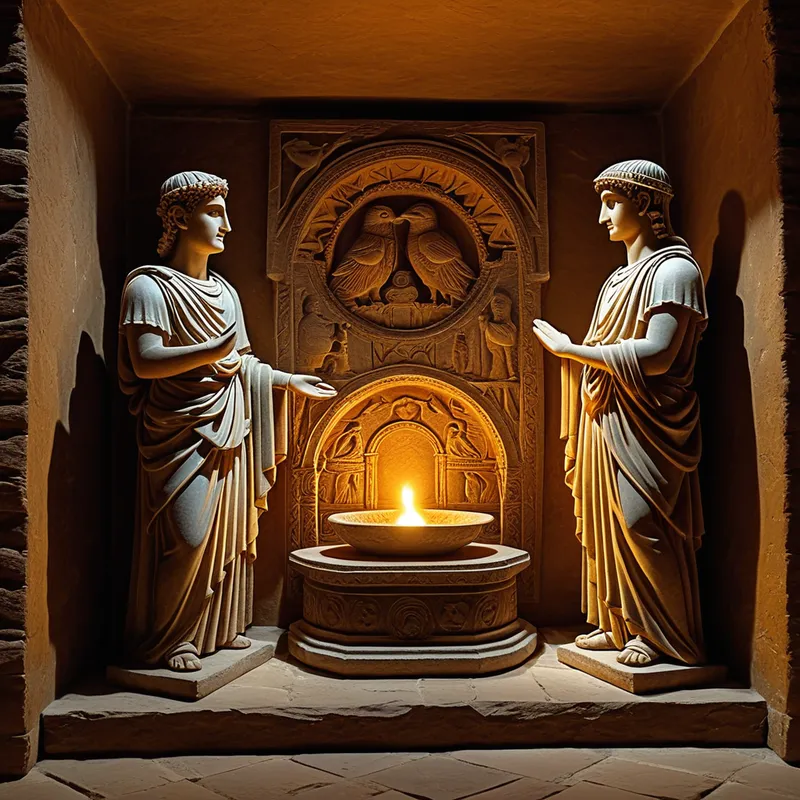
They were born of the land itself, of the very soil upon which the family’s home was built. Some whispered they were the spirits of the family’s most distant ancestors, those who first broke [the earth](/myths/the-earth “Myth from Hindu culture.”/) on that spot. Others said they were children of the great goddess Lara or Larunda, silent guardians given to mortal kin. Their form was youthful, ageless, often two figures in a graceful, dancing posture, one holding a drinking horn (rhyton), the other a bowl (patera).
Their domain was the atrium, the penus, [the crossroads](/myths/the-crossroads “Myth from Celtic culture.”/) just beyond the door. Their altar was the [lararium](/myths/lararium “Myth from Roman culture.”/), a sacred niche where the family gathered. Each morning, the paterfamilias would offer Them the first morsel of the meal, a sprinkle of wine, a pinch of salt. On the Kalends, the Ides, and the Nones, the household adorned their small statues with garlands. The conflict They guarded against was not of epic monsters, but of slow decay: the silence of a broken family, the neglect of ritual, the cold hearth. Their [triumph](/myths/triumph “Myth from Roman culture.”/) was the simple, profound resolution of continuity—the smoke of the offering rising, [the child](/myths/the-child “Myth from Alchemy culture.”/) learning the prayers, the land recognizing its people.
To forget Them was to become a stranger in your own home. To honor Them was to weave your life into an unbroken thread that stretched back into the dark, fertile earth and forward into the dreams of children yet unborn. They were the breath of the house itself.
Cultural Origins & Context
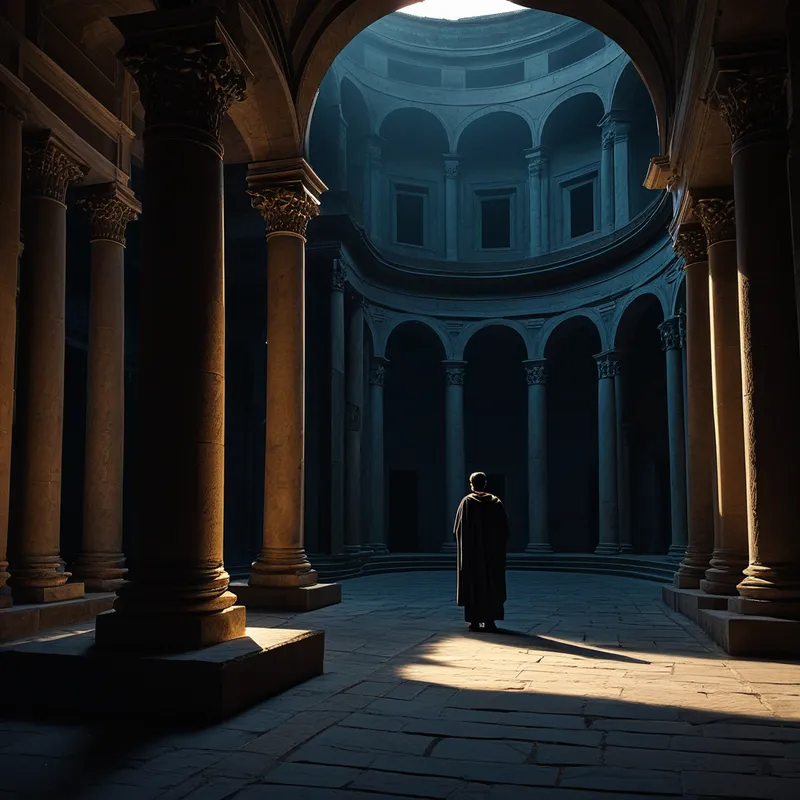
The Lares were not the gods of the grand state religion, but the deities of the intimate, daily round. Their cult was prehistoric, rooted in the animistic beliefs of early Italic peoples who saw spirit in every spring, grove, and boundary stone. They were the genius loci—the spirit of the place—particularized to the domestic sphere.
This myth was passed down not in epic poetry, but in action and habit. It was taught by a father’s steady hand guiding a son’s during an offering, by a mother’s whispered prayer. Its primary “texts” were the physical lararia found in homes from the humblest farmhouse to the grandest Pompeian villa. Their societal function was foundational: they sacralized the family (familia) as the essential cell of society. They tied identity to place long before the concept of a nation-state. To be without one’s Lares was to be spiritually homeless, a fate worse than material poverty. Public [Lares Compitales](/myths/lares-compitales “Myth from Roman culture.”/) served a similar function for neighborhoods, weaving a protective web through the entire community.
Symbolic Architecture
The Lares represent the psychic embodiment of belonging. They are the symbolic anchors of [the personal unconscious](/myths/the-personal-unconscious “Myth from Jungian Psychology culture.”/) to a specific point in [space](/symbols/space “Symbol: Dreaming of ‘Space’ often symbolizes the vastness of potential, personal freedom, or feelings of isolation and exploration in one’s life.”/) and time—a home, a [lineage](/symbols/lineage “Symbol: Represents ancestral heritage, family connections, and the transmission of traits, values, and responsibilities across generations.”/), a tradition.
The hearth is not where the fire burns, but where the memory is kept warm.
Psychologically, they symbolize the internalized “guardians of the threshold” of [the Self](/myths/the-self “Myth from Jungian culture.”/). They are the accumulated psychic [energy](/symbols/energy “Symbol: Energy symbolizes vitality, motivation, and the drive that fuels actions and ambitions.”/) of routine, care, and ancestral [pattern](/symbols/pattern “Symbol: A ‘Pattern’ in dreams often signifies the underlying structure of experiences and thoughts, representing both order and the repetitiveness of life’s situations.”/) that creates a container safe enough for individual [personality](/symbols/personality “Symbol: Personality in dreams often symbolizes the traits and characteristics of the dreamer, reflecting how they perceive themselves and how they believe they are perceived by others.”/) to grow. The paterfamilias making the daily offering represents the conscious ego tending to these deep, structuring patterns of the [psyche](/myths/psyche “Myth from Greek culture.”/). The lararium itself is a powerful [symbol](/symbols/symbol “Symbol: A symbol can represent an idea, concept, or belief, serving as a powerful tool for communication and understanding.”/) of the inner sanctum, the psychic [altar](/symbols/altar “Symbol: An altar represents a sacred space for rituals, offering, and connection to the divine, embodying spirituality and devotion.”/) where one honors what has come before and makes offerings for what is to come.
Their duality—often depicted as a pair—may speak to the necessary balance they guard: tradition and innovation, [memory](/symbols/memory “Symbol: Memory symbolizes the past, lessons learned, and the narratives we construct about our identities.”/) and hope, the rootedness of the past and the potential of the future. They are not dynamic heroes but constant presences, representing the psychological [truth](/symbols/truth “Symbol: Truth represents authenticity, honesty, and the quest for knowledge beyond mere appearances.”/) that growth requires a stable [foundation](/symbols/foundation “Symbol: A foundation symbolizes the underlying support systems, values, and beliefs that shape one’s life, serving as the bedrock for growth and development.”/).
The Dreamer’s Resonance
When the Lares pattern stirs in the modern dreamer, it often speaks to a crisis of belonging or a rupture in one’s inner foundation. The dream imagery is typically liminal and somatic.
One might dream of the house they grew up in, but it is empty, cold, and the rooms have shifted. Or they may find a hidden, neglected room containing strange, ancient-looking statuettes covered in dust. There is a profound sense of searching for a “shrine” in a new apartment, a feeling that the walls do not yet “know” or “protect” them. The somatic process is one of disorientation—a literal loss of inner compass tied to place and lineage. This can manifest during life transitions: a move, a family estrangement, the death of a parent, or even a cultural dislocation. The psyche is signaling that the unconscious anchors have come loose, and the foundational layer of the personality feels adrift.
Alchemical Translation
The alchemical process modeled by the Lares myth is not one of dramatic coniunctio or slaying dragons, but of the sacred routine—the opus of daily remembrance that transmutes a mere physical space into a psychic vessel, and a collection of individuals into a soul-filled community.
For the modern individual pursuing individuation, the “Lararian work” involves consciously building and tending one’s inner lararium. This is the work of integration, of honoring the “ancestors” of one’s own psyche—the inherited patterns, the childhood joys and wounds, the cultural and familial spirits that dwell within us, for good or ill.
Individuation begins not by fleeing one’s origins, but by ritually acknowledging them, thereby transforming their blind fate into a conscious legacy.
The offering is attention. The ritual is reflection. The sacred days (Kalends, Ides, Nones) are the moments we set aside to consciously connect with our roots and our place in [the world](/myths/the-world “Myth from Tarot culture.”/). The transmutation occurs when we move from being passively shaped by these unconscious [household gods](/myths/household-gods “Myth from Ancient Egyptian culture.”/) to becoming the active paterfamilias or materfamilias of our own inner domain. We don’t exorcise these spirits; we befriend them, give them their due, and in doing so, secure the blessed, protected hearth from which our own unique journey—our hero’s adventure—can safely begin and to which it can meaningfully return.
Associated Symbols
Explore related symbols from the CaleaDream lexicon: