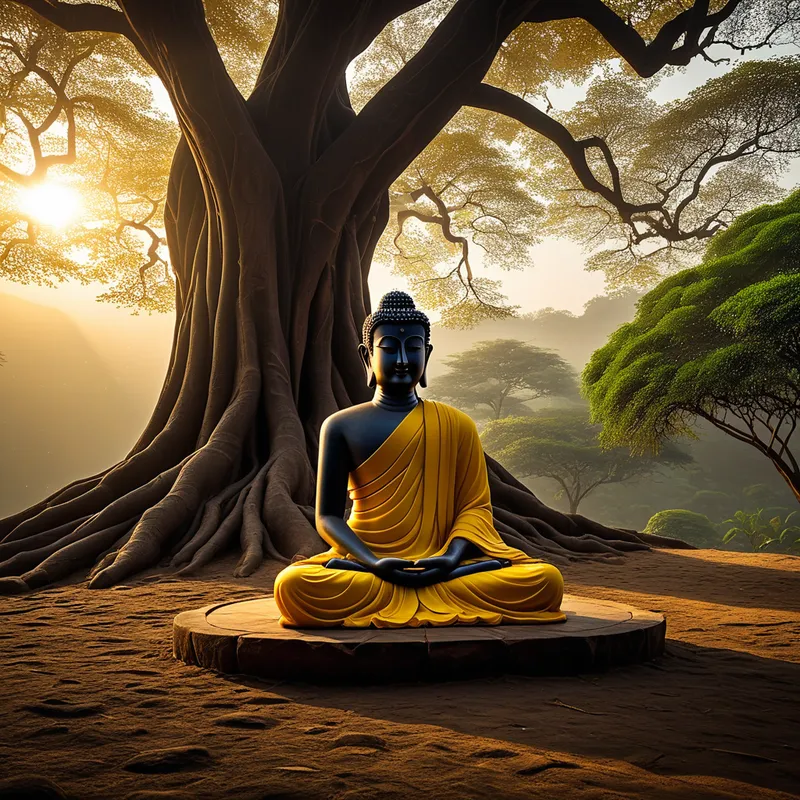
Nirvana Myth Meaning & Symbolism
The story of a prince who renounced his throne to seek the end of suffering, achieving the ultimate liberation from the endless cycle of birth and death.
The Tale of Nirvana
Listen. Before the world was as you know it, there was a prince. Not a prince of mere stone and banner, but a prince of the heart’s deepest prison. His name was Siddhartha Gautama, and he dwelt within a palace of perfumed illusion, a gilded cage built by a fearful king to hide from him the truth of the world. Walls of silk, floors of lotus petals, a life where old age, sickness, and death were whispered away like bad dreams.
Yet, the prince’s heart was a restless bird. Driven by a whisper he could not name, he ventured beyond the walls. And there, in the dusty streets, he saw the Four Sights. An old man, bent and trembling, a map of time written on crumbling skin. A man fever-wracked and moaning, body betraying its own spirit. A corpse, silent and still, being carried to the pyre. And finally, a wandering ascetic, his face a calm mirror reflecting a peace untouched by the world’s storms.
In that moment, the palace walls turned to ash in his mind. The laughter of his court, the touch of his wife Yasodhara, the face of his newborn son Rahula—all became chains of exquisite sorrow. That very night, while the palace slept a sleep of forgetting, he mounted his steed Kanthaka, and with his charioteer Channa, he passed through the gates. He cut his royal hair, exchanged silks for rags, and stepped into the wilderness, a seeker with nothing but a question that burned like a star: How can suffering end?
For six years he wandered, a skeleton clad in dust. He sat at the feet of masters, learned the hymns of the Vedas. He pushed his body to the brink with the severest austerities, fasting until his ribs cast shadows like prison bars, believing freedom lay in crushing the flesh. But freedom did not come. Only weakness, and the mocking echo of his unanswered question.
Near death, he accepted a simple bowl of rice milk from a village girl named Sujata. Strength returned, not as pride, but as clarity. He knew then the path was not in indulgence nor in annihilation, but in a Middle Way. He walked to a place of ancient trees, the Bodhi tree at Bodh Gaya, and sat upon a seat of grass, vowing not to rise until he knew.
Then came the great assault. Mara, the Lord of Illusion and Desire, rose up in fury. He was not a monster with horns, but the sum of all that binds: fear, doubt, sensual delight, and pride. Mara sent his beautiful daughters to seduce, his monstrous armies to terrify. He hurled storms of rocks and fire, which turned to flowers at the seeker’s feet. He whispered, “Who are you to claim this seat? What witness do you have?” And the seeker, Siddhartha, touched the earth with his right hand. The great Earth herself, Bhumi, thundered her testimony, and Mara’s legions fled.
Alone in the deep night, the seeker turned his awareness inward, through the watches of the night. He saw, with impossible clarity, the endless procession of his own past lives. He saw the law by which all beings wander: Paticca-samuppada. He saw how ignorance sparks craving, craving births becoming, becoming leads to birth, and birth to aging and death—the whole dreadful wheel. And in seeing it, he severed it. As the morning star glittered in the predawn sky, the last shadow of ignorance dissolved. The fires of greed, hatred, and delusion were extinguished. He was awake. He was the Buddha. He had attained Nirvana. The great cycle of Samsara had, for him, ceased its turning. He knew the deathless. The story of the prince was over. The story of liberation had begun.
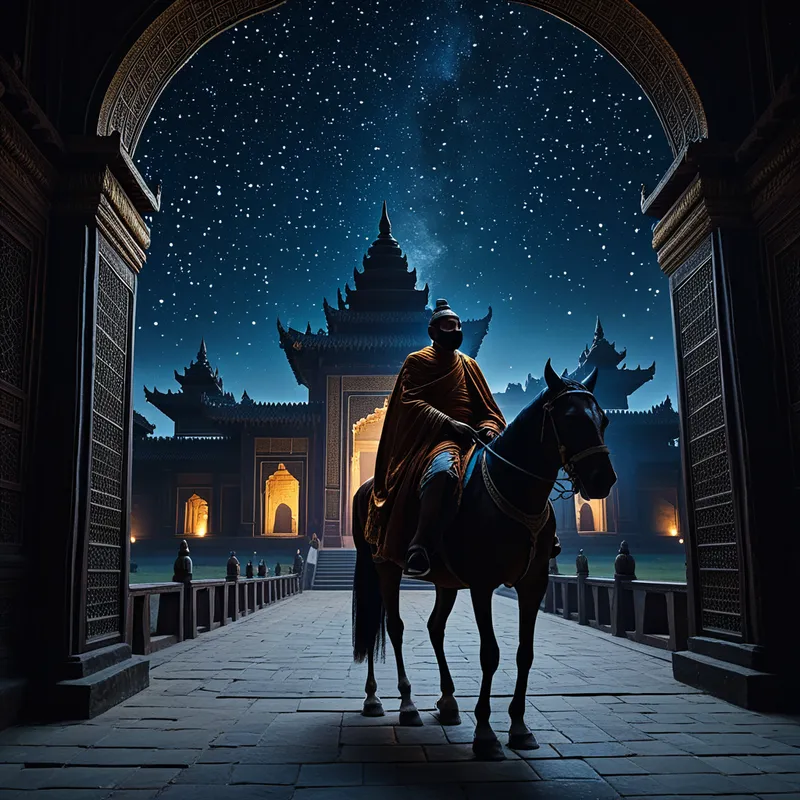
Cultural Origins & Context
This is not a myth of gods on mountaintops, but a human story elevated to a cosmic principle. Its origins are historical, rooted in the Gangetic plains of northern India in the 5th century BCE, a time of intense philosophical ferment. The tale was not sung by bards for entertainment, but meticulously preserved by the Sangha as the central narrative of a living tradition. It was passed down orally for centuries before being committed to text in the Pali Canon.
Its primary societal function was paradigmatic. It provided the ultimate “why” for the Buddhist path. The story of the prince who had everything and renounced it all answered the critical question: Why leave home? Why renounce? It established the archetype of the seeker who succeeds, making the unimaginable goal of Nirvana seem attainable, charted by a human being. It served as a master template for monastic life, validating the renunciant’s choice, and for lay followers, it offered an object of reverence and a map of the highest human potential. The narrative was a teaching tool, each episode—the palace, the sights, the austerities, Mara’s assault, the enlightenment—a chapter in a manual of liberation.
Symbolic Architecture
The myth of Nirvana is a profound map of the psyche’s journey from identification to liberation. The palace is not just a physical location; it is the ego-complex in its fortified state, constructed by parental and societal fears to keep the conscious self (the prince) insulated from the painful realities of the unconscious—namely, impermanence, vulnerability, and mortality.
The palace of the father is the prison of the son. Liberation begins when the walls no longer hide the world, but hide the self from itself.
The Four Sights are the unavoidable, traumatic eruptions of the unconscious into the defended conscious mind. They are the “return of the repressed” on a cosmic scale: the reality of time, decay, and death that the persona cannot integrate. The ascetic represents the first glimpse of the Self, the archetype of wholeness and peace, which calls the ego away from its provisional identity.
The Great Renunciation is the ego’s agonizing but necessary sacrifice of its provisional identity (prince, householder) to serve the call of the deeper Self. The six years of fruitless austerity symbolize the psyche’s misguided attempt to achieve wholeness through negation—the spiritual ego trying to become the Self by annihilating the human. Sujata’s offering marks the acceptance of the Middle Way, the reconciliation of opposites, which is the only ground from which transformation can occur.
Mara is the personification of the entire personal and collective shadow. He is not an external devil, but the sum total of our psychological resistances: our addictions (the daughters), our fears and neuroses (the armies), our imposter syndrome (“who are you?”). The defeat of Mara by calling the Earth to witness is the ultimate act of psychological grounding. It signifies the ego aligning itself not with personal history or achievement, but with the objective, impersonal reality of the psyche’s own innate law and accumulated wisdom (karma as psychological fact).
Nirvana itself, often misunderstood as mere annihilation, is symbolically the extinguishing of the fires that distort perception—greed, hatred, delusion. It is not the end of being, but the end of being in conflict with being. It is the state where the ego-Self axis is perfectly aligned, where the individual consciousness rests in the ground of being without separation.
The Dreamer's Resonance
When this myth stirs in the modern dreamer, it often manifests not as a linear narrative, but as potent, recurring symbols of confinement and breakthrough. One may dream of being in a beautiful, luxurious home that suddenly feels suffocating, with doors that lead only to other, identical rooms—the palace of the ego. Dreams of encountering the aged, the sick, or the dead, especially in incongruously “perfect” settings, can be the psyche’s own presentation of the Four Sights, forcing a confrontation with denied aspects of existence.
The somatic experience is key. There is often a profound feeling of restlessness, of a “divine discontent” amidst worldly success. This can manifest as anxiety, a feeling of being an impostor in one’s own life, or a deep, inarticulate yearning. The dreamer might experience the “Great Departure” as dreams of leaving—walking out of a job, a relationship, or a family gathering without a word, carried by a powerful, non-rational imperative.
Mara’s assault appears in dreams as sudden, overwhelming temptations to fall back into old, comfortable patterns of gratification, or as terrifying nightmares where one is attacked by shadowy figures representing one’s own doubts and fears. The moment of “touching the earth” might be a dream of falling, but landing softly on solid ground, or of holding onto a tree while a storm rages. These dreams signal that the ego, under pressure from the Self’s call for transformation, is undergoing the necessary crisis that precedes a reorientation of the entire personality.
Alchemical Translation
The alchemical process mirrored in this myth is the Nigredo leading to the Albedo. The confrontation with the Four Sights is the Nigredo—the blackening, the descent into the reality of suffering (Dukkha), which dissolves the naive, “golden” consciousness of the palace. It is a necessary mortification, the burning away of illusion.
The path to the philosopher’s stone begins in the graveyard. One must become intimately acquainted with ash before one can perceive the phoenix.
The Middle Way, discovered after the failure of austerities, is the crucial Citrinitas—the integration of opposites. It is the rejection of both spiritual inflation (asceticism) and material identification (hedonism) in favor of a conscious, balanced holding of tension. This is the birth of the transcendent function, the psychic organ that mediates between opposites.
Sitting under the Bodhi tree is the vessel of transformation, the vas hermeticum. Here, the purified contents of the psyche are held in steady, focused attention (Samadhi). Mara’s assault is the final, violent reaction of the unconscious as the old ego-structure fights for its life. The calling of the Earth as witness is the moment of Rubedo. It is the ego’s full submission to and alignment with the objective psyche, the Self. The ego does not conquer the unconscious; it bears witness to a power greater than itself and claims its seat only by virtue of that connection.
For the modern individual, this models the process of individuation. It is not about literally renouncing the world, but about renouncing our psychological identification with our roles, our history, our wounds, and our desires. It is the internal work of seeing through the palace walls of our persona, confronting the shadow (Mara), and through sustained introspection (meditation), allowing the center of gravity to shift from the ego to the Self. The “Nirvana” achieved is not an escape from life, but the capacity to live fully without being enslaved by it—to be in the world, but not of the burning wheel of our own compulsive becoming.
Associated Symbols
Explore related symbols from the CaleaDream lexicon: