The Kojiki Creation Myth Meaning & Symbolism
From swirling chaos, the first gods emerge, creating the Japanese islands and establishing the sacred, animistic order of Shinto.
The Tale of The Kojiki Creation
In the beginning, there was no time, no space, only a formless, silent churning—a sea of oily chaos, like a yolk adrift in the shell of the cosmos. This was Ame-tsuchi. From this nothing-everything, the first things came to be. Not with a bang, but with a gentle, inevitable emergence, like reeds sprouting from a marsh. First came Kotoamatsukami, the "Separate Heavenly Deities," beings of pure principle, alone in the high plain of heaven.
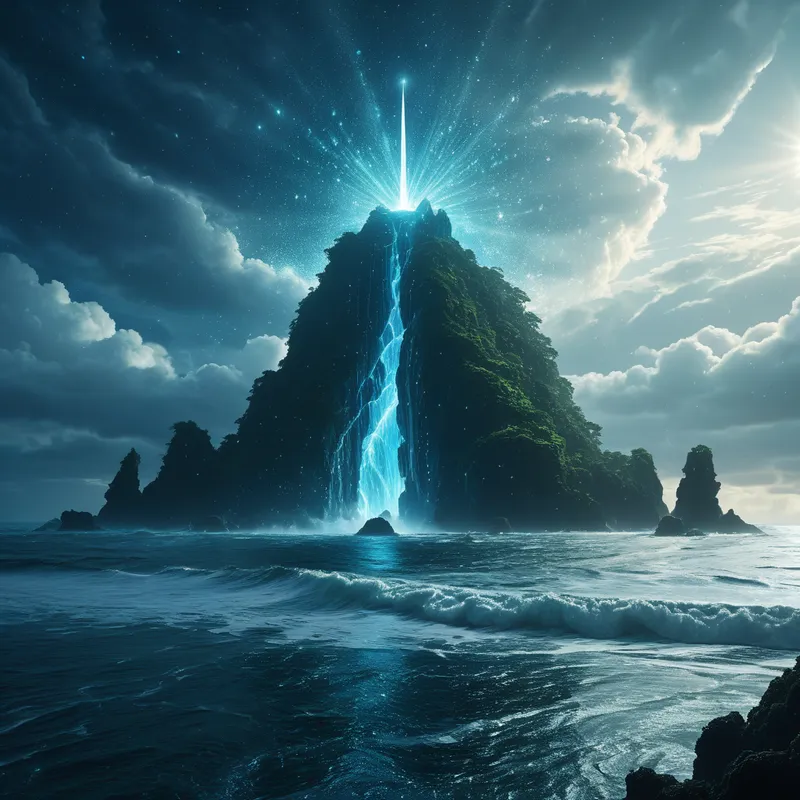
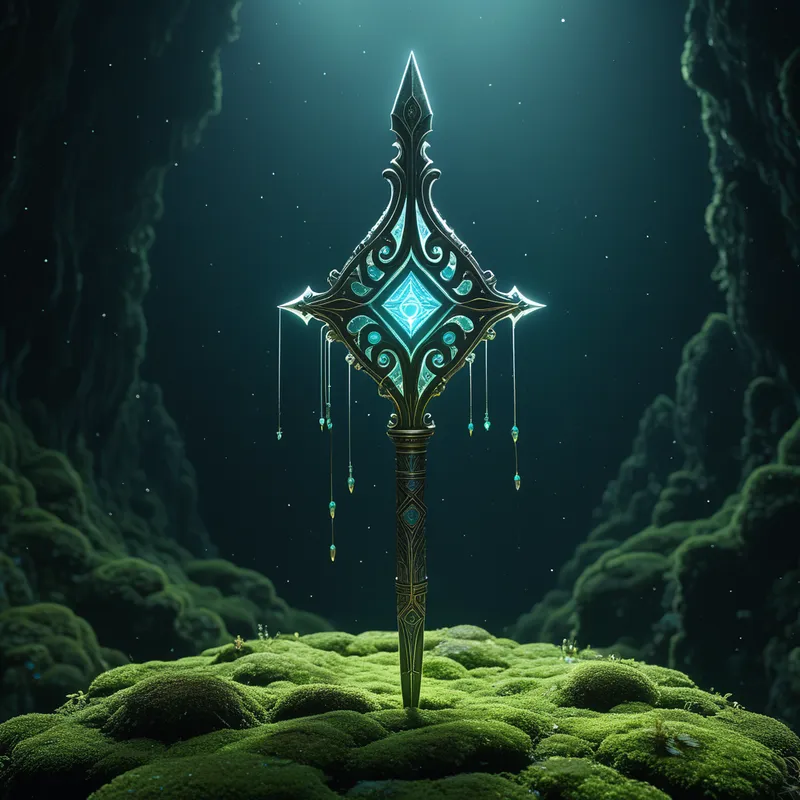
Then, generation upon generation, the divine multitude appeared, until the seventh pair, the ones charged with a great task. They were Izanagi-no-Mikoto and Izanami-no-Mikoto, given a jeweled spear, the Ame-no-nuboko. Standing upon the floating bridge of heaven, Ama-no-ukihashi, they looked down into the swirling brine below. Izanagi stirred the chaos with the spear. When he lifted it, the brine that dripped from its tip coagulated, thickened, and formed an island. This was Onogoro-shima.
They descended. On this first land, they erected a great pillar, the Ame-no-mihashira, and a palace. They performed the ritual of union, circling the pillar—Izanagi from the left, Izanami from the right. When they met, Izanami spoke first: "What a fine young man." Their union was flawed, and their firstborn was a leech-child, set adrift in a reed boat. The gods counseled them: the male must speak first. They circled the pillar again. This time, Izanagi spoke: "What a fine young woman." From this correct union, the eight great islands of Japan were born, then the deities of sea, wind, mountain, and field.
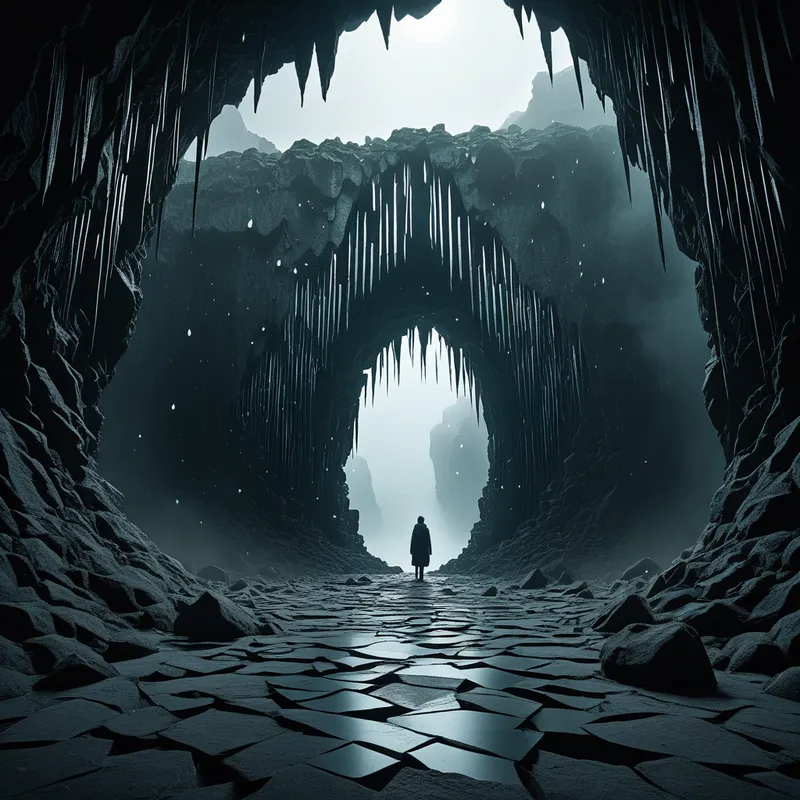
But in giving birth to the fire god, Kagutsuchi, Izanami was burned terribly. She descended to the land of Yomi. Grief-stricken, Izanagi pursued her. In the profound darkness, he heard her voice. "You have come too soon," she whispered. "I have eaten of the hearth of Yomi. Do not look upon me." But he, desperate, lit a tooth of his comb as a torch. The flame revealed her body, swollen and rotting, host to eight thunder deities. Horrified, Izanagi fled.
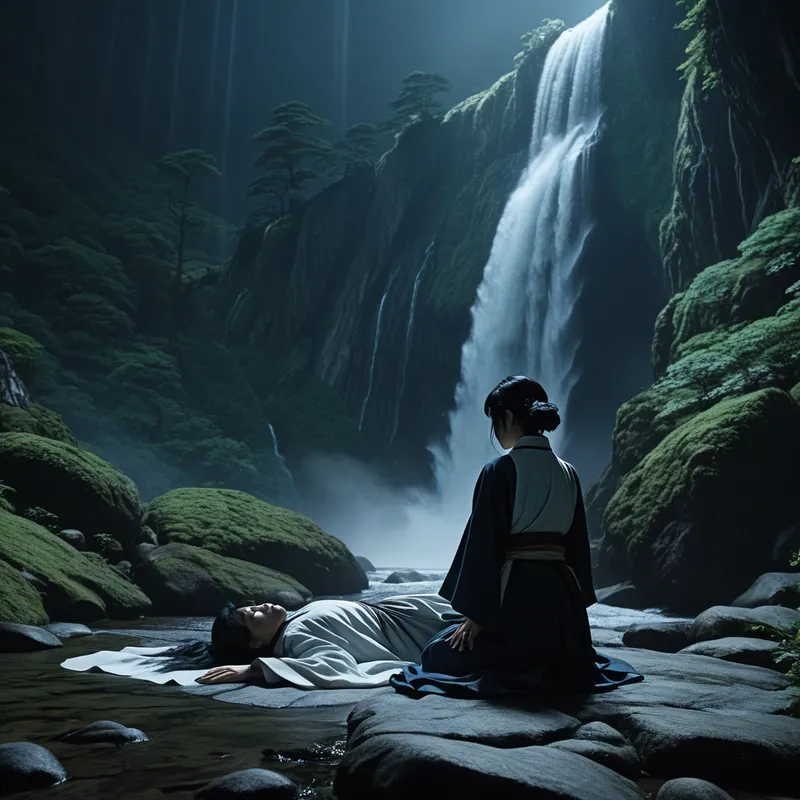
Enraged and shamed, Izanami, now a goddess of death, gave chase. Izanagi blocked the pass to Yomi with a massive boulder. From opposite sides, they spoke their final words, severing their bond. To purify himself from the pollution of death, Izanagi bathed in a river. As he washed, deities sprang from his discarded garments and the waters. From his left eye was born Amaterasu-Ōmikami, radiant and sovereign. From his right eye came Tsukuyomi-no-Mikoto, ruler of the night. From his nose burst Susanoo-no-Mikoto, tempestuous and wild. To Amaterasu, Izanagi gave the plain of heaven. The lineage of the gods, and thus the Japanese islands and people, was established.
Cultural Origins & Context
The Kojiki is not merely a storybook; it is a political and spiritual charter, compiled in 712 CE under the auspices of Empress Genmei. Its purpose was to codify and legitimize the imperial lineage by tracing it back, in an unbroken line, to the sun goddess Amaterasu. The myths were drawn from oral traditions recited by professional storytellers, the kataribe, who were the living memory of the clans. This creation narrative served to explain the origins of the Japanese archipelago (Kuniumi) and the divine nature of its ruling family, embedding the imperial institution within the very fabric of the cosmos. It established the foundational principle of Shinto: that the land itself is alive with sacred spirits, kami, born from the acts of the primordial deities. The myth provided a sacred history that connected the community to the land and the heavens, reinforcing social order through divine precedent.
Symbolic Architecture
The myth is a profound map of psychic emergence. The primordial chaos, Ame-tsuchi, represents the undifferentiated unconscious—a state of potential where all things are possible but nothing is distinct. The appearance of the solitary deities signifies the first stirrings of consciousness, the emergence of abstract principles from the formless deep.
The act of creation is not an explosion from nothing, but a differentiation from the everything of potential. The spear does not conjure land; it distinguishes it from the sea.
The jeweled spear, Ame-no-nuboko, is the instrument of this differentiation—a phallic symbol of focused intention that stirs the unconscious and brings forth form. The critical ritual around the pillar highlights the necessity of correct order and relationship for healthy creation. The first, failed union, where the female speaks first, produces a "leech-child"—a symbol of a creation that cannot stand, a regression back into formlessness. The successful ritual establishes the proper alignment of masculine and feminine principles, leading to the birth of a stable, structured world.
Izanami's descent into Yomi and Izanagi's subsequent flight represent the psyche's inevitable confrontation with death, decay, and the shadow. His purification in the river is a classic motif of catharsis and rebirth. From this act of cleansing, the most significant deities are born: the Sun (consciousness, order), the Moon (reflection, the unconscious), and the Storm (emotion, untamed energy). The self, having faced its own pollution, is now capable of generating a complex and dynamic psychic landscape.
The Dreamer's Resonance
When this myth resonates in modern dreams, it often signals a profound process of psychic (re)creation or a necessary confrontation with a foundational "pollution." Dreaming of a formless, swirling sea or fog may point to a life phase of utter potential but paralyzing lack of direction. The dreamer may feel adrift in the Ame-tsuchi of their own unlived life.
Dreams of failed rituals—a broken pillar, a speech given out of turn—can reflect a deep-seated sense that one's creative or relational foundations are flawed, producing only "leech-children": projects, relationships, or aspects of the self that are weak, dependent, and unable to thrive. The chase from the land of the dead is a potent somatic experience in dreams, often manifesting as being pursued by a once-loved figure now rendered terrifying, or by one's own shame or grief given monstrous form. This is the psyche forcing a confrontation with what has been repressed or left to rot in the personal Yomi. The final act of bathing, of washing away a profound stain, may appear in dreams as immersion in cleansing waters, shedding of skin or old clothes, or finally crossing a threshold into a bright, new space.
Alchemical Translation
The Kojiki creation myth is a precise alchemical manual for the individuation process. It begins in the massa confusa, the chaotic prima materia of the unexamined self. The first step is the emergence of the "Separate Heavenly Deities"—the initial, often abstract, insights or values that begin to orient the psyche.
Individuation requires the courage to stir the chaotic waters of the soul with the spear of inquiry, accepting that the first formations may be unstable.
The central alchemical operation is the conjunctio, the sacred marriage. The myth warns that this union must follow a correct, conscious order. Psychologically, this represents the integration of masculine and feminine aspects (animus and anima, logic and emotion, agency and receptivity) within the individual. A premature or disordered integration—where unconscious contents overwhelm the conscious attitude—leads only to malformed outcomes and deeper confusion.
The descent into Yomi is the essential nigredo, the blackening. It is the confrontation with one's personal shadow, with trauma, loss, and mortality. Izanagi's flight is not a failure but a necessary rupture; some realms of experience are ultimately incompatible with life and must be sealed off. The purification ritual is the albedo, the whitening. It is the conscious work of cleansing the psyche of the toxic identifications and pollutions gathered in the encounter with the shadow.
From this purification comes the true birth of the sovereign self. Amaterasu is the rubedo, the reddening—the emergence of a stable, radiant consciousness capable of ruling the inner realm. Tsukuyomi and Susanoo, the Moon and Storm, are then not enemies, but necessary siblings within a now-complex and dynamic totality. The individual is no longer a child of chaos but a creator in their own right, capable of generating light, weathering inner storms, and reflecting upon their own depths.
Associated Symbols
Explore related symbols from the CaleaDream lexicon:
- Ocean — The primordial, chaotic waters of Ame-tsuchi, representing the undifferentiated unconscious and the source of all potential form.
- Spear — The Ame-no-nuboko, the divine instrument that stirs chaos into order, symbolizing focused intention, masculine principle, and the act of differentiation.
- Bridge — The Ama-no-ukihashi, the celestial bridge connecting heaven and earth, representing the link between the divine and mortal, the conscious and unconscious realms.
- Pillar — The Ame-no-mihashira, the central axis around which creation turns, symbolizing world order, stability, and the sacred center where opposites meet.
- Fire — Embodied in Kagutsuchi, it represents both creative energy and destructive force, the necessary catalyst that also brings death and transformation.
- Cave — Symbolic of the Land of Yomi, the dark, subterranean realm of the dead and the shadow, where repressed or polluted aspects of the self reside.
- Purification — Izanagi's ritual bathing, representing the essential process of cleansing the psyche from the pollution of trauma, guilt, or shadow confrontation.
- Sun — Amaterasu-Ōmikami, the sovereign sun goddess born from purification, symbolizing radiant consciousness, clarity, order, and the ruling principle of the enlightened self.
- Moon — Tsukuyomi-no-Mikoto, born alongside the sun, representing reflection, the cyclical nature of the unconscious, and the receptive, illuminating quality of introspection.
- Storm — Susanoo-no-Mikoto, the impetuous deity, symbolizing raw emotion, chaotic energy, creative destruction, and the untamed forces that must be integrated into the whole.
- Death — The transformation of Izanami and the realm of Yomi, representing necessary endings, the decay of old forms, and the fertile ground from which new consciousness springs.
- Shinto Shrine — The architectural manifestation of the myth's outcome: a sacred space where kami are honored, representing the established order, purity, and the ongoing connection between the human and divine worlds.