The Key of Hecate - Greek godd Myth Meaning & Symbolism
A myth of the goddess Hecate granting a mortal a key to navigate the crossroads of life, death, and the unconscious, demanding absolute courage.
The Tale of The Key of Hecate - Greek godd
Listen, and hear the tale whispered where three roads meet, under a moon that is both full and dark. The air here tastes of iron, of cold soil, and of the ozone that comes before a soul’s storm. This is the domain of Hecate, she of the triple form, who sees what was, what is, and what may yet be. She is the keeper of the thresholds, the one who holds the lantern in the absolute dark between worlds.
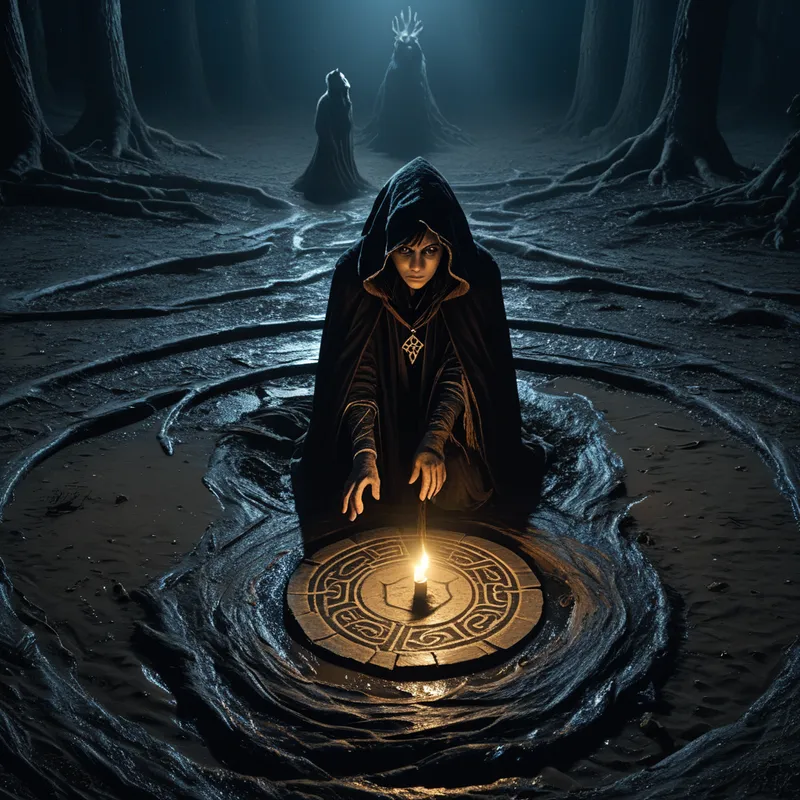
It is told that in a time when the veil was thin as a dying breath, a mortal came to such a crossroads. Not a hero seeking glory, but a soul shattered by fate—a mother who had outlived her child, a warrior who had forgotten the reason for the fight, a seeker who had found only emptiness at the end of every path. They came with nothing but a question that burned like a coal in their chest, a question with no language. They fell to their knees in the sucking mud, the wind howling a dirge through the bare, twisted trees.
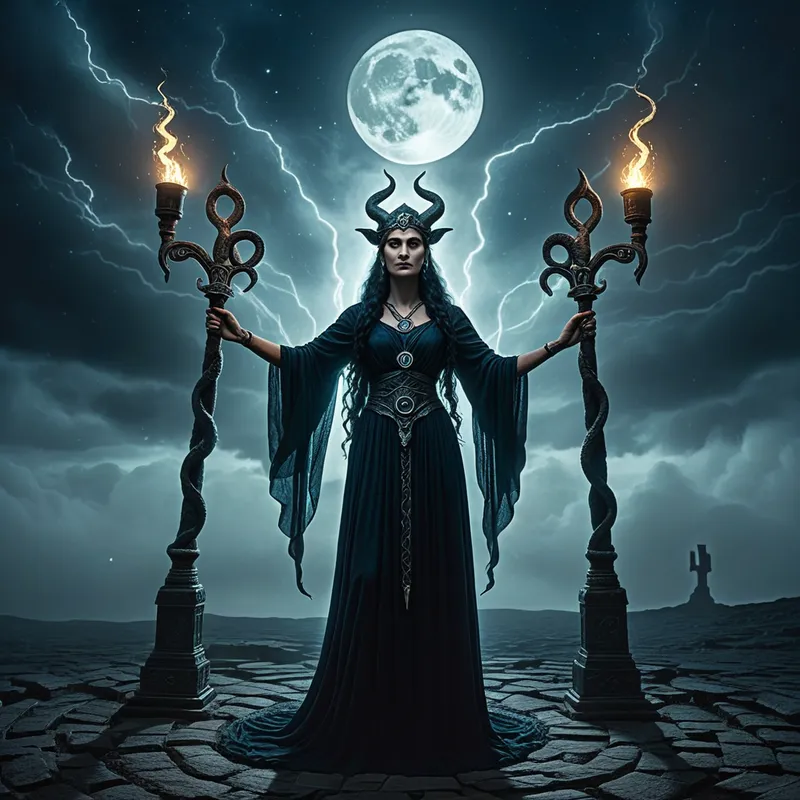
Then, the light changed. Not the light of the hidden moon, but a colder, greener luminescence that rose from the very earth. The shadows at the junction of the three paths deepened, coalesced, and took form. Or rather, three forms. There stood Hecate. To the left, the face of the Crone, etched with the runes of all endings. To the right, the face of the Mother, holding the potential of all beginnings. And central, facing the mortal, the face of the Maiden, eternal and severe, holding a torch that cast no warmth, only revelation.
No words passed in the mortal tongue. The air thrummed with a silent command: Choose. But the roads were identical in their darkness. To choose one was to forsake the other two selves, the other two destinies. The mortal’s breath came in ragged gasps, the terror of absolute freedom a physical weight. In that moment of perfect paralysis, of total surrender to not-knowing, the central figure of Hecate extended a hand.
Not with a torch, or a dagger, or a cup. But with a Key.
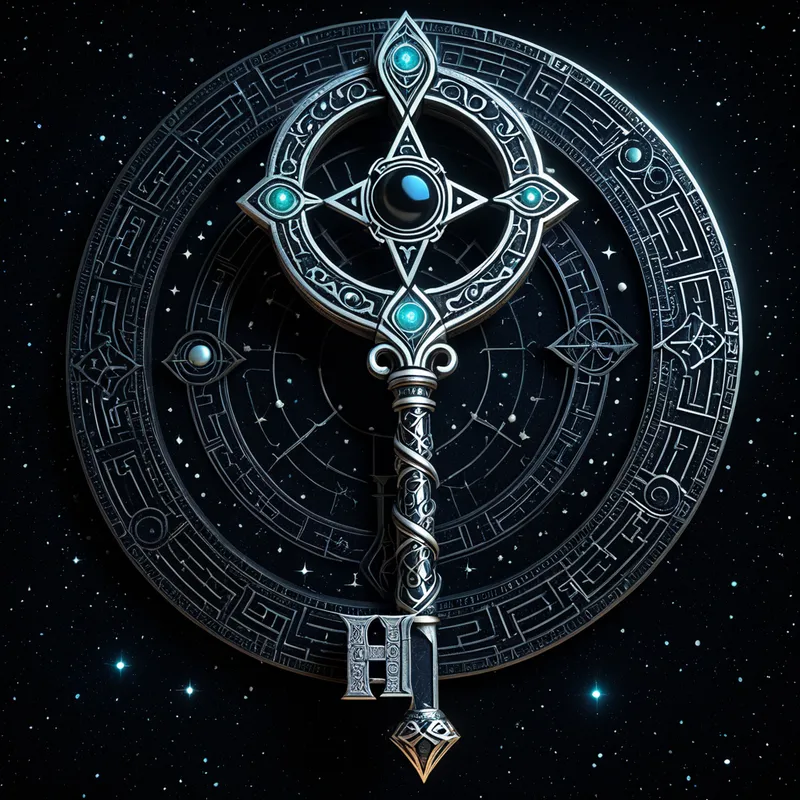
It was forged of black iron, yet it shimmered. Its bow was shaped like the triple moon itself. Its teeth were intricate, complex, like the map of a labyrinth or the skeleton of a forgotten star. It was offered, not given. To take it was to accept a burden far greater than any answer. The mortal’s hand, trembling, closed around the cold metal. At its touch, a shock, silent and seismic, passed through their being. They did not see the roads change. They felt them. One path thrummed with the grief of the past, heavy and sweet as burial spices. One vibrated with the sharp anxiety of the future, all branching possibilities. One was simply the stark, solid reality of the present mud and stone.
The Key was not for a door on any one road. It was for the lock that existed at the very point where all three intersected—the lock on the self. The goddess’s three faces watched, impassive. The choice remained, but now the mortal held the instrument. They could turn it within. With a sound like a mountain sighing, the crossroads themselves seemed to turn around the kneeling figure. The mortal stood, no longer kneeling, the Key now a part of their hand, their heart, their sight. Hecate and her torchlight faded, dissolving back into the mist from which they came, leaving the figure alone at the center, possessed of the terrible, liberating knowledge that all paths were now open, and all were theirs to walk.
Cultural Origins & Context
The figure of Hecate originates in the complex strata of ancient Greek religion, with possible roots in Anatolian mother-goddess cults. She was a unique and potent figure, worshipped not in grand daytime temples but at household shrines and, most significantly, at liminal spaces—crossroads, city gates, and tombs. Her myth was not a single, canonical epic like those of Zeus or Achilles. It was a living tradition passed down through the practices of “wise women,” midwives, and those who dealt with the unseen. The “Key of Hecate” is a powerful symbolic motif that emerges from her iconography and hymns, where she is often titled Kleidouchos, the “Key-Holder.”
This mythic motif functioned as a societal and psychological anchor. In a world defined by rigid boundaries—city/wilderness, life/death, conscious/unconscious—Hecate and her Key governed the transitions. The story was told to explain the experience of profound crisis, where one’s old identity dies but a new one is not yet born. It served as a sacred map for navigating trauma, spiritual initiation, and the “crossroads” decisions that define a life. It was a myth for the edges of society and the psyche, offering a model of power that came not from domination, but from understanding and navigating thresholds.
Symbolic Architecture
The Key is the central symbol, and it is profoundly multivalent. It is not a weapon, but a tool of access. It represents the power to unlock hidden knowledge, but also the responsibility that comes with it. The three roads are the classic Hecatean trinity: Past, Present, and Future; or alternatively, the three realms she influences—Earth, Sky, and Underworld. Psychologically, they represent the competing narratives of our lives: the burdens of memory, the demands of current reality, and the pull of aspiration or fear.
The true crossroads is not outside, but within. The Key does not open a gate in the world; it unlocks the chamber where the world is dreamed.
The mortal’s paralysis is crucial. It represents the ego’s breakdown, the necessary dissolution of the conscious personality that precedes contact with the deeper, guiding archetype (Hecate as the Senex or Wise Woman). Receiving the Key is an act of grace, but only after the ego surrenders its illusion of control. Hecate herself symbolizes the unified Self that can hold these triple perspectives without conflict. She is the archetypal guardian of the unconscious, and her gift is the capacity for discernment—not choosing the “right” path, but understanding the nature of all paths from a higher vantage point.
The Dreamer's Resonance
When this myth stirs in the modern dreamer, it signals a profound somatic and psychological process of liminality. The dreamer may find themselves at literal crossroads, before multiple doors, or holding a strange, heavy key. The somatic feeling is often one of anxious anticipation, a “pit of the stomach” dread mixed with awe.
Psychologically, this dream pattern emerges during life transitions so deep they constitute a psychic death and rebirth: the end of a defining relationship, a career collapse, a spiritual awakening, or the integration of a major trauma. The dreamer is the mortal in the mud—their old identity has crumbled, and the conscious mind (the ego) is terrified and directionless. The appearance of the Key, or the triune goddess figure, signifies the activation of the Self, the central archetype of wholeness, beginning to provide tools from the unconscious. The process is one of moving from paralysis to empowered choice, but a choice based on inner authority rather than external pressure. The dream is a snapshot of the psyche offering itself the means of its own liberation.

Alchemical Translation
The alchemical process mirrored here is the Nigredo, the blackening, the descent into the primal mud of the crossroads. This is the necessary first stage of individuation—the confrontation with the shadow and the utter dissolution of outdated personality structures. The mortal’s despair is the massa confusa, the chaotic first matter.
Hecate, as the archetypal guide, represents the latent wisdom of the unconscious that emerges during this crisis. Her Key is the symbol of the Albedo, the illuminating insight that follows the darkness. It is the “philosophical stone” in its functional form—the tool that transmutes base confusion into conscious understanding.
The alchemy occurs not when you find the door, but when you realize you are the door, and the Key has been within the lock all along.
For the modern individual, the myth models the journey from victimhood to sovereignty. The triumph is not a heroic slaying, but a humble receiving and a courageous turning inward. The “Key” we must forge and accept is the capacity to hold multiple, contradictory truths about ourselves (our past wounds, present limitations, future potentials) without being shattered by them. It is the psychic function that allows us to navigate life’s inevitable crossroads not with fear, but with the solemn power of one who knows that every end is a threshold, and every threshold holds the potential for a new, more integrated beginning. We become, in our small human way, key-holders at our own crossroads.
Associated Symbols
Explore related symbols from the CaleaDream lexicon: