The Journey of the Soul Rumi
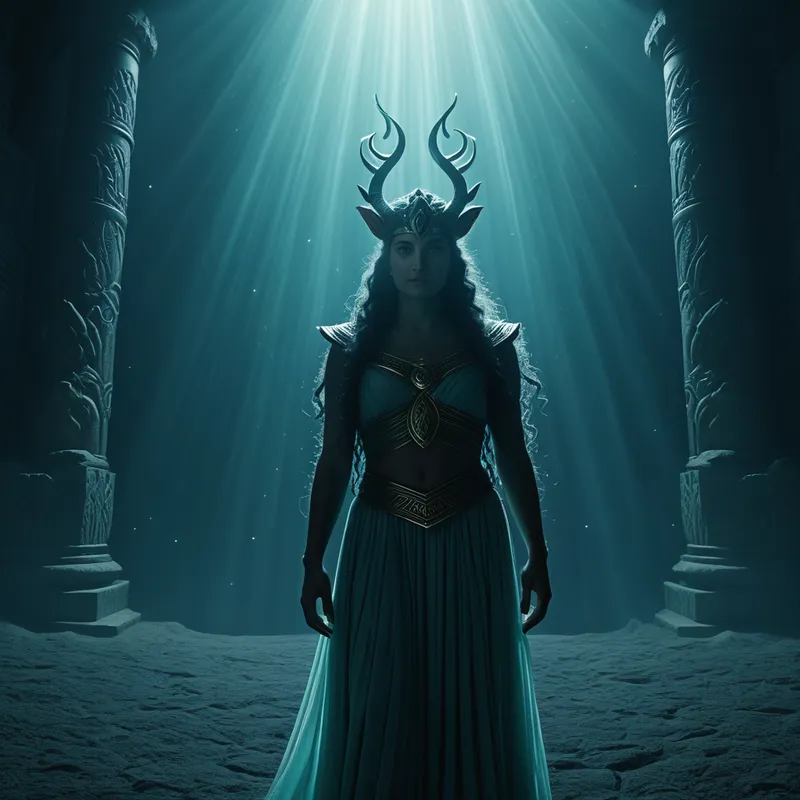
Rumi's mystical poetry traces the soul's transformative journey toward divine love and union, blending Persian wisdom with Sufi spiritual insight.
The Tale of The Journey of the Soul Rumi
The tale begins not with a birth, but with a shattering. Mawlana Jalal-ud-Din Rumi, a respected scholar of law and theology in 13th-[century](/myths/century “Myth from Biblical culture.”/) Anatolia, walked a well-ordered path of intellect and piety. His soul was a polished vessel, yet empty of the wine it was meant to hold. The catalyst for the journey arrived in the wild, ecstatic form of Shams of Tabriz, a wandering dervish whose eyes were mirrors reflecting only the sun of the divine. Shams did not teach Rumi; he ignited him. He asked questions that burned away the foundations of mere knowledge, plunging Rumi into a spiritual crisis so profound it was a kind of [death](/myths/death “Myth from Tarot culture.”/). The disappearance and murder of Shams completed the rupture. Rumi’s grief was oceanic, but it was not an end—it was [the womb](/myths/the-womb “Myth from Various culture.”/) of his becoming.
From this abyss, poetry began to pour forth like a river breaking through a dam. His soul, now a nay (reed flute), sang of its separation from the divine reed-bed. In the Masnavi, his six-volume spiritual epic, he wove tales of merchants and kings, beggars and lovers, each a delicate shell containing the [pearl](/myths/pearl “Myth from Chinese culture.”/) of a deeper truth. The soul’s journey was depicted as a lover’s frantic search for the Beloved, a drunkard’s stumble toward the tavern, a nightingale’s endless lament for [the rose](/myths/the-rose “Myth from Persian culture.”/). He sang of the moth consumed by the candle’s flame, not as annihilation, but as the ultimate, joyous reunion. The journey was one of relentless stripping away—of ego, of certainty, of the very self that claims to seek. It was a dance where the dancer vanishes into the dance.
Rumi’s final union was not a destination announced with fanfare, but a silent merging. When he passed from this world, his funeral was attended by mourners of all faiths. It was said [the sky](/myths/the-sky “Myth from Persian culture.”/) itself wept. His tomb in Konya, the Green Dome, became not a monument to a dead man, but a doorway for the living—a testament that the journey of the soul he charted was eternally open, a path of burning love leading from the fragile human heart back to the ocean of the divine.
Cultural Origins & Context
Rumi’s mythology is born at the confluence of profound cultural streams. He was a Persian poet, writing in the lyrical tradition that gave [the world](/myths/the-world “Myth from Tarot culture.”/) Hafez and Saadi, yet his spiritual home was the mystical dimension of Islam: Sufism. In the 13th century, the Islamic world was a crucible of philosophical exchange, and Sufism served as its mystical heart, emphasizing tawhid (the oneness of God) not as a theological concept, but as an experiential reality to be lived.
The socio-political landscape was one of tumult, with the Mongol invasions decimating centers of learning in the East. This context of [impermanence](/myths/impermanence “Myth from Buddhist culture.”/) and loss seeped into the spiritual seeking of the age. Sufi orders (tariqas) like the Mevlevi, which formed around Rumi’s teachings, provided a structured yet fluid path (suluk) for the soul’s journey. Practices such as the whirling dance (sama), for which Rumi’s followers became famous, were not performances but embodied prayers, a means to turn from [the ego](/myths/the-ego “Myth from Jungian culture.”/) and revolve around the divine center.
Rumi’s work is also a dialogue with the Quranic universe. His metaphors of wine, the beloved, and the tavern are deeply rooted in the Sufi exegetical tradition, where worldly images are transmuted into symbols of spiritual intoxication, divine beauty, and the heart as the place of revelation. He stood as a bridge, translating the austere principles of law (sharia) into the passionate language of the inner truth (haqiqa), making the soul’s journey accessible to all who could hear the music beneath the words.
Symbolic Architecture
Rumi’s entire cosmology is a symbolic [architecture](/symbols/architecture “Symbol: Architecture in dreams often signifies structure, stability, and the framing of personal identity or life’s journey.”/) designed to dismantle the [seeker](/symbols/seeker “Symbol: A person actively searching for meaning, truth, or a higher purpose, often representing the dreamer’s own quest for identity or fulfillment.”/)’s ordinary [perception](/symbols/perception “Symbol: The process of becoming aware of something through the senses. In dreams, it often represents how one interprets reality or internal states.”/). At its center is the [paradox](/symbols/paradox “Symbol: A contradictory yet true concept that challenges logic and perception, often representing unresolved tensions or profound truths.”/) of [separation](/symbols/separation “Symbol: A spiritual or mythic division between realms, states of being, or consciousness, often marking a transition or loss of connection.”/) and unity. The [soul](/symbols/soul “Symbol: The soul represents the essence of a person, encompassing their spirit, identity, and connection to the universe.”/) is portrayed as exiled, yet that [exile](/symbols/exile “Symbol: Forced separation from one’s homeland or community, representing loss of belonging, punishment, or profound isolation.”/) is the necessary [condition](/symbols/condition “Symbol: Condition reflects the state of being, often focusing on physical, emotional, or situational aspects of life.”/) for the [journey](/symbols/journey “Symbol: A journey in dreams typically signifies adventure, growth, or a significant life transition.”/) of longing that leads it home.
“You are not a drop in the ocean. You are the entire ocean in a drop.” This famous distillation captures the core Sufi doctrine of the microcosm. The human soul is not a fragment cast off from God, but a focal point containing the whole of the divine reality, obscured by the veil of the ego-self (nafs).
The figure of the Beloved is the master [symbol](/symbols/symbol “Symbol: A symbol can represent an idea, concept, or belief, serving as a powerful tool for communication and understanding.”/). It is simultaneously the [human](/symbols/human “Symbol: The symbol of a human represents individuality, complexity of emotions, and social relationships.”/) [friend](/symbols/friend “Symbol: A friend in dreams often represents companionship, connection, and the desire for social support, reflecting aspects of our interactions and relationships in waking life.”/) (Shams), the abstract ideal of [beauty](/symbols/beauty “Symbol: This symbol embodies aesthetics, harmony, and the appreciation of life’s finer qualities.”/), and the ultimate Divine [Reality](/symbols/reality “Symbol: Reality signifies the state of existence and perception, often reflecting one’s understanding of truth and life experiences.”/). This [ambiguity](/symbols/ambiguity “Symbol: A state of uncertainty or multiple possible meanings, often found in abstract art and atonal music where clear interpretation is intentionally elusive.”/) is intentional, blurring the lines between [human](/symbols/human “Symbol: The symbol of a human represents individuality, complexity of emotions, and social relationships.”/) and divine love to show that the former is a [gateway](/symbols/gateway “Symbol: A threshold between states, representing transition, opportunity, or initiation into new phases of life or consciousness.”/) to the latter. The Tavern is the ruin where respectable ego is shattered by the [wine](/symbols/wine “Symbol: Wine often symbolizes celebration, indulgence, and the deepening of personal connections, but it can also represent excess and escape.”/) of divine [knowledge](/symbols/knowledge “Symbol: Knowledge symbolizes learning, understanding, and wisdom, embodying the acquisition of information and enlightenment.”/), and the [Moth](/symbols/moth “Symbol: The moth is a symbol of transformation, intuition, and exploration, representing a journey towards enlightenment and the desire for freedom.”/) and [Candle](/symbols/candle “Symbol: Candles symbolize illumination, hope, and spiritual guidance, often representing the light within amidst darkness.”/) enact the soul’s willing annihilation (fana) in the fire of love to achieve abiding subsistence (baqa) in God.
The [Reed](/symbols/reed “Symbol: A flexible plant symbolizing resilience, adaptability, and vulnerability. It bends without breaking, representing survival through yielding.”/) [Flute](/symbols/flute “Symbol: The flute epitomizes elegance and grace, often symbolizing harmony, beauty, and spirituality.”/) (nay), with its plaintive cry, symbolizes the soul incarnate—hollowed out by separation, its [music](/symbols/music “Symbol: Music in dreams often symbolizes the harmony between the conscious and unconscious mind, illustrating emotional expression and communication.”/) born of the ache for its [source](/symbols/source “Symbol: The origin point of something, often representing beginnings, nourishment, or the fundamental cause behind phenomena.”/). The Mill, grinding [grain](/symbols/grain “Symbol: Represents sustenance, growth cycles, and the foundation of civilization. Symbolizes life’s harvest, patience, and transformation from seed to nourishment.”/), represents the grind of earthly suffering that, if endured with patience and love, produces the fine flour of wisdom. This is not a symbolic [system](/symbols/system “Symbol: A system represents structure, organization, and interrelated components functioning together, often reflecting personal or social order.”/) to be decoded intellectually, but one to be inhabited, felt, and ultimately, transcended.
The Dreamer’s Resonance
For the modern dreamer, adrift in a world of fragmentation and hyper-rationality, Rumi’s mythology resonates as a profound map of inner wholeness. His journey speaks directly to the [psyche](/myths/psyche “Myth from Greek culture.”/)’s innate movement toward integration. The initial “shattering” by Shams mirrors those unexpected life events—loss, crisis, profound encounter—that break open our carefully constructed personas, forcing a deeper, more authentic self to the surface.
The central tension between longing and union addresses the core human condition of incompleteness. In psychological terms, Rumi’s “Beloved” can be understood as [the Self](/myths/the-self “Myth from Jungian culture.”/) in the Jungian sense—the total, integrated psyche, [the divine spark](/myths/the-divine-spark “Myth from Gnostic culture.”/) within. The restless yearning he describes is the ego’s pilgrimage toward this greater Self. His poetry legitimizes grief, confusion, and passionate desire not as obstacles to spirituality, but as its very fuel. It gives sacred language to [the dark night of the soul](/myths/the-dark-night-of-the-soul “Myth from Christian Mysticism culture.”/), reframing it as a necessary passage, not a pathological state.
Furthermore, his embodiment of the journey through dance and poetry offers a corrective to purely cerebral spirituality. It suggests that the soul’s transformation requires the whole being—body, heart, and mind. The dreamer finds in Rumi permission to feel deeply, to embrace paradox, and to see their personal wounds and joys as part of a universal, archetypal motion toward love.

Alchemical Translation
The alchemical process—[nigredo](/myths/nigredo “Myth from Alchemical culture.”/), [albedo](/myths/albedo “Myth from Alchemical culture.”/), [rubedo](/myths/rubedo “Myth from Alchemical culture.”/)—finds a precise echo in Rumi’s journey of the soul. The meeting with Shams and the ensuing crisis is the nigredo, the blackening, the dissolution of the old scholarly identity (the [prima materia](/myths/prima-materia “Myth from Alchemical culture.”/)). It is a descent into [chaos](/myths/chaos “Myth from Greek culture.”/) and grief, where all certainties are burned away.
“The wound is the place where the Light enters you.” This is the albedo, the whitening. The raw pain of separation is not avoided but purified into a luminous longing. The ego, stripped of its pretensions, becomes a clean vessel. Rumi’s poetry itself is the product of this stage—the silver tears of the moon distilled into verse.
Finally, the ecstatic verses of union and the continuous practice of love as embodied in the whirling dance represent the rubedo, the reddening, the creation of the philosopher’s stone. Here, the transformed soul achieves the [coniunctio oppositorum](/myths/coniunctio-oppositorum “Myth from Alchemical culture.”/)—the marriage of human and divine, lover and Beloved. The base metal of the separate self is transmuted into the gold of conscious unity. The alchemy is not of lead to gold, but of the leaden, isolated heart into a heart that has become a crucible for, and mirror of, divine love. The journey is the alchemical work, and love is both the fire and the gold.
Associated Symbols
Explore related symbols from the CaleaDream lexicon:
- Soul — The eternal essence on a pilgrimage from separation to divine union, characterized by its profound longing and capacity for transformation.
- Journey — The essential motion of the spirit away from the illusion of separation and toward the reality of wholeness, often fraught with necessary suffering and revelation.
- Love — The consuming fire that is both the path and the destination, annihilating the ego and revealing the fundamental unity of all existence.
- Beloved — The ultimate object of longing, a symbol that shimmers between human intimacy and the absolute presence of the Divine.
- Fire — The transformative agent of divine love that burns away the dross of the false self to reveal the pure gold of the true soul.
- Ocean — The boundless, undifferentiated reality of the Divine from which the soul-as-drop originates and to which it yearns to return.
- Dance — The embodied prayer of surrender, where spinning in ritual movement symbolizes the soul revolving around the still center of God.
- Cup — [The vessel](/myths/the-vessel “Myth from Alchemical culture.”/) of the heart, which must be emptied of self to be filled with the intoxicating wine of divine knowledge and love.
- Death — Not an end, but the necessary dissolution of the ego required for spiritual rebirth and true union with the eternal.
- Mirror — The polished heart that, when cleansed of the rust of worldly attachment, perfectly reflects the beauty and attributes of the Divine.
- Reed Flute — The human soul, made hollow and sorrowful by its exile from the divine source, whose only music is the beautiful lament of separation.
- Transformation Cocoon — The dark, confining period of spiritual crisis and dissolution that secretly prepares the soul for its winged emergence into a new state of being.