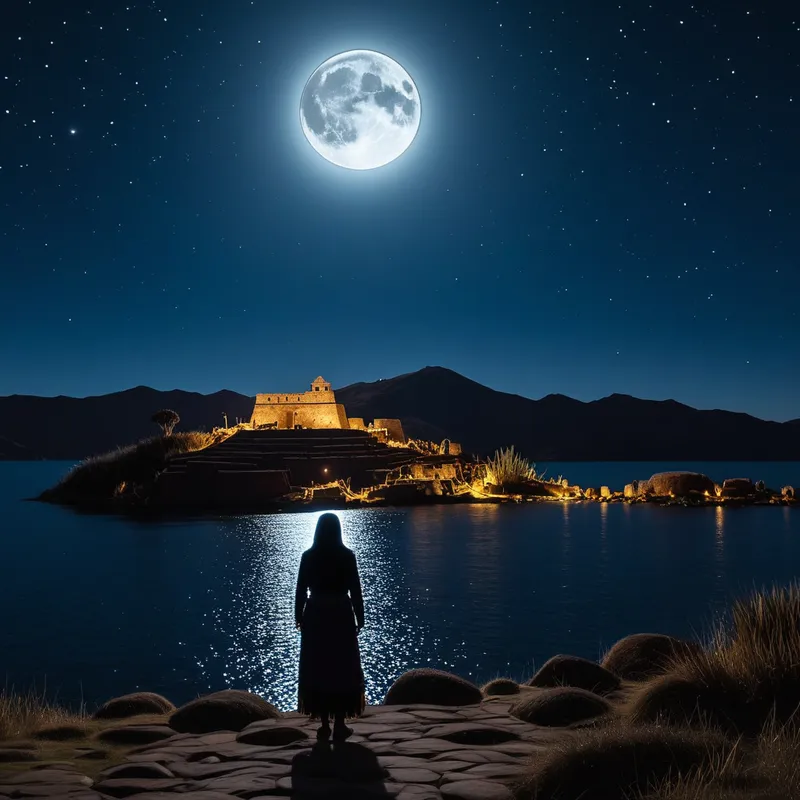
The Island of the Moon Myth Meaning & Symbolism
A sacred Incan myth of the Moon Goddess retreating to an island, creating a mirror of silver light that reveals the soul's hidden depths.
The Tale of The Island of the Moon
Listen. In the time when the world was woven from light and stone, when the breath of [Viracocha](/myths/viracocha “Myth from Incan culture.”/) still hummed in the wind, there existed a silence so profound it was a presence. This was the silence of Mama Killa. She, the Queen of the Night, the Measurer of Time, the Silver Mother, walked the heavens with a heavy heart. Her light, though beautiful, was a borrowed glow, forever chasing the blazing, undeniable radiance of her brother and husband, Inti.
Her domain was the realm of dreams, of tides, of the hidden cycles within women and within the earth. Yet in the court of the sun, her voice was a whisper against a roar. Her wisdom—the wisdom of the unseen, the intuitive, the reflective—was overshadowed. The people, the children of Inti, the Tawantinsuyu, raised their faces to the day, building empires of gold and order in his name. They honored her, yes, with silver offerings, but their worship was a pale reflection of the solar fervor reserved for Inti and his son, the Sapa Inca.
One night, as the Milky Way, the Mayu, spilled across the black sky, Mama Killa looked down upon the great mirror of the world, Titicaca. In its dark, still waters, she saw not her own face, but the perfect, cold echo of her loneliness. A resolve, hard and clear as a quartz crystal, formed within her. She would not compete. She would not plead. She would retreat.
Gathering her silver light, she descended not as a bolt, but as a slow, mournful rain of luminous mist. She touched the sacred waters of the lake, and where her essence met the deep, an island began to rise. Not an island of rugged stone like the sun’s creations, but one of luminous, pearlescent rock that drank the starlight. It was the Koati. Here, she built her temple not with hands, but with will—a sanctuary of pure, reflective silence.
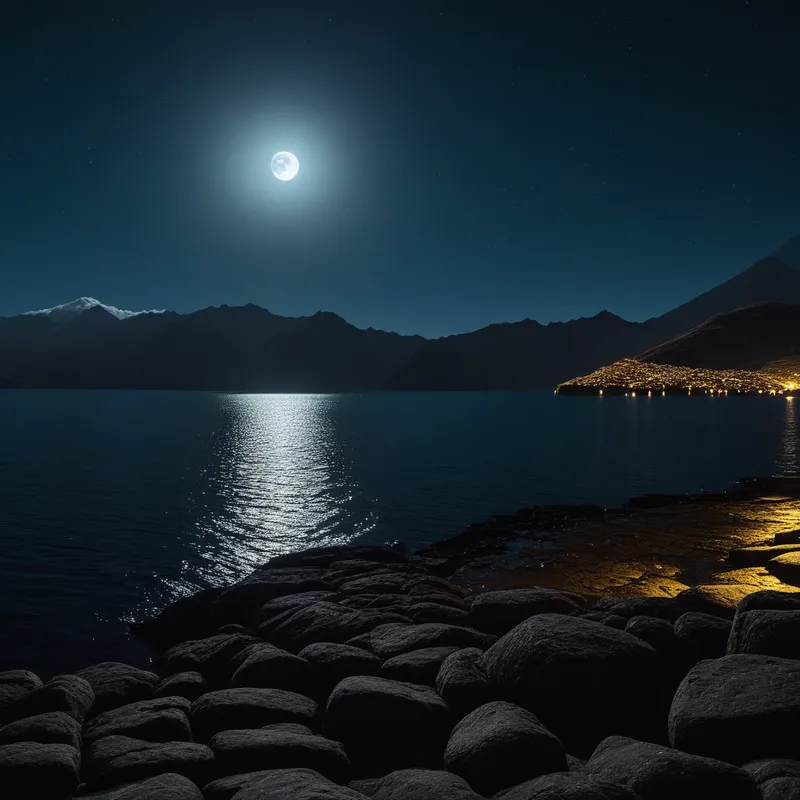
She cast her most potent magic upon the waters surrounding her island. They became a mirror, not of surface appearances, but of the soul. Any who dared approach, drawn by the island’s eerie beauty, would see not the island, but the truth of their own hearts reflected back—their hidden fears, their unacknowledged loves, their deepest shames and most secret beauties. For most, it was a vision too terrible, too intimate, to bear. They would flee, speaking of haunted waters and a goddess of madness.
The Sapa Inca, hearing of this challenge to the solar order, sent his bravest warriors and his most cunning priests. Their golden barges set out under the new moon, a time of darkness they thought would cloak their approach. But as they neared the invisible boundary, the blank waters suddenly glowed. Each man saw himself reflected, not as a hero of the empire, but as a vulnerable, mortal child; a jealous brother; a fearful son. The armada scattered in panic, their discipline shattered by self-revelation.
And so, the Island of the Moon stood, and stands still, in the center of the sacred lake. A realm apart. A testament that some truths are too potent for the full light of day, requiring the gentle, revealing glow of the moon to be seen. Mama Killa, in her retreat, did not diminish. She became complete. She became the sovereign of the interior world, and her island remains the ultimate huaca of reflection, where one does not find the goddess, but finds oneself.
Cultural Origins & Context
The myth of the Island of the Moon is intrinsically tied to the Isla de la Luna or Koati, an actual, sacred island on the Bolivian side of Lake Titicaca. For the Inca, and likely for the pre-Incan Tiwanaku cultures, this was not merely a story but a topographic myth—a narrative embedded in the landscape itself. The island housed a significant aqllawasi (House of the Chosen Women), where acllas (chosen women) dedicated to the service of Mama Killa lived, weaving sacred textiles and brewing chicha (ceremonial beer) for rituals.
The myth served multiple societal functions. Firstly, it established a divine geography, explaining the sacredness of specific locations in the Tawantinsuyu. Secondly, it validated the important, yet separate, sphere of feminine religious and social power, embodied by the acllas and the Coya, the principal wife of the Sapa Inca. The story was likely passed down through oral tradition by hamut’aq (wise men/sages) and the acllas themselves, especially during nighttime rituals and women’s rites. It functioned as a balance to the overwhelmingly solar, masculine state mythology, preserving a space for the intuitive, cyclical, and reflective principles essential to the cosmological whole.
Symbolic Architecture
At its core, this myth is not about [abandonment](/symbols/abandonment “Symbol: A dream symbol representing feelings of being left behind, isolated, or emotionally deserted, often tied to primal fears of separation and loss of support.”/), but about the necessary [separation](/symbols/separation “Symbol: A spiritual or mythic division between realms, states of being, or consciousness, often marking a transition or loss of connection.”/) for individuation. Mama Killa’s retreat is not a defeat; it is a profound act of self-definition. The [island](/symbols/island “Symbol: An island represents isolation, self-reflection, and the need for separation from the external world.”/) symbolizes the psyche itself—a distinct, separate entity that must be delineated from the overwhelming “other” (the solar [consciousness](/symbols/consciousness “Symbol: Consciousness represents the state of awareness and perception, encompassing thoughts, feelings, and experiences.”/), the collective, the [persona](/symbols/persona “Symbol: The social mask or outward identity one presents to the world, often concealing the true self.”/)) to exist authentically.
The true mirror does not show you what you wish to be, but what you are in the silent places where no sun shines.
The silver light of the [moon](/symbols/moon “Symbol: The Moon symbolizes intuition, emotional depth, and the cyclical nature of life, often reflecting the inner self and subconscious desires.”/) represents reflective consciousness—not the active, analytical light of the sun, but the passive, receptive light that reveals [shadow](/symbols/shadow “Symbol: The ‘shadow’ embodies the unconscious, repressed aspects of the self and often represents fears or hidden emotions.”/). The waters around the island are the personal unconscious. The terrifying, revealing [reflection](/symbols/reflection “Symbol: Reflection signifies self-examination, awareness, and the search for truth within oneself.”/) is the confrontation with the [Shadow](/symbols/shadow “Symbol: The ‘shadow’ embodies the unconscious, repressed aspects of the self and often represents fears or hidden emotions.”/). The warriors who flee are the ego, terrified of seeing its own incomplete, conflicted [nature](/symbols/nature “Symbol: Nature symbolizes growth, connectivity, and the primal forces of existence.”/). The island, therefore, becomes a [symbol](/symbols/symbol “Symbol: A symbol can represent an idea, concept, or belief, serving as a powerful tool for communication and understanding.”/) of the Self, a place of [integration](/symbols/integration “Symbol: The process of unifying disparate parts of the self or experience into a cohesive whole, often representing psychological wholeness or resolution of internal conflict.”/) that can only be reached by crossing the waters of the unconscious and enduring the mirror’s gaze.
Psychologically, Mama Killa represents the [anima](/symbols/anima “Symbol: The feminine archetype within the male unconscious, representing soul, creativity, and connection to the inner world.”/) in its most developed form—not as a [projection](/symbols/projection “Symbol: The unconscious act of attributing one’s own internal qualities, emotions, or shadow aspects onto external entities, people, or situations.”/) onto another, but as an internal, sovereign function of relating to the inner world. Her initial state, overshadowed by Inti, mirrors the common psychic [condition](/symbols/condition “Symbol: Condition reflects the state of being, often focusing on physical, emotional, or situational aspects of life.”/) where inner, feeling values are dominated by outer, achieving drives.
The Dreamer’s Resonance
When this myth pattern stirs in the modern dreamer, it often signals a profound need for psychic retreat and self-reflection. Dreaming of a distant, luminous island across dark water points to a nascent, glowing potential within the Self that feels inaccessible. The dream ego may be on the “mainland” of daily life—over-identified with the “solar” principles of work, persona, and extroversion—feeling a deep longing for the “lunar” qualities of introspection, emotion, and soul.
The somatic experience can be one of quiet yearning, a fatigue with external striving, or a feeling of being “overshadowed” by others or by one’s own overactive mind. To dream of attempting the crossing but being turned back by a frightening reflection indicates active resistance to shadow-work. The mirror shows what the conscious ego has refused to acknowledge: buried grief (Grief), unexpressed creativity, or a neglected aspect of one’s identity. The myth manifests in dreams as a call to build one’s own interior sanctuary, to value reflective silence over noisy action, and to dare to look into the soul’s mirror.

Alchemical Translation
The alchemical process modeled here is separatio followed by solutio—separation and dissolution. The first step, Mama Killa’s journey to the island, is the separatio: the conscious differentiation of the soul’s values from the dominant, collective consciousness. One must withdraw psychic energy (libido) from outer pursuits to invest it in the inner world. This is often experienced as depression, listlessness, or a “dark night of the soul,” but it is the essential precondition for transformation.
The island is not reached by conquest, but by surrender to the journey across the dark.
The second step is the mirror’s revelation—the solutio. This is the dissolution of the ego’s rigid self-image in the waters of truth. The golden warriors, symbols of the ego’s defenses and pride, are dissolved not by an enemy, but by self-knowledge. This is the alchemical “washing” where the materia prima (the crude psyche) is purified by honest self-confrontation.
The ultimate goal is not to bring the island back to the mainland, but to establish a constant, living connection between the two. For the modern individual, this means achieving a state where the solar principle of action in the world is informed and tempered by the lunar principle of inner reflection. The triumph is a psyche in balance, where one can act (Inti) with power, but from a center that knows itself (Mama Killa). The individual becomes their own sovereign, residing in the integrated Self, which contains both the shining sun and the reflective moon.
Associated Symbols
Explore related symbols from the CaleaDream lexicon:
- Moon — The central archetype of reflective consciousness, cyclical time, the feminine, and the soul’s inner light, embodied by Mama Killa’s retreat to claim her sovereignty.
- Island — Represents the individuated Self, a psychic territory of wholeness that must be separated from the mainland of collective consciousness to be realized.
- Water — Symbolizes the unconscious mind, the emotional and intuitive depths of Lake Titicaca that must be crossed to reach self-knowledge.
- Mirror — The myth’s core mechanism of revelation, representing the psyche’s capacity for self-reflection and the often-terrifying confrontation with the Shadow.
- Retreat — The essential, active act of withdrawing psychic energy from external validation to nourish the inner world, as modeled by the goddess.
- Goddess — Mama Killa as the archetypal expression of developed feminine power, not as mother or lover, but as sovereign ruler of an interior domain.
- Shadow — The hidden contents of the personality revealed by the moonlit waters, which the solar warriors cannot integrate and thus flee from.
- Journey — The psychic voyage from a state of being overshadowed to a state of self-possession, crossing the dark waters of the unknown.
- Moonlit Lake — The liminal, reflective surface between consciousness and the unconscious, where profound inner truths become visible.
- Temple — The sacred, interior space of the Self built on the island, representing a psychic structure dedicated to soul-work and authenticity.
- Silver — The metal of the moon, symbolizing the value of intuitive wisdom, receptive knowing, and the beauty of reflected light over intrinsic blaze.
- Light — Not as conquering illumination, but as gentle, revealing luminescence that makes the hidden seen without destroying it.