The Harrowing of Hell Myth Meaning & Symbolism
The story of Christ's descent into the underworld to shatter its gates, defeat death, and liberate the souls of the righteous dead.
The Tale of The Harrowing of Hell
Listen, and hear a tale not of the sunlit world, but of the silent kingdom beneath all kingdoms. In the deep heart of the cosmos, in the three days when the sun itself seemed to hold its breath, a deed was done in the utter dark.
The one they called the Christos had breathed his last upon the tree of suffering. His body lay sealed in stone, but his spirit—that unquenchable spark—took a path no living soul had ever walked backwards. He descended. Down past the roots of mountains, beyond the memory of [water](/myths/water “Myth from Chinese culture.”/), into the realm of Sheol, the [Hades](/myths/hades “Myth from Greek culture.”/) of old. This was no fiery pit of torment, but a grey, silent plain, a land of forgetfulness where the shades of all humanity, from the first man to the last prophet, dwelt in a twilight sleep, bound by the ancient curse of mortality.
The air was thick with the dust of ages and the silence of hope long deferred. The gates of this place were not of iron, but of a despair so dense it had become like bronze, forged by the collective resignation of every soul who had ever died. And before these gates stood its guardian, the Last Enemy, whose name is Death, whose crown is dust, and whose scepter is the finality that chills the heart.
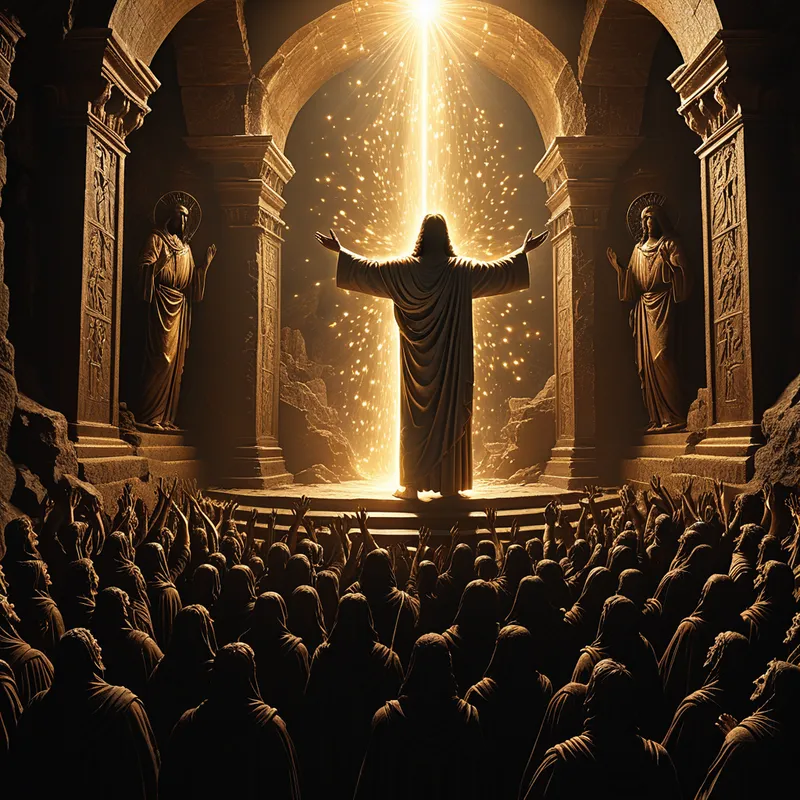
Then, a sound. Not a whisper, but a resonance that began in the very fabric of [the shadow](/myths/the-shadow “Myth from Jungian culture.”/)-land. A light, not of sun or star, but of a different order of being, pierced the grey. It was the one who had swallowed death from the inside. He stood before the impregnable gate. He did not plead. He did not fight with sword or spear. He spoke a Word—the same Word that had called light from the primal void. And the gate, recognizing its creator in the form of its victim, shrieked in its foundations and was shattered into ruin.
Into the stunned silence of [the underworld](/myths/the-underworld “Myth from Greek culture.”/), he strode, his footsteps now the only sound of true life that had ever echoed there. The sleeping shades stirred, sensing a warmth they had forgotten. [The prophets](/myths/the-prophets “Myth from Biblical culture.”/), the patriarchs, the just and the waiting—from Adam to the thief who died beside him—saw the light and recognized its promise. Death, the guardian, was bound with the chains of its own broken logic. The one it thought to hold had become the holder.
And he reached out his hand, scarred yet radiant. He did not drag them out. He called them forth. By name. By essence. The long captivity was over. In his wake, as he turned to ascend back to [the world](/myths/the-world “Myth from Tarot culture.”/) of the living, he left not a conquered prison, but a plundered kingdom. He led a train of souls, a river of light flowing upward from the deepest dark, back through the broken gates, following the path of resurrection he himself was blazing. Hell was harrowed—its storehouse emptied, its power broken from within. The deepest descent had become the foundation for the ultimate ascent.
Cultural Origins & Context
The story of the Harrowing, while not detailed in the canonical gospels, flourished in the fertile ground of early Christian imagination and liturgy. Its primary scriptural anchor is a enigmatic line in the First Epistle of [Peter](/myths/peter “Myth from Biblical culture.”/), which states Christ “went and made proclamation to the imprisoned spirits.” This seed blossomed in the extra-canonical Gospel of Nicodemus, and most powerfully, in the ancient homilies of the Eastern Church. For instance, the Paschal Homily of St. John Chrysostom, proclaimed every Easter in Orthodox churches, thunders: “Hell took a body, and discovered God. It took earth, and encountered Heaven. It took what it saw, and was overcome by what it did not see!”
This myth served a critical theological and societal function. It answered a profound existential question: what became of the righteous who died before the Christ-event? It proclaimed that Christ’s victory was cosmic, absolute, reaching even into the past to heal it. It was told not as a dry doctrine, but as a liturgical drama, a necessary chapter in the story of salvation that completed the circle, ensuring no part of human history or experience remained outside the scope of redemption.
Symbolic Architecture
At its core, the Harrowing is the archetypal map of a descent into the [shadow](/symbols/shadow “Symbol: The ‘shadow’ embodies the unconscious, repressed aspects of the self and often represents fears or hidden emotions.”/) for the [purpose](/symbols/purpose “Symbol: Purpose signifies direction, meaning, and intention in life, often reflecting personal ambitions and core values.”/) of [integration](/symbols/integration “Symbol: The process of unifying disparate parts of the self or experience into a cohesive whole, often representing psychological wholeness or resolution of internal conflict.”/) and liberation. Christ here is not the solar [hero](/symbols/hero “Symbol: A hero embodies strength, courage, and the ability to overcome significant challenges.”/) who battles external monsters, but the divine [consciousness](/symbols/consciousness “Symbol: Consciousness represents the state of awareness and perception, encompassing thoughts, feelings, and experiences.”/) that voluntarily enters the [collective unconscious](/symbols/collective-unconscious “Symbol: The Collective Unconscious refers to the part of the unconscious mind shared among beings of the same species, embodying universal experiences and archetypes.”/) of humanity—the “land of the dead” where all our unprocessed traumas, forgotten potentials, and ancestral patterns lie dormant.
The hero does not slay the dragon of the deep; he enters its belly, and from within, transforms its very nature into a vehicle of ascent.
The shattered gates represent the breaking of compulsive, fatalistic patterns—the “it has always been this way” of the [psyche](/myths/psyche “Myth from Greek culture.”/). The liberated souls are the lost parts of [the self](/myths/the-self “Myth from Jungian culture.”/): talents abandoned, hopes crushed, virtues stifled by circumstance, and even the wisdom of past sufferings (the prophets and patriarchs). They are not evil; they are captive, waiting for the conscious ego (the Christ figure) to acknowledge and reclaim them. [Death](/symbols/death “Symbol: Symbolizes transformation, endings, and new beginnings; often associated with fear of the unknown.”/), bound, symbolizes the neutralization of the [psyche](/myths/psyche “Myth from Greek culture.”/)‘s self-destructive inertia, [the tyranny](/symbols/the-tyranny “Symbol: A symbol of oppressive control, unjust authority, and systemic domination that suppresses individual freedom and collective well-being.”/) of the past over the future.

The Dreamer’s Resonance
When this myth stirs in the modern soul, it often manifests in dreams of profound interior journeys. You may dream of descending into a basement, a cave, a submerged city, or a forgotten subway system—all metaphors for the personal Hades. The feeling is not typically of terror, but of momentous, somber purpose. You might find yourself in a grey, silent place filled with familiar yet distant figures—versions of yourself from different life stages, or ancestral echoes.
The key action in such dreams is not fighting, but seeking and speaking. You may be searching for a specific person, a lost object (a childhood toy, a key), or simply moving toward a source of light in the distance. The act of naming—calling out to these lost fragments—is crucial. The somatic sensation upon waking is often one of profound release, a weight lifted, or a deep, quiet exhilaration. It signals a process of psychic reclamation, where [the ego](/myths/the-ego “Myth from Jungian culture.”/) is strong enough to consciously enter its own depths and recover what was left behind in earlier traumas or choices.

Alchemical Translation
For the individual, the Harrowing models the non-negotiable phase of individuation known as the [nigredo](/myths/nigredo “Myth from Alchemical culture.”/), [the dark night of the soul](/myths/the-dark-night-of-the-soul “Myth from Christian Mysticism culture.”/). It is the willed descent into depression, grief, or acknowledged brokenness, not to wallow, but to confront the root.
The alchemical gold is not found on the sunny surface; it is forged in the descent, where the spirit learns to hold light in the very place that knows no light.
The modern “harrowing” begins when one stops projecting their inner dead—their regrets, shames, and unlived life—onto the outer world and instead turns inward. You “shatter the gates” by challenging core, despairing beliefs: “I am unlovable,” “My creativity is dead,” “I am forever defined by that failure.” You “bind death” by ceasing to let past narratives dictate future possibilities.
The triumphant ascent is the integration. Those reclaimed “souls”—the repressed courage, the buried compassion, the forsaken joy—are brought back into the daylight of daily life. The personality is no longer at war with parts of itself; it is enriched, expanded, and paradoxically, humbled by them. The liberated past becomes a source of wisdom, not a prison. The individual who has harrowed their own hell does not become a perfect, shadowless being. They become a sovereign of a larger, more authentic kingdom, capable of holding both light and dark, having discovered that the key to the deepest prison was, all along, carried within the wound.
Associated Symbols
Explore related symbols from the CaleaDream lexicon: