The Hare Trickster East African Myth Meaning & Symbolism
A clever hare outwits powerful beasts through cunning and trickery, embodying the triumph of intellect over brute force in East African folklore.
The Tale of The Hare Trickster East African
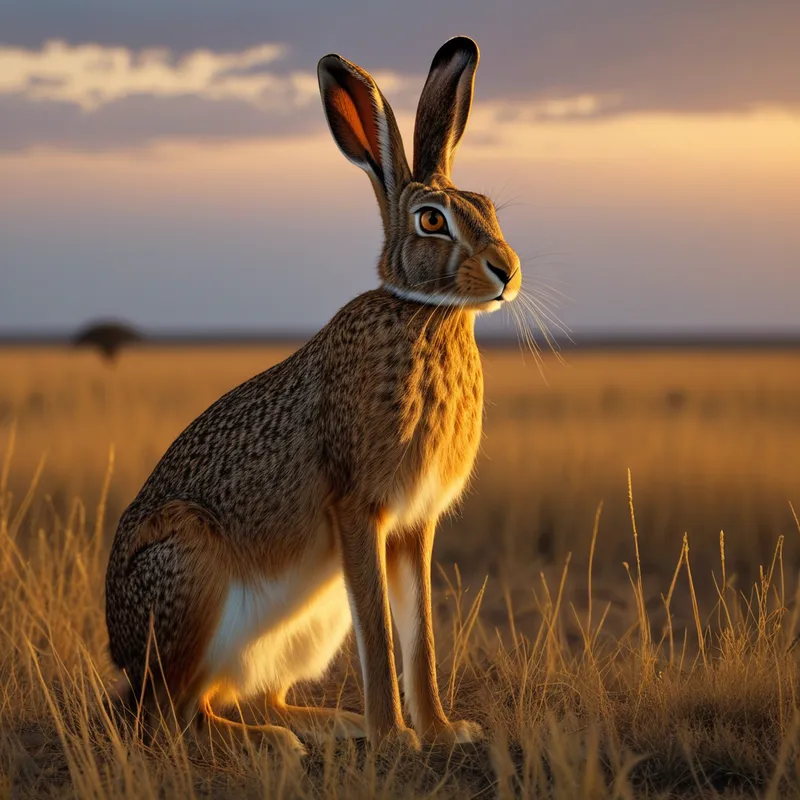
Listen, and let the dust of the savanna settle on your skin. Let the sun, a burning Sun, beat down on a world where the strong rule by claw and tooth. Here, the Lion was king, his roar shaking the acacia trees. The Elephant walked with earth-shaking steps. And then there was Sungura, the Hare—small, quick, a whisper of brown fur and twitching nose in the tall grass.
The great beasts grew arrogant. They declared that the waters of the only River in the dry season were theirs alone. The Hare and the other small creatures were forbidden to drink. Thirst became a sharp Stone in every throat. While the Lion slept in the shade, his belly full, Sungura watched. He did not see a barrier; he saw a puzzle.
He approached the Lion’s den, not with a snarl, but with a story. “Great King,” he said, his voice a thread of sound, “a terrible beast has come. It lives in the deep well. It claims to be the true king of this land. It roared its challenge to you.” The Lion’s eyes burned with prideful Rage. “Show me this imposter!”
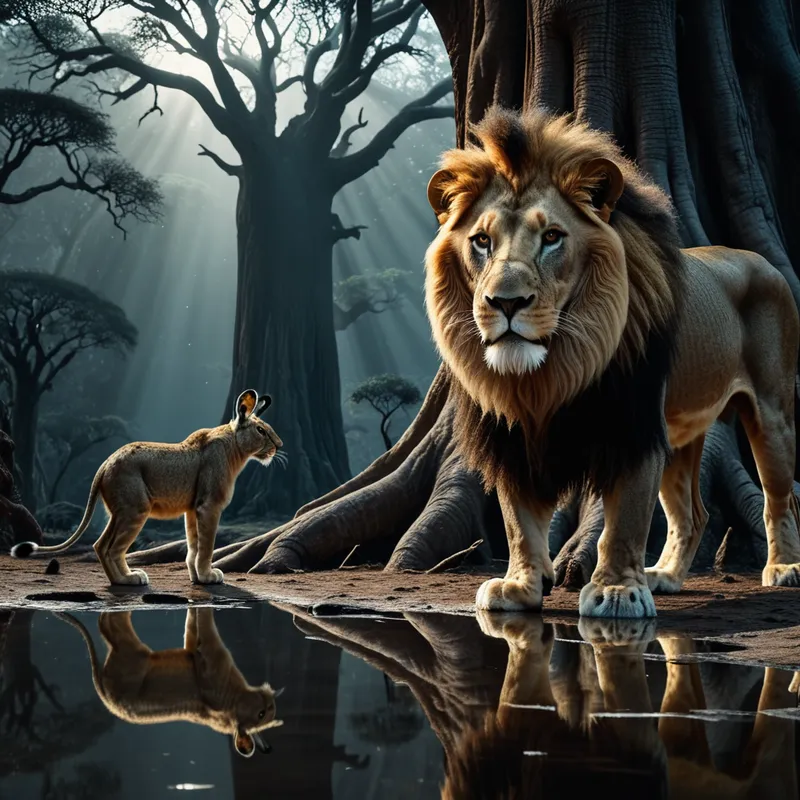
At the well’s Mouth, the Hare gestured into the dark, still water. “He is down there, King. See for yourself.” The Lion, chest puffed, leaned over and saw his own magnificent, furious reflection. He roared. The Water roared back. Convinced this was his rival, the Lion leaped in with a mighty splash, plunging into the cold, deep dark. He struggled, but the well held him. His roars became bubbles.
Sungura did not laugh. He simply turned and signaled to the waiting animals. One by one, the dik-dik, the mongoose, the birds, came to the River and drank their fill. The old order, based solely on might, had been upturned not by a greater force, but by a clever Trick. The Hare had used the Lion’s own Pride as a weapon, turning the king into a prisoner of his own image. From that day, the law of the land carried a new, silent clause: the mind is a territory vaster than any plain, and the clever shall find a Key where others see only a wall.
Cultural Origins & Context
This is not a single story, but a pattern woven through the oral traditions of many East African peoples, including the Swahili, Kamba, and others. The hare, known as Sungura or Kalulu, is a cornerstone of folklore. These tales were not mere children’s bedtime stories; they were the social and ethical curriculum of the community, told by elders under the vast Sky around evening fires.
The societal function was multifaceted. For the powerless—the young, the socially inferior—the Hare provided a psychological model of resilience. It taught that physical limitation does not equate to destiny. For the powerful, it served as a cautionary tale against hubris and the folly of underestimating others. The myth upheld a deeper Order, one where intelligence and adaptability were valued currencies, ensuring that no single form of power could become absolute tyranny. It was a narrative tool for maintaining balance, passed down not in scrolls, but in the living breath of storytellers, ensuring cultural wisdom flowed like a River through generations.
Symbolic Architecture
At its core, the Hare is the quintessential [Trickster](/symbols/trickster “Symbol: A boundary-crossing archetype representing chaos, transformation, and the subversion of norms through cunning and humor.”/) [archetype](/symbols/archetype “Symbol: A universal, primordial pattern or prototype in the collective unconscious that shapes human experience, behavior, and creative expression.”/). It represents the cunning of the psyche, the [ability](/symbols/ability “Symbol: In dreams, ‘ability’ often denotes a recognition of skills or potential that one possesses, whether acknowledged or suppressed.”/) of [consciousness](/symbols/consciousness “Symbol: Consciousness represents the state of awareness and perception, encompassing thoughts, feelings, and experiences.”/) to find indirect paths where direct confrontation would mean annihilation.
The Trickster does not break the rules of the powerful; it reveals that the rules are a game, and it simply knows a better move.
The Well is profoundly symbolic. It is a Mirror of the unconscious. The [Lion](/symbols/lion “Symbol: The lion symbolizes strength, courage, and authority, often representing one’s inner power or identity.”/), all bluster and conscious ego, sees only a rival “out there.” He fails to recognize himself, and in attacking his own [reflection](/symbols/reflection “Symbol: Reflection signifies self-examination, awareness, and the search for truth within oneself.”/), he is ultimately subdued by the contents of his own unconscious—his unbridled pride and rage. The Hare, in orchestrating this, acts as an unlikely agent of psychological [integration](/symbols/integration “Symbol: The process of unifying disparate parts of the self or experience into a cohesive whole, often representing psychological wholeness or resolution of internal conflict.”/), forcing the one-dimensional ego to confront its [shadow](/symbols/shadow “Symbol: The ‘shadow’ embodies the unconscious, repressed aspects of the self and often represents fears or hidden emotions.”/) in the watery [depths](/symbols/depths “Symbol: Represents the subconscious, hidden emotions, or foundational aspects of the self, often linked to primal fears or profound truths.”/).
The triumph is not the destruction of power, but its clever circumvention and the restoration of communal access to [life](/symbols/life “Symbol: The symbol of ‘Life’ represents a journey of growth, interconnectedness, and existential meaning, encompassing both the joys and challenges that define human experience.”/)-giving resources ([Water](/symbols/water “Symbol: Water symbolizes the subconscious mind, emotions, and the flow of life, representing both cleansing and creation.”/)). It symbolizes the intellect’s (Hare) victory over brute instinct (Lion), establishing a more nuanced, sustainable order.
The Dreamer’s Resonance
When this myth pattern stirs in the modern Dream, it often signals a moment where the dreamer feels outmatched by a seemingly overwhelming force. This could be an oppressive boss, an insurmountable problem, or a deep-seated internal critic (the inner Lion).
Dreaming of being the Hare suggests the psyche is mobilizing its resources of wit, agility, and indirect problem-solving. There is a somatic feeling of tension, a quickening, a scanning for creative loopholes. Dreaming of being the Lion at the well indicates a profound moment of self-confrontation. The dreamer may be enraged by a perceived external enemy, only to be shown by the unconscious that the true conflict is with an unacknowledged part of the self. The splash into the well is the felt sense of the ego being plunged into the cooling, disorienting waters of self-awareness, a necessary humiliation for growth.
Alchemical Translation
The myth models a crucial stage in individuation: the transmutation of a one-sided, power-dominant consciousness into a more integrated state. The Lion represents the inflated ego, ruling through sheer will but brittle in its lack of self-awareness. The Hare is the neglected, clever spirit of the psyche—the underdog function (often intuition or thinking in a feeling-dominated culture, or vice versa) that has been deemed too small to matter.
The alchemical work begins not when the small defeats the large, but when the small realizes the large is blind.
The Journey here is the Hare’s strategic maneuver. It does not fight the ego on the ego’s terms. Instead, it leads the ego to a reflective surface—therapy, a crisis, art, relationship—where it must see itself. The Lion’s plunge is the nigredo, the darkening, the necessary defeat of the old, arrogant attitude. The subsequent access to the River for all creatures symbolizes the albedo, the whitening, where a new order of the psyche emerges. Resources (creativity, emotion, connection) that were blocked by the monolithic ego now flow freely.
For the modern individual, the myth instructs: when faced with an immovable force, do not become a smaller version of it. Become the Hare. Cultivate the cunning to lead the problem to a Mirror. Often, the solution lies not in overpowering the obstacle, but in tricking it into revealing its true nature—which may be your own reflection, waiting to be integrated.
Associated Symbols
Explore related symbols from the CaleaDream lexicon:
- Trickster — The central archetype of the Hare, representing disruptive intelligence that overturns rigid order to create new possibilities and reveal hidden truths.
- Water — Symbolizes the unconscious mind, emotional life, and reflection; the well where the Lion sees himself is a pool of unconscious content.
- Mirror — Represents self-reflection and confrontation with the shadow; the Lion’s failure to recognize his reflection is the ego’s failure to know itself.
- Lion — Embodies raw, untamed power, pride, and the dominant ego that rules without self-awareness.
- River — The flow of life, community, and psychic resources that becomes accessible once the blocking force (the ego) is circumvented.
- Pride — The fatal flaw of the Lion, the inflated self-regard that the Trickster uses as a lever to topple unbalanced power.
- Key — The Hare’s cunning is the key that unlocks a seemingly impossible situation, providing access to what was forbidden.
- Order — The deeper, more sustainable balance the myth seeks to restore, where multiple forms of intelligence (not just strength) have value.
- Journey — The psychological process modeled by the myth: from oppression, through clever confrontation, to liberation and a new state of being.
- Shadow — The unacknowledged, aggressive pride of the Lion that he projects outward as an enemy, only to confront it in the well.