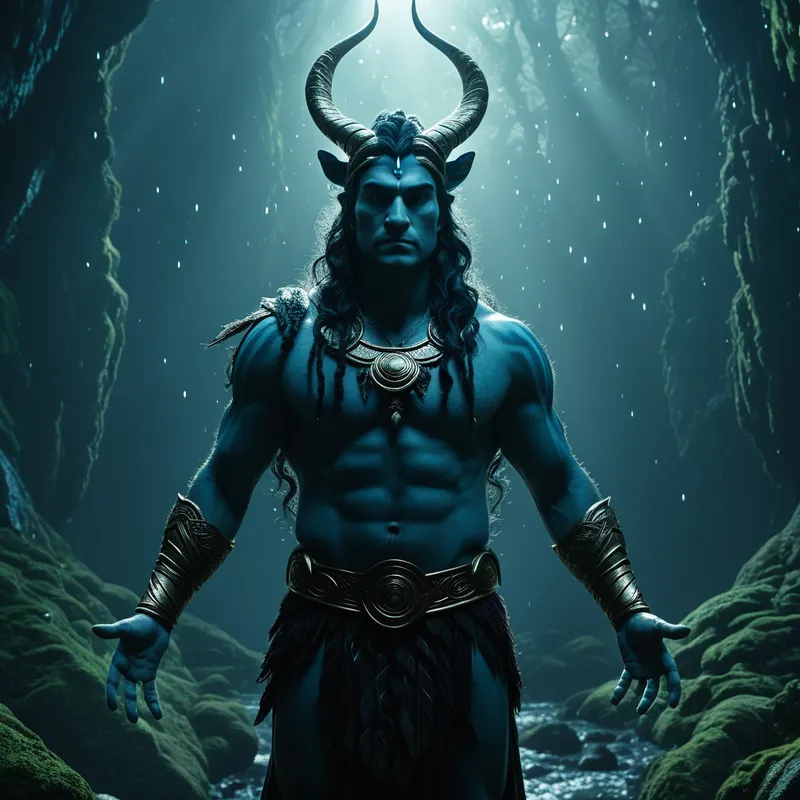
The Griot and Sacred Memory
West African griots served as living archives, transmitting sacred myths and cultural memory through powerful oral traditions that connected communities to their spiritual heritage.
The Tale of The Griot and Sacred Memory
In the beginning, there was [the Word](/myths/the-word “Myth from Biblical culture.”/). But the Word was not yet a story; it was a seed, a potential held in the breath of the ancestors. Then came the first griot, born not of a womb but of necessity, a vessel chosen by the community to hold what could not be written in sand. He was given a name, but his true name was Jeli, the blood of speech.
The tale begins not with a single event, but with a slow, deliberate gathering. Imagine the fire’s heart after the sun has fled, when [the world](/myths/the-world “Myth from Tarot culture.”/) is reduced to a circle of flickering light and pressing dark. The people settle, their bodies forming a living amphitheater. The griot does not rush. He feels the weight of the night, the expectation hanging like ripe fruit. He closes his eyes, and it is not darkness he sees, but a river—[the river](/myths/the-river “Myth from Buddhist culture.”/) of time, flowing backward. He dips his cup into its waters.
His voice, when it comes, is not his own. It is layered, a chorus. It carries the gravel of ancient warriors, the melodic lilt of forgotten queens, the proverbial wisdom of farmers who read [the sky](/myths/the-sky “Myth from Persian culture.”/). He begins with the genesis: “In the time when the sky was closer to [the earth](/myths/the-earth “Myth from Hindu culture.”/)…” He speaks the world into being again. He recounts the founding of the clan, the heroic deeds and tragic flaws of the lineage, the migrations across savannahs, the pacts sealed with rivers and [sacred groves](/myths/sacred-groves “Myth from Celtic culture.”/). He does not merely list kings; he resurrects them. You smell the dust kicked up by their horses, feel the tension before a decisive battle, share the private grief of a mother who lost a son to a misunderstanding with a neighboring tribe.
The griot’s memory is a palace with infinite rooms. In one, the laws and treaties are kept, recited with legal precision to settle disputes. In another, genealogies are woven into intricate tapestries of connection, proving a person’s place in the cosmic order. In the deepest chamber lies the sacred myth—the stories of the Dome, [the trickster](/myths/the-trickster “Myth from Various culture.”/) adventures of [Anansi](/myths/anansi “Myth from African culture.”/), the ethical parables that define what it means to be human.
His instrument—the kora, the balafon, the ngoni—is not accompaniment. It is a second voice, a spiritual twin. The strings vibrate with the frequency of the ancestors; the wooden keys echo the heartbeat of the earth. The music weaves through the narrative, unlocking emotions that words alone cannot touch—the soaring pride, the profound sorrow, the resilient joy. To forget a note is to forget a clause in the [covenant](/myths/covenant “Myth from Christian culture.”/) with the past.
The griot’s power is terrifying in its totality. He holds the honor and the shame of every family. He can crown a leader with a praise-song that elevates their spirit to the heavens, or he can, with a deliberate omission or a subtly pointed verse, dissolve a reputation into nothingness. He is the guardian of [the threshold](/myths/the-threshold “Myth from Folklore culture.”/) between the living and the dead, the conduit through which the ancestors continue to speak, guide, and judge. The story does not end; it is suspended in the night air, absorbed into the listeners’ blood, becoming part of the memory they will one day pass on. The griot falls silent. The fire crackles. The people are no longer just themselves; they are the latest chapter in an epic that began at the dawn of consciousness.
Cultural Origins & Context
The [griot tradition](/myths/griot-tradition “Myth from West African culture.”/), known by terms such as Jeli (Mande), Guewel (Wolof), and Arokin (Yoruba), is not a relic but a living institution that emerged from the complex, hierarchical societies of West Africa’s Sahel and savannah regions, particularly within the Mali, Ghana, and Songhai empires. Griots are not mere entertainers; they are hereditary artisans of speech, belonging to endogamous castes. Their role was—and in many places, remains—integral to the social, political, and spiritual machinery.
They served as court historians, diplomats, legal advisors, and master of ceremonies. A king without a griot was a king without a voice, without a legitimizing link to his predecessors. The griot’s memory functioned as the state archive, a living database of law, precedent, and identity. This oral tradition flourished in an ecology where writing, though sometimes present (like with Arabic script), was not the primary vessel for sacred and historical knowledge. Knowledge was not meant to be inert on a page; it was meant to be performed, felt, and metabolized by the community in real time. The griot was the embodied, dynamic library, and his fidelity was the fidelity of the culture itself.
Symbolic Architecture
The griot represents the ultimate [synthesis](/symbols/synthesis “Symbol: The process of combining separate elements into a unified whole, representing integration, resolution, and the completion of a personal journey.”/) of the Sage [archetype](/symbols/archetype “Symbol: A universal, primordial pattern or prototype in the collective unconscious that shapes human experience, behavior, and creative expression.”/), but one deeply rooted in communal flesh rather than isolated intellect. He is the living bridge between the temporal and the eternal, the individual and the collective, speech and [spirit](/symbols/spirit “Symbol: Spirit symbolizes the essence of life, vitality, and the spiritual journey of the individual.”/).
The griot’s voice is the river of time made audible. It does not flow in one direction from past to present, but circulates, allowing the present to drink from the past and the past to be reanimated in the present.
His [memory](/symbols/memory “Symbol: Memory symbolizes the past, lessons learned, and the narratives we construct about our identities.”/) is not a passive [storage](/symbols/storage “Symbol: Storage symbolizes the preservation of memories, knowledge, emotions, or physical belongings, often reflecting the subconscious mind’s organization.”/) but an active [altar](/symbols/altar “Symbol: An altar represents a sacred space for rituals, offering, and connection to the divine, embodying spirituality and devotion.”/), where the past is continually sacrificed and reborn as meaning for the present. Each performance is a [ritual](/symbols/ritual “Symbol: Rituals signify structured, meaningful actions carried out regularly, reflecting cultural beliefs and emotional needs.”/) of remembrance, a sacred technology for time travel. The [tension](/symbols/tension “Symbol: A state of mental or emotional strain, often manifesting physically as tightness, pressure, or unease, signaling unresolved conflict or anticipation.”/) in his [role](/symbols/role “Symbol: The concept of ‘role’ in dreams often reflects one’s identity or how individuals perceive their place within various social structures.”/) is profound: he is both the keeper of order—the rigid lineages and laws—and the channel for [chaos](/symbols/chaos “Symbol: In Arts & Music, chaos represents raw creative potential, uncontrolled expression, and the breakdown of order to forge new artistic forms.”/)—the raw, emotional, and often ambiguous truths of [human](/symbols/human “Symbol: The symbol of a human represents individuality, complexity of emotions, and social relationships.”/) experience. He must hold the light of praise and the [shadow](/symbols/shadow “Symbol: The ‘shadow’ embodies the unconscious, repressed aspects of the self and often represents fears or hidden emotions.”/) of [shame](/symbols/shame “Symbol: A painful emotion arising from perceived failure or violation of social norms, often involving exposure of vulnerability or wrongdoing.”/) in the same [breath](/symbols/breath “Symbol: Breath symbolizes life, vitality, and the connection between the physical and spiritual realms.”/), balancing them with the [precision](/symbols/precision “Symbol: The quality of being exact, accurate, and meticulous. It represents control, clarity, and the elimination of error in thought or action.”/) of a master jeweler.
The [instrument](/symbols/instrument “Symbol: An instrument symbolizes creativity, communication, and the means by which one expresses oneself or influences the world.”/) he plays is a key that unlocks the somatic [dimension](/symbols/dimension “Symbol: Represents the fundamental structure of reality, consciousness, or existence beyond ordinary perception.”/) of memory. The [music](/symbols/music “Symbol: Music in dreams often symbolizes the harmony between the conscious and unconscious mind, illustrating emotional expression and communication.”/) bypasses the rational mind and speaks directly to the [soul](/symbols/soul “Symbol: The soul represents the essence of a person, encompassing their spirit, identity, and connection to the universe.”/) and the bones, encoding [history](/symbols/history “Symbol: History in dreams often represents the dreamer’s past experiences, lessons learned, or unresolved issues that continue to influence their present.”/) not as fact, but as felt experience. To listen is not to learn, but to remember what you never personally knew.
The Dreamer’s Resonance
To encounter the griot in the psychic landscape is to confront the part of oneself that is the keeper of personal and ancestral myth. On a personal level, he symbolizes the inner historian—the voice that narrates our life story. Is it a story of victimhood or heroism? Of connection or isolation? The griot asks us: What are the foundational myths you repeat to yourself? What lineages of trauma or strength do you carry in your blood?
On a transpersonal level, the griot connects us to [the collective unconscious](/myths/the-collective-unconscious “Myth from Jungian culture.”/), the vast repository of human experience. He represents the imperative to remember—not just the triumphs, but the wounds. In a modern world plagued by cultural amnesia and the digital memory of fragmented data, the griot archetype urges a return to integrated, embodied narrative. He represents the healing that comes when shame is spoken and integrated into the community story, when grief is sung and thus shared. The psychological “griot work” is the difficult task of retrieving, honoring, and responsibly wielding our own personal and inherited stories, transforming them from silent burdens into sources of identity and resilience.

Alchemical Translation
The alchemy performed by the griot is the transformation of [death](/myths/death “Myth from Tarot culture.”/) into life, of time into timelessness. Raw event, through [the vessel](/myths/the-vessel “Myth from Alchemical culture.”/) of sacred speech and music, is transmuted into living memory, which then becomes identity, and finally destiny.
This is the core alchemy: History is not a corpse to be examined, but a ancestor to be fed. Through the ritual of recitation, the past is nourished and, in return, nourishes the present.
The process follows a sacred circuit: Silence (the unremembered) → Word (the griot’s speech) → Song (the emotional charge) → Embodiment (the listener’s absorption) → Tradition (the continued life of the memory). The griot himself is the alchemist’s vessel, the [vas hermeticum](/myths/vas-hermeticum “Myth from Alchemical culture.”/) that contains this volatile process. He turns the leaden weight of the forgotten into the gold of cultural continuity. The danger, the [nigredo](/myths/nigredo “Myth from Alchemical culture.”/), is the potential for distortion, for the poison of flattery or the corrosion of withheld truth. The ultimate goal is not factual perfection, but wholeness—a story complex and true enough to sustain a people.
Associated Symbols
Explore related symbols from the CaleaDream lexicon:
- Memory — The living substance transmitted by the griot, not as a static record but as a dynamic, flowing force that shapes identity.
- River — The ceaseless flow of time, lineage, and story that the griot navigates, drawing from its depths to [water](/myths/water “Myth from Chinese culture.”/) the present.
- Bridge — The griot as the connective span between generations, between the living and the ancestral world, and between spoken word and spiritual meaning.
- [Altar](/myths/altar “Myth from Christian culture.”/) — The space of performance as a sacred site where the past is offered up and transformed through ritual speech and music.
- Blood — The literal and metaphorical lineage carried in genealogies, and the visceral, life-force energy conveyed through passionate recitation.
- Voice — The primary instrument of the griot, embodying authority, history, and the very breath of the ancestors.
- Drum — The heartbeat of the community and the ancestral realm, a foundational instrument that calls spirits, marks time, and grounds the narrative in rhythm.
- Ancestor — The silent chorus whose wills, deeds, and wisdom are given voice through the griot’s performance.
- Fire — [The communal hearth](/myths/the-communal-hearth “Myth from Various culture.”/) around which stories are told, symbolizing the transformative light of memory that pushes back the darkness of forgetting.
- Mask — The griot’s ability to channel multiple voices and personas, becoming a vessel for forces greater than his individual self.
- Roots of a Sacred Tree — The deep, interconnected, and nourishing foundation of genealogy and tradition that the griot both draws from and sustains.
- Circle — The community gathered in ritual equality around the griot, the cyclical nature of time in oral tradition, and the completeness of the knowledge held.