The Greek god Plutus Myth Meaning & Symbolism
The story of Plutus, the god of wealth, blinded by Zeus to wander the earth indiscriminately, until a healing restores his sight and his true purpose.
The Tale of The Greek god Plutus
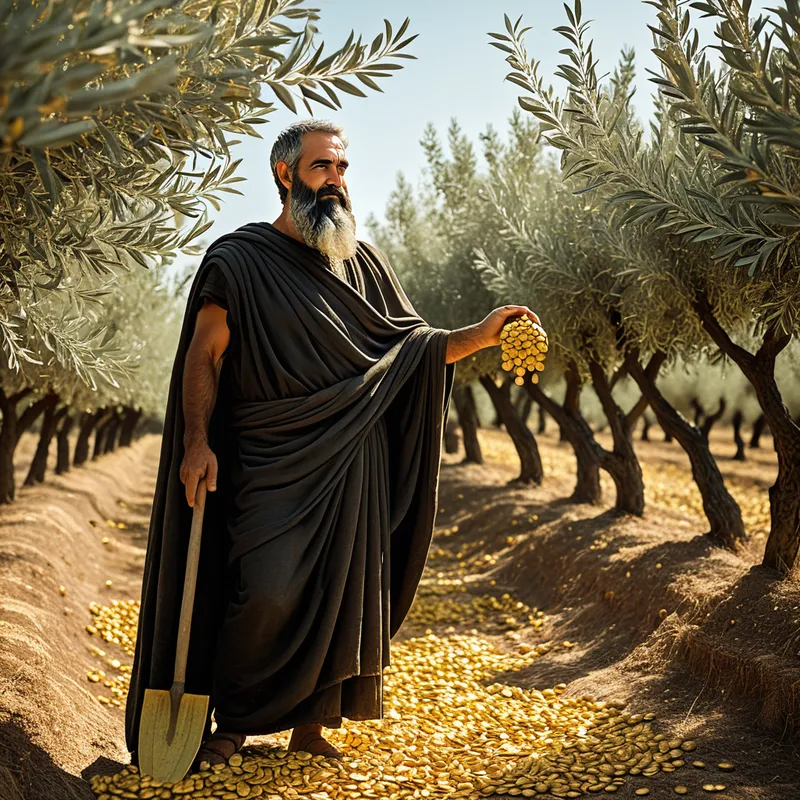
Listen, and hear the tale of the Giver and the Taker, the god who walks unseen. In the beginning, he was not blind. Plutus was born of the deep, fertile earth, a child of Demeter and the mortal hero Iasion, conceived in a thrice-plowed field under the witness of stars. He was abundance incarnate, a radiant youth whose very gaze caused the soil to quicken and coffers to fill. Where he looked, wealth blossomed—true wealth, of grain, of vine, of thriving community.
But his sight was too potent, too discerning. He walked the world, bestowing his gifts not upon the loud or the proud, but upon the just, the wise, the humble tiller of soil. He bypassed the palaces of tyrants to fill the barn of the virtuous farmer. This order, this moral distribution, stirred the ire of the king of gods. Zeus, from his cloudy throne, saw a power that answered to a law older than his own—the law of the furrow, not the scepter. Fear, that cold seed, took root. What if this young god’s vision united the world under a different sovereignty, one of earthy fairness, undermining divine caprice?
So, the Cloud-Gatherer acted. Not with thunder, but with a subtle, cruel theft. He sent Ate, the spirit of delusion, who draped a cloth not over the god’s eyes, but over his sight. The world did not darken for Plutus; it simply lost all meaning. The just man and the villain became blurred shapes; the fertile field and the barren rock, mere patches of color. His radiant gaze was now a void, a directionless beam. Blinded, Plutus became a wanderer. He stumbled through the world, his cornucopia spilling its contents heedlessly. Gold clattered at the feet of the wicked; grain rotted in the halls of the gluttonous. He became a curse disguised as a blessing, an agent of chaos, because the hand that gives must be guided by a seeing heart.
For ages, this was his fate: the lost god, the broken distributor. Until a mother’s love, patient as the turning seasons, sought him out. Demeter, whose grief once froze the world, now felt a different ache—for her lost, stumbling son. She found him not in a temple, but on a dusty road, a magnificent figure clothed in rags of misfortune. She did not command or rage. She, the goddess of cycles, knew that some wounds require the right season to heal.
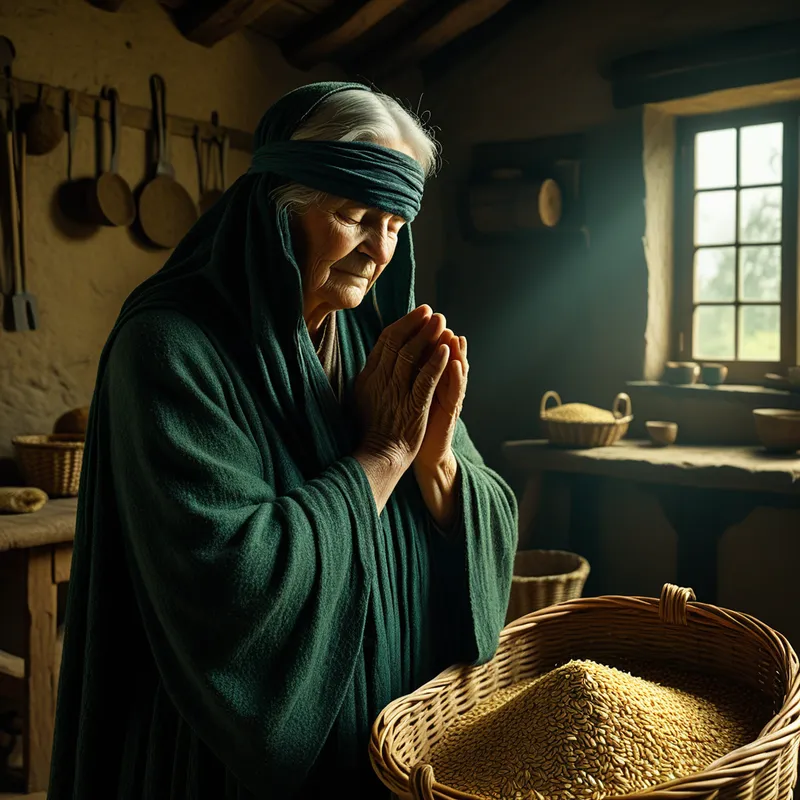
She led him to a sanctuary in Epidaurus, the place of mending. There, in the quiet sanctum of Asclepius, she performed the rite not of a deity, but of a nurturer. With hands that coax life from dormant seeds, she laid them upon his sightless eyes. Her touch was not a flash of magic, but the slow, sure warmth of the sun upon winter earth. The cloth of Ate did not tear; it dissolved, like mist under a dawn it cannot withstand.
And Plutus saw. His first sight was not of gold or jewel, but of his mother’s face, lined with care and love, and beyond her, the honest, expectant face of a poor farmer who had offered him shelter. The circuit was restored. His gaze, once more, could discern the quality of the soul, the readiness of the land. The wealth that flowed from him again had direction, purpose, and justice. He was no longer a wanderer, but a gardener of fortune, his sight the necessary hoe that weeds the garden of human fate.
Cultural Origins & Context
The myth of Plutus is primarily preserved in the comedic yet philosophically sharp play Plutus by the Athenian playwright Aristophanes (388 BCE), and in earlier fragments from the Hesiodic corpus and other sources. Unlike the grand Homeric Hymns, his story found a home in Old Comedy, a genre that used satire and fantastical scenarios to critique Athenian society, politics, and morality.
Aristophanes’ audience was a democracy wrestling with stark inequality, imperial wealth, and the corrupting influence of new money. The play—where a blind Plutus is healed, causing chaos as wealth redistributes to the virtuous—was not mere entertainment. It was a civic debate in mythic form. The myth served as a societal pressure valve and a moral compass. It asked the audience: Is wealth a blind force, or should it be a seeing one? Is our current distribution a result of divine blindness or human corruption? By framing this urgent social question within a mythic narrative, it allowed for a safe, yet profound, exploration of economic justice, divine will, and human merit.
Symbolic Architecture
At its core, the myth of Plutus is a profound allegory for the nature of true abundance and the moral faculty required to steward it. Plutus is not merely money; he is Oikos, the prosperity of the household and the land. His blindness represents the amoral, arbitrary nature of fortune when it is severed from wisdom and ethical vision.
Wealth without sight is chaos; sight without wealth is potential. The god must be whole.
Zeus’s act of blinding is the archetypal act of the ruling consciousness fearing the autonomous, moral power of the instinctual realm (represented by Demeter’s earthy son). It is the ego’s tendency to cripple a powerful complex—here, the complex of nourishment, inheritance, and resource—to maintain control, even if that control creates widespread dysfunction.
The healing by Demeter and Asclepius symbolizes the integration of this wounded wealth complex back into a nourishing, holistic system. It is not a battle, but a therapeutic restoration. Demeter represents the nurturing, patient, cyclical aspect of the psyche that tends to deep wounds. Asclepius represents the archetype of healing and wholeness. Their sanctuary is the temenos, the sacred enclosed space of the soul where fragmentation can be made whole.

The Dreamer's Resonance
When this myth stirs in the modern dreamer, it often manifests as dreams of faulty distribution, hidden treasures, or sudden, disorienting windfalls. To dream of scattering money blindly, or finding a hoard that turns to dust, is to encounter the blind Plutus within. The somatic sensation is often one of anxiety in the chest or gut—a feeling of resources being squandered, energy misspent, or gifts unappreciated.
Psychologically, this dream pattern signals a confrontation with one’s own "wealth complex"—not just financial, but one’s wealth of time, talent, love, and creative energy. Are you, the dreamer, distributing these inner resources wisely? Are you "blind" to where your true talents lie, giving your energy to vain pursuits or toxic relationships? Or conversely, are you refusing to "see" the abundance available to you, living in a psychological poverty? The dream is a call to examine the moral and perceptual faculty that guides your inner economy. It asks: What has blinded you to your own true riches, or to the just distribution of your gifts in the world?

Alchemical Translation
The alchemical journey modeled by Plutus is the transmutation of fortuna (blind chance) into providentia (foresightful provision). The prima materia is the raw, chaotic experience of abundance or lack that feels arbitrary and unjust. The blinding by Zeus is the nigredo, the darkening, where one’s sense of value and distribution is shattered, leading to a wandering, aimless period.
The healing is not the acquisition of gold, but the restoration of the organ that perceives value.
The seeker’s task is not to chase wealth, but to heal the inner blindness. This requires retreat to the inner temenos (the Demeter/Asclepius space)—through introspection, therapy, or creative solitude. Here, the nurturing, patient aspect of the soul (Demeter) must apply herself to the wound. This is the albedo, the whitening, a cleansing of perception. One must ask: What delusions (Ate) have I allowed to cloud my judgment of what is truly valuable?
The final stage, the rubedo or reddening, is the integration of the healed Plutus. It is the moment when one’s resources—time, energy, skill, compassion—are now deployed with discernment. The cornucopia flows, but it flows toward what is life-giving, authentic, and aligned with the soul’s deeper justice. The individual becomes a conscious distributor of their own fate, transforming from an orphan of fortune (the blind wanderer) into a steward of a self-created legacy. The true gold produced is not external wealth, but a psyche where abundance and ethical vision are forever married.
Associated Symbols
Explore related symbols from the CaleaDream lexicon: