The god Thor Myth Meaning & Symbolism
The story of the thunder god who defends the cosmos with his hammer, wrestling with giants, serpents, and his own unyielding nature.
The Tale of The god Thor
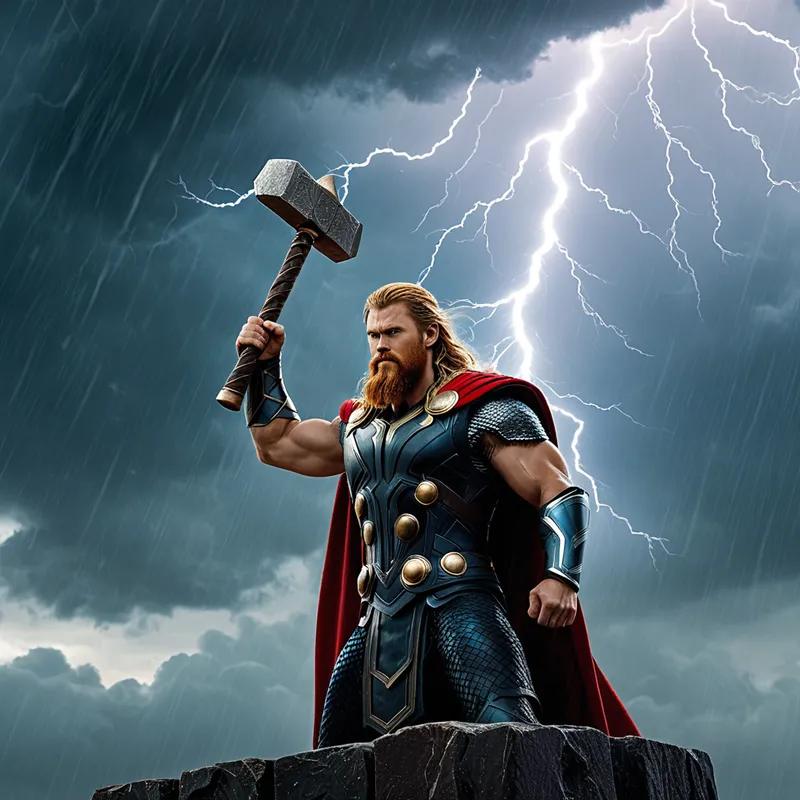
Hear the rumble in the distance, the deep-throated growl of the storm rolling over the mountains. That is the sound of his chariot, drawn by two goats whose hooves strike sparks from the clouds. He is Thor, son of Odin, and the defender of Asgard and [Midgard](/myths/midgard “Myth from Norse culture.”/).
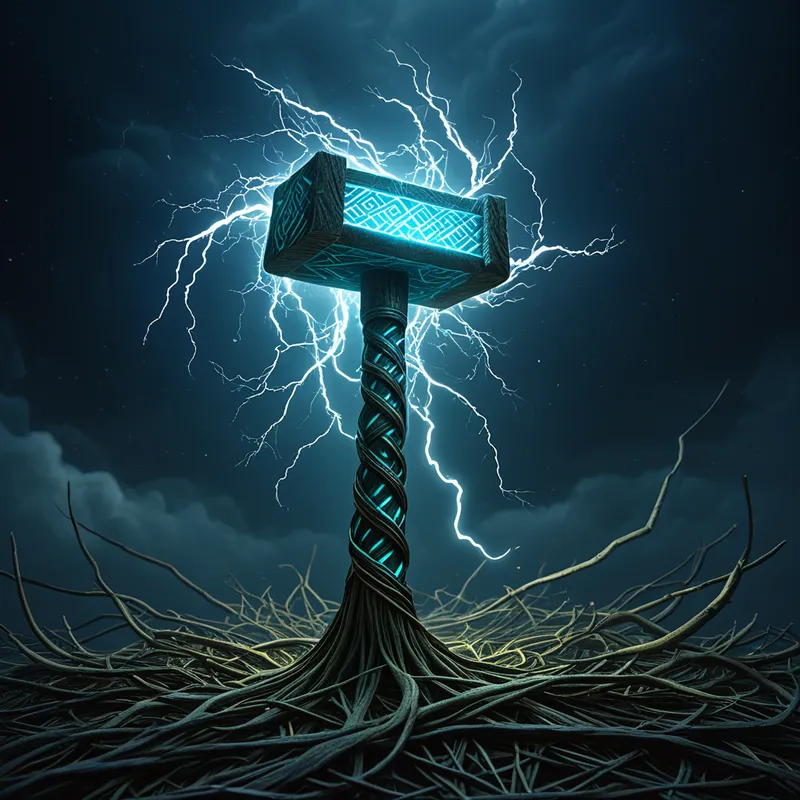
His home is Bilskirnir, vast and echoing, but he is rarely within its walls. His work is out there, in the wild edges where the order of the gods meets the chaos of the [Jötnar](/myths/jtnar “Myth from Norse culture.”/). His hands, broad and strong, are never empty. In one, he wears the iron gauntlets, Járngreipr. In the other, he grips the heart of his power: the hammer [Mjölnir](/myths/mjlnir “Myth from Norse culture.”/). Forged in the heart of a dying star by the cunning dvergr, it is unbreakable, and when thrown, it always returns to his hand, trailing thunder.
One day, he awakens to find Mjölnir gone. The hall feels cold without its presence. A whisper comes: the giant Thrym has stolen it and buried it eight leagues deep in [the earth](/myths/the-earth “Myth from Hindu culture.”/). He will return it only for the hand of [Freyja](/myths/freyja “Myth from Norse culture.”/) in marriage. The gods despair. Without the hammer, Asgard is defenseless. The walls themselves seem to shrink.
Loki, ever a whisper in the ear of crisis, proposes a deception. Thor must go to Jötunheimr disguised as the bride Freyja, with Loki as his maid. Thor roars in protest, but the silence of his empty hand is a louder argument. So, they dress the thunder god in a bridal gown, veil his fierce face, and hang the great hammer’s absence like a weight around his neck.
In the hall of Thrym, the giant king marvels at his bride’s fierce eyes and prodigious appetite as “Freyja” devours an entire ox, eight salmon, and three casks of mead. Loki, quick-tongued, explains it is [the passion](/myths/the-passion “Myth from Christian culture.”/) of a bride who has not eaten for eight days in her longing. When Thrym leans in to lift [the veil](/myths/the-veil “Myth from Various culture.”/) for a kiss, he recoils from the lightning in those eyes. Loki again explains it is the fire of a bride who has not slept for eight nights in her longing.
Fooled, Thrym calls for the hammer to hallow the bride. They place Mjölnir in the lap of the veiled god. The moment his fingers close around the familiar, worn handle, [the world](/myths/the-world “Myth from Tarot culture.”/) changes. The veil is torn away. The gown shreds like storm clouds. And Thor, whole again, rises in his full fury. The hall of Thrym becomes a tomb of lightning and shattered stone.
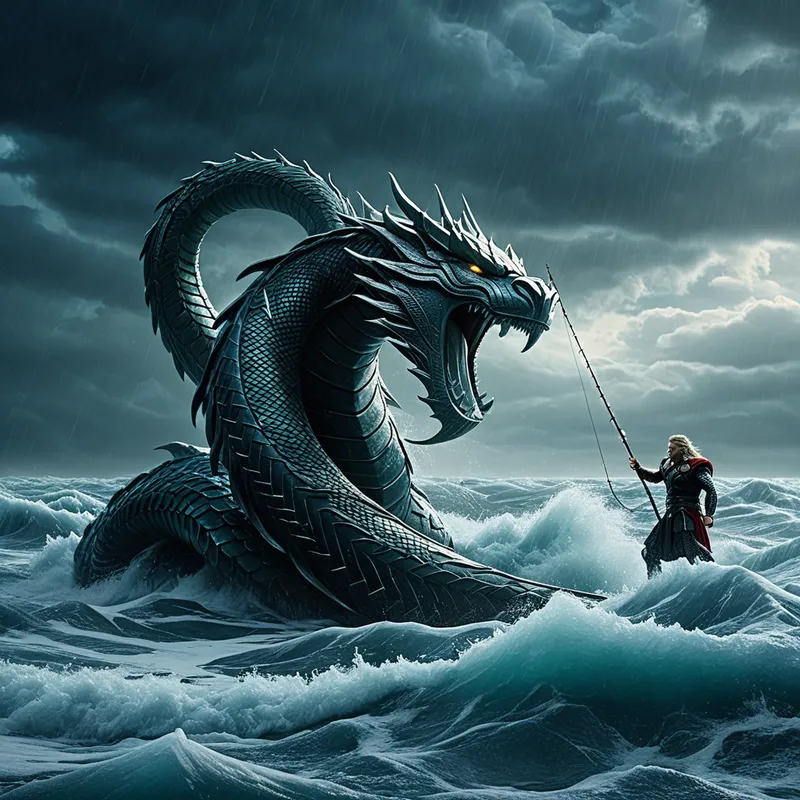
Another day, he ventures far from home with the giant Hymir. They sail to the edge of the world, where [the sea](/myths/the-sea “Myth from Greek culture.”/) is as dark as old blood. Thor baits his hook with the head of Hymir’s greatest ox and casts his line into the abyssal waters. The bite is a cataclysm. The line screams. The sea boils. With a roar that shakes the boat’s timbers, Thor plants his feet and heaves, muscles corded like mountain roots. From the depths rises the impossible: the vast, scaled head of [Jörmungandr](/myths/jrmungandr “Myth from Norse culture.”/), its eyes like cold moons, its fangs dripping venom that sizzles on [the sea](/myths/the-sea “Myth from Greek culture.”/). They stare into each other’s eyes—god and doom, protector and destroyer—in a moment of pure, terrifying recognition. Thor raises his hammer for the killing blow, but Hymir, in sheer terror, cuts the line. The serpent sinks back into the deep, and the waters go still, holding their secret. Thor knows, and the serpent knows, this is not their final meeting.
Cultural Origins & Context
These tales of Thor were not scripture, but living breath. They were told in the smoky halls of the Viking Age, from the 8th to the 11th centuries, across Scandinavia and the Norse diaspora. The primary sources that preserve his myth for us are the Poetic Edda and the later, prose Prose Edda, penned by the Icelandic scholar Snorri Sturluson long after the Christianization of the North.
Thor was not a distant, philosophical god like Odin. He was the god of the common person, the farmer, the settler. His battles against the giants were a cosmic metaphor for the human struggle against the chaos of nature—the storm that ruins crops, the harsh winter, the unknown perils beyond the fence-line. Wearing a miniature hammer, Mjölnir, was a common amulet, a tangible plea for protection, fertility for the land, and hallowing for the home. His myths served a vital societal function: they reinforced the values of strength, perseverance, and the direct, physical defense of community order against encroaching chaos.
Symbolic Architecture
Thor is the [archetype](/symbols/archetype “Symbol: A universal, primordial pattern or prototype in the collective unconscious that shapes human experience, behavior, and creative expression.”/) of the conscious ego in its heroic, defensive [posture](/symbols/posture “Symbol: Posture in dreams represents one’s stance in life, social presentation, and inner confidence or submission. It reflects how one carries themselves through challenges and relationships.”/). He represents the part of the [psyche](/myths/psyche “Myth from Greek culture.”/) tasked with maintaining boundaries, enforcing order, and confronting external threats with direct [action](/symbols/action “Symbol: Action in dreams represents the drive for agency, motivation, and the ability to take control of situations in waking life.”/). His hammer, Mjölnir, is not merely a [weapon](/symbols/weapon “Symbol: A weapon in dreams often symbolizes power, aggression, and the need for protection or defense.”/); it is the [symbol](/symbols/symbol “Symbol: A symbol can represent an idea, concept, or belief, serving as a powerful tool for communication and understanding.”/) of focused, creative force. It hallows (makes holy) and destroys, it shapes and it shatters.
The hammer is the will made manifest, the decisive act that forges reality from possibility and defends the sanctity of the known self.
His adversaries, the giants, symbolize the undifferentiated, overwhelming forces of the unconscious—raw [nature](/symbols/nature “Symbol: Nature symbolizes growth, connectivity, and the primal forces of existence.”/), uncontrollable [emotion](/symbols/emotion “Symbol: Emotion symbolizes our inner feelings and responses to experiences, often guiding our actions and choices.”/), and the shadowy aspects of existence that threaten to engulf conscious [identity](/symbols/identity “Symbol: Identity represents the sense of self, encompassing personal beliefs, cultural background, and social roles.”/). His [journey](/symbols/journey “Symbol: A journey in dreams typically signifies adventure, growth, or a significant life transition.”/) to retrieve his hammer in drag is a profound [lesson](/symbols/lesson “Symbol: A lesson in a dream signifies a learning opportunity, often reflecting personal growth or unresolved issues requiring attention.”/): the [hero](/symbols/hero “Symbol: A hero embodies strength, courage, and the ability to overcome significant challenges.”/) must sometimes descend into disguise, into a state of apparent weakness or incongruity (the mighty [warrior](/symbols/warrior “Symbol: A spiritual archetype representing inner strength, discipline, and the struggle for higher purpose or self-mastery.”/) as [bride](/symbols/bride “Symbol: A bride symbolizes new beginnings, commitment, and the transition into a partnership or a new phase in life.”/)), to reclaim his authentic power. It is a myth of necessary humiliation and strategic cunning preceding triumphant restoration.
His fishing [expedition](/symbols/expedition “Symbol: A purposeful journey into the unknown, representing exploration of the unconscious, life transitions, or quests for meaning.”/) for Jörmungandr is [the ego](/myths/the-ego “Myth from Jungian culture.”/)’s confrontation with the ultimate [shadow](/symbols/shadow “Symbol: The ‘shadow’ embodies the unconscious, repressed aspects of the self and often represents fears or hidden emotions.”/): the Self in its most terrifying, transpersonal form. The World [Serpent](/symbols/serpent “Symbol: A powerful symbol of transformation, wisdom, and primal energy, often representing hidden knowledge, healing, or temptation.”/) is the [chaos](/symbols/chaos “Symbol: In Arts & Music, chaos represents raw creative potential, uncontrolled expression, and the breakdown of order to forge new artistic forms.”/) that encircles and defines our entire world of order. To look it in the eye is to confront the [knowledge](/symbols/knowledge “Symbol: Knowledge symbolizes learning, understanding, and wisdom, embodying the acquisition of information and enlightenment.”/) of one’s own destined end (their battle is prophesied to be mutual doom at [Ragnarök](/myths/ragnark “Myth from Norse culture.”/)). This is not a battle won, but a [fate](/symbols/fate “Symbol: Fate represents the belief in predetermined outcomes, suggesting that some aspects of life are beyond human control.”/) acknowledged—a vital [integration](/symbols/integration “Symbol: The process of unifying disparate parts of the self or experience into a cohesive whole, often representing psychological wholeness or resolution of internal conflict.”/) for any mature psyche.
The Dreamer’s Resonance
When the thunder god strides into modern dreams, he announces a phase of intense psychic mobilization. To dream of Thor, or of his hammer, is to feel the somatic rumble of a gathering inner strength. You may be dreaming of a colossal, simple tool; a storm you cannot avoid; or a figure of immense, sometimes clumsy, power facing an overwhelming foe.
Psychologically, this signals that the dreamer’s ego is fortifying itself. There is a perceived threat—often external, like a domineering person or an impossible workload, but sometimes internal, like a surge of rage or passion that feels giant-like and dangerous. The dream is the psyche’s way of mustering its defensive resources. The process is one of consolidation: drawing boundaries, claiming your power (finding your hammer), and preparing for a direct confrontation. If the dream involves failure or the loss of the hammer, it speaks to a deep fear of being disarmed, ineffective, or unable to protect what you hold dear.
Alchemical Translation
The alchemical journey modeled by Thor is the transmutation of brute strength into conscious, responsible power. The [prima materia](/myths/prima-materia “Myth from Alchemical culture.”/) is raw, instinctual force—the thunderous rage, the impulsive strike. The process begins in the humiliation of the cross-dressing journey, which represents the [nigredo](/myths/nigredo “Myth from Alchemical culture.”/), the darkening. The ego must be dissolved in the solvent of paradox and apparent absurdity to be reformed.
The hero must become the bride to reclaim his hammer; the will must surrender its pride to become truly effective.
Retrieving the hammer is the albedo, the whitening—the reclaiming of one’s essential tool, now with the added wisdom of the descent. But the final transmutation occurs in the boat, facing the serpent. This is the [rubedo](/myths/rubedo “Myth from Alchemical culture.”/), the reddening, the confrontation with the ultimate shadow. Here, the heroic ego’s goal is not to slay the unconscious, but to see it, to hold the tension, to recognize it as part of the whole system.
For the modern individual, Thor’s myth charts the path of individuation through the development of a strong, resilient ego that knows its purpose is protection, not tyranny. It teaches that true strength lies not in never losing your weapon, but in knowing how to go into [the underworld](/myths/the-underworld “Myth from Greek culture.”/) to get it back, and in having the courage to look your deepest, most chaotic fate in the eye without immediately swinging to destroy it. You are called to build your hall, wield your will with purpose, and, when the time comes, stand firm in the knowing gaze of the deep.
Associated Symbols
Explore related symbols from the CaleaDream lexicon: