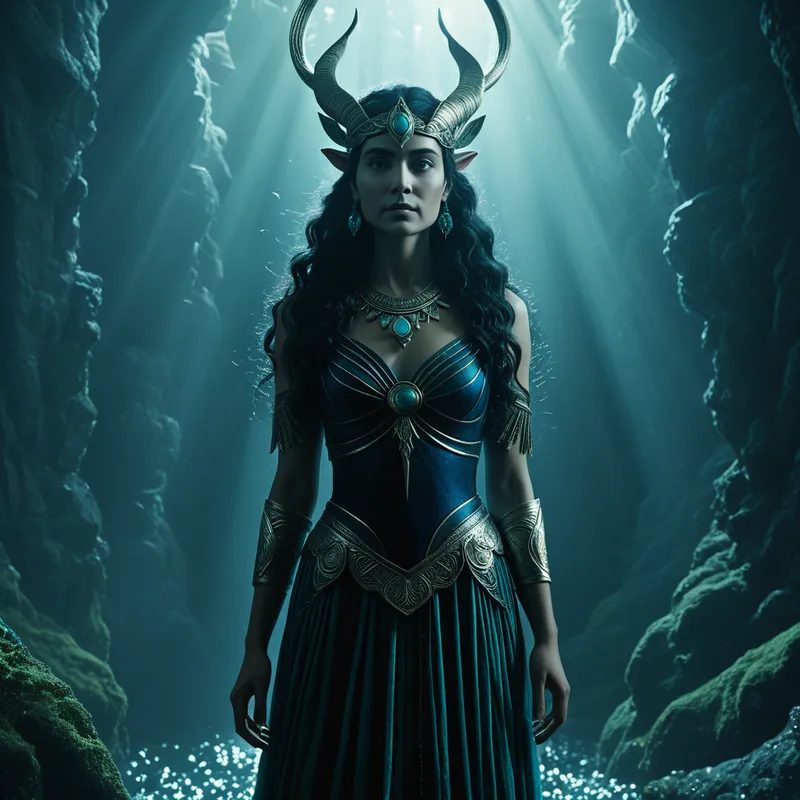
The God of Wealth Caishen
Caishen is the revered Taoist deity of wealth and prosperity, embodying both material abundance and spiritual fortune in Chinese mythology.
The Tale of The God of Wealth Caishen
In the celestial bureaucracy of the Taoist heavens, where deities govern the myriad facets of existence, resides a figure whose presence is invoked in whispers of hope and the clink of coin. This is Caishen, the God of Wealth. His tale is not one of a single, monolithic legend, but a tapestry woven from many threads across centuries, converging into a powerful archetype of fortune.
One prevalent narrative speaks of his mortal origin as Zhao Gongming, a formidable general and adept Taoist cultivator during the chaotic era of the Shang Dynasty. A man of fierce loyalty and formidable magic, he commanded the winds and rain, riding upon a black tiger—a creature symbolic of the untamed power of the west and the martial spirit. His mastery over the elements was such that he could summon tempests and darkness to confound his enemies. Yet, in the grand celestial reckoning depicted in the Ming dynasty novel Investiture of the Gods, his fate was transformed. Following his earthly demise, his integrity and power were recognized by the heavenly Jade Emperor, who conferred upon him a divine portfolio. Zhao Gongming was apotheosized, ascending to oversee not war, but wealth, becoming the Marshal Zhao, a central figure in the pantheon of Caishen.
His celestial ministry is a bustling, orderly domain. He is often depicted not in solitary meditation, but amidst a bustling court of lesser wealth deities, assistants, and attendants. His role is that of a divine accountant and distributor, meticulously recording the merits and fortunes of mortals. He does not merely shower gold upon the world; he administers it. His gaze penetrates the heart, discerning between virtuous industry and greedy avarice. To the diligent, the charitable, and the righteous, his blessings flow—a timely business opportunity, a bountiful harvest, a hidden trove. To the wicked and the miserly, his ledger remains closed, and his golden ingots are but a taunting mirage.
Thus, Caishen’s tale is ultimately one of divine order. He represents the cosmic principle that material prosperity, when aligned with virtue (De), is not a corrupting force but a harmonious component of the Tao. He is the celestial bridge between earthly effort and heavenly reward, a ruler who governs the flow of life’s most potent energy.
Cultural Origins & Context
The veneration of Caishen emerges from the deep, pragmatic spirituality of Chinese folk religion, seamlessly integrated into the Taoist cosmological framework. His worship is less about theological dogma and more about a lived relationship with the invisible forces that govern daily survival and success. He is a quintessential example of a “functional deity,” a divine bureaucrat whose portfolio addresses a fundamental human concern.
Historically, the figure of the wealth god evolved and multiplied. Different regions, trades, and eras produced their own variants. There is the Civil God of Wealth (Cai Bo Xing Jun), often depicted in scholarly robes, representing fortune gained through bureaucracy, intellect, and legitimate enterprise. Contrasting him is the Martial God of Wealth (Wu Cai Shen), exemplified by Zhao Gongming, symbolizing wealth acquired through bravery, protection, and assertive action. This duality reflects the two primary paths to social advancement in imperial China: the civil service examinations and military valor.
His integration into Taoism is profound. Within the Taoist celestial hierarchy, a mirror of the imperial court, Caishen holds a specific office. He answers to the Jade Emperor and works in concert with other deities who oversee longevity, happiness, and prosperity. This systematization places wealth within a holistic spiritual ecosystem. It is not an isolated pursuit but one pillar of a blessed life, alongside health, harmony, and virtue. During festivals, most notably the Lunar New Year, his icon is cleaned, offered incense, and petitioned not for outrageous greed, but for stability, security, and the means to care for one’s family and community—a prosperity that fosters social and spiritual harmony.
Symbolic Architecture
Caishen’s iconography is a rich symbolic language, each element a key to understanding his multifaceted nature. He is typically portrayed as a stately, bearded mandarin, often with a face flushed red—the color of joy, vitality, and good fortune in Chinese culture. His robes are magnificent, embroidered with cosmic symbols or patterns of bats (homophones for “blessing”). This visage is one of benevolent authority, the ideal ruler who dispenses bounty with dignified grace.
The objects he holds are his primary lexicon. In one hand, he may clutch the Ruyi scepter, an emblem of authority and the fulfillment of wishes. In the other, he invariably holds the Yuanbao—the sycee or shoe-shaped gold ingot. This is not merely a picture of money; it is a symbol of primordial value, condensed energy, and the potential that wealth represents. Some depictions show him seated upon a mountain of these ingots, or with a golden ingot for a headdress, signifying his complete identification with the essence of wealth as a cosmic force.
The golden ingot is alchemical. It represents the transformation of base effort (labor, intention, virtue) into a condensed, tangible, and exchangeable form of spiritual and material power.
His mount, the Black Tiger, is a crucial and often overlooked symbol. The tiger, king of the land animals, embodies raw power, courage, and the ferocity required to guard treasure. Its black color associates it with the Water element of the Wu Xing and the direction West, the realm of the setting sun, autumn, and metal—the very substance of coins. This tiger signifies that true prosperity is not passive; it must be protected, its acquisition sometimes requiring the fearless confrontation of life’s challenges. Caishen, serene upon this fierce beast, symbolizes the mastery and civilizing of wild, untamed fortune.
The Dreamer's Resonance
To encounter Caishen in the inner landscape of dream or active imagination is to confront one’s personal relationship with the archetype of value, resources, and self-worth. He is the psychological embodiment of the “inner treasurer.” Does he appear welcoming, offering a golden ingot? This may signal a burgeoning sense of self-worth, a recognition of one’s inherent talents, or the imminent fruition of long-held efforts. The psyche is announcing a state of inner abundance.
Conversely, if he is stern, turning away, or his ingots are tarnished, it may point to a perceived poverty of spirit—a deep-seated belief in lack, unworthiness, or a “scarcity mindset” that constricts one’s life. The black tiger may then appear not as a majestic steed but as a threatening force, representing the ferocious anxiety, envy, or fear that often guards (and isolates) our hidden resources, both material and emotional. Caishen’s judgment, in the psychological sense, is not a celestial punishment but a reflection of the dreamer’s own inner ledger—their beliefs about what they deserve and their alignment (or misalignment) between their actions and their deeper values.

Alchemical Translation
In the alchemical vessel of the soul, Caishen presides over the transmutation of lead into gold. Here, lead is the raw matter of our existence: our time, our labor, our focused attention, and our ethical conduct (De). The alchemical fire is the heat of our dedication and intention. Caishen is the archetypal principle that governs this transformative process, ensuring it follows a cosmic law.
This is the spiritual economy: wealth is not stolen or magically conjured, but earned through the alchemy of applied virtue. The ingot is the lapis philosophorum, the philosopher’s stone of the mundane world, proof of a successful inner operation.
His administration teaches that hoarding is a perversion of the alchemical process, for gold that does not circulate loses its luster and purpose. True spiritual wealth, mirrored in material well-being, must flow. It must be invested in life, in relationships, in creative ventures, and in compassionate action. To invoke Caishen authentically is not to beg for a handout, but to commit to the inner work of refining one’s character, honing one’s skills, and engaging with the world in a manner that naturally attracts and circulates abundance. He symbolizes the moment when inner integrity crystallizes into outer fortune, when the soul’s gold is minted into the currency of the world.
Associated Symbols
Explore related symbols from the CaleaDream lexicon:
- Wealth — The condensed, tangible manifestation of energy, effort, and value, representing both material security and the potential for growth and exchange.
- Gold — The ultimate symbol of incorruptible value, spiritual illumination, and the successful culmination of an alchemical process, whether material or psychological.
- Tiger — The embodiment of raw power, ferocious protection, and untamed instinct, often representing the formidable energy that must be mastered to guard or attain one’s treasures.
- Mountain — A symbol of stability, enduring value, and lofty achievement; the foundation upon which lasting prosperity is built.
- Dragon — The ultimate Chinese symbol of potent celestial power, good fortune, and the dynamic, transformative force that brings rain (nourishment) and controls waterways (the flow of resources).
- Ritual — The structured, respectful engagement with unseen forces, creating a sacred bridge between human desire and divine principle through offerings, invocation, and mindful practice.
- Order — The celestial bureaucracy and cosmic principle that governs the fair and merit-based distribution of fortune, opposing chaos and random chance.
- Taoist Talisman — A physical conduit of divine power and intention, often used in petitions to deities like Caishen to seal agreements, invoke blessings, or ward off misfortune in the pursuit of prosperity.
- Circle — A symbol of wholeness, completion, and the cyclical nature of fortune; the unending flow of resources, energy, and the seasons of gain and release.
- Key — That which unlocks hidden treasure, opportunity, or a higher station; representing the knowledge, virtue, or action that opens the door to abundance.
- Altar — The dedicated space where the human and divine meet, the focal point for offerings, gratitude, and the conscious cultivation of relationship with the powers that govern fortune.
- Journey — The path of cultivation, effort, and ethical living that one must travel to authentically attract and be worthy of the blessings administered by the celestial powers.