The Fork in the Perilous Forest Myth Meaning & Symbolism
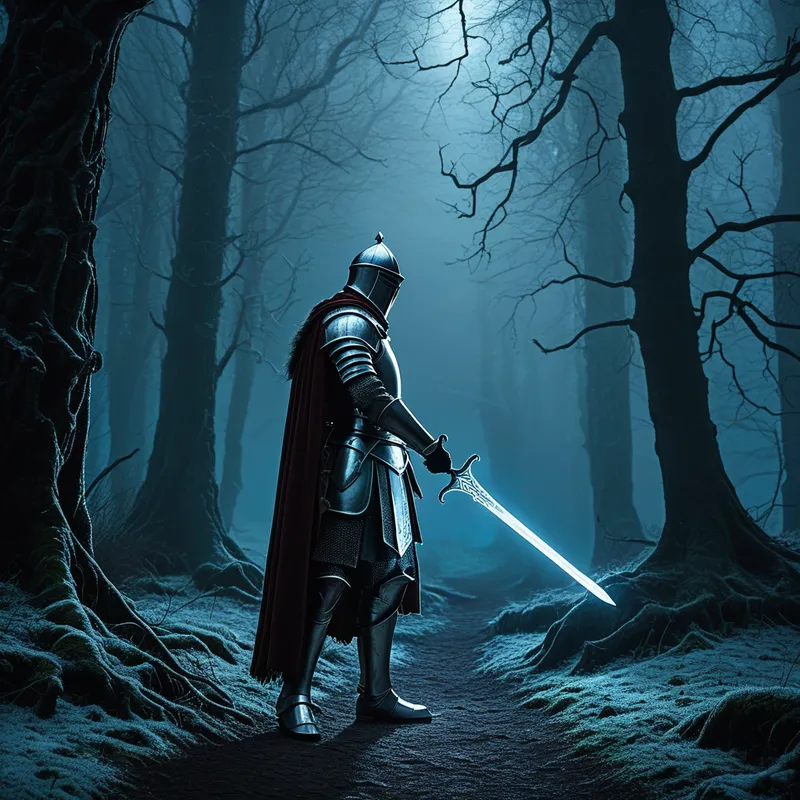
A knight faces a spectral fork in a haunted wood, where his choice reveals not the path, but the true nature of the traveler.
The Tale of The Fork in the Perilous Forest
Listen, and hear a tale not of a [grail](/myths/grail “Myth from Christian culture.”/), but of a choice. It is whispered in the deep places, in the Perilous Forest, where the sun’s fingers are weak and the trees remember the footsteps of giants. Here, where [the world](/myths/the-world “Myth from Tarot culture.”/) grows thin, a knight errant travels—not a name you would know, for his name is lost, and that is the point. He is Every-Knight, his shield scarred, his heart heavy with a quest not yet fully formed in his mind.
The air is cold and tastes of damp earth and old magic. The path, a mere suggestion between mossy stones and grasping roots, winds ever deeper. The light fails, not to darkness, but to a perpetual twilight, a green-grey gloom where things move just at the edge of sight. He feels watched. The forest breathes with him. Then, he sees it.
The path does not split. It is cleaved. Before him, [the way](/myths/the-way “Myth from Taoist culture.”/) becomes two with a finality that stops his breath. This is no ordinary fork. The left path is bathed in a soft, impossible gold, as if a piece of noon has been sewn into the fabric of the gloom. It looks safe, welcoming. The right path plunges into a deeper murk, a tunnel of thorn and shadow, from which a cold draft whispers of damp stone and forgotten things.
As he stands, paralyzed, the fork itself begins to shift. It is not the path, but a presence. From the nexus of the two ways, a form coalesces from mist and leaf-shadow—a spectral figure, a Genius Loci of [the crossroads](/myths/the-crossroads “Myth from Celtic culture.”/). It wears the semblance of an ancient hermit, yet its eyes are the color of the forest floor, holding no human warmth. Its voice is the sound of wind through bare branches.
“Choose, son of man,” it intones. “But know this: you do not choose the path. You choose the knight who will walk it. The path chooses the man you reveal yourself to be.”
The knight’s hand goes to his sword hilt, but the gesture feels hollow. His quest, his pride, his very identity shrink before this simple, terrifying ultimatum. He looks at the golden path and thinks of honor, of swift completion, of returning to Camelot a proven hero. He looks at the shadowed path and feels a dread that is also a strange, magnetic pull—a sense of something true waiting in the dark, something that belongs to him alone.
His choice is not a step, but a surrender. He does not reason. He closes his eyes, and when he opens them, his feet are moving. He takes the shadowed path.
And as he does, the golden path vanishes as if it were never there. The thorny way ahead seems to soften, not into ease, but into a stark, honest clarity. The whispering ceases. The watching presence dissipates, its purpose fulfilled. The knight walks on, not lighter, but truer. The forest is still perilous, but the peril is now known. He chose, and in choosing, he met [the self](/myths/the-self “Myth from Jungian culture.”/) that was capable of the choice. The quest is no longer outside him. It is the walking of the path itself.
Cultural Origins & Context
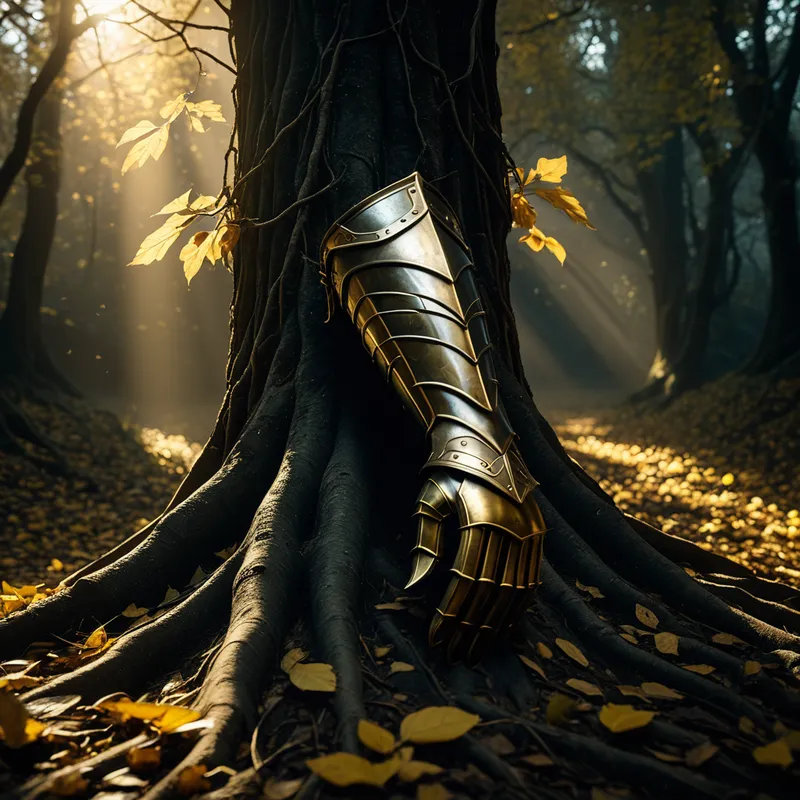
This tale exists in the margins of the great Arthurian cycles, a folktale haunting the edges of Le Morte d’Arthur. It was not sung in the great halls by trouveres, but muttered by firesides by woodsmen, whispered by hermits, and told by seasoned knights to wide-eyed squires as a warning and a riddle. Its function was not to chronicle history, but to model a psychological ordeal.
In a culture obsessed with external quests—for [the Grail](/myths/the-grail “Myth from Arthurian culture.”/), for a magical sword, for a defeated enemy—this myth turns the gaze inward. The Perilous Forest itself is the ultimate symbol of the unconscious, the untamed wilderness within and without the bounds of Christianized Camelot. The fork, and its guardian, represent the critical junctures of fate that are less about destiny imposed and more about character revealed. It served as a narrative container for the terrifying truth that the greatest adventure is not slaying a dragon, but facing the ambiguity of one’s own soul.
Symbolic Architecture
The myth’s power is not in the [knight](/symbols/knight “Symbol: The knight symbolizes honor, chivalry, and the pursuit of noble causes, reflecting the ideal of the noble warrior.”/)’s [action](/symbols/action “Symbol: Action in dreams represents the drive for agency, motivation, and the ability to take control of situations in waking life.”/), but in the [nature](/symbols/nature “Symbol: Nature symbolizes growth, connectivity, and the primal forces of existence.”/) of the [choice](/symbols/choice “Symbol: The concept of choice often embodies decision-making, freedom, and the multitude of paths available in life.”/) presented. The fork is not a dilemma between good and evil, but between the [persona](/symbols/persona “Symbol: The social mask or outward identity one presents to the world, often concealing the true self.”/) and the [shadow](/symbols/shadow “Symbol: The ‘shadow’ embodies the unconscious, repressed aspects of the self and often represents fears or hidden emotions.”/).
The golden, inviting [path](/symbols/path “Symbol: The ‘path’ symbolizes a journey, choices, and the direction one’s life is taking, often representing individual growth and exploration.”/) symbolizes the [Persona](/myths/persona “Myth from Greek culture.”/)—the socially acceptable, laudable, and seemingly safe self. It promises validation, a clear heroic narrative, and a return to the collective (Camelot) unscathed. The shadowed, thorny [path](/symbols/path “Symbol: The ‘path’ symbolizes a journey, choices, and the direction one’s life is taking, often representing individual growth and exploration.”/) is the call of the Shadow. It is not “evil,” but all that the conscious self has deemed too dark, too difficult, or too personal to integrate: fear, uncertainty, unique calling, and unvarnished [truth](/symbols/truth “Symbol: Truth represents authenticity, honesty, and the quest for knowledge beyond mere appearances.”/).
The guardian spirit does not offer a test of strength, but a mirror of being. The choice is an act of self-definition.
The vanishing of the golden path after the choice is the critical alchemical [moment](/symbols/moment “Symbol: The symbol of a ‘moment’ embodies the significance of transient experiences that encapsulate emotional depth or pivotal transformations in life.”/). It signifies that the appealing, false self was an illusion contingent on denial. Once [the shadow](/myths/the-shadow “Myth from Jungian culture.”/) is acknowledged and engaged, the simplistic, binary [option](/symbols/option “Symbol: Options in dreams symbolize choices or paths in life, reflecting the dreamer’s current decision-making situations.”/) collapses. One is committed to the complexity of [reality](/symbols/reality “Symbol: Reality signifies the state of existence and perception, often reflecting one’s understanding of truth and life experiences.”/), where light and dark are intertwined in the single path of individuation.
The Dreamer’s Resonance
When this myth pattern arises in modern dreams—as a fork in a road, a choice between two doors, or a decision with opaque consequences—it signals a somatic crossroads in the dreamer’s life. The body-mind is processing a deep, identity-shifting choice that logic alone cannot resolve.
The anxiety in the dream is not about making a “wrong” choice in the worldly sense, but about the death of a former self. The golden path often represents the expectations of family, career, or society. The shadowed path is the pull of authentic desire, a difficult truth that must be faced, or a creative potential that feels risky to embrace. The dream is the [psyche](/myths/psyche “Myth from Greek culture.”/)’s ritual space to rehearse this confrontation with the Shadow-guardian. The resolution, if the dream allows it, is not a vision of success on the chosen path, but the simple, profound act of choosing the harder, more truthful way. The feeling upon waking may be one of solemn clarity or resonant unease, the signature of [the ego](/myths/the-ego “Myth from Jungian culture.”/) having touched a deeper layer of the Self.

Alchemical Translation
The myth is a perfect model for the Individuation process. The knight’s journey into the forest is the [nigredo](/myths/nigredo “Myth from Alchemical culture.”/), the descent into the darkness of the unconscious. The fork is the moment of [separatio](/myths/separatio “Myth from Alchemical culture.”/), where components of the self must be distinguished. The spectral guardian is the archetypal Senex in its neutral, ruthless aspect, enforcing a necessary discrimination.
Choosing the shadowed path is the mortificatio—the symbolic death of the naive ego attached solely to its shining persona. This death, however, is the precondition for albedo, the whitening. The path does not become easy, but it becomes “his.” The clarity that follows is the illumination of having aligned with a deeper will.
The triumph is not in reaching a destination, but in becoming the traveler who can bear the journey. The transformed knight is not the one who found a treasure, but the one who lost an illusion.
For the modern individual, the alchemy occurs when we recognize our own “Perilous Forests”—times of career change, relational endings, creative blocks, or spiritual crises. The myth instructs us that the goal is not to avoid the fork, but to stand before it fully, to listen to the cold whisper of the guardian (our own deepest intuition), and to choose not the path of least resistance, but the path of most integrity. In that act of courageous self-revelation, we perform the ancient magic: we transmute confusion into direction, and a wandering knight into a sovereign soul, walking the one, true path that has been waiting for him all along.
Associated Symbols
Explore related symbols from the CaleaDream lexicon: