The Fante Sea Spirits Myth Meaning & Symbolism
A West African myth where the spirits of the departed dwell in the sea, guiding the living through dreams and the liminal tides of memory.
The Tale of The Fante Sea Spirits
Listen. The land ends, but the story does not. Where the red earth of the Fante coast meets the endless breath of the Atlantic, there is a threshold. It is a place of salt, of sighing waves, and of memory older than the oldest baobab.
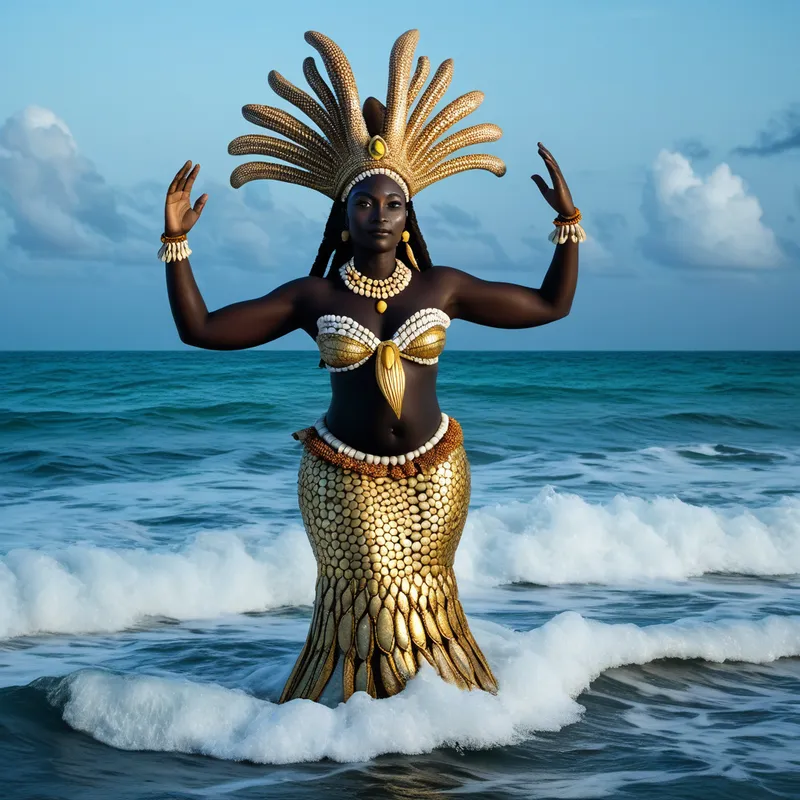
In the beginning, it is said, the first people knew no permanent death. When the body grew weary, the kra would simply slip away, not to a distant sky, but to the cool, dark cradle of the sea. There, in the silent halls of the deep, they became the Nsamanfo of the waters—the Sea Spirits. They did not forget the world above. They remembered the taste of palm wine, the rhythm of the talking drum, the warmth of the cooking fire on the shore.
The conflict was not one of battle, but of distance. The living, on the sun-baked land, would grieve. They would cast their eyes over the vast, empty blue and feel a chasm of silence. The spirits, in their aqueous realm, felt the pull of that grief like a tide. They wished to console, to guide, to remind their children that the circle was unbroken. But the veil between worlds was as deep and dark as the ocean trench.
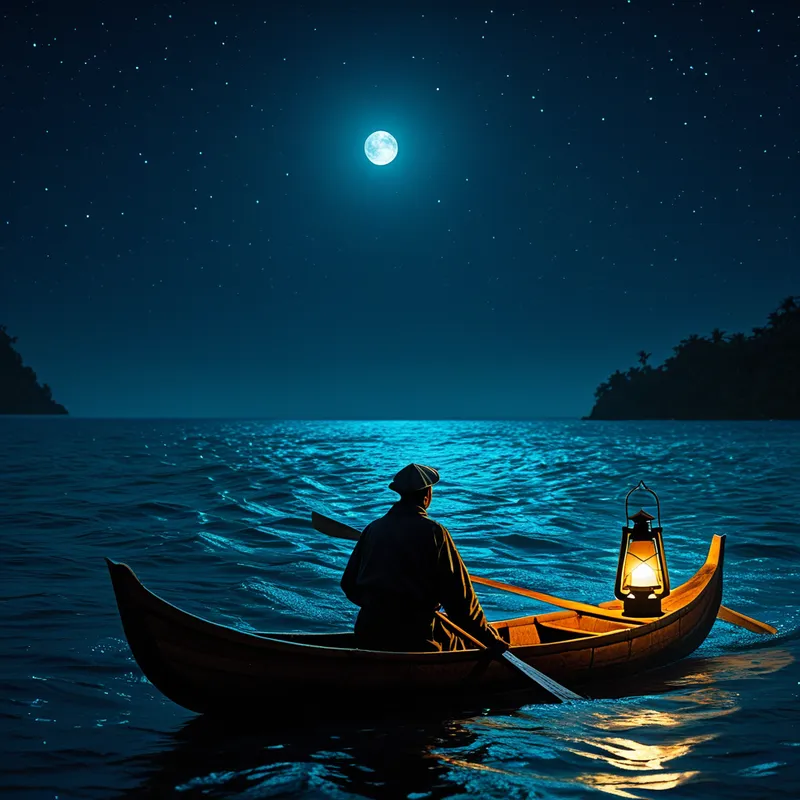
The rising action was a quiet, persistent yearning. On nights when the moon laid a silver path on the black water, a fisherman, alone in his canoe, might feel a profound calm descend. The sea, usually churning with its own mysteries, would grow still as glass. In that stillness, he would not see monsters, but shapes—familiar yet elusive. The curve of a smile his grandmother wore, the particular slope of his father’s shoulder as he paddled. He would hear, not with his ears but with his bones, the echo of a song sung at his naming ceremony. The water itself became a mirror, not showing his own face, but the faces of those who came before.
Sometimes, the connection was more direct. A storm would threaten to dash the village canoes to splinters. As the people prayed on the shore, an elder would wade into the surf, pouring libations of gin and scattering white cowrie shells. He would call out the sacred names of the clan. And the storm, as if soothed by a lullaby, would split and pass around the village, leaving it untouched. The sea, which could take life, was also the dwelling of the protectors of life.
The resolution is not an ending, but an understanding woven into the fabric of daily life. Death became not a departure to a foreign land, but a return to a familiar, if hidden, home. The ocean was no longer just a source of food or a barrier to cross; it was the great, breathing archive of the people. The spirits did not demand temples of stone, but remembrance. A portion of the first catch was always returned to the waves. Stories were told not just of their lives on land, but of their continued watchfulness from the water. The threshold remained, but it became a place of conversation, a sacred interface where memory flowed in both directions, as constant and necessary as the tide.
Cultural Origins & Context
This myth springs from the soul of the Fante, a people whose world is literally defined by the coastline. Their history, economy, and cosmology are inextricably linked to the Atlantic Ocean. The myth of the Sea Spirits is not a singular, fixed story with one canonical version, but a living narrative ecosystem passed down through oral tradition—by elders, storytellers (griots), and priests of the aquatic deities, most notably those of Mami Wata.
Its societal function is multifaceted. Psychologically, it is a profound grief-management system, transforming the terrifying finality of death into a transition to a neighboring, accessible realm. It alleviates the existential terror of loss by placing the departed literally “just out of sight,” in a domain the community interacts with daily. Sociologically, it reinforces clan identity and continuity. The ancestors in the sea are the ultimate custodians of tradition and law; their perceived approval or disapproval, communicated through dreams, omens, or the health of the fishing harvest, guides social conduct. Ecologically, it embeds a principle of sacred reciprocity with the marine environment. You cannot take from the sea without giving back, for it is quite literally the home of your family. This myth provided a spiritual framework for sustainable practice long before the term was coined.
Symbolic Architecture
The myth’s power lies in its dense symbolic layering, mapping the geography of the [soul](/symbols/soul “Symbol: The soul represents the essence of a person, encompassing their spirit, identity, and connection to the universe.”/) onto the physical [landscape](/symbols/landscape “Symbol: Landscapes in dreams are powerful symbols representing the dreamer’s emotional state, personal journey, and the broader context of life situations.”/).
The [Ocean](/symbols/ocean “Symbol: The ocean symbolizes the vastness of the unconscious mind, representing deeper emotions, intuition, and the mysteries of life.”/) is the primary [symbol](/symbols/symbol “Symbol: A symbol can represent an idea, concept, or belief, serving as a powerful tool for communication and understanding.”/)—it is the [collective unconscious](/symbols/collective-unconscious “Symbol: The Collective Unconscious refers to the part of the unconscious mind shared among beings of the same species, embodying universal experiences and archetypes.”/), the vast, salty [womb](/symbols/womb “Symbol: A symbol of origin, potential, and profound transformation, representing the beginning of life’s journey and the unconscious source of creation.”/) of all potential and [memory](/symbols/memory “Symbol: Memory symbolizes the past, lessons learned, and the narratives we construct about our identities.”/) where individual [consciousness](/symbols/consciousness “Symbol: Consciousness represents the state of awareness and perception, encompassing thoughts, feelings, and experiences.”/) dissolves and is reconstituted. It is the [realm](/symbols/realm “Symbol: The symbol of ‘Realm’ often signifies the boundaries of one’s consciousness, experiences, or emotional states, suggesting aspects of reality that are either explored or ignored.”/) of the [shadow](/symbols/shadow “Symbol: The ‘shadow’ embodies the unconscious, repressed aspects of the self and often represents fears or hidden emotions.”/), not as a dark menace, but as a deep, nurturing [reservoir](/symbols/reservoir “Symbol: A contained body of water representing stored resources, emotions, or potential, often signifying controlled or suppressed aspects of the self.”/) of ancestral wisdom.
The Shoreline is the liminal [space](/symbols/space “Symbol: Dreaming of ‘Space’ often symbolizes the vastness of potential, personal freedom, or feelings of isolation and exploration in one’s life.”/), the ego-consciousness that defines itself against the boundless deep. It is the razor’s edge between the known world of the individual and the unknown collective realm of the ancestors.
To stand at the shore is to stand at the border of your own being, feeling the pull of all you come from and all you will return to.
The Sea Spirits (Nsamanfo) represent the integrated ancestral complex within the psyche. They are not ghosts to be feared, but internalized guides—the voices of experience, tradition, and DNA that whisper from the [depths](/symbols/depths “Symbol: Represents the subconscious, hidden emotions, or foundational aspects of the self, often linked to primal fears or profound truths.”/) of our own [nature](/symbols/nature “Symbol: Nature symbolizes growth, connectivity, and the primal forces of existence.”/). The cowrie [shell](/symbols/shell “Symbol: Shells are often seen as symbols of protection, transition, and the journey of personal growth.”/), with its [water](/symbols/water “Symbol: Water symbolizes the subconscious mind, emotions, and the flow of life, representing both cleansing and creation.”/)-born [origin](/symbols/origin “Symbol: The starting point of a journey, often representing one’s roots, source, or initial state before transformation.”/) and resemblance to a watching eye or a vulva, symbolizes divine feminine wisdom, prosperity, and the [portal](/symbols/portal “Symbol: In dreams, a portal symbolizes a passage to new experiences, dimensions, or aspects of the self.”/) through which [life](/symbols/life “Symbol: The symbol of ‘Life’ represents a journey of growth, interconnectedness, and existential meaning, encompassing both the joys and challenges that define human experience.”/) emerges and souls return.
The [Fisherman](/symbols/fisherman “Symbol: Represents exploration of emotional depths and the pursuit of desires, often reflecting patience and skill.”/)’s Canoe is the [vehicle](/symbols/vehicle “Symbol: Vehicles in dreams often symbolize the direction in life and the control one has over their journey, reflecting personal agency and decision-making.”/) of the seeking ego, venturing into the unconscious (the deep waters) to retrieve sustenance ([insight](/symbols/insight “Symbol: A sudden, deep understanding of a complex situation or truth, often arriving unexpectedly and illuminating hidden connections.”/), meaning). The perilous [night](/symbols/night “Symbol: Night often symbolizes the unconscious, mystery, and the unknown, representing the realm of dreams and intuition.”/) [journey](/symbols/journey “Symbol: A journey in dreams typically signifies adventure, growth, or a significant life transition.”/) signifies the courage required to engage with the depths of one’s own soul and [history](/symbols/history “Symbol: History in dreams often represents the dreamer’s past experiences, lessons learned, or unresolved issues that continue to influence their present.”/).
The Dreamer’s Resonance
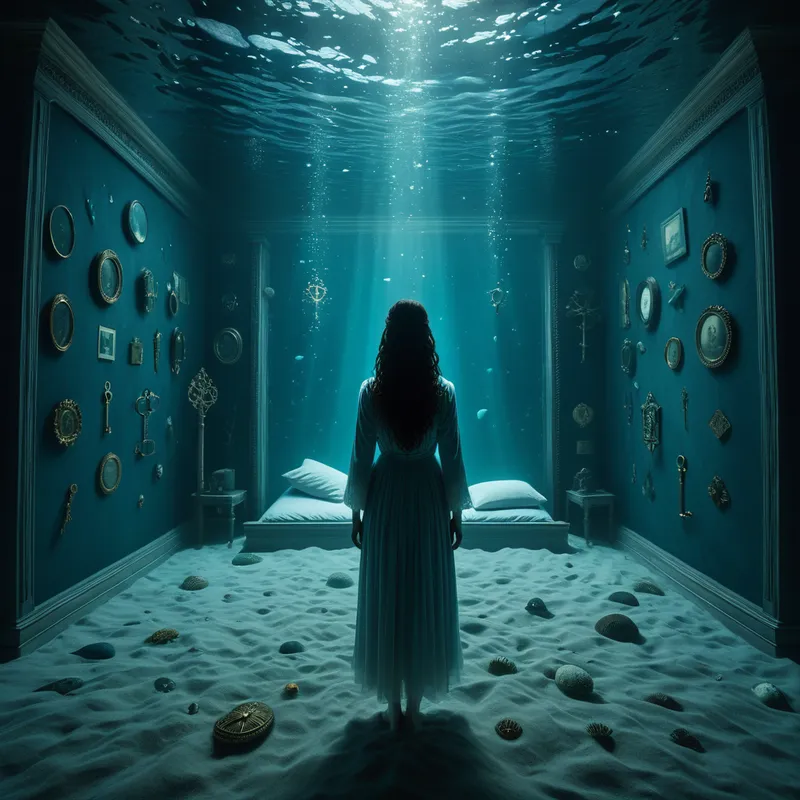
When this myth pattern stirs in the modern dreamer, it often signals a profound engagement with the ancestral layer of the psyche. It is not merely about missing deceased relatives. To dream of serene faces in deep water, of being guided through a storm by unseen presences, or of finding familiar objects on an ocean floor is to experience what Jung called the “ancestral memory” or the “collective layer” of the unconscious breaking through.
The somatic process is one of deep, rhythmic calming—a feeling of being held by something vast and ancient. Psychologically, the dreamer is often at a life threshold: a birth, a death, a major decision, or a crisis of identity. The psyche, in its wisdom, reaches back into the “sea” of inherited patterns, strengths, and traumas to find resources. The dream may be facilitating a process of healing generational wounds or integrating disowned lineage. The appearance of the Sea Spirits in dreams suggests the unconscious is offering connection, context, and a sense of belonging to a story larger than the individual’s lifespan. It is the soul’s way of remembering its own origins.
Alchemical Translation
The alchemical journey modeled here is the transmutation of grief into guidance, and of isolation into belonging. The prima materia, the base substance, is the raw pain of separation and the fear of mortality. The myth provides the vas (vessel)—the symbolic ocean—in which this transformation can occur.
The first stage (nigredo) is the confrontation with the depth itself: the feeling of being unmoored, of staring into the abyss of loss or existential uncertainty. The myth assures us this abyss is not empty; it is populated.
The second stage (albedo) is the reflection, the moonlit moment of stillness where the “mirror” of the water reveals the ancestral faces. This is the illumination, the realization that what we seek (wholeness, identity, answers) lies in engaging with what we come from. We must learn to “fish” in these depths.
Individuation is not about becoming a solitary island, but about discovering the underground aquifers that connect you to the continental shelf of humanity.
The final stage (rubedo) is the integration, symbolized by the elder performing the shoreline libation. This is the conscious ritual that acknowledges the connection. For the modern individual, this translates into active engagement with one’s history—genealogical research, understanding family narratives, honoring traditions, or simply internalizing the strengths of one’s forebears. The “gold” produced is not material wealth, but a profound sense of psychic anchorage. You are no longer a solitary wave, but a conscious participant in the eternal rhythm of the ocean of being. The Sea Spirits myth guides us to find our place in the great, salt-blooded lineage of life itself.
Associated Symbols
Explore related symbols from the CaleaDream lexicon:
- Ocean — The vast, collective unconscious and the ancestral realm; the source of all life and the final resting place, symbolizing the depth of memory and the unknown.
- Ancestral Spirits — The direct manifestation of the Nsamanfo, representing the internalized guides, inherited wisdom, and unresolved patterns that dwell within the psyche’s depths.
- Mirror — The surface of the calm sea, representing the threshold to the spirit world and the tool for self-reflection that reveals not just the self, but the faces of those who formed it.
- Threshold — The shoreline where land meets sea, embodying the liminal state of consciousness during ritual, dream, or meditation where communication between worlds becomes possible.
- Memory — The essential substance of the Sea Spirits’ realm; the preserved experiences, emotions, and knowledge of the lineage that washes up into present awareness.
- Fish — The sustenance and insights drawn from the ancestral depths; the bounty retrieved by the courageous ego venturing into the unconscious.
- Ritual — The libation poured upon the waves, representing the conscious, formal act of honoring and maintaining the connection between the living and the ancestral sea.
- Dream — The primary vessel for modern encounters with the Sea Spirits, the nocturnal canoe journey where the psyche navigates the waters of ancestral memory.
- Healing — The ultimate gift of the myth, the process by which engagement with the ancestral sea salves the wounds of separation and fosters psychic wholeness.
- Journey — The fisherman’s voyage, symbolizing the soul’s necessary expedition into the depths of its own history and the collective past to retrieve meaning.