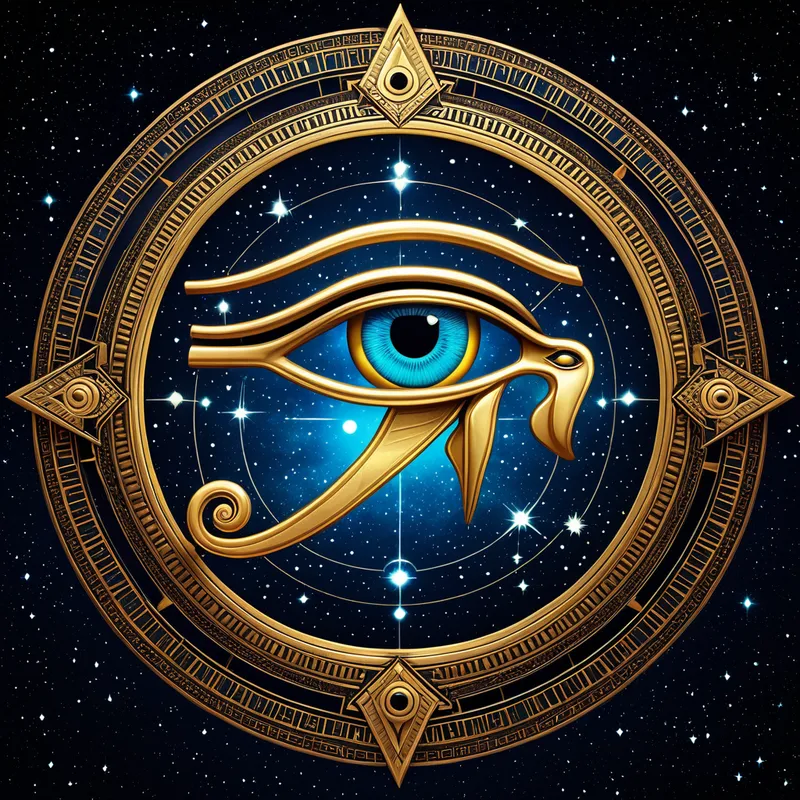
The Eye of Horus - the all-see Myth Meaning & Symbolism
A myth of cosmic theft, divine vengeance, and ultimate restoration, where a fragmented eye becomes the ultimate symbol of wholeness, protection, and restored perception.
The Tale of The Eye of Horus - the all-see
Listen, and hear the tale written in the silt of the Nile and the light of the stars. Before the world knew its name, in the time when gods walked with the weight of kingdoms on their shoulders, there was a great conflict that shook the pillars of the sky.
It began not with a whisper, but with a scream of usurpation. Set, whose heart was a tempest of envy and ambition, coveted the throne of the Two Lands. He looked upon his brother Osiris, the wise and green king, and saw not a ruler, but a prize to be taken. Through cruel trickery, Set struck, trapping Osiris in a chest and casting him into the Nile’s dark currents, scattering his divine essence. The world wept.
From this grief rose a fury clad in feathers. Horus, son of the slain Osiris, his eyes twin suns of righteous wrath, challenged Set for the legacy of his father. Their battle was not of mere armies, but of elements. They became beasts of power: a black boar of desolation against a falcon whose wings blotted out the sun. The air crackled with their divine rage, and the desert sands drank their spilled ichor.
In the fiercest clash, a tragedy was etched into eternity. Set, in a move of brutal cunning, reached out and tore the very light from Horus’s face—his left eye, the Wedjat. It was no mere injury. This eye was a cosmos in miniature, a vessel of perception, sovereignty, and sacrificial power. As it was plucked forth, a piece of the universal order shattered. Horus reeled, his world halved in agony, his divine sight cast into the realm of fragments.
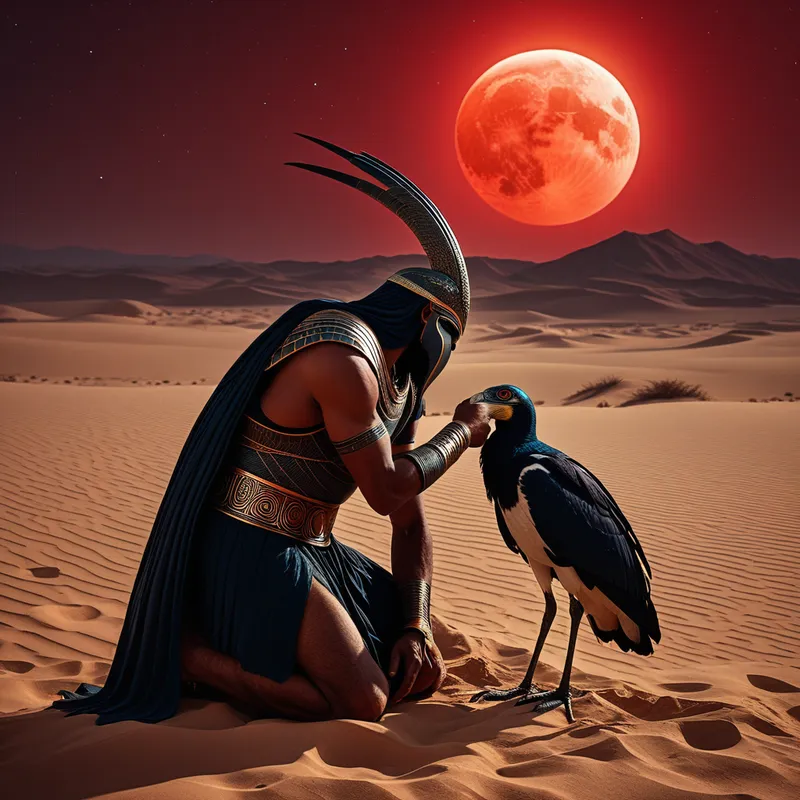
But the story does not end in darkness. For where there is fragmentation, the impulse toward wholeness stirs. The ibis-headed Thoth, scribe of the gods, healer of the broken word, descended. With hands that knew the geometry of stars and the grammar of healing, he sought the pieces. He gathered the luminous fragments from the bloodied sand and the chaotic winds where Set had scattered them. Through incantations older than time, Thoth performed the first act of cosmic restoration. He pieced the eye back together, not as it was, but as it could be—whole, yet forever marked by its journey.
And when Thoth presented the restored Wedjat to Horus, it was not a simple return. It was an offering, a testament. Horus, in an act that defined his kingship, did not keep this hard-won wholeness for himself. He offered it to his father, Osiris, in the silent depths of the Duat. That single act—the gift of a restored eye to a restored king—did more than heal a wound. It made Osiris whole in the afterlife, it secured the throne for rightful order, and it transformed the Wedjat from a wounded organ into the ultimate symbol. It became the Eye of Horus - the all-see, a protector of pharaohs, a measurer of truth, and a beacon that declared: what is shattered can be made sacred.
Cultural Origins & Context
This myth is the bedrock of ancient Egyptian cosmology and kingship ideology. It was not a simple folktale but a state narrative, recited in temple rituals, carved into pyramid texts, and painted on tomb walls to ensure the cosmic order (Maat). The story of Horus and Set explained the perpetual struggle between order and chaos, the desert and the fertile Nile, and the rightful succession of power. The restoration of the Eye legitimized the Pharaoh (the living Horus) and provided a blueprint for resurrection in the afterlife. It was a myth performed, a sacred drama ensuring the sun would rise and the Nile would flood.
Symbolic Architecture
The myth is a profound map of psychic injury and integration. The Eye is not just a body part; it is the faculty of conscious perception, insight, and spiritual sovereignty.
To lose the Eye is to suffer a fragmentation of the Self—a theft of one’s perspective, wholeness, and power by the chaotic, shadowy forces (Set) within or without.
Set represents the disruptive, envious, and violent aspect of the psyche that attacks our center of understanding, often after a trauma or betrayal (the loss of Osiris). The tearing out is the experience of psychological devastation, where one’s worldview is shattered.
Thoth symbolizes the mediating, intellectual, and healing function of consciousness. He is the archetype of the therapist or the inner wisdom that patiently collects the scattered pieces of a broken identity, memory, or trust. The restoration is not a return to a naive, pre-injured state, but a reconstruction. The healed Eye is wiser, more complex, and bears the marks of its history.
Finally, Horus’s offering of the Eye to Osiris is the critical alchemical step. It represents sacrificing the reintegrated consciousness—not to an external god, but to the deeper, ancestral, or spiritual Self (the Osiris within). The act transforms personal healing into a sacred function, making the restored perception a tool for nourishing the soul and upholding inner order.
The Dreamer's Resonance
When this myth pattern stirs in modern dreams, it often signals a profound process of psychic reassembly. Dreaming of a damaged or stolen eye, searching for missing pieces of a valuable object, or encountering a figure who offers to mend something broken—these are somatic echoes of the Wedjat’s journey.
The dreamer may be undergoing a period where their perception of themselves, a relationship, or their life path has been violently disrupted (the Set attack). The dream work is the Thoth function: the unconscious is actively gathering disparate experiences, memories, and feelings to rebuild a coherent sense of self. There is often a somatic feeling of searching, piecing together, or a slow, deliberate healing. The dream may culminate in a moment of offering—presenting the healed "thing" to a wise elder, a tomb, or an altar—symbolizing the dreamer’s readiness to dedicate their hard-won insight to a purpose greater than mere ego repair.

Alchemical Translation
The myth models the complete arc of individuation—the Jungian process of becoming an integrated, whole individual. The initial state is one of identified righteousness (Horus the Avenger), which is inevitably attacked by the shadow (Set). The ensuing loss is the necessary nigredo, the dark night of the soul where one’s guiding light is extinguished.
The alchemical work is in the gathering. Each recovered fragment of the Eye is a reclaimed piece of one’s history, a denied talent, a buried trauma, or a lost perspective. Thoth’s magic is the conscious, patient work of analysis, reflection, and synthesis.
The final offering is the rubedo, the reddening, where the achieved gold of personal wholeness is surrendered to the transpersonal. It is the realization that true restoration is not for the small self alone. The integrated perception (the all-seeing Eye) must be placed in service to the nourishing of the deeper, eternal Self (Osiris). In modern terms, this is when personal healing translates into wisdom, mentorship, creative expression, or any action that feeds the soul and contributes to the "cosmic order" of one’s community and inner world. The Eye, once wounded and reclaimed, becomes the ultimate protector—not from external harm, but from inner disintegration. It is the symbol that we are not destroyed by our fractures; we are defined by our restoration.
Associated Symbols
Explore related symbols from the CaleaDream lexicon: