
The Exu in Brazil Myth Meaning & Symbolism
The myth of Exu, a Yoruba deity of crossroads and communication, embodies the necessary chaos that precedes order and the shadow that holds the key to the self.
The Tale of The Exu in Brazil
Listen. There is a place where the world is stitched together. Not in the grand cathedrals or the quiet hearts of homes, but in the dust. Where one path, worn by the feet of farmers, meets another, trod by merchants and messengers. This is the crossroads. And here, he waits.
He is the first breath before a word is spoken. The spark that leaps from flint before the fire is lit. He is the moment of choice, suspended between “yes” and “no,” between staying and going. His name is a vibration on the air: Exu. Do not picture a man, nor a beast, but the force that exists in the meeting. His colors are the black of fertile earth and the red of life’s vital pulse. In his hand, he carries a trident, not to wound, but to point the way—all ways at once.
Before anything can begin, he must be acknowledged. The story goes that in the beginning, the mighty [Olodumare](/myths/olodumare “Myth from Yoruba culture.”/) gave a task to the Orixás. “Build a world,” he said. But each Orixá, in their domain of river, forest, or thunder, worked alone. Their gifts piled up in silence, beautiful but separate. No song reached the sky; no prayer found its mark. The world was a collection of splendid, isolated rooms with no corridors between them.
A great stillness, a paralysis of potential, settled over creation.
Then, from the margins, Exu stirred. He went not to the grand works, but to the spaces in between. He whispered to the wind at the river’s edge, and the wind carried a leaf to the forest. He nudged a stone from the mountain onto the path to the village. He was the dropped tool that caused a meeting, the misunderstood message that sparked a debate, the sudden impulse to take the unfamiliar trail. Chaos, beautiful and necessary, rippled out from his footsteps.
The Orixás grew frustrated. “Our works are disrupted!” cried the orderly ones. “Our plans are undone!” lamented the wise. They complained to Olodumare, blaming Exu for the disorder. The creator listened, then asked a simple question: “Without the space between, can the drum speak to the dancer? Without the messenger, can the king’s word reach the people?”
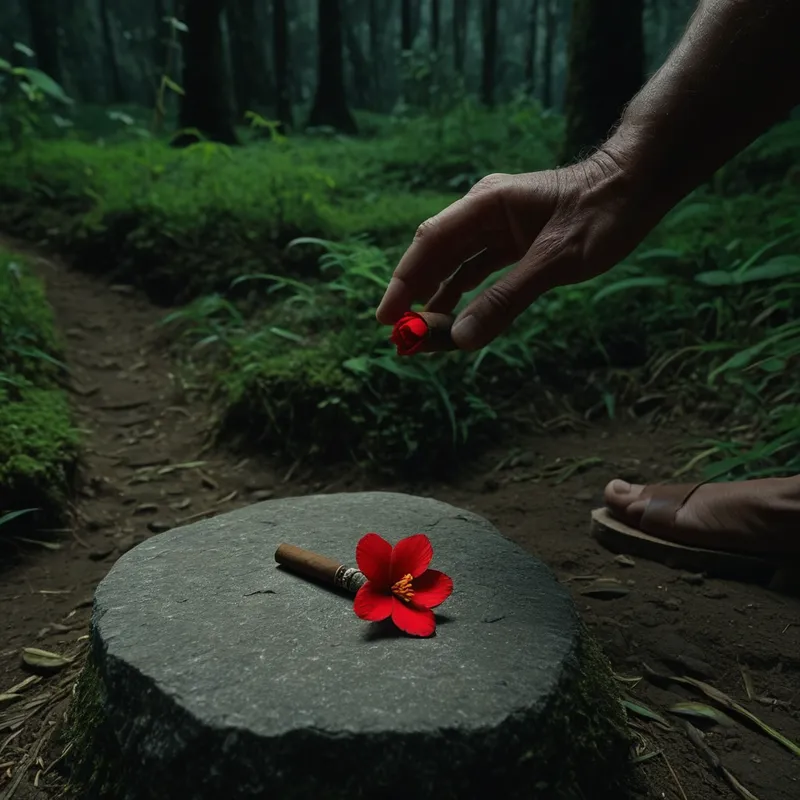
Understanding dawned, slow and profound. They saw that Exu was the space between. He was the messenger, the path, the very principle of connection and dynamism. Without him, there could be no exchange, no ritual, no life. From that day, it was decreed: no offering, no prayer, no ceremony for any Orixá could begin without first offering respect to Exu. He opens the way. He carries the word. He translates the divine into the language of the world, and the pleas of the world into the ears of the divine.
He is the guardian of the threshold, the master of the beginning. To meet him is to stand at your own crossroads, feeling the pull of every possible future in the dust beneath your feet.
Cultural Origins & Context
This is not a myth frozen in a distant past. It is a living, breathing narrative carried across the Atlantic in the memories, muscles, and souls of enslaved Yoruba people. In the brutal hold of the slave ship, the gods did not die; they transformed. The crossroads became the precarious intersection of African memory and Brazilian reality. Exu, ever the translator, adapted.
In the new world, Exu found expression in the syncretic heart of Afro-Brazilian religions: Candomblé and later, Umbanda. Here, the myth served a critical, dual societal function. First, it was a theology of resistance and preservation. By insisting that all communication must go through Exu, the tradition safeguarded its African core while appearing to venerate Catholic saints (Exu was often superficially identified with the Devil, a profound misreading that speaks to colonial fear of this ambiguous power).
Second, it provided a profound psychological framework for navigating an unpredictable and often hostile world. Exu embodied the reality of chance, accident, opportunity, and misunderstanding. To honor him was to acknowledge life’s inherent unpredictability and to seek agency within it, not through rigid control, but through skillful engagement with the moment of choice. He was the divine principle of street-smarts, of cultural improvisation, of making a way out of no way.
Symbolic Architecture
Exu is the archetypal embodiment of the liminal. He is not the [destination](/symbols/destination “Symbol: Signifies goals, aspirations, and the journey one is on in life.”/), but the [journey](/symbols/journey “Symbol: A journey in dreams typically signifies adventure, growth, or a significant life transition.”/) to it. He is not the message, but the act of sending it. Psychologically, he represents the function of the psyche that mediates between the unconscious and the conscious, between instinct and [intention](/symbols/intention “Symbol: Intention represents the clarity of purpose and direction in one’s life and can symbolize motivation and commitment within a dream context.”/), between the [shadow](/symbols/shadow “Symbol: The ‘shadow’ embodies the unconscious, repressed aspects of the self and often represents fears or hidden emotions.”/) and the [persona](/symbols/persona “Symbol: The social mask or outward identity one presents to the world, often concealing the true self.”/).
The key is not found in the locked room of the self, but in the chaotic hallway that connects all rooms. Exu is that hallway.
His trident symbolizes this triadic [nature](/symbols/nature “Symbol: Nature symbolizes growth, connectivity, and the primal forces of existence.”/): past, present, future; conscious, unconscious, collective; or the three roads that meet at a point of [decision](/symbols/decision “Symbol: A decision in a dream reflects the choices one faces in waking life and can symbolize the pursuit of clarity and resolution.”/). His association with the [crossroads](/symbols/crossroads “Symbol: A powerful spiritual symbol representing a critical decision point where paths diverge, often associated with fate, transformation, and life-altering choices.”/) is the ultimate [symbol](/symbols/symbol “Symbol: A symbol can represent an idea, concept, or belief, serving as a powerful tool for communication and understanding.”/) of free will and consequence. He holds no moral judgment on the [path](/symbols/path “Symbol: The ‘path’ symbolizes a journey, choices, and the direction one’s life is taking, often representing individual growth and exploration.”/) you choose, only ensures that the [choice](/symbols/choice “Symbol: The concept of choice often embodies decision-making, freedom, and the multitude of paths available in life.”/) is possible and that its results are communicated throughout the [system](/symbols/system “Symbol: A system represents structure, organization, and interrelated components functioning together, often reflecting personal or social order.”/) of your being.
Most critically, Exu represents the shadow—not as evil, but as the vital, amoral, energetic counterpart to our civilized ego. He is our repressed impulses, our cunning, our lust, our anger, and our [capacity](/symbols/capacity “Symbol: A measure of one’s potential, limits, or ability to contain, process, or achieve something, often reflecting self-assessment or external demands.”/) for necessary deception. To deny him is to cut oneself off from a vast [reservoir](/symbols/reservoir “Symbol: A contained body of water representing stored resources, emotions, or potential, often signifying controlled or suppressed aspects of the self.”/) of [life](/symbols/life “Symbol: The symbol of ‘Life’ represents a journey of growth, interconnectedness, and existential meaning, encompassing both the joys and challenges that define human experience.”/)-force and creativity. To engage with him respectfully is to integrate that power.
The Dreamer’s Resonance
When the figure of Exu or the motif of the potent, charged crossroads appears in modern dreams, it signals a profound somatic and psychological process: the ego stands at a threshold of transformation. This is not a gentle nudge but a necessary crisis.
The dreamer may feel anxiety, exhilaration, or a sense of being “blocked” until a choice is made. The somatic experience can be one of static energy in the body—a buzzing in the limbs, a tightness in the chest—the physical correlate of potential energy seeking release. Psychologically, it is the confrontation with the personal shadow. The dream presents a chaotic, trickster-like figure or an impossibly complex intersection because the conscious mind has reached the limit of its linear planning. The unconscious is demanding recognition of the ambiguous, the paradoxical, and the repressed elements that must be included for the next step in life to be authentic.
The dream is an invitation to make an offering to this inner Exu: to acknowledge the messy, instinctual, and “impolite” parts of oneself that hold the key to forward motion.

Alchemical Translation
The myth of Exu models the indispensable first stage of psychic transmutation, or individuation: the confrontation with and integration of the shadow. The “world” of the isolated Orixás is the psyche where complexes operate in splendid isolation—the inner child, the inner critic, the anima/animus—without communication. This creates inner stagnation, depression, and a life that feels compartmentalized and unreal.
Individuation does not begin with light, but with the respectful acknowledgment of the guardian of the threshold, who is made of our own refused darkness.
The “chaos” Exu introduces is the disturbing but vital upwelling of repressed material: old wounds, forbidden desires, unexpressed rage. The ego, like the orderly Orixás, initially perceives this only as disruption and seeks to blame and suppress it. The alchemical turn is the realization that this chaos is the catalyst. The shadow is not the enemy, but the messenger. The “disorder” is the friction needed to generate the psychic heat for transformation.
To honor Exu first is the ritual act of turning inward and saying, “I see you. I acknowledge your power. Carry my intention.” It is the conscious decision to dialogue with the unconscious, to let the instinctual and the rational communicate. Only when this internal crossroads is activated—when the shadow is engaged—can energy flow, synthesis occur, and the true work of building a cohesive, resilient Self begin. The integrated Exu becomes the inner mediator, the psychic function that allows for fluidity, adaptation, and authentic communication between all parts of our being.
Associated Symbols
Explore related symbols from the CaleaDream lexicon:
- Crossroads — The central symbol of choice, potential, and meeting points, representing the literal and metaphysical domain of Exu where destinies are decided.
- Trickster — The archetype of boundary-breaking, chaos, and necessary disruption that Exu perfectly embodies, challenging rigid order to allow for dynamic growth.
- Shadow — The psychological counterpart to Exu, representing the disowned, instinctual, and potent aspects of the self that must be integrated for wholeness.
- Key — Exu holds the key to openings, doors, and communication, symbolizing access to hidden knowledge, new phases, and the unlocking of blocked potential.
- Door — The threshold guarded by Exu, representing portals between worlds, states of consciousness, and the moment of passage from one phase of life to another.
- Messenger — The core function of Exu, representing communication, the carrying of intent, and the vital connection between different realms of existence.
- Chaos — The dynamic, creative force that Exu governs, which precedes and makes possible new order, breaking stagnation to allow for transformation.
- Fire — The transformative, purifying, and energetic element often associated with Exu, representing the spark of life, will, and catalytic action.
- Dance — The dynamic, rhythmic movement of life and energy that Exu facilitates, symbolizing the fluid negotiation of reality and celebratory engagement with force.
- Mask — A symbol of Exu’s many facets and the persona, representing the necessary roles we play, the ambiguity of identity, and the interface with the world.