The Drum Myth Meaning & Symbolism
A myth where a hero steals the heartbeat of the gods to give humanity the drum, the vessel for prayer, memory, and the soul's voice.
The Tale of The Drum
Listen. Before the world knew its own rhythm, there was only the silence of the earth and the distant, perfect music of the sky. The gods, the Orishas, lived in a realm of pure sound. Their speech was melody, their thoughts were harmony, and the pulse of their very being was a deep, resonant beat that held the cosmos in order. This beat was the first drum. It was not an object, but the living heart of the divine.
On the earth below, humanity walked in a profound quiet. They could see the beauty of creation, feel the wind and the sun, but they could not speak to it. Their prayers were whispers lost on the breeze. Their grief was a silent stone in the throat. Their joy had no wings. They looked to the sky and heard faint echoes of that celestial rhythm, a thunder that promised connection but delivered only separation. A great longing settled in the bones of the people, a homesickness for a home they had never known.
Among them was a man named Ayán. He was not the strongest hunter nor the wisest elder, but he had ears that heard the world’s hidden music—the sap rising in the trees, the termites chewing wood, the secret conversation of stones in the riverbed. Most of all, he heard the echo of the divine drum, a faint, taunting tremor in the soil. This echo became an obsession. It filled his dreams until he woke with his hands twitching, aching to shape the silence.
He knew he could not reach the sky. So he sought the one who could: the great spider, Anansi. In the deep forest, where roots formed ancient thrones, Ayán found him spinning a web that glistened with morning dew and starlight. "I need the heartbeat of the gods," Ayán said, his voice raw with want. Anansi’s many eyes gleamed. It was a foolish, glorious request. A theft from heaven itself.
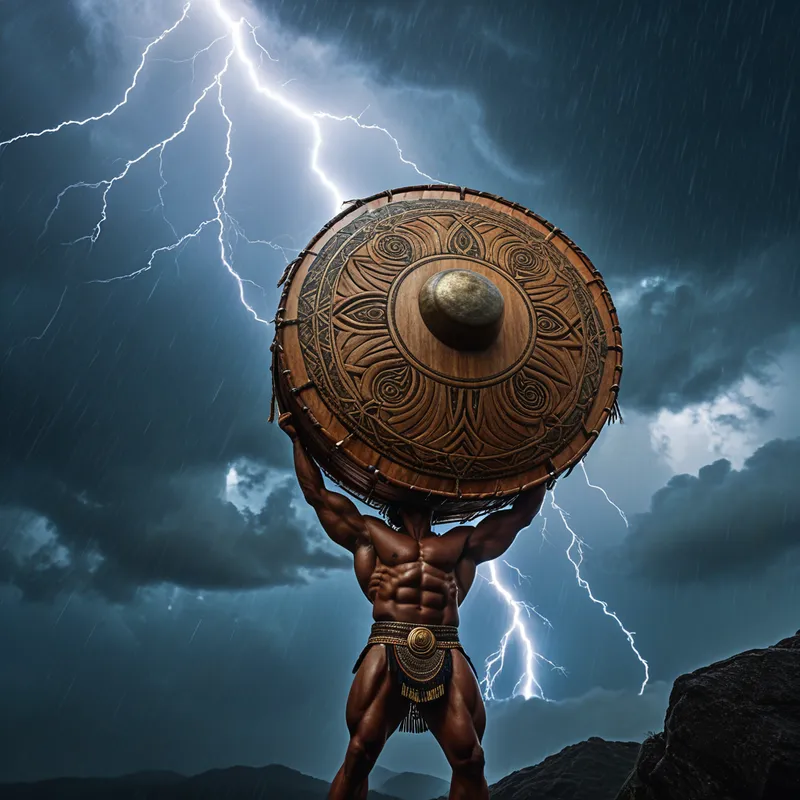
The plan was woven from cunning and danger. Anansi spun a single, impossibly strong thread, light as a sigh and strong as destiny. He attached it to an arrow fashioned from the bone of a silent bird. When the next storm gathered, when the Olorun’s drumming made the firmament shake, Anansi launched the arrow into the heart of the thundercloud. It pierced the sacred rhythm. For a moment, the beat stuttered. And in that stolen silence between pulses, Anansi pulled.
He pulled down not a thing, but a sound. A captured, throbbing note of divine life. It fell to earth like a shooting star, not of light, but of vibration. It struck the base of a great, sacred Iroko tree, which shuddered and sang. Ayán, waiting beneath it, felt the wave pass through him. He took his axe, its blade blessed with silence, and with tears in his eyes, he felled the tree. Not to kill it, but to midwife its transformation.
From the wood, he hollowed a chamber. From the skin of the first goat that came to listen, he stretched a membrane. He shaped, he carved, he prayed. And when he placed his palms upon the skin, the captured sound awoke. Boom. The earth trembled. Ba-boom. The people caught their breath. He played, and the rhythm was no longer distant. It was here. In their chests. In their feet. It was the missing voice of their souls. The gods roared in outrage at the theft, but as the drumbeat spread from village to village, weaving the people into one breathing, dancing body, their anger turned to a grudging, then a gracious, recognition. Humanity had not just stolen a sound; they had completed a circuit. The drum became the altar, the prayer, the memory, and the bridge.
Cultural Origins & Context
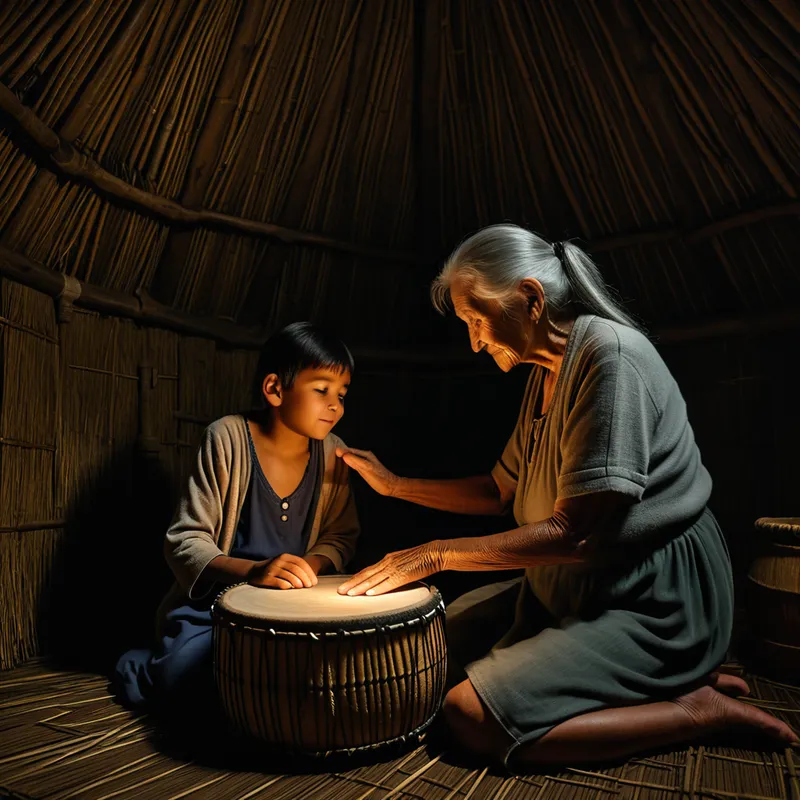
This myth, in its myriad variations, is foundational to the musical and spiritual traditions of West Africa and the Diaspora. It is not a single, fixed story but a deep, resonant motif that echoes from the Yoruba and Akan heartlands to the Candomblé terreiros of Brazil and the Vodou peristyles of Haiti. It was never meant to be read, but to be heard and felt, passed down by griots, drummers, and elders during ceremonies, initiations, and communal gatherings.
Its societal function is multifaceted. Primarily, it is an etiological myth, explaining the sacred origin of the drum itself, elevating it from a mere instrument to a divine relic. It legitimizes the drummer (Ayángalu) as a spiritual technician, a mediator who operates the machinery connecting the human and divine realms. The myth also encodes a profound truth about African cosmologies: the universe is not silent matter, but a dynamic, sonic landscape. Communication with the ancestors and the Orishas/Loa is not a matter of abstract thought, but of correct vibration, of "calling down" the divine through rhythm. The drum is the telephone line to the other world.
Symbolic Architecture
At its core, the myth of The Drum is about the human hunger for authentic voice and the courageous, transgressive act required to obtain it. The celestial drum represents wholeness, divine order, and a pre-conscious state of unity. Humanity’s silent existence symbolizes the individuated ego, separate and longing for reconnection to the Self.
The stolen rhythm is the archetypal theft of fire: the conscious seizure of a divine prerogative to fuel human evolution.
Ayán, the hero, embodies the individuating ego. His "ears that hear the hidden music" represent an awakened consciousness, a sensitivity to the unconscious (the sap, the stones, the termites). His alliance with Anansi, the trickster, is crucial. Individuation is not a purely heroic, frontal assault; it requires cunning, adaptability, and a willingness to use unorthodox means (the spider's thread) to access transcendent content. The felling of the Iroko tree is a necessary sacrifice—a death of the old, natural form to create a vessel for a new, cultural spirit. The drum that results is the symbol in the truest sense: it is not the divine heartbeat itself, but the human-made container that can hold and translate it. It represents the synthesized psyche, where the raw, archetypal energy of the unconscious (the stolen sound) is integrated into a structured, conscious form (the carved wood and stretched skin) that can be used for communication, community, and healing.

The Dreamer's Resonance
When this myth stirs in the modern dreamer, it often signals a profound somatic and psychological process: the search for one's authentic rhythm. To dream of a drum, especially one that is broken, silent, or impossibly distant, speaks to a disconnection from one's inner pulse—one's instincts, passions, and core vitality. The dream ego may feel like the pre-drum humanity: functional but mute, unable to articulate a deep need or grief.
Dreams of hearing a compelling, irresistible drumbeat from an unseen source mirror Ayán’s obsession. This is the call of the Self, the promise of a more integrated, expressive life. The somatic response—a heartbeat quickening, a urge to move—is the body recognizing its own blueprint for wholeness before the mind can comprehend it. Conversely, dreams of successfully playing a drum, of creating a rhythm that moves others, mark moments of powerful psychic integration. The dreamer has, however temporarily, "stolen" a piece of their own divine authority and given it a voice. They are playing their own tune, not one imposed upon them.

Alchemical Translation
The alchemical journey modeled by this myth is the transmutation of inchoate longing into creative, soulful expression—the opus of becoming who you are meant to be. The process begins in the nigredo, the black silence of feeling separate, unheard, and longing for a connection that seems to belong only to others (the gods).
The first stage of the work is to admit the longing, to let it become an obsession, as Ayán did. This painful focus is the fire that fuels the quest.
The seeker must then employ the trickster function (Anansi). This is the willingness to bypass conventional, "approved" paths to the sacred. In modern terms, it might mean embracing therapy, art, dance, or meditation—practices that feel indirect or even frivolous to the heroic ego, but which provide the subtle thread to climb. The "theft" is the critical, courageous act of claiming: "This joy, this anger, this creativity is mine to express. I am taking it back from the projected 'gods' of parental expectations, social norms, or internalized critics."
The mortificatio is symbolized by the felling of the Iroko tree. One must sacrifice a former, natural state of being—perhaps an old identity, a comfortable silence, or a rigid self-concept—to provide the raw material for the new vessel. Finally, the coniunctio, the sacred marriage, occurs when the stolen, divine essence (the unconscious content) is integrated into the crafted vessel of the ego. The result is not the ego becoming godlike, but becoming a proficient drummer for the Self.
The final, ongoing alchemy is in the playing. The integrated psyche is not a static achievement but a dynamic instrument. One must continually "play the drum"—express, create, communicate, and resonate with others—to keep the bridge between heaven and earth, between the unconscious and the conscious, alive and vibrating. In doing so, the modern individual completes the myth: they become both Ayán the thief and Ayángalu the priest, stealing fire from their own depths to illuminate their world.
Associated Symbols
Explore related symbols from the CaleaDream lexicon: