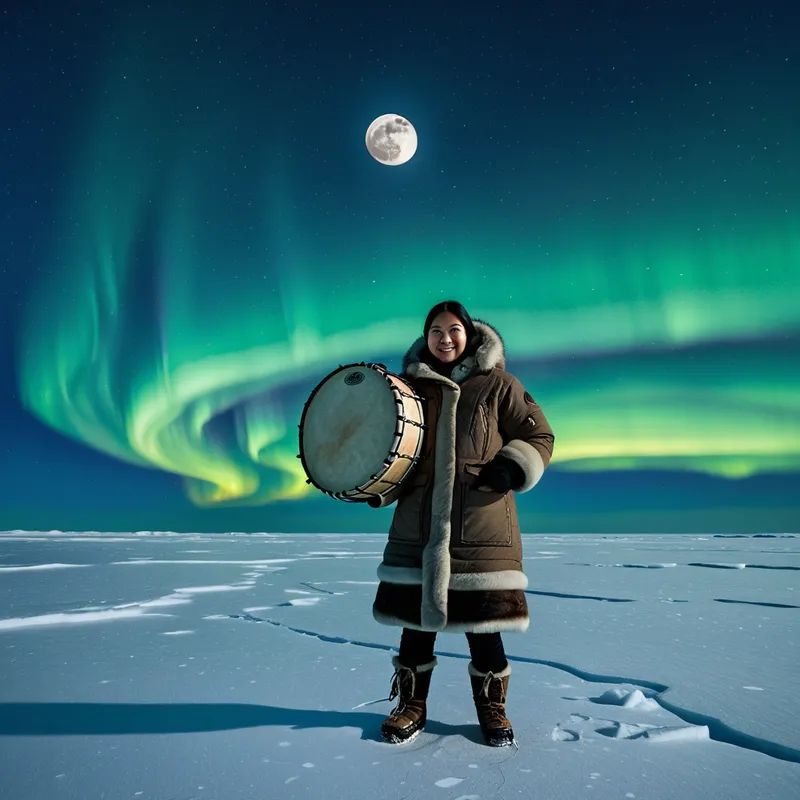
The Drum Dance Origin Myth Meaning & Symbolism
A myth where a grieving woman journeys to the moon to retrieve her son, returning with the first drum and the sacred dance that mends the world.
The Tale of The Drum Dance Origin
Listen. In the time when the world was younger and the ice sang its own slow songs, there lived a woman. Her heart was a warm seal-oil lamp in the long dark. She had a son, a boy quick as an Arctic fox, whose laughter was the only sun in the deep winter. But the world is a place of taking as much as giving. A great sickness, a silent white bear of the spirit, came into their snow-house. It took the boy’s breath and left only a small, cold stillness where a vibrant life had been.
The woman’s grief was a blizzard that did not cease. She sat on the sleeping platform, holding the small parka, and her wails were the only wind. The people feared her sorrow would crack the very ice they lived upon. For days, she did not eat. For nights, she did not sleep. She only stared at the smoke-hole, at the slice of sky.
Then, one night, the full moon, Tatqeq, shone with an impossible, liquid brightness. It poured through the smoke-hole and painted a path of silver on the floor, leading to the door. A voice, not a sound but a feeling in the marrow of her bones, spoke. “Your son is not in the ground. He is with me. If you have the strength to walk the cold road, you may see him.”
Without a second thought, the woman wrapped herself in her furs and stepped out onto the sea-ice. The moon’s light had solidified into a bridge, a shimmering ribbon of frost and star-dust that arched from the frozen ocean directly into the face of Tatqeq. The air was so cold it crystallized her tears on her cheeks, but she walked. She walked past sleeping seals, past the groaning pressure ridges, higher and higher, until the world below was a bowl of shadows and the air thinned to silence.
She stepped onto the moon. It was a land of luminous grey dust and profound quiet. And there, in a gentle hollow, she saw him. Her son. He was playing with other spirit-children, their forms glowing softly like the inside of a mussel shell. He saw her and smiled, but it was a distant smile, the smile of one who remembers a dream.
“You cannot stay, Mother,” he said, his voice like the ringing of ice. “And I cannot return. The path is one-way. But you cannot go back empty-handed, or your heart will turn to stone and shatter.”
He gestured to the ground. There lay a wooden hoop and a piece of fine, translucent membrane—the stomach of a walrus. “Take these,” he said. “Stretch this over that. This is my heartbeat, which I leave with you.” Then he pointed to his own feet. “Watch.” He began to move, a slow, shuffling step, then a lift of the knee, a turn. It was a dance of solemn joy, of memory held in the body. “This is the shape of my spirit, which I leave with you.”
The woman memorized the steps with her soul. She took the gifts. As she turned to leave, the world tilted. The silver bridge was gone. She fell, not with terror, but with a sudden weight, tumbling through the star-flecked dark.
She awoke on the familiar ice, the first dawn bleeding pink on the horizon. In her hands were the gifts. With trembling fingers, she did as instructed, stretching the membrane over the hoop, lashing it tight with sinew. She tapped it. Thump. A sound like a heart beating against the ribs of the world. She stood on the ice, and remembering, she began to move. The slow shuffle, the lift, the turn. As she danced and drummed, a strange warmth spread from her hands to her frozen heart. The people emerged from their homes, drawn by the sound. They watched. They felt their own losses, their own fears, stir in response to that rhythm. One by one, they joined her, finding their own steps to the common beat.
The woman had not brought her son back to life. But she had brought back something else: the rhythm to hold life and death together, and the dance to carry the people across the ice of their sorrows.

Cultural Origins & Context
This myth, known in various forms across the Inuit world from Greenland to Alaska, is not merely a story. It is a foundational charter for one of the most vital communal practices: the drum dance, or Ajaqaat. Traditionally told by elders, often women, during the long winter gatherings, its function was multifaceted. It was an etiological myth, explaining the sacred origin of the drum (the qilaut) and the dance. It was a psychological and social technology, providing a sanctioned container for the expression of profound, potentially isolating grief. By framing the drum as a literal heartbeat retrieved from the land of the dead, it sanctified music and movement as legitimate bridges between the worlds of the living and the spirits ([tuurngait](/myths/tuurngait “Myth from Inuit culture.”/)), and between the individual and the community. The storyteller, by voicing the woman’s journey, performed a subtle act of healing for all listeners, reaffirming that sorrow could be transformed into a rhythm that sustains the whole.
Symbolic Architecture
At its core, this is a myth of the katabasis—the descent or difficult [journey](/symbols/journey “Symbol: A journey in dreams typically signifies adventure, growth, or a significant life transition.”/) to retrieve something of immense value. The woman is not a [warrior](/symbols/warrior “Symbol: A spiritual archetype representing inner strength, discipline, and the struggle for higher purpose or self-mastery.”/) but a griever; her [weapon](/symbols/weapon “Symbol: A weapon in dreams often symbolizes power, aggression, and the need for protection or defense.”/) is her [vulnerability](/symbols/vulnerability “Symbol: A state of emotional or physical exposure, often involving risk of harm, that reveals authentic self beneath protective layers.”/), and her [quest](/symbols/quest “Symbol: A quest symbolizes a journey or search for purpose, fulfillment, or knowledge, often representing life’s challenges and adventures.”/) is initiated by an unbearable psychological [reality](/symbols/reality “Symbol: Reality signifies the state of existence and perception, often reflecting one’s understanding of truth and life experiences.”/).
The drum is the solidified heartbeat of the lost other, the objective artifact of a subjective pain. To play it is not to forget, but to externalize the inner rhythm of memory, making private loss a public pulse.
The [moon](/symbols/moon “Symbol: The Moon symbolizes intuition, emotional depth, and the cyclical nature of life, often reflecting the inner self and subconscious desires.”/) here is not a romantic [symbol](/symbols/symbol “Symbol: A symbol can represent an idea, concept, or belief, serving as a powerful tool for communication and understanding.”/) but the cold, reflective land of the dead and the unconscious. It is the [realm](/symbols/realm “Symbol: The symbol of ‘Realm’ often signifies the boundaries of one’s consciousness, experiences, or emotional states, suggesting aspects of reality that are either explored or ignored.”/) where what is lost resides in its essential, remembered form. The dance steps are the “shape of the [spirit](/symbols/spirit “Symbol: Spirit symbolizes the essence of life, vitality, and the spiritual journey of the individual.”/),” representing the process of giving form to the formless. [Grief](/symbols/grief “Symbol: A profound emotional response to loss, often manifesting as deep sorrow, yearning, and a sense of emptiness.”/) is amorphous, crushing; a dance is specific, patterned, and shareable. The myth thus encodes a profound psychological [truth](/symbols/truth “Symbol: Truth represents authenticity, honesty, and the quest for knowledge beyond mere appearances.”/): healing from [trauma](/symbols/trauma “Symbol: A deeply distressing or disturbing experience that overwhelms the psyche, often manifesting in dreams as unresolved emotional wounds or psychological injury.”/) involves retrieving a vital [energy](/symbols/energy “Symbol: Energy symbolizes vitality, motivation, and the drive that fuels actions and ambitions.”/) from the frozen place of [memory](/symbols/memory “Symbol: Memory symbolizes the past, lessons learned, and the narratives we construct about our identities.”/) and consciously shaping it into a form that can be reintegrated into the flow of [life](/symbols/life “Symbol: The symbol of ‘Life’ represents a journey of growth, interconnectedness, and existential meaning, encompassing both the joys and challenges that define human experience.”/).
The Dreamer’s Resonance
When this mythic pattern stirs in the modern dreamer, it often manifests as dreams of searching for a lost object or person in a stark, silent, or elevated landscape (attics, frozen lakes, empty moonscapes). There is a somatic quality of weight—the heavy heart, the slow, effortful movement. The dreamer may hear a distant, rhythmic pulsing or find themselves trying to assemble an object from disparate parts.
Psychologically, this signals a confrontation with frozen grief, a loss that has been “buried” but not processed. The psyche is initiating its own retrieval mission. The journey to the moon represents the ego’s necessary venture into the cold, detached territory of the unconscious to re-contact a lost complex—a part of the self that felt annihilated with the loss. The dream is the first step on that silver bridge, indicating the Self is providing a pathway where before there was only paralyzing sorrow.
Alchemical Translation
For the individual, this myth models the alchemical process of nigredo transforming into the albedo. The black despair of grief (nigredo) is not bypassed; it is the essential raw material. The journey to the moon is the separatio, where the conscious mind must separate from its identification with the loss to see it objectively. The retrieval of the drum and dance is the coniunctio—the marrying of the conscious ego with the retrieved spirit-essence from the unconscious.
Individuation often requires us to become the grieving mother and the moon-dwelling son simultaneously: to hold the aching absence and to retrieve the eternal pattern of what was lost.
The final act—drumming and dancing with the community—is the rubedo, the red stage of embodied integration. The psychic energy, once trapped in static mourning, is transmuted into creative, rhythmic life-force. The individual does not “get over” their loss; they learn to dance with it, to make its rhythm a part of their new, more complex melody. The drum becomes the lapis philosophorum—the tool that turns leaden sorrow into the gold of meaningful expression and connection.
Associated Symbols
Explore related symbols from the CaleaDream lexicon:
- Drum — The central artifact of the myth, representing the externalized heartbeat, the rhythm of memory, and the instrument that bridges individual sorrow with communal resonance.
- Moon — Symbolizes the cold, reflective realm of the dead, the unconscious, and the place where lost essences reside in their pure, remembered form.
- Journey — Represents the necessary katabasis, the difficult, solitary descent or ascent into the psychic unknown to retrieve a vital part of the self.
- Dance — The patterned, physical expression of the spirit’s shape; the transformation of amorphous grief into shareable, life-affirming movement.
- Heart — The source of the rhythm; the seat of love and loss that must be externalized as sound to be healed and integrated.
- Mother — The archetypal carrier of profound grief and the active agent who undertakes the transformative quest for retrieval and creation.
- Spirit — The essence of the lost son, which cannot return in its old form but can be translated into a gift (drum/dance) for the living.
- Ritual — The formalized, communal practice born from the myth, providing a sacred container for the expression and transmutation of deep emotion.
- Grief — The raw, black material of the nigredo stage, the unbearable weight that initiates the entire alchemical process of transformation.
- Healing — The ultimate outcome, not as the eradication of loss, but as the integration of its rhythm into the ongoing song of life and community.
- Origin — The myth explains the sacred beginning of a cultural practice, rooting profound psychological truth in a foundational story.
- Circle — Represented by the drum’s hoop, symbolizing wholeness, cycles of life and death, and the communal circle of the dance.