The Dreamcatcher's Origin Myth Meaning & Symbolism
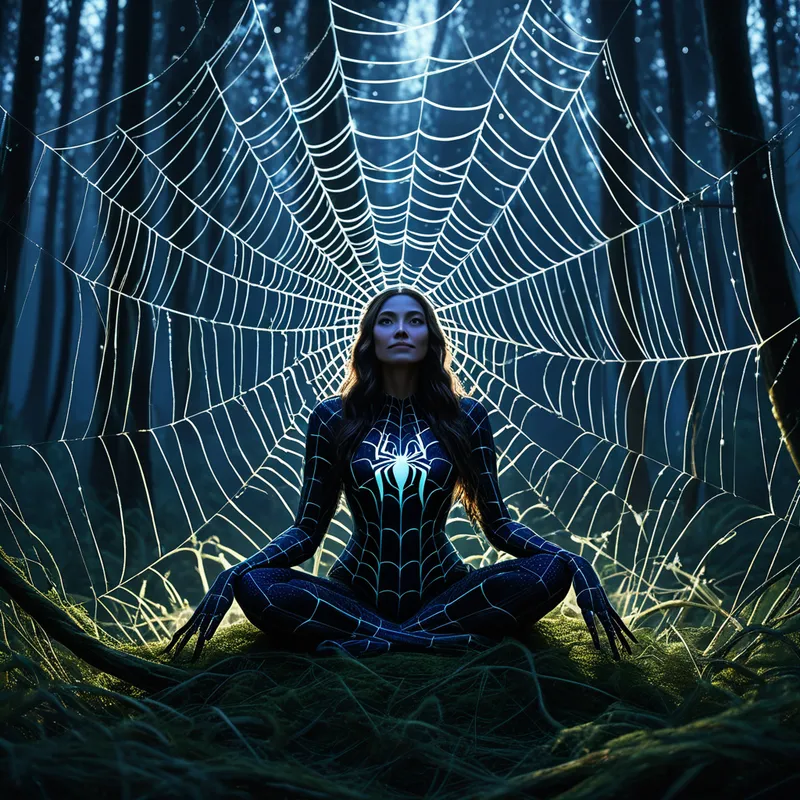
A grandmother spider weaves a sacred hoop to protect a child, teaching that the web of life catches nightmares, allowing only good dreams to pass.
The Tale of The Dreamcatcher’s Origin
In the time when [the world](/myths/the-world “Myth from Tarot culture.”/) was younger, and the voices of the spirits were as clear as [the wind](/myths/the-wind “Myth from Various culture.”/) in the pines, there lived a people by the great lakes. Among them was a village troubled by a creeping shadow. The children, the future of the people, were restless in their sleep. Visions not of guidance, but of confusion and fear, visited them. Dark, formless things slithered from the night air into their small lodges, whispering anxieties that stained their innocent dreams.
The people sought the counsel of their elders, who in turn sought the wisdom of the medicine man. He fasted and prayed, his spirit journeying far from his body, seeking an answer in the realms where animal spirits speak and grandfather stones remember. He traveled until he came to a high place, a bald peak where [the earth](/myths/the-earth “Myth from Hindu culture.”/) touches [the sky](/myths/the-sky “Myth from Persian culture.”/). And there, he encountered [Spider Woman](/myths/spider-woman “Myth from Native American culture.”/), known to some as Asibikaashi.
She was not as other beings. She was ancient, her eight eyes holding the patience of mountains, her limbs delicate yet strong as the roots of the oldest tree. She had watched the people, seen their distress. “The air is thick with dreams,” she spoke, her voice a soft rustle. “Not all dreams are for the dreamer. Some are visitors from places of chaos, and they have found a path to your young.”
The medicine man, weary from his journey, asked, “Great Teacher, how can we close this path? How can we protect the sleep of our children?”
[Spider](/myths/spider “Myth from Native American culture.”/) Woman did not answer with words at first. Instead, she began to move. From her being, she drew a silken thread, luminous like moonbeams on [water](/myths/water “Myth from Chinese culture.”/). She took a pliable hoop of willow, a circle that has no end, symbolizing the sun’s journey and the cycle of life. With infinite care, she began to weave.
Her legs worked in a sacred pattern, looping and tying, creating a web within the circle. It was a perfect, intricate net, growing from the outside in, until at its very center, there remained a single, open space—a hole, a doorway. As she wove, she sang a song of protection, a song that bound the intention of safety into every strand.
When she was finished, she presented the hoop to the medicine man. “Take this,” she whispered. “Hang it where [the child](/myths/the-child “Myth from Alchemy culture.”/) sleeps. The web is a map of life, with many paths. The bad dreams, the dark visitors, they are not wise. They will see the web and become tangled in its threads, held fast until the first light of the sun, which will cleanse them away. But the good dreams,” she said, her eyes glinting, “the dreams that come from the ancestors and the guiding spirits, they know the true path. They will find the center, the open way, and slide down like gentle rain or a soft feather to bless the sleeper.”
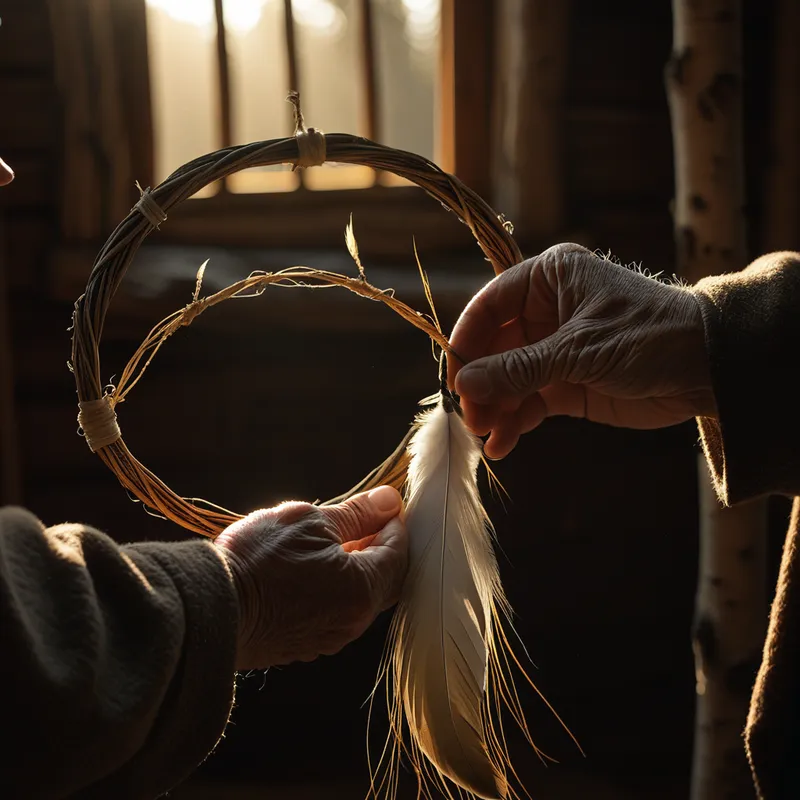
The medicine man returned to his people, bearing the first dreamcatcher. They followed Spider Woman’s teaching, adorning it with sacred feathers so the good dreams might find their way down. And so it was. The children slept peacefully once more, their nights filled with visions of beauty and guidance, while the nightmares evaporated with the morning dew. The knowledge was passed from elder to parent, from weaver to child, a tangible prayer hung above the cradleboard.
Cultural Origins & Context
The origin story of the dreamcatcher is most firmly rooted in the Ojibwe</abibikaashi (or Asibikaashi), who would weave her magical webs for the infants. As the Ojibwe Nation spread geographically, it became difficult for Asibikaashi to reach all the children. Thus, the mothers and grandmothers began to weave the protective willow hoops, replicating her web, to serve as localized, physical manifestations of her care. The dreamcatcher was, and for many remains, a deeply personal, familial object of spiritual technology—not mere decoration, but a conduit of a specific, protective intention woven into its very form.
Its societal function was multifaceted: it was a practical tool for ensuring peaceful sleep (vital in communities living in close harmony with nature), a pedagogical device for teaching children about the spirit world and the importance of good thoughts, and a symbol of the grandmother’s (Nokomis) enduring, protective love. The passing down of the craft, from selecting [the willow](/myths/the-willow “Myth from Celtic culture.”/) to tying the final knot, was an act of cultural transmission, weaving the younger generation into the web of tradition itself.
Symbolic Architecture
The dreamcatcher is a [mandala](/symbols/mandala “Symbol: A sacred geometric circle representing wholeness, the cosmos, and the journey toward spiritual integration.”/) of the [psyche](/myths/psyche “Myth from Greek culture.”/), a symbolic map of how [consciousness](/symbols/consciousness “Symbol: Consciousness represents the state of awareness and perception, encompassing thoughts, feelings, and experiences.”/) interacts with the unseen. Every element is a profound [metaphor](/symbols/metaphor “Symbol: A figure of speech where one thing represents another, often revealing hidden connections and deeper truths through symbolic comparison.”/).
The Willow Hoop represents the circle of [life](/symbols/life “Symbol: The symbol of ‘Life’ represents a journey of growth, interconnectedness, and existential meaning, encompassing both the joys and challenges that define human experience.”/), the sun’s [path](/symbols/path “Symbol: The ‘path’ symbolizes a journey, choices, and the direction one’s life is taking, often representing individual growth and exploration.”/), and the unity of all things. It is the container of existence, the sacred [boundary](/symbols/boundary “Symbol: A conceptual or physical limit defining separation, protection, or identity between entities, spaces, or states of being.”/) that defines a protected [space](/symbols/space “Symbol: Dreaming of ‘Space’ often symbolizes the vastness of potential, personal freedom, or feelings of isolation and exploration in one’s life.”/)—much like the circle of a lodge or the circumference of [the self](/myths/the-self “Myth from Jungian culture.”/).
The web is not a barrier, but a filter for consciousness. It does not seek to destroy the dark, but to sort the useful from the harmful, integrating the wisdom of discernment.
The Web or Net, woven from the outside in, mirrors the web of life. Its many points of [connection](/symbols/connection “Symbol: Connection symbolizes relationships, communication, and bonds among individuals.”/) symbolize the interconnectedness of all beings, events, and thoughts. The [journey](/symbols/journey “Symbol: A journey in dreams typically signifies adventure, growth, or a significant life transition.”/) from the periphery to the center is the path of individuation—moving from the complex, tangled outer world of [persona](/symbols/persona “Symbol: The social mask or outward identity one presents to the world, often concealing the true self.”/) and collective expectation toward the simple, open [truth](/symbols/truth “Symbol: Truth represents authenticity, honesty, and the quest for knowledge beyond mere appearances.”/) of the core self.
The Central Hole is the most critical element. It is the [gateway](/symbols/gateway “Symbol: A threshold between states, representing transition, opportunity, or initiation into new phases of life or consciousness.”/), the [axis](/symbols/axis “Symbol: A central line or principle around which things revolve, representing stability, orientation, and the fundamental structure of reality or consciousness.”/) mundi of this small [cosmos](/symbols/cosmos “Symbol: The entire universe as an ordered, harmonious system, often representing the totality of existence, spiritual connection, and the unknown.”/). It represents the clear channel to the divine, the open [heart](/symbols/heart “Symbol: The heart symbolizes love, emotion, and the core of one’s existence, representing deep connections with others and self.”/), the point of pure potential and [reception](/symbols/reception “Symbol: The symbol of ‘reception’ often signifies the act of welcoming or accepting new ideas, experiences, or people into one’s life.”/). It is the place where true [guidance](/symbols/guidance “Symbol: The act of receiving or seeking direction, advice, or leadership in a dream, often representing a need for clarity, support, or a higher purpose on one’s life path.”/), untainted by egoic [distortion](/symbols/distortion “Symbol: The alteration of form, sound, or perception from its original state, often creating unsettling or creative effects.”/), can enter.
The Feathers act as conduits and ladders. They are symbols of [breath](/symbols/breath “Symbol: Breath symbolizes life, vitality, and the connection between the physical and spiritual realms.”/), air, and [spirit](/symbols/spirit “Symbol: Spirit symbolizes the essence of life, vitality, and the spiritual journey of the individual.”/)—the gentle means by which benevolent dreams “slide down” into the [awareness](/symbols/awareness “Symbol: Conscious perception of self, surroundings, or internal states. Often signifies awakening, insight, or heightened sensitivity.”/) of the sleeper. They represent the softening of [spirit](/symbols/spirit “Symbol: Spirit symbolizes the essence of life, vitality, and the spiritual journey of the individual.”/) into tangible, guiding influence.
Psychologically, the myth presents [Spider](/symbols/spider “Symbol: Represents creativity, feminine energy, and the weaving of destiny, as well as potential feelings of entrapment or anxiety.”/) Woman as the [archetype](/symbols/archetype “Symbol: A universal, primordial pattern or prototype in the collective unconscious that shapes human experience, behavior, and creative expression.”/) of the [anima](/symbols/anima “Symbol: The feminine archetype within the male unconscious, representing soul, creativity, and connection to the inner world.”/) in her most nurturing, wise, and creative form. She is the psychic weaver who shows us how to construct a healthy ego-[structure](/symbols/structure “Symbol: Structure in dreams often symbolizes stability, organization, and the framework of one’s life, reflecting how one perceives their environment and personal life.”/)—one that is permeable to nourishment but resistant to psychic toxins.
The Dreamer’s Resonance
When the imagery of the dreamcatcher, its weaving, or its failure appears in modern dreams, it signals a profound somatic and psychological process related to psychic filtration and boundary-setting.
To dream of weaving a dreamcatcher suggests the dreamer is actively, consciously working to establish healthier psychic boundaries. They are in the process of discerning which influences (thoughts, relationships, media) to allow into their inner sanctum and which to hold at bay. There is often a felt sense of careful, intentional creation.
A dream of a broken or torn web indicates a perceived failure in these boundaries. The dreamer may feel invaded by anxieties, overwhelmed by external demands, or that their discernment has broken down, allowing “bad dreams” (persistent worries, traumas, or negative self-talk) direct access. This often correlates with somatic experiences of vulnerability, unrestful sleep, or a tight chest.
Dreaming of feathers gently touching one’s face as they descend through a hoop speaks to a moment of receiving grace, intuition, or comfort. It is the psyche’s signal that connection to a guiding, benevolent inner wisdom is open and active. This can manifest upon waking as a sense of calm clarity or a sudden insight.
Conversely, to see dark shapes stuck in the web is to witness one’s own psychological process of holding and neutralizing negative complexes. The dream is showing that the protective, filtering mechanism is working; the fears are being contained and will be dissolved by the “light” of conscious awareness.
Alchemical Translation
The myth of the dreamcatcher’s origin models the alchemical process of [separatio](/myths/separatio “Myth from Alchemical culture.”/) and sublimatio—the separation of the pure from the impure, and the elevation of spirit.
The modern individual is bombarded by a ceaseless stream of psychic content: the “dreams” of [the collective unconscious](/myths/the-collective-unconscious “Myth from Jungian culture.”/), societal expectations, digital noise, and personal anxieties. The initial state is one of undifferentiated chaos, where all influences have equal weight and access, much like the troubled village. The call to adventure is the recognition that this state is unsustainable, that a filter must be constructed.
Individuation is the craft of becoming your own weaver. It is the patient, daily act of tying intention to action, creating a web of self that catches the lead of illusion, allowing only the gold of authentic experience to reach the core.
Spider Woman represents the awakened, guiding function of the Self. She teaches the first step of alchemical transmutation: forming [the sacred circle](/myths/the-sacred-circle “Myth from Various culture.”/) (the vas or vessel). This is the commitment to the work of self-knowledge, the setting of an intentional container for one’s life.
The weaving is the work of discernment (separatio). Each knot is a conscious choice, a value affirmed, a boundary set. It is the difficult, meticulous task of examining every thread of one’s being—beliefs, habits, relationships—and deciding which belong to the integrated self and which are foreign, fear-based intrusions to be held at the periphery.
The central hole is the achievement of the open center (sublimatio). It is not emptiness, but purified potential. It represents the state where [the ego](/myths/the-ego “Myth from Jungian culture.”/), having been properly structured and bounded, becomes transparent to the Self. It is the point where the individual no longer blocks their own connection to transpersonal wisdom, allowing it to flow unimpeded. The feathers—the gentle, tangible results of this work—are the inspired ideas, the moments of synchronicity, and the deep, guiding feelings that then descend into a life lived with purpose and protection.
Thus, the dreamcatcher is more than a story of a protective charm. It is an eternal blueprint for the creation of a resilient and receptive psyche, a reminder that we are both the protected child and the wise grandmother, tasked with weaving the very web that guards our own sacred sleep.
Associated Symbols
Explore related symbols from the CaleaDream lexicon: