The Architecture of Dreams: Somatic Echoes and Alchemical Visions
The Somatic Echo
Before the story, before the symbol, there is the echo. It is a vibration in the bones, a pressure behind the eyes, a taste in the mouth that has no name. To dream of dreaming is to feel the architecture of your own psyche as a physical space. It is the sensation of a vast, internal cathedral being rearranged in the dark while you sleep—the groan of stone, the sigh of settling dust. You wake not with a memory, but with a residue: a weightlessness in the chest, a tightness in the jaw, a disorientation that feels less like confusion and more like being a stranger in the homeland of your own mind. This is the somatic prelude, the body’s raw, unprocessed report on the night’s silent labor.
The Dreamer's Log (Case Vignette)
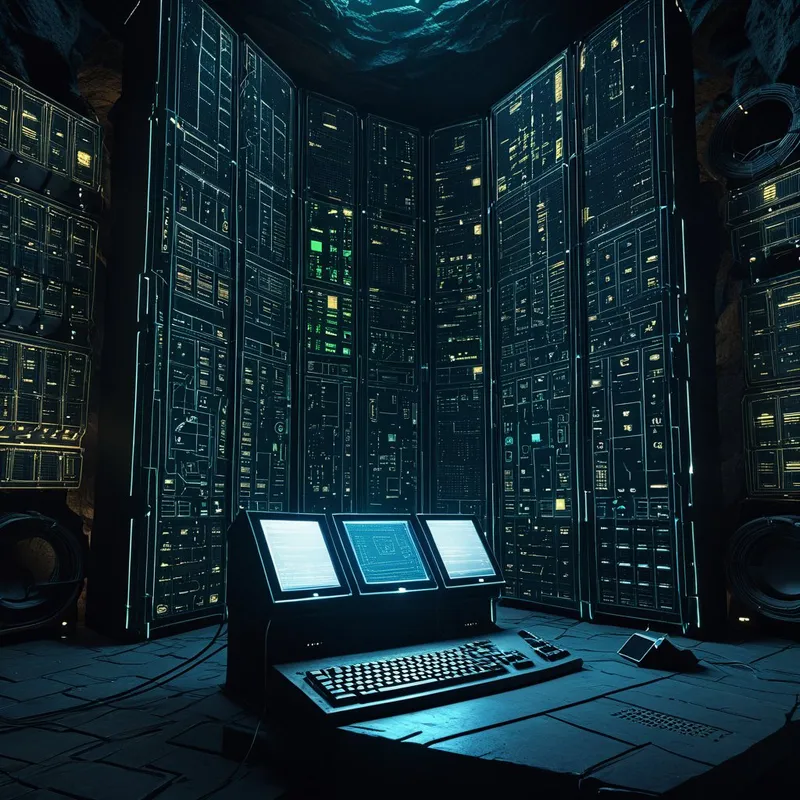
I am standing before a terminal in a cavernous, forgotten data-archive. The screen is a fractured pane of glass, flickering with glyphs I once knew but can no longer read. I try to input a command, to access a file labeled “Self,” but my fingers pass through the keys like smoke. The only sound is the deep, resonant hum of the obsidian server stacks surrounding me, a sound that feels like the heartbeat of something vast and sleeping.
This dream is the psyche’s alchemical report on a foundational identity structure dissolving, leaving the dreamer in the potent, terrifying void between who they were and who they are becoming.
The False Lead
This theme is not about prophetic visions or mere memory replay. To mistake the architecture of dreams for simple prophecy is to confuse the blueprint with the building. It is not a forecast of external events, but a real-time schematic of internal ones. The terror or beauty you encounter is not a warning of what is to come to you, but a revelation of what is happening within you. The dream is not a movie to be passively watched; it is a construction site where you are both the labor and the architect.
Psychological Architecture
Here lies the deep Shadow work. To dream of the dreamscape itself is to be ushered to the control room of your own consciousness, often at a moment of profound structural shift. The old “I,” the coherent narrative you present to the world, is shown to be a user interface. Behind it, in the shadowed server halls, older programs run—the orphaned emotions, the exiled memories, the protector parts frozen in time. This dream theme forces a confrontation with the Internal Family System of the soul. You meet not a monster, but a subsystem—a frightened child who holds a grief, an angry protector guarding a wound. Individuation here is the agonizing, gracious process of welcoming these exiles back into the parliament of the self, not as rulers, but as honored members. It is the reintegration of disowned firmware.
Mythic Resonance
This is the universal human firmware, as seen in the myth of Ariadne and the Labyrinth. The dream is the labyrinth—a vast, intricate, and seemingly irrational structure built by a deeper intelligence (the Minotaur, our own shadow-beast, at its center). The thread Ariadne gives Theseus is not just a tool for escape, but the thread of consciousness itself, the somatic awareness we must hold onto to navigate the inner maze without being consumed. Similarly, in the Aboriginal concept of the Dreamtime, the dream is not a separate state but the foundational, singing layer of reality from which all form emerges. Our nightly journeys are brief returns to that source code.
Symbolic Nodes
- Broken or Unreadable Screens/Books: The interface of the known self is failing.
- Vast, Empty Interiors (Cathedrals, Warehouses, Server Farms): The psyche’s unused or reorganizing space.
- Finding Hidden Rooms: Discovering unknown or repressed aspects of the self.
- Flying or Falling Through Architectures: A shift in perspective on the internal structures of belief and identity.
- Being Guided by a Faceless Presence: The unconscious itself acting as guide.
Archetypal Resonance
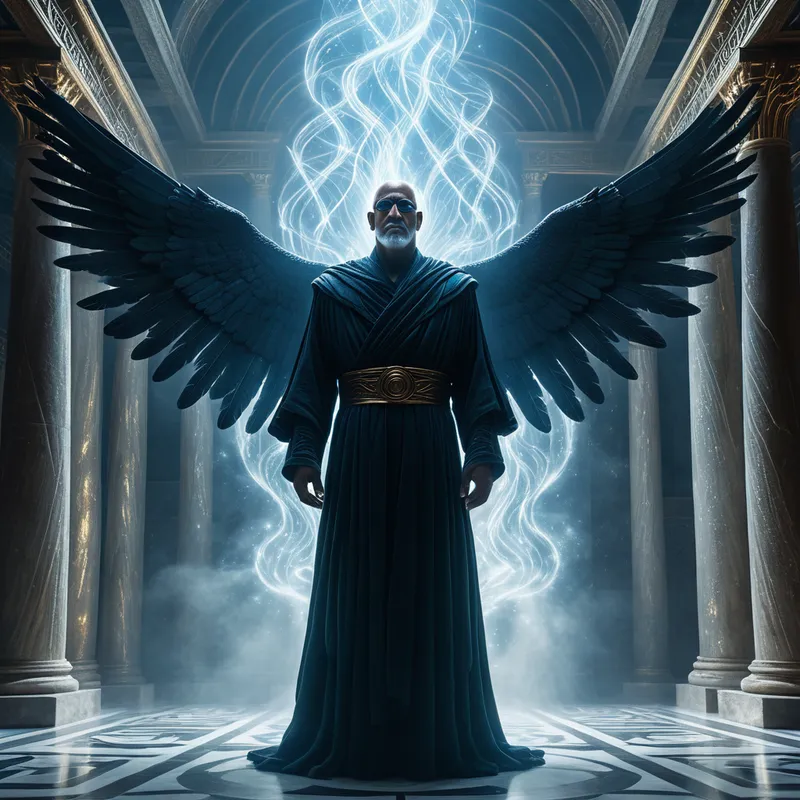
The energy here is most purely that of The Magician Archetype. This is not the stage illusionist, but the deep alchemist, the one who understands the hidden structures of reality and works to transform them. The somatic echo—that feeling of being in a vast, rearranging space—is the Magician’s sanctum. The alchemical potential is total: to transmute the lead of fragmented, unconscious patterns into the gold of integrated awareness. The shadow of the Magician—the Manipulator or Illusionist—appears when we try to use this dream-knowledge to control external reality or others, rather than undertaking the humble, fierce work of inner transformation. The dream of dreams calls the Magician forth to do its core work: to know, to dare, to will, and to be silent in the face of the mystery.
The Alchemical Process
The alchemical transmutation here is Sublimation—the turning of a solid directly into a vapor, bypassing the liquid state. The “solid” is the rigid, identified self-structure (the old terminal, the readable glyph). The intense psychological heat and pressure come from sustaining the conscious awareness—the Ariadne’s thread—as that structure dissolves. You must hold the terror of the void, the grief of the lost file labeled “Self,” without rushing to rebuild a familiar, perhaps smaller, identity. This is the nigredo, the blackening. The vapor that results is not nothingness; it is potentiality, a cloud of pure, unformed consciousness. From this vapor, in its own time, a new, more complex, and authentic structure will crystallize. The sovereignty gained is not control, but partnership—the ability to sit in the control room of your own becoming without panic, recognizing yourself as both the system and its graceful, attending awareness.
The Integration Protocol
Question 1: Upon waking with this dream’s echo, where in my body do I feel its residue most strongly? Is it a density, a hollowness, a vibration? Can I describe its texture without a story?
Question 2: If the landscape of that dream is a map of my current inner architecture, what old room was I shown? What new space, however empty or strange, was revealed?
Question 3: Which exiled part of me—which frightened, angry, or grieving inner “family member”—might be the operator of that forgotten terminal, trying to send a signal to my waking self?
Action 1 (Somatic Anchoring): Before rising, place a hand on the area of your body that holds the dream’s echo. Breathe into that space for three minutes, not to change the sensation, but to acknowledge it as a real, physical report. Let the story come later, if it comes at all.
Action 2 (Unstructured Glyph Writing): Take a blank page. Without thinking, allow your hand to draw, scribble, or write the “unreadable glyphs” from the dream. Do not attempt to decipher them. Let the motion itself be the communication from the unconscious to the motor cortex, bypassing the cognitive interpreter entirely.
Action 3 (Sanctum Resonance): In your physical space, create a small, deliberate emptiness—a cleared shelf, a blank wall section, a simple bowl of clear water. Let this be an external anchor for the internal void revealed in the dream, a testament that empty space is not neglect, but potential.
Final Validation
It is profoundly difficult to have the ground of your own mind shown to be in flux. To feel the bedrock become vapor is a primordial terror. Yet, this is not a sign of breaking, but of profound becoming. The dream does not dismantle you out of cruelty, but out of a fidelity to a greater blueprint you are growing into. You are not losing your self. You are being asked, with immense trust, to witness its glorious, necessary renovation. Hold the thread. The labyrinth is not a prison; it is the shape of your own magnificent, unfolding depth.