The Draugr Myth Meaning & Symbolism
A tale of the restless dead who guard their grave-mounds, challenging the living to confront the unburied past and the shadow that refuses to die.
The Tale of The Draugr
Hear now, and listen well by the fire’s dying light, for I speak of things that do not rest. In the time when the longship’s wake was still fresh on the fjord and the high seat pillars were planted in new soil, there lived a man named Hrapp. He was a man of fierce will, a binder of men and a hoarder of wealth, whose grip was as tight in death as it was in life.
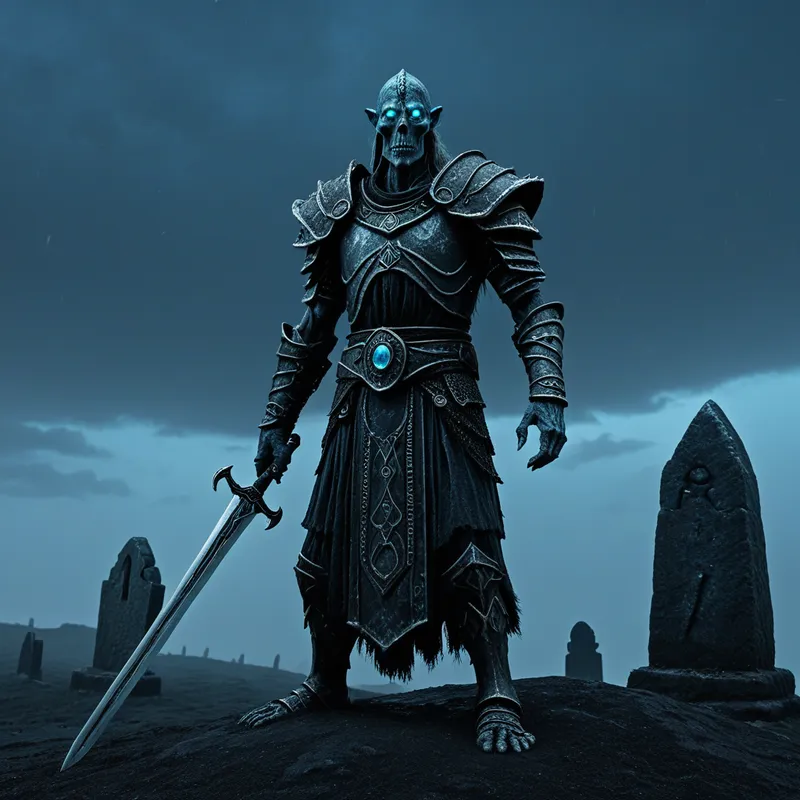
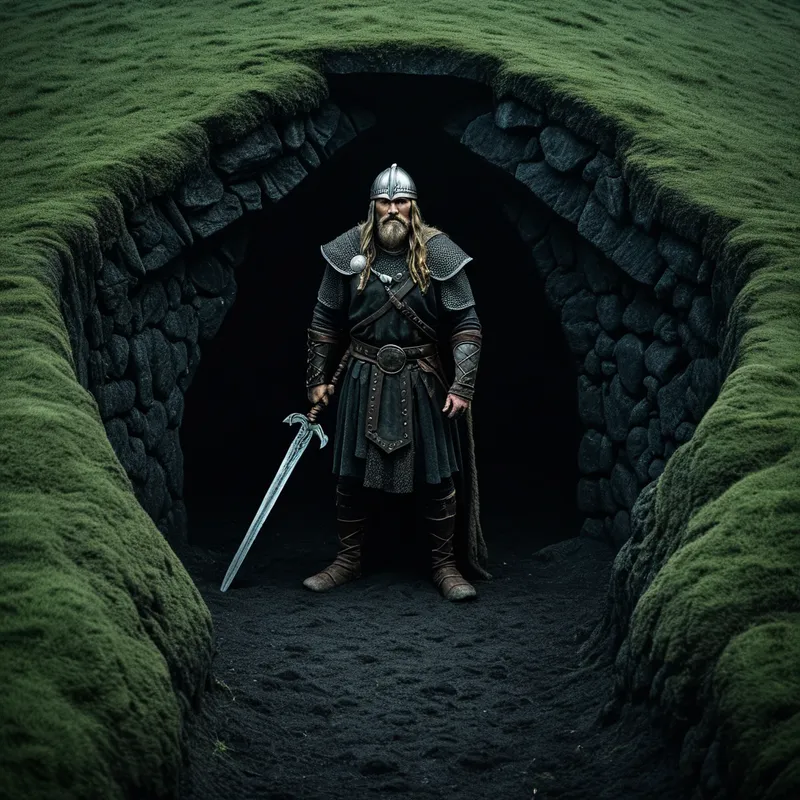
When the sickness took him, he gave a final, rasping command: “Bury my wealth with me in the mound. Let my sword lie in my hand. This land is mine.” And so they did, heaping earth and stone over his barrow until it stood like a grim fist against the sky. But the peace of the grave was not for Hrapp. The land he claimed grew bitter. Cattle sickened. Men who farmed too near the mound woke with a crushing weight upon their chests, smelling the damp earth of the grave. At night, a shape was seen—a hulking, swollen form darker than the darkness, walking the boundaries of the farm. This was no ghost, but a Draugr, a corpse with the strength of ten men, its flesh corpse-blue and heavy as stone, its eyes burning with a cold, possessive light.
The new master of the land, a man named Glam, scoffed at the old tales. He would farm the land by the mound. One evening, as a grisly fog crept in, the door to the byre burst inward. There stood the Draugr, Hrapp’s form bloated and terrible, his ancient mail stained with grave-mold. “You tread on my ground,” the thing hissed, its voice like stones grinding in a deep well. They fought, a brutal, silent struggle in the mud and muck, a contest not just of strength, but of wills. Glam was strong, but the Draugr was the very earth itself, unyielding and cold. With a final, crushing grip, the Draugr broke Glam’s back, and in that moment of death, he cursed him: “You have sought me, and now you shall become as I am. Your eyes shall see only what I wish you to see, and you shall haunt this place as my servant.”
And so it was. Glam rose, a new Draugr, bound to the will of the first, a sentinel of sorrow and spite. The land became a place of dread, a kingdom of the dead that encroached upon the living. It fell to a hero, a man with the blood of kings and the cunning of a fox, to break this curse. He did not come with a host, but alone, with trickery and ancient wisdom. He lured the Draugr-Glam into a confined space, a place where its monstrous strength could be turned against it, and with a blade blessed by old words, he hewed at the un-dead flesh until the thing lay still, truly dead at last. The mound was opened, Hrapp’s bones were scattered, and his wealth, tarnished and cold, was taken and dispersed among the living. The land, at last, breathed free. The shadow had been faced, and the boundary between mound and farmstead was restored.
Cultural Origins & Context
The Draugr is not a specter of mist and melancholy, but a creature of the specific, hard soil of the Norse world-view. These tales are not primarily from the grand Poetic Edda, but from the Íslendingasögur and Fornaldarsögur, stories of settlers, farmers, and families. They are profoundly local myths, told in longhouses during the skammdeg to explain why a certain field lay fallow, or why a particular shoreline was avoided.
The Draugr is a being of intense, misplaced attachment. In a culture where honor, wealth, and land were paramount, a “bad death” or a possessive personality could literally poison the legacy. The Draugr guards its haugr (mound) and its grave goods not out of malice alone, but out of a distorted, frozen sense of duty and identity. It enforces a dead past upon the living present. The societal function was clear: it reinforced the necessity of proper funeral rites, the importance of community over selfish hoarding, and the literal and spiritual danger of failing to let go. It was a narrative bulwark against greed and a reminder that the land belongs to the lineage, not to the individual beyond his time.
Symbolic Architecture
Psychologically, the Draugr is the ultimate embodiment of the Shadow made concrete. It is not a hidden aspect of the self, but one that has grown so powerful through neglect and repression that it has taken on a life—or anti-life—of its own. It is the unresolved past, the unprocessed trauma, the grudge that we nurse until it nurses us. It is the part of the psyche that says “This is mine!” long after the claim has any living relevance, creating a psychic territory of stagnation and dread.
The Draugr does not haunt the living out of evil, but out of a frozen, possessive love for a world that has moved on. It is loyalty turned to pathology.
The grave-mound is the perfect symbol: it is a memory made physical, a tomb of something that was once alive but is now buried. Yet, in this myth, the buried thing is not at peace. It is a sealed psychic complex, festering with unresolved energy. The Draugr’s superhuman strength represents the disproportionate power these unconscious complexes hold over us when we refuse to face them. Its corporeality is critical—this is not a fear to be dispelled with light, but a dense, heavy truth that must be grappled with, hand-to-hand.
The Dreamer’s Resonance
When the pattern of the Draugr rises in the modern dreamscape, it rarely appears as a Norse zombie. Its essence manifests. You may dream of a childhood home that is now impossibly large, dark, and filled with a possessive, watchful presence. You may find yourself trying to clean a basement that endlessly refills with damp, heavy, moldering objects—the clutter of the past. You may be pursued not by a monster, but by a crushing sense of obligation or a legacy (familial, professional) that feels depleting and dead, yet demands your fealty.
Somatically, this dream process often involves sensations of weight, pressure, and cold—the classic “weight on the chest” of the Draugr’s visitation. Psychologically, it signals a confrontation with an autonomous complex. The dream-ego is being challenged to re-enter a “buried” area of the psyche, a mound of old grief, anger, or identity, and to reclaim energy that is trapped there. The Draugr-dream is a call to boundary work: what from the past is truly yours to carry, and what is a dead man’s treasure you are cursed to guard?
Alchemical Translation
The hero’s journey against the Draugr is a precise map for psychic transmutation, the alchemical nigredo. The first step is recognition: the land is blighted, the cattle sicken. In individuation, this is the depression, anxiety, or stagnation that signals a festering complex. One cannot ignore the mound.
The second is confrontation. The hero does not destroy the Draugr from afar; he engages it directly, on its own ground. This is the terrifying, essential work of shadow integration: facing the possessive grief, the entrenched resentment, the frozen self-image. It is a dirty, brutal struggle, often felt as a psychological regression.
The triumph is not in annihilation, but in dissolution. The Draugr is not banished to nothingness; its form is broken, and its hoarded wealth is liberated for the living community of the psyche.
Finally, there is dissolution and redistribution. The hero does not keep the Draugr’s treasure for himself alone; he scatters the bones and shares the wealth. Psychologically, this is the integration of the complex’s energy. The possessive drive of the Draugr, when broken down, releases vital life force—perhaps creativity, determination, or a capacity for boundaries—that can now be used consciously, for growth rather than guarding. The mound remains, but it is now a monument, not a prison. The land—the total psyche—becomes fertile again. The process teaches that what we refuse to bury properly will rise to bury us, and that true inheritance requires the courage to open the grave.
Associated Symbols
Explore related symbols from the CaleaDream lexicon: