The dragon's hoard Myth Meaning & Symbolism
A myth of a sleeping dragon guarding a cursed treasure, where the true prize is not gold, but the confrontation with the self.
The Tale of The dragon’s hoard
Listen, and let the firelight carve the shadows into shapes of old. In the forgotten places of the world, where mountains gnaw at the sky and roots delve into the bones of the earth, there lies a cave. It is not a place for the living. The air is thick, not with dust, but with a silence so profound it has weight, a stillness that has swallowed centuries. It smells of cold stone, of ozone before a storm, and beneath it all, the sweet, metallic tang of untouched gold.
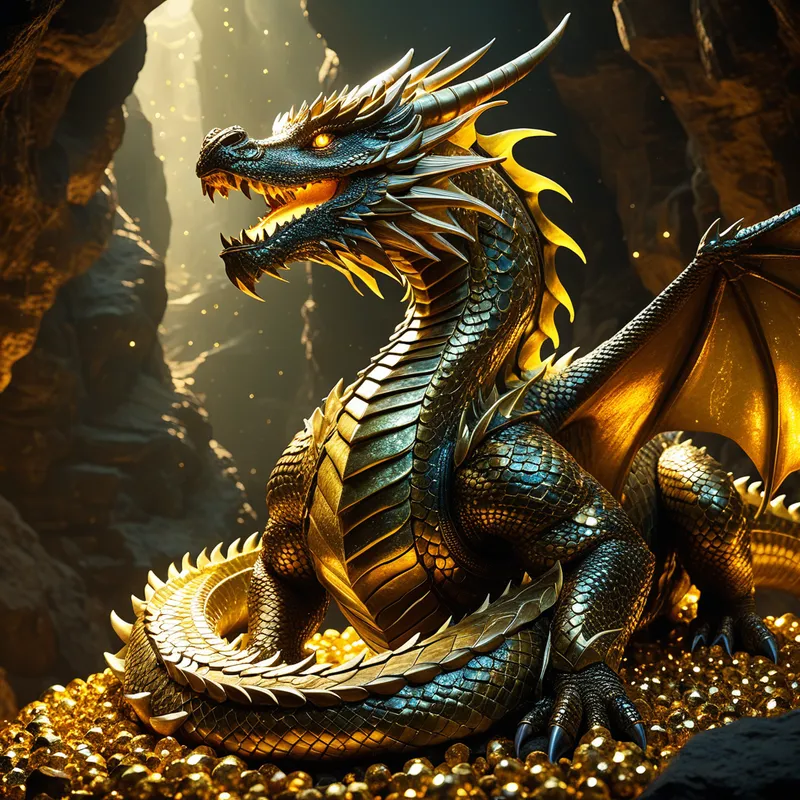
Within, the dragon sleeps. It does not dream. Its sleep is a vigil, a coiled tension older than the kingdoms of men. Its scales are not mere armor; they are plates of history, each one a record of a fallen empire, a broken oath, a forgotten name. Beneath its vast, barrel-chested bulk, spilling from between its claws and tail, is the Hoard. It is not a treasury. It is a glacier of cold fire: cups that have drunk the blood of kings, crowns that have crushed the brows of tyrants, rings that have sealed fates, and coins that have bought souls. Each piece winks with a malevolent, hypnotic light, a constellation of captured desires.
The tale is never about the finding. Any fool can find a cursed place. The tale begins with the hearing. A whisper on the wind, a rumor in a tavern, a line in a crumbling scroll: There, in the navel of the world, lies that which can make you a god or destroy you utterly. And so comes the one who hears the call—not a knight in shining armor, but a soul with a hunger. Perhaps it is for glory, to slay the beast and be sung of. Perhaps it is for wealth, to lift a village from poverty or to drown a palace in luxury. Perhaps it is a deeper, darker thirst, a void that echoes the dragon’s own.
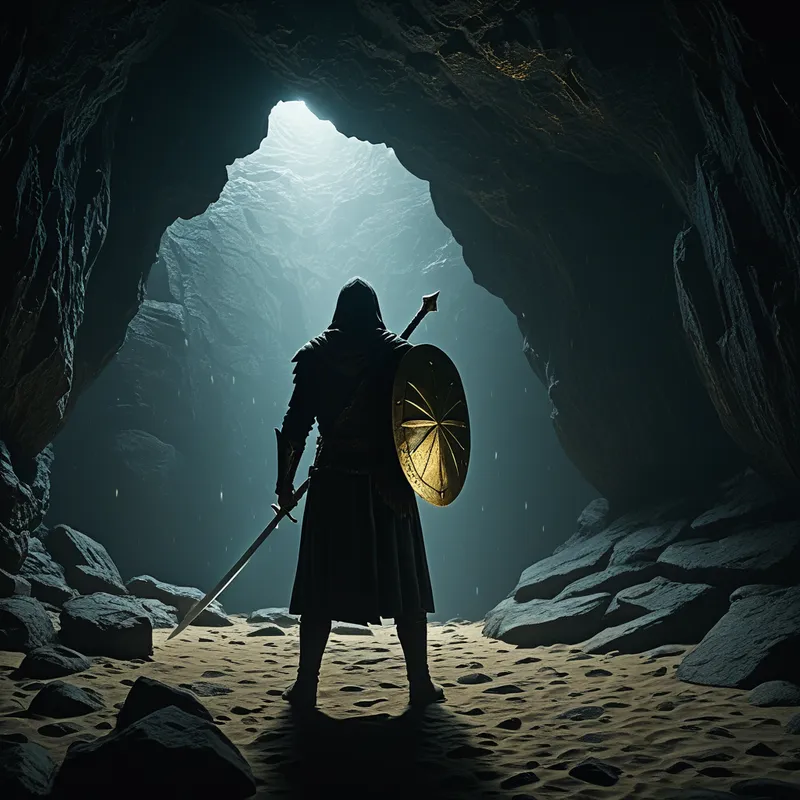
The journey is a stripping away. The green world fades. The path becomes stone, then darkness. The only sound is the heartbeat and the scuff of boot on rock, and the growing, palpable pressure of being watched by something that has not opened its eyes. Then, the gleam. It is not a welcome. It is a lure. The gold fills the vision, a terrible, beautiful panorama of answered prayers. The hero steps forward, breath caught, hand outstretched…
And the world inhales.
A great, dry rustle, like a mountain of dead leaves stirred by a volcanic breath. One eye, slit-pupiled and burning with the cold fire of the hoard itself, opens. There is no rage, not at first. There is recognition. The dragon sees not a thief, but another hungry thing, drawn to the glitter. It uncoils, and the cave becomes too small. The conflict is not of sword on scale—that comes later, a desperate, clanging epilogue. The true conflict is in that moment of meeting. The dragon’s breath is not merely fire; it is the heat of avarice incarnate, the furnace of obsession. It is the guardian, and the hoard is its charge, its reason for being, its self-made prison.
The battle is chaos and flame. It is the shriek of metal, the stench of scorched hair and fear, the blinding glare off golden surfaces. The hero fights not just a beast, but the atmosphere of greed itself, which thickens the air and makes the sword arm heavy. Victory, when it comes, is never clean. It is bought with blood, with burns, with a piece of the soul left behind on the cavern floor. The dragon falls with a sound like a landslide, its great eye dimming, its guardianship ended. The hero stands, panting, victorious, amidst the silent, accusing treasure.
And here the oldest versions of the tale grow quiet. The hero looks at the hoard. The hypnotic gleam is gone. In the dragon’s absence, it is just metal and stone, cold, heavy, and silent. Some tales say they take a single cup, a reminder. Some say they leave it all, sealing the cave forever. The treasure, once touched by the dragon’s essence, is changed. It has been witnessed.
Cultural Origins & Context
The motif of the dragon guarding treasure is perhaps one of humanity’s most ubiquitous and enduring myths. It appears in the epic of Gilgamesh, who seeks the plant of immortality guarded by a serpent. It thrums through Norse sagas, where the serpent Jörmungandr encircles the world, and the dragon Fafnir, once a dwarf transformed by greed, lies upon his cursed gold. It is crystallized in the Old English poem Beowulf, where the aged hero faces his final foe, a fire-drake enraged by the theft of a single golden cup from its hoard.
This was not a story confined to the mead-halls of the North. Variations echo in the Chinese Long who guards celestial pearls of wisdom, in the Nāgas of South Asian lore protecting jewels in subterranean realms, and in countless global folktales of serpents in wells guarding the source of life. Its societal function was multifaceted. For communities, it was a cautionary tale about the dangers of greed and the corruption of wealth disconnected from life and community—Fafnir murders his own father for gold. For the individual, especially the warrior-hero, it was the ultimate test, a confrontation with a primordial, amoral power that stood between humanity and a prize of ultimate value. The myth was passed down not just as entertainment, but as a deep map of the psyche’s terrain, warning that the greatest treasures are always guarded by the most terrifying aspects of ourselves.
Symbolic Architecture
Psychologically, the dragon is not merely an external monster. It is the personified shadow, the guardian at the threshold of the unconscious. Its hoard represents the latent potential, the untapped psychic energy—the “gold” of the Self—that lies within, but which is frozen, inert, and protected by our own defensive complexes.
The dragon does not own the treasure; it is the treasure in its unredeemed, unconscious, and dangerous form.
The hero represents the conscious ego, venturing into the unknown depths (the cave) of the psyche. The dragon’s sleep signifies a state of psychic equilibrium, however stagnant. The hero’s approach disturbs this balance, forcing a confrontation. The fire is the searing heat of repressed desires, unprocessed trauma, and instinctual fury that erupts when our deepest complexes are threatened. The battle, then, is the necessary, painful process of integrating the shadow. One cannot simply sneak past the dragon; it must be faced, its power acknowledged and engaged. The hoard’s transformation after the dragon’s death is critical: the treasure only becomes truly valuable—or reveals its true, often spiritual, nature—after the guardian consciousness (the greedy, possessive ego identified with the treasure) is dissolved.
The Dreamer’s Resonance
When this myth stirs in the modern dreamer, it rarely appears as a literal dragon. It may manifest as a monstrous figure blocking access to a room full of light, a terrifying but mesmerizing animal that one must carefully navigate around, or a overwhelming sense of a vast, hidden resource just out of reach, protected by a paralyzing anxiety or a deep-seated fear.
Somatically, the dream may be accompanied by feelings of immense pressure on the chest (the dragon’s weight), intense heat or cold, or the sensation of being frozen or watched. Psychologically, this dream pattern signals a crucial moment in the process of individuation. The dreamer is on the cusp of accessing a major reservoir of creative energy, personal power, or forgotten talent. However, this potential is guarded by a powerful defense mechanism—perhaps a long-held identity as someone who is “not good enough,” a fear of one’s own ambition or anger, or a deep-seated belief that one does not deserve abundance. The dragon is the psychic structure that says “this is mine to guard, not yours to use.” The dream is an invitation, and a warning, to prepare for an inner confrontation.

Alchemical Translation
The alchemical journey of the dragon’s hoard is a perfect model for psychic transmutation. The base material (prima materia) is the raw, unconscious complex—the greedy, fearful, possessive impulse (the dragon and its hoard as one fused entity). The cave is the vas hermeticum, the sealed vessel of introspection and confrontation.
The first stage, nigredo (blackening), is the descent into the cave, the confrontation with the shadow in all its terrifying darkness. The battle is the separatio, the crucial operation of distinguishing the Self from the complex. The ego (hero) must separate the pure gold (the latent Self) from the dragon (the pathological identification with the treasure). This is a fiery, chaotic process of calcinatio, burning away the attachments and fears.
The slaying of the dragon is not an act of destruction, but of liberation—freeing the gold from the curse of isolation and turning a stagnant complex into flowing energy.
The dragon’s death marks the albedo (whitening), a purification. The hoard, now seen clearly, loses its compulsive glow. The final stage, rubedo (reddening), is the integration. The hero does not necessarily take the physical treasure, but internalizes its essence—the courage, the self-knowledge, the redeemed power. The treasure is no longer an external object to be possessed, but an internal quality to be embodied. For the modern individual, this translates to any profound inner work: facing the “dragon” of a crippling addiction to reclaim one’s vitality, confronting the “hoard-guarding” fear of vulnerability to access the capacity for love, or battling the serpent of self-doubt to claim one’s creative voice. The myth teaches that our greatest riches are always guarded, and that the price of claiming them is a transformative battle with the guardian we ourselves appointed.
Associated Symbols
Explore related symbols from the CaleaDream lexicon: