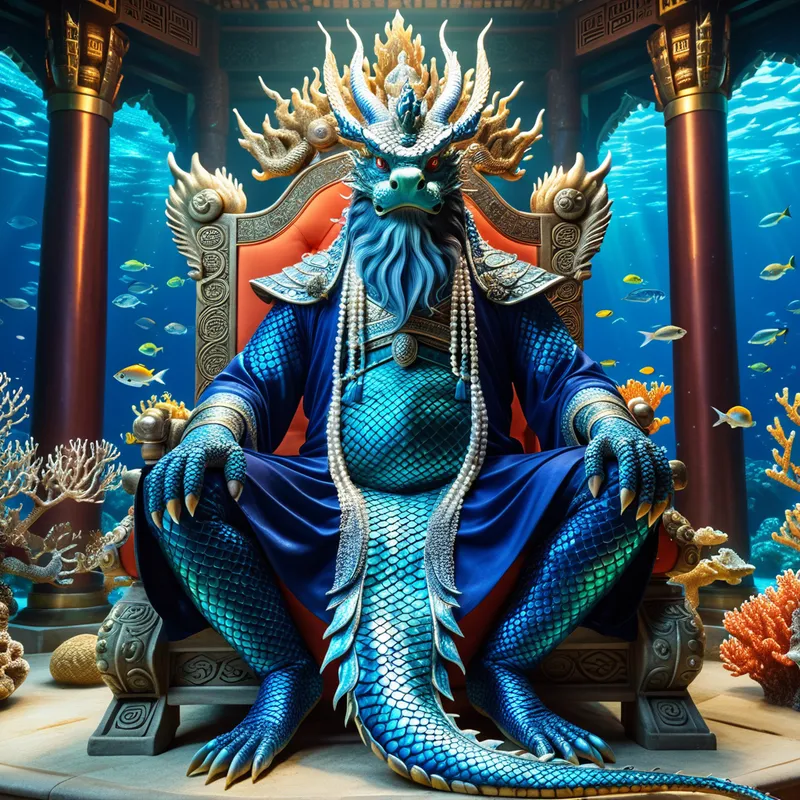
The Dragon King of the Sea Myth Meaning & Symbolism
A myth of a celestial king ruling the ocean's depths, embodying sovereignty over the unconscious and the promise of transformation through descent.
The Tale of The Dragon King of the Sea
Listen, and let the salt-tang of the wind carry you to the edge of the world, where the land crumbles into the abyss. Here, the Donghae does not merely wave; it breathes. Its depths hold kingdoms unseen, realms of liquid jade and crushing pressure, ruled by a sovereign of ancient scale and fathomless mind: Yongwang.
In the age when mountains were young and stars were being named, Yongwang reigned from his palace of luminous coral, Yonggung. Its pillars were whalebone, its gardens forests of kelp that danced to deep currents. His courtiers were not men, but the wise old turtle, the swift messenger fish, and the cunning octopus. He was the keeper of rain, the master of tides, the hidden heart of all fertility. His power was not of the blazing sun, but of the profound, generative dark—the dark that cradles seeds and dreams.
But the world above knew him only through absence and need. When the rains failed and the earth cracked like a starving mouth, the people would gather on the black cliffs. They would send down their most precious gifts—a flawless jade, a bolt of silk woven by a queen—plunging into the foam. They prayed not to a distant, abstract god, but to a neighbor, a capricious and mighty landlord of the deep. Sometimes, the sea would answer. A sudden swell would bring a bounty of fish. A gentle, persistent rain would begin to fall, smelling of distant depths. Other times, the sea would brood in silence, or rage with storms that seemed like the lashing of a great, scaled tail.
And sometimes, a different kind of supplicant would come. A hero, cursed or questing. A prince, fleeing a poisoned throne. A monk, seeking a sacred text said to be guarded in the library of pearls. They would stand at the shore’s edge, feeling the vast, silent attention of the deep upon them. To gain audience, they had to offer not a thing, but a self. They had to dive into the unknown, past the fear of drowning, past the crushing weight, trusting that the King’s will was not mere destruction. Those who were pure of purpose—or desperately brave—might find the water parting, a path of shimmering light opening to the palace gates. There, in the silent, heavy atmosphere, they would behold the Ruler himself, his eyes holding the patience of continents, his presence the weight of the world’s water. Their fate, and often the fate of their people, would be decided in that audience in the deep.

Cultural Origins & Context
The myth of the Yongwang is not a single, codified epic, but a living pattern woven through the fabric of Korean spiritual and folk consciousness. Its roots are ancient, blending indigenous Korean shamanic (Muism) reverence for nature spirits with later influences from Taoist and Buddhist cosmology. The Dragon King is a Sungju, a specific tutelary spirit of a place—in this case, the vast, unconquerable place that is the ocean.
The tales were kept alive not in royal courts, but on the lips of fishermen casting nets into the predawn grey, by farmers watching the sky for the rain only the Dragon could grant, and by Mudang performing rituals (Gut) to appease or petition the watery sovereign. He functioned as a crucial piece of the ecological and spiritual contract. He explained the ocean’s terrifying power and its life-giving bounty. He provided a narrative framework for dealing with the fundamental uncertainties of agrarian and coastal life. The myth taught respect, not conquest; it emphasized that humanity’s survival depended on a respectful relationship with a powerful, autonomous, and often inscrutable natural world.
Symbolic Architecture
The Yongwang is the archetypal ruler of the unconscious. His kingdom is not a geographic location, but the interior sea of the psyche—the realm of instinct, emotion, memory, and the primordial self that exists before the ego’s light.
The true king is not the one who stands tallest in the sun, but the one who sits deepest in the dark, holding the source of all life.
The ocean he rules symbolizes the unconscious in its totality: its nurturing, generative potential (the rain, the fish) and its terrifying, annihilating power (the storm, the drowning depth). The journey to his palace is the perilous descent into one’s own depths, a necessary voyage to retrieve something vital—a lost piece of the self (the prince’s rightful throne), wisdom (the monk’s sacred text), or a creative/fertile solution (the village’s rain). The gifts thrown into the sea represent the ego’s sacrifices, the cherished conscious attitudes we must relinquish to gain access to deeper, more authentic power.
The Dragon King himself is the symbol of a mature, integrated authority that comes from embracing, rather than repressing, the depths. He is not a monster to be slain, but a sovereign to be met. His sovereignty represents the psychological achievement of ruling one’s inner world—not with the iron fist of repression, but with the accepting, containing authority that allows chaos and order, terror and beauty, to coexist.
The Dreamer’s Resonance
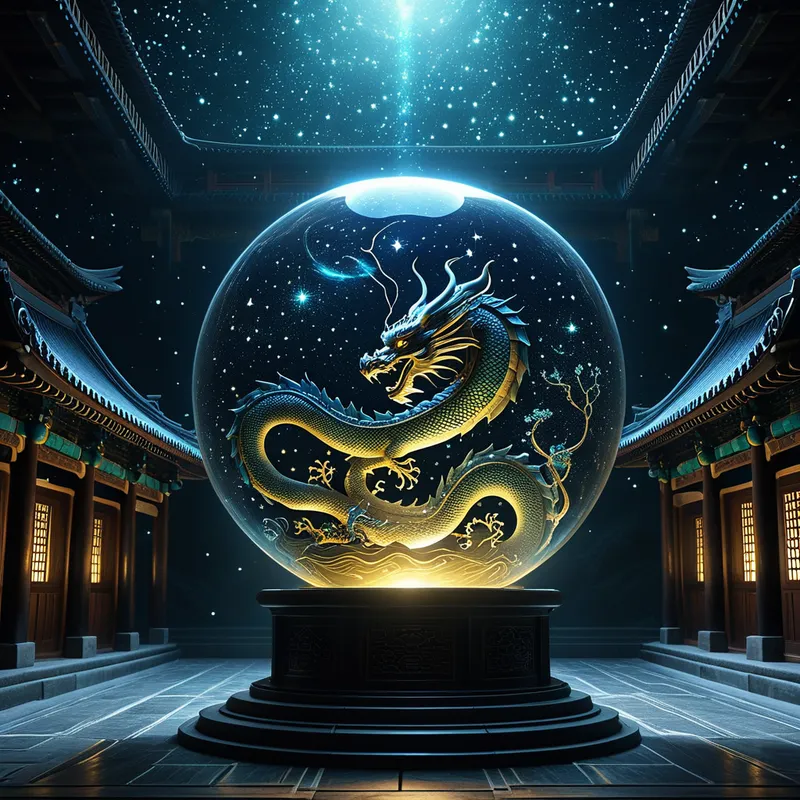
When the pattern of the Dragon King surfaces in modern dreams, it signals a profound encounter with the ruling principle of the personal or collective unconscious. Dreaming of a vast, calm, yet deeply inhabited ocean suggests the dreamer is in touch with a rich inner life, a sense of psychic abundance. Dreaming of a stormy sea or being on a cliff facing turbulent waves often coincides with feelings of being overwhelmed by unconscious contents—a tidal wave of emotion, anxiety, or unprocessed material threatening to engulf the conscious mind.
A direct dream encounter with the Dragon—seeing its eye in the deep, being received in the underwater palace—marks a critical threshold. Somatic sensations may accompany this: the feeling of pressure, of sinking, or of breathing underwater. Psychologically, this is the process of “going under” to retrieve something. The dreamer may be in a life transition that requires surrendering old identities (the sacrifice to the sea) to discover a more authentic source of authority and power (the audience with the King). It is the psyche’s way of orchestrating a necessary descent, a confrontation with the deep, inner ruler who holds the keys to renewal and true sovereignty.

Alchemical Translation
The myth of the Yongwang is a precise map for the alchemical process of individuation, specifically the stage of nigredo—the descent into the dark, the dissolution of the ego’s certainties in the primal waters.
The conscious ego, identified with the “land,” experiences drought, crisis, or exile. This suffering is the catalyst. The required action is not a fight upward, but a surrender downward—the dive into the sea. This is the voluntary engagement with the unconscious, the beginning of analysis, or any deep introspective work. The crushing pressure and fear of drowning are the resistances, the terror of being unmade.
To find the king, you must first become lost in his kingdom.
Arriving at the palace is the moment of encountering the core complexes and archetypal patterns that rule one’s life from the shadows. The Dragon King is the Self, the central, ordering archetype of the total psyche. The audience with him represents the ego’s dialogue with the Self. The boon granted—the rain, the text, the rightful place—is the new psychic energy, insight, or structure that emerges from this integration. The individual does not “kill” the dragon to become heroic; they acknowledge its sovereignty and, in doing so, participate in its royal authority. They return to the surface world not just with a prize, but fundamentally changed, now capable of “ruling” their own life with the depth, wisdom, and generative power of the once-hidden king within.
Associated Symbols
Explore related symbols from the CaleaDream lexicon:
- Dragon — The sovereign of the deep unconscious, representing immense latent power, ancient wisdom, and the archetypal force that must be integrated, not conquered.
- Ocean — The vast, unknown realm of the unconscious psyche, containing both life-giving resources and annihilating terror, over which the Dragon King rules.
- Water — The element of the emotions, the unconscious, fluidity, and primal life force; the medium through which one must travel to reach transformation.
- Journey — The essential descent from the conscious world into the depths of the self, a perilous voyage required to gain audience with inner authority.
- King — The archetype of inner sovereignty, order, and containment; the ruling principle of the psyche that emerges from integrating the depths.
- Temple — The underwater palace, Yonggung, representing the sacred, ordered center within the chaotic unconscious, the seat of the inner ruler.
- Rain — The blessing from the depths, symbolizing the generative, fertilizing psychic energy released when the conscious ego successfully petitions the unconscious.
- Sacrifice — The precious gift cast into the sea, representing the conscious attitude or possession the ego must relinquish to gain passage to deeper truth.
- Shadow — The hidden, often feared aspects of the self that dwell in the Dragon King’s realm, which must be acknowledged and integrated.
- Cave — Analogous to the underwater palace, a deep, interior space where one encounters the foundational archetypes and truths of the psyche.
- Moon — The reflective, feminine luminary that rules the tides, intimately connected to the Dragon King’s domain and the cyclical, emotional nature of the unconscious.
- Fish — The inhabitants and messengers of the deep, representing the autonomous, instinctual thoughts and movements of the unconscious mind.