The Djinn of the Desert
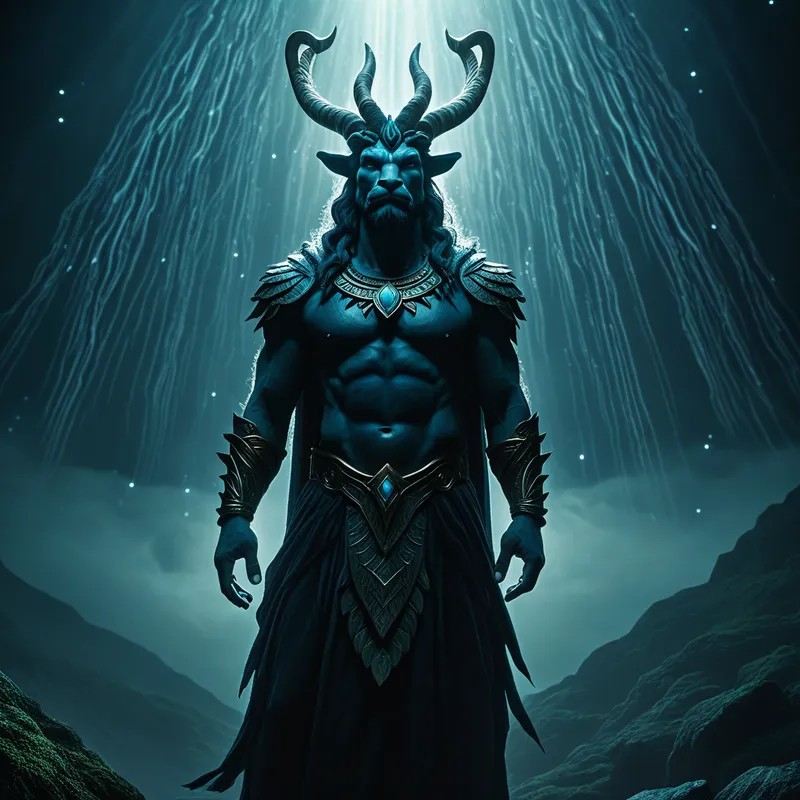
Ancient spirits of Arabian mythology, the Djinn of the Desert wield mysterious powers and form forbidden pacts, embodying the untamed forces of the sands.
The Tale of The Djinn of the Desert
Before the first man drew breath from the dust, before the winds were given their names, there existed another. Born from the smokeless fire, they were the [Djinn](/myths/djinn “Myth from Islamic culture.”/). But among these countless tribes—the Marid, the Ifrit, the Ghul—there are those who belong not to the crowded city nor the shadowed mountain pass. They are the [Djinn](/myths/djinn “Myth from Islamic culture.”/) of [the Desert](/myths/the-desert “Myth from Biblical culture.”/), the oldest children of the emptiness.
The tale is told of a traveler, a seeker of hidden knowledge named Khalid, who ventured beyond the known dunes into the Rub’ al Khali. For forty days and forty nights, he walked, his [water](/myths/water “Myth from Chinese culture.”/) gone, his reason fraying under the sun’s hammer. On the brink of dissolution, where the heat-haze danced not as illusion but as a living [thing](/myths/thing “Myth from Norse culture.”/), he saw it: a solitary, twisted acacia tree, impossible in that sea of sand. Beneath it sat a figure, neither old nor young, its form shimmering like the air above a flame.
“You seek,” the figure stated, its voice the sound of shifting sands. “But do you know what you call for?”
Khalid, parched and desperate, whispered of power, of secrets that would make him a king among men. The Djinn—for it was one—smiled a smile that held no warmth. “Power I can give. It is my nature. But the desert does not give; it exchanges. For every secret unveiled, a truth of your own must be buried in the sand. For every wish granted, a piece of your certainty must be scattered to [the wind](/myths/the-wind “Myth from Various culture.”/).”
A pact was forged, not in ink, but in intention. The Djinn taught Khalid the language of the sirocco, how to hear the whispers of ancient rivers long vanished beneath the dunes. He learned to find oases that moved and to command the very stones. He returned to his people a mighty sage, a miracle-worker. Yet, with each use of his granted power, something within him faded. The memory of his mother’s face. The taste of simple water. The comfort of unbroken night, for now the stars themselves spoke in demanding tongues. He had gained [the world](/myths/the-world “Myth from Tarot culture.”/), but the desert, through its Djinn, was slowly reclaiming the substance of his soul, grain by grain.
Cultural Origins & Context
The Djinn are not mere “genies” of later Western fancy, but integral beings within the pre-Islamic and Islamic cosmology of the Arabian Peninsula. Created by God from marijin min nar—“a smokeless fire”—they exist as a conscious, communal creation parallel to humanity, with their own societies, faiths, and free will. The desert, the sahra, was not a void to the ancient Arabs, but a full and potent landscape, the barr (open land) that was both provider and destroyer. It was logically, then, the prime domain of the most untamed and elemental of these spirits.
The Djinn of the Desert embody the raw and ambiguous nature of this environment. They are not inherently evil, but they are inherently other, operating by a logic that mirrors the desert’s own: harsh, transactional, and indifferent to human morality. Encounters with them, as recorded in folklore and the One Thousand and One Nights, are perilous not because they are always malicious, but because their perspective is alien. A desert Djinn may grant a wish with perfect literalism, revealing the tragic gap between human desire and its fulfillment. They represent the inherent risk of engaging with forces that predate and supersede human order.
Symbolic Architecture
The [Djinn](/symbols/djinn “Symbol: A powerful supernatural being from Middle Eastern and Islamic traditions, often associated with wish-granting, trickery, and elemental forces.”/) of the Desert are the psychological embodiment of the untamed, unconscious [psyche](/myths/psyche “Myth from Greek culture.”/) projected onto the ultimate [landscape](/symbols/landscape “Symbol: Landscapes in dreams are powerful symbols representing the dreamer’s emotional state, personal journey, and the broader context of life situations.”/) of [austerity](/symbols/austerity “Symbol: Austerity in dreams symbolizes self-imposed restriction, discipline, or external hardship, often reflecting a need for purification, control, or a response to scarcity.”/). The desert represents the stripped-bare Self, a place where all non-essentials—the [persona](/symbols/persona “Symbol: The social mask or outward identity one presents to the world, often concealing the true self.”/), the comforts of consensus [reality](/symbols/reality “Symbol: Reality signifies the state of existence and perception, often reflecting one’s understanding of truth and life experiences.”/)—are scoured away. The [Djinn](/symbols/djinn “Symbol: A powerful supernatural being from Middle Eastern and Islamic traditions, often associated with wish-granting, trickery, and elemental forces.”/) that dwell there are the potent, autonomous complexes that emerge when one enters this state of radical interiority.
They are the personified potential of the psyche, but a potential that is chaotic and not yet integrated. To meet the Djinn is to meet one’s own latent capacities for creation and destruction, which are often one and the same force.
Their elemental [origin](/symbols/origin “Symbol: The starting point of a journey, often representing one’s roots, source, or initial state before transformation.”/)—fire—is crucial. It is the fire of inspiration, of [obsession](/symbols/obsession “Symbol: An overwhelming fixation on a person, idea, or object that consumes mental energy and disrupts balance.”/), of transformative [energy](/symbols/energy “Symbol: Energy symbolizes vitality, motivation, and the drive that fuels actions and ambitions.”/), but also of consumption and annihilation. The desert provides no fuel for this fire but the [seeker](/symbols/seeker “Symbol: A person actively searching for meaning, truth, or a higher purpose, often representing the dreamer’s own quest for identity or fulfillment.”/)’s own [soul](/symbols/soul “Symbol: The soul represents the essence of a person, encompassing their spirit, identity, and connection to the universe.”/). Thus, the classic pact is a profound [allegory](/symbols/allegory “Symbol: A narrative device where characters, events, or settings represent abstract ideas or moral qualities, conveying deeper meanings through symbolic storytelling.”/) for psychological [inflation](/symbols/inflation “Symbol: A dream symbol representing feelings of diminishing value, loss of control, or expansion beyond sustainable limits in one’s life or psyche.”/): [the ego](/myths/the-ego “Myth from Jungian culture.”/), encountering a vast power from the unconscious (the Djinn), seizes it without the requisite [strength](/symbols/strength “Symbol: ‘Strength’ symbolizes resilience, courage, and the ability to overcome challenges.”/) of [character](/symbols/character “Symbol: Characters in dreams often signify different aspects of the dreamer’s personality or influences in their life.”/) to hold it. The price is always a [piece](/symbols/piece “Symbol: A ‘piece’ in dreams often symbolizes a fragment of the self or a situation that requires integration, reflection, or understanding.”/) of one’s own humanity, as [the ego](/myths/the-ego “Myth from Jungian culture.”/) is burned away by the very fire it sought to command.
The Dreamer’s Resonance
To dream of the Desert Djinn is to stand at a threshold within oneself. It signifies an encounter with a potent, raw aspect of your own nature that feels both immensely powerful and profoundly alien. This could manifest as a sudden, compelling inspiration (an artistic vision, a business idea, a spiritual calling) that seems to arrive from a source outside yourself, carrying an aura of fatefulness.
The danger the myth warns of is possession. The Djinn does not integrate; it occupies. In modern terms, one might become possessed by an ideology, a creative mania, a hunger for power, or a numinous spiritual experience that one mistakes for totality. The dream may present the Djinn as a mesmerizing guide or a terrifying pursuer, but its core message is the same: a fundamental power dynamic within the psyche is being activated. Are you the master of this energy, or is it mastering you? The desert setting underscores the feeling of isolation that accompanies such an encounter; this is a solitary negotiation with the deepest layers of [the Self](/myths/the-self “Myth from Jungian culture.”/), where the normal rules of engagement do not apply.
Alchemical Translation
In the alchemical opus, the journey corresponds to the stage of [nigredo](/myths/nigredo “Myth from Alchemical culture.”/)—the blackening, the descent into primal matter, the desert of the soul. The Djinn is the volatile spirit, the [Mercurius](/myths/mercurius “Myth from Alchemical culture.”/), trapped within this matter. It is the hidden, fiery life-force within the seemingly dead and barren psyche.
The pact is the perilous beginning of transformation. The seeker (the ego-consciousness) must engage with this volatile spirit, but the initial engagement is always one of projection and danger. The Djinn’s literal-minded wish-granting mirrors the crude, unconscious way psychic contents initially express themselves when released.
The ultimate goal is not to enslave the Djinn, but to achieve a [coniunctio](/myths/coniunctio “Myth from Alchemical culture.”/), a [sacred marriage](/myths/sacred-marriage “Myth from Alchemy culture.”/) between the conscious mind and this fiery spirit. This requires the “salt” of wisdom and the “[sulfur](/myths/sulfur “Myth from Alchemical culture.”/)” of passion to properly contain the “[mercury](/myths/mercury “Myth from Roman culture.”/)” of the Djinn. Only then does its power become transformative rather than destructive, leading not to the loss of the soul, but to its amplification—the creation of the philosopher’s stone, the integrated Self. The desert, in the end, must bloom not with mirages, but with a genuine, hard-won oasis.
Associated Symbols
Explore related symbols from the CaleaDream lexicon:
- Desert — The archetypal landscape of austerity, revelation, and trial, where all non-essentials are stripped away to confront the bare essence of being.
- Fire — The primal element of transformation, passion, and destruction; the smokeless origin of the Djinn and the volatile energy of the unconscious.
- Mirage — The illusion of fulfillment, representing the deceptive and literal nature of wishes granted by unconscious forces without wisdom.
- Wind — The invisible, shaping force of the desert and the breath of spirit, often carrying the whispers and presence of the unseen Djinn.
- Cave — A hidden chamber within the vastness, symbolizing the secret recesses of the psyche where potent, archaic contents (like the Djinn) lie dormant.
- Ring of Power — An object of binding and control, representing the human attempt to constrain and command vast, autonomous psychic forces.
- Shadow — The repressed, unknown aspects of the Self, akin to the Djinn who dwell in the barren places outside the light of consciousness.
- Trickster — The archetype of boundary-crossing and ambiguous gifts, perfectly embodied by the Djinn who subverts wishes and teaches through peril.
- Dream — The internal desert where one encounters these autonomous psychic entities, a realm of symbolic negotiation with the depths.
- Key — The means of unlocking hidden power or knowledge, but also the potential to unlock forces one may be unable to contain.
- Sacrifice — The necessary price of engagement with deep power, often a piece of one’s former identity or innocence, paid to the sands of transformation.
- Djinn — The autonomous complex of raw, pre-moral psychic power, personified as a being of smokeless fire and ambiguous intent.