The Divided Self Myth Meaning & Symbolism
A primal myth of the soul's origin, describing a powerful, spherical being split in two by the gods, condemning each half to a lifelong search for its other.
The Tale of The Divided Self
Listen, and hear the story written in the marrow of your bones, the ache in your chest when you behold a face that feels like home.
In the beginning, before the mountains were raised and the seas were poured, the first children of the earth were not as you are now. They were mighty, whole, and complete. Their form was not bipedal and singular, but spherical—a perfect orb of flesh and spirit, rolling with terrible purpose and joy. Each being had four arms, four legs, and a single head with two faces gazing in opposite directions, beholding the entire world at once. They were of three kinds: some were doubly male, some doubly female, and some were the glorious union of both, the androgynos.
These round beings possessed a power that shook the very foundations of Olympos. They were fiercely proud, boundless in their energy, and they dared to scale the heavens themselves, challenging the dominion of the gods. Their ambition was not of malice, but of a fullness so potent it knew no limit.
Zeus, the cloud-gatherer, looked upon their ascent, and a great deliberation fell upon the divine council. To destroy them would be to extinguish a magnificent spark of the cosmos. Yet, to allow their challenge to stand was impossible. Then, the wise Zeus conceived a plan not of annihilation, but of division.
"Let us cut them in two," he declared, his voice the rumble of distant thunder. "Thus, they will be weakened, and their number will be doubled, increasing the tributes paid to us. And they shall walk upright upon two legs, forever looking forward, forever seeking what lies behind them in their very soul."
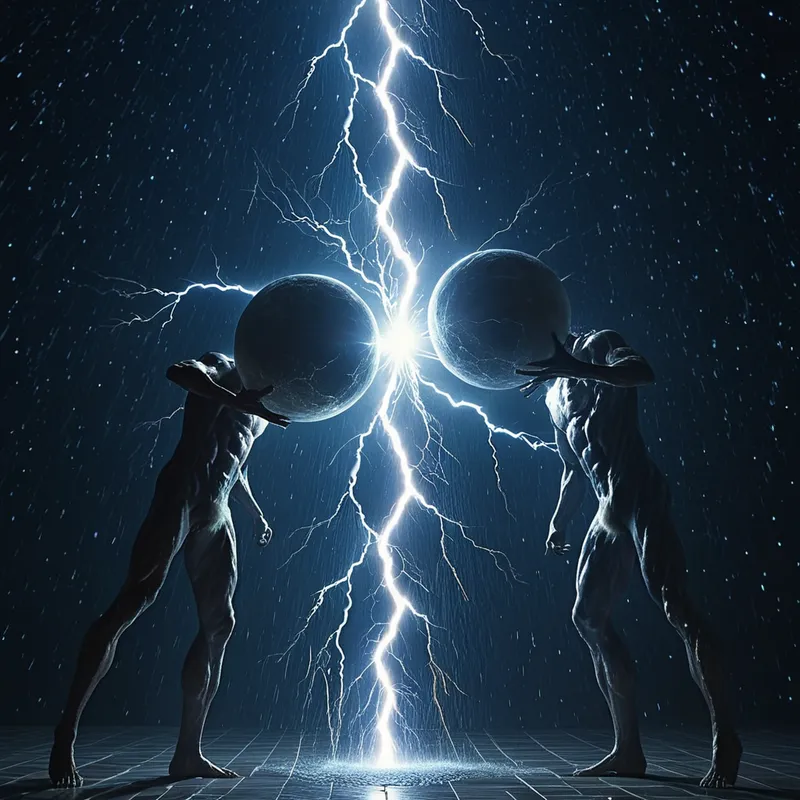
And so it was done. The great smith Hephaistos took up his cleaving tools, and Hermes bound each spherical being. With a divine stroke that echoed through the firmament, each whole was split cleanly down the middle. The sound was not a scream, but a sigh that became the wind.
The halves fell to earth, raw and bleeding spirit. Where once was smooth wholeness, now was a gaping wound of longing—a flat, searching plane of flesh where they had been joined. Apollo, moved by pity, turned their heads and pulled their skin tight to suture the wound into a navel, the eternal seal and reminder of their loss.
From that day, each half-life stumbled on two legs, arms clutching empty air. Their one face, now forward-facing, wept with a memory it could not name. They would wander the earth, and when they encountered the half from which they were severed, a miraculous thing occurred. They would not speak, but throw their arms about one another, desperate to be joined again into one, to heal the primordial wound. They would cling until they perished from hunger and inaction, for no other need mattered.
Seeing this, Zeus in his mercy moved their genitals to the front, so that in embracing, they might find a temporary solace, a fleeting echo of union, and then turn their attention back to the business of life. And so the human race was born—not from dust, but from a cleaving; not from solitude, but from a memory of profound unity, forever seeking its other half in the eyes of another.
Cultural Origins & Context
This haunting narrative is not found in epic verse like the tales of Achilles or Theseus. It springs from the philosophical dialogues of Plato, specifically within the Symposium, where the comic playwright Aristophanes offers it not as holy writ, but as a profound explanatory myth. Its setting is a drinking party, a gathering of Athens' intellectual elite, where speeches on the nature of Eros are given.
This context is vital. The myth functions as a philosophical and psychological etiology—a story of origins—for human desire, sexuality, and the pervasive sense of incompletion. It was a tool for educated Athenians to conceptualize the powerful, often irrational, forces of attraction and longing that drove them. It provided a dignified, cosmic reason for the all-consuming power of love, framing it not as a mere appetite, but as a sacred quest to restore a lost state of divine wholeness. It was passed down not by rhapsodes in the public square, but through the private, scholarly circulation of Plato's texts, becoming a cornerstone of Western thought on love and the self.
Symbolic Architecture
The myth's power lies in its stark, visceral symbolism. The original spherical being represents the primordial, unconscious state of psychic totality. It is the Self before the dawn of ego-consciousness, containing all opposites within its perfect, revolving form.
The navel is not merely a scar; it is the soul's memory of a severed connection to the cosmos, the physical seal on a spiritual wound.
The act of division by the gods symbolizes the inevitable trauma of incarnation—the moment consciousness is born from the unconscious, creating the fundamental dualities of self/other, mind/body, male/female. The gods here represent the impersonal, ordering principles of reality that necessitate this separation for the drama of individual life to unfold.
The desperate clinging of the halves is the pure, unmediated force of Eros—not merely sexual, but the soul's magnetic pull toward wholeness. Zeus's "solution" of repositioning genitals is a profound commentary on the human condition: our deepest spiritual yearning for reunion is channeled through, and often confused with, biological and emotional desire. Our relationships become the theater where this ancient drama is re-enacted.
The Dreamer's Resonance
When this myth stirs in the modern unconscious, it manifests in dreams of profound searching and poignant incompletion. You may dream of wandering through endless halls looking for a room whose location you've forgotten, or of trying to speak to a loved one across a widening chasm where your voice makes no sound. You may see yourself in a mirror, but your reflection is blurred, turned away, or shows only half your face.
Somatically, this can feel like a hollow ache in the chest, a literal "heartache," or a restless energy that has no clear object. Psychologically, it signals a confrontation with the anima or animus—the lost inner opposite. The dream is not merely about finding a soulmate externally, but about recognizing that the "other half" you seek is a disowned part of your own psyche. The clinging from the myth becomes a compulsive dependency in relationships, where we demand another make us whole, rather than undertaking the inner work of re-integration ourselves.

Alchemical Translation
The individuation process modeled here is not about finding your missing half in another person. It is the arduous opus of reclaiming that half within yourself.
The alchemical marriage is not between two people, but between the conscious ego and the lost counterpart within the soul's own depths.
The first step is recognizing the wound—the conscious admission of one's inherent feeling of incompleteness, the "navel-gazing" that acknowledges the scar of separation. This is the nigredo, the blackening, a descent into the longing.
The second is withdrawing the projection. We must cease demanding that lovers, partners, or pursuits carry the full burden of our wholeness. We must see that the magnetic pull we feel toward certain qualities in others is a mirror showing us what we have exiled within ourselves.
The final, transformative stage is the inner conjunction. This is the conscious, willed integration of those lost qualities—the masculine with the feminine, the logical with the intuitive, the strong with the vulnerable. We cannot physically roll back into a sphere, but we can spiritually achieve a state of inner circulation where all parts are acknowledged, honored, and brought into dialogue. We become, not a fused monolith, but a reconciled duality, a conscious microcosm of that original, glorious whole. We heal not by returning to a pre-conscious state, but by evolving toward a conscious wholeness that remembers its division, and has transcended it. In doing so, the search ends not in finding, but in becoming.
Associated Symbols
Explore related symbols from the CaleaDream lexicon: