The Div Akvan Myth Meaning & Symbolism
The tale of a shape-shifting demon who casts heroes into the sea, representing the psyche's chaotic force that must be faced and integrated for true strength.
The Tale of The Div Akvan
Hear now the tale of a terror that walked the borderlands, where the solid earth of order meets the formless, churning abyss. In the days when heroes were giants and demons wore the world’s raw chaos as their skin, there arose from the deep places a creature of pure caprice: the Div Akvan.
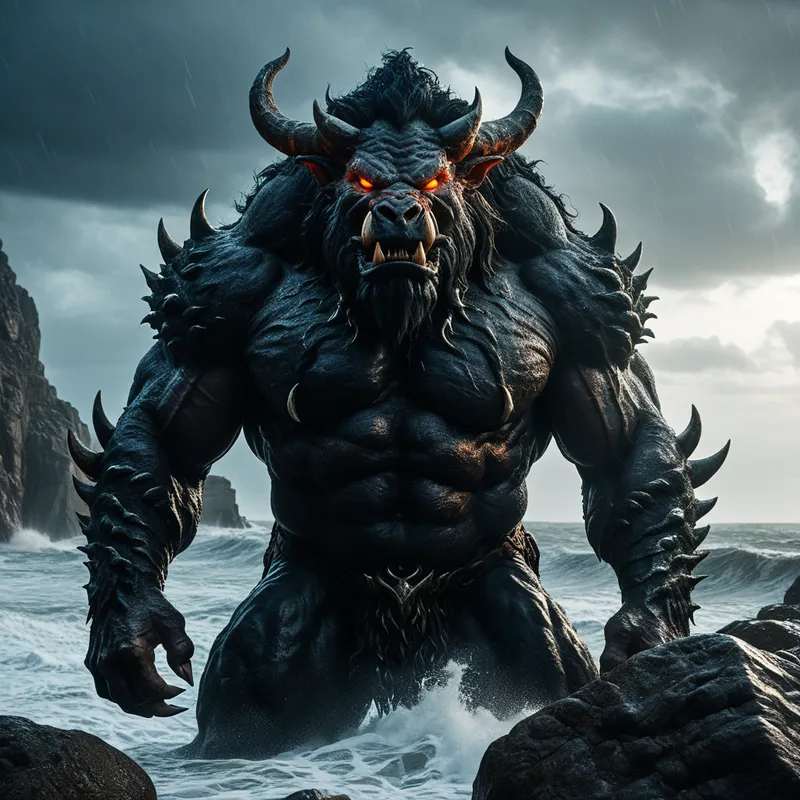
He was not a demon of fire or of darkness confined to a pit, but a spirit of the in-between, a child of the tumultuous sea and the unyielding shore. His form was that of a mountain of muscle, skin like cured leather, and upon his shoulders sat the fearsome, tusked head of a black boar, eyes smoldering like coals. But his true power was not in his strength alone; it was in his nature, which was the nature of chaos itself. The Div Akvan delighted in a single, cruel game. He would roam the coasts and the roads, and when he found a traveler—be they humble merchant or proud warrior—he would pose a riddle with no answer, a choice with no victory: “Shall I cast you upon the dry land, or hurl you into the depths of the sea?”
To choose the land was to be dashed against the unfeeling rocks. To choose the sea was to be swallowed by the endless, hungry waves. The demon’s laughter was the sound of the storm-wind as he seized his victim, and with a heave born of infinite malice, he would cast them according to his own whimsical will, always choosing the opposite of their plea. Thus did he mock hope and revel in despair, turning human destiny into a toy.
This was the state of the world when the great champion, the Rostam, weary from his Seven Labors but ever vigilant, came upon the demon’s trail. He found not a battlefield, but a scene of profound violation: his mighty steed, Rakhsh, was missing. The tracks led to the coast, where the Div Akvan, having magically subdued the heroic horse, stood gloating by the roaring surf.
Rostam’s heart burned with a cold fury. He did not charge blindly, for he knew brute force alone could not conquer a principle. He approached, and the demon, grinning with tusked mouth, turned to him and uttered the fateful question: “O mighty warrior! Choose! Shall I cast you upon the dry land, or hurl you into the sea?”
But Rostam, in a flash of insight that was both cunning and profound, saw the trap for what it was: a prison of literal thinking. He did not choose either of the demon’s offerings. Instead, he reached into the deeper logic of the cosmos, the law of the Asha. He called upon his own indomitable will and shouted a third option into the face of the chaos: “Choose for yourself, O Div! But know this: if you possess any wisdom, you will cast me upon the land, where my loyal companions and allies await!”
In that moment, the demon’s game broke. Rostam had refused the binary doom and instead projected a reality of his own making—one where the land meant not death, but community and strength. Confused, its chaotic logic short-circuited, the Div Akvan seized Rostam and, as was its nature to contradict, hurled the hero not to the land, but far out into the raging, open sea.
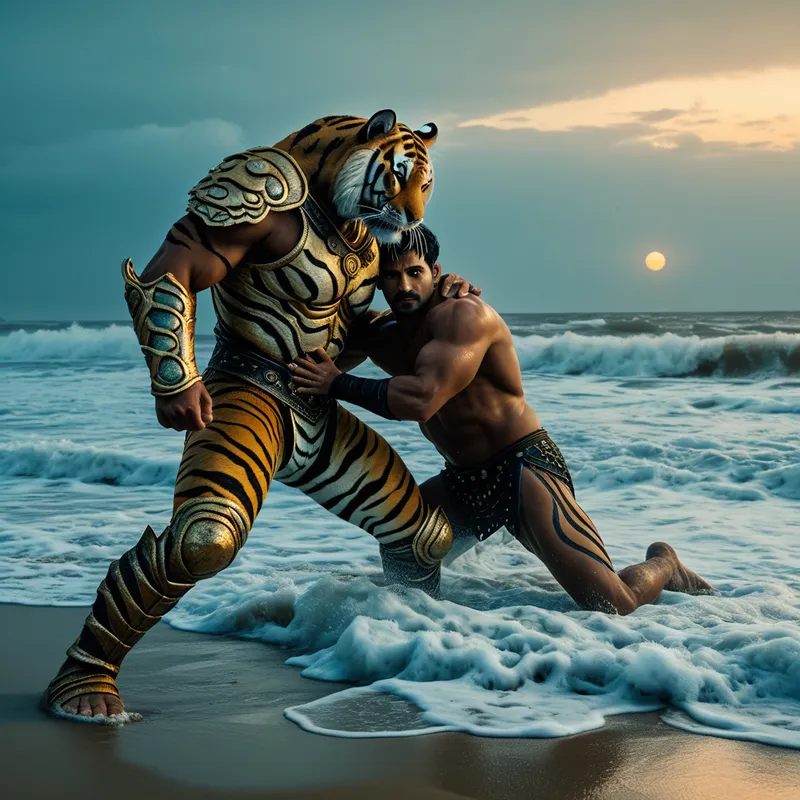
And this was Rostam’s victory. For in the water, he was not a victim to be drowned. He was Rostam, son of Zal, and the ocean itself became his arena. He swam with the power of a Nahang, his spirit unbroken. He fought the waves, survived, and returned to the shore with a resolve hardened like tempered steel. There, he found the Div Akvan, its trick spent, its power diminished. The subsequent battle was fierce, but its outcome was decided the moment Rostam transcended the false choice. With his legendary strength, he subdued the demon, bound it, and ended its reign of capricious terror. Order, born not from avoidance, but from passing through the heart of chaos, was restored.
Cultural Origins & Context
This myth is preserved within the monumental epic, the Shahnameh of Ferdowsi. Composed at the turn of the first millennium CE, the Shahnameh was an act of cultural preservation, gathering the ancient Iranian myths, legends, and history into a Persian poetic tapestry after the Arab conquest. The story of Rostam and the Div Akvan belongs to the legendary section of the epic, a time of supernatural beings and foundational heroes.
The myth functioned as more than mere adventure. In a Zoroastrian-informed worldview, the universe is a battleground between the forces of Asha and Druj. The Div Akvan is a manifest agent of Druj—not evil in a simplistic sense, but a force of active disorder, randomness, and the erosion of meaning. Storytellers would recite this tale to illustrate a core tenet: that the heroic duty is to confront and actively restrain chaos to preserve the civilized world. It taught that the enemy of human flourishing is often the capricious, meaningless event that seeks to reduce life to a cruel joke, and that such forces must be met with both courage and transcendent wisdom.
Symbolic Architecture
The Div Akvan is the archetypal embodiment of the [Shadow](/symbols/shadow “Symbol: The ‘shadow’ embodies the unconscious, repressed aspects of the self and often represents fears or hidden emotions.”/) in its most impersonal and terrifying form. It is not a personal flaw, but the psyche’s encounter with the objective, existential [chaos](/symbols/chaos “Symbol: In Arts & Music, chaos represents raw creative potential, uncontrolled expression, and the breakdown of order to forge new artistic forms.”/) that underlies [reality](/symbols/reality “Symbol: Reality signifies the state of existence and perception, often reflecting one’s understanding of truth and life experiences.”/). Its home—the shoreline—is the perfect [symbol](/symbols/symbol “Symbol: A symbol can represent an idea, concept, or belief, serving as a powerful tool for communication and understanding.”/) of the liminal [space](/symbols/space “Symbol: Dreaming of ‘Space’ often symbolizes the vastness of potential, personal freedom, or feelings of isolation and exploration in one’s life.”/) between [consciousness](/symbols/consciousness “Symbol: Consciousness represents the state of awareness and perception, encompassing thoughts, feelings, and experiences.”/) (the known land) and the unconscious (the unknown sea).
The demon’s false choice is the tyranny of the either/or, the reduction of life’s complex possibilities into a doomed binary. It represents every situation where we feel trapped between two bad options, victims of circumstance.
Rostam’s genius is his psychological maneuver. He does not fight the [choice](/symbols/choice “Symbol: The concept of choice often embodies decision-making, freedom, and the multitude of paths available in life.”/) on its own terms. By introducing a third, imaginative [option](/symbols/option “Symbol: Options in dreams symbolize choices or paths in life, reflecting the dreamer’s current decision-making situations.”/)—“cast me to the land where my allies are”—he reframes the entire [paradigm](/symbols/paradigm “Symbol: A fundamental model or framework in arts and music that shapes creative expression, perception, and cultural understanding.”/). He injects meaning and [relationship](/symbols/relationship “Symbol: A representation of connections we have with others in our lives, often reflecting our emotional state.”/) into the equation of chaos. His subsequent casting into the sea then becomes not a defeat, but a necessary ordeal, a [baptism](/symbols/baptism “Symbol: A ritual of spiritual cleansing, initiation, and rebirth, symbolizing profound transformation and commitment to a new path.”/) into the very chaos he must survive and integrate. His swim back is the [journey](/symbols/journey “Symbol: A journey in dreams typically signifies adventure, growth, or a significant life transition.”/) of the ego, battered but intact, returning from the [depths](/symbols/depths “Symbol: Represents the subconscious, hidden emotions, or foundational aspects of the self, often linked to primal fears or profound truths.”/) of the unconscious with new [strength](/symbols/strength “Symbol: ‘Strength’ symbolizes resilience, courage, and the ability to overcome challenges.”/).
The Dreamer’s Resonance
When the pattern of the Div Akvan stirs in modern dreams, it often manifests as an overwhelming, impersonal force causing senseless upheaval. The dreamer may face a monstrous figure that offers impossible choices, or find themselves repeatedly thrown into turbulent, dark waters despite their protests. The somatic feeling is one of profound helplessness and vertigo.
This dream signals a psyche grappling with a surge of undifferentiated chaos, often triggered by life events that shatter one’s sense of control or predictability: sudden loss, betrayal, or existential crisis. The demon represents the part of the psyche that believes life is random and cruel. The dream is not a prophecy of doom, but an enactment of the confrontation. The very act of dreaming it is the psyche’s initial attempt to face the formless terror, to give it a shape (the demon) so that it can eventually be engaged. The emotional turmoil is the necessary first wave of the unconscious, demanding to be acknowledged.

Alchemical Translation
The alchemical process modeled here is the nigredo—the blackening, the descent into the chaotic prima materia—followed by the solutio—the dissolution in the sea. The Div Akvan is the agent that forces this descent. The modern individual’s “Rostam moment” occurs when, in the midst of a life crisis, they stop asking “why is this happening to me?” (the victim’s question) and begin to ask “how will I carry this?” or “what meaning can I forge from this?”
The triumph is not in avoiding the plunge into the sea of chaos, but in changing the nature of the plunge from a sentence of death into a trial of survival.
To integrate the Div Akvan is to acknowledge the role of chaos, randomness, and absurdity as constituents of reality, without becoming enslaved to them. It is to develop what the ancients called wisdom and what psychology calls ego strength—the capacity to hold one’s center while acknowledging the surrounding tumult. The demon, once bound, becomes a source of power; its energy of disruption, when integrated, fuels resilience and a creativity that is no longer afraid of the unknown. The individual who has survived their own psychic sea and returned to shore does not live in a world without chaos, but they live in a world where chaos does not have the final word.
Associated Symbols
Explore related symbols from the CaleaDream lexicon:
- Ocean — The vast, unknown unconscious and the realm of primal chaos into which the ego is cast for its ultimate trial and purification.
- Hero — The archetypal force, embodied by Rostam, that consciously engages with chaos, not to destroy it utterly, but to transform its relationship to the conscious world.
- Shadow — The Div Akvan itself, representing the impersonal, chaotic, and terrifying aspects of reality and the psyche that must be confronted and integrated.
- Choice — The demon’s false binary represents the illusion of limited options in a crisis; true power lies in inventing a third, transcendent path.
- Stone — Symbolizes Rostam’s unwavering will and the core of immutable self that remains solid even when cast into the chaotic sea.
- Journey — The entire myth is a journey from order, through chaotic dissolution, and back to a renewed and stronger state of order.
- Chaos — The raw, undifferentiated state of matter and psyche that the Div Akvan personifies and wields as its primary weapon.
- Order — The principle of Asha that Rostam defends and ultimately strengthens by passing through chaos, rather than by avoiding it.
- Strength — Not merely physical might, but the psychological fortitude to endure dissolution and return from the abyss with integrity intact.
- Trickster — The Div Akvan operates as a malignant trickster, subverting expectation and logic, forcing a confrontation with life’s absurdity.
- Rebirth — Rostam’s emergence from the sea is a symbolic rebirth, having died to his old understanding of the world and been remade by the ordeal.