The Death Coach Myth Meaning & Symbolism
A spectral coach heralds death's arrival, a mythic threshold where fate is met, souls are collected, and the boundary between worlds dissolves.
The Tale of The Death Coach
Listen, and let the peat-fire smoke carry you. The hour is the dead of night, when the world holds its breath. The road is not a road you know; it is a ribbon of packed earth between sleeping fields, silvered by a cold, indifferent moon. In the cottage, the fire is banked, the family asleep. All is still, save for the wind’s low keen.
Then, a sound. Not of this world. A distant, rhythmic clatter-clack that is not hoof-fall, not wheel-turn, but the grinding of bone on stone. It swells from the west, from the direction of the sea and the setting sun—the direction of Tír na nÓg. A light appears, bobbing like a will-o’-the-wisp, but colder, more purposeful. It resolves into a lantern, hanging from the front of a coach.
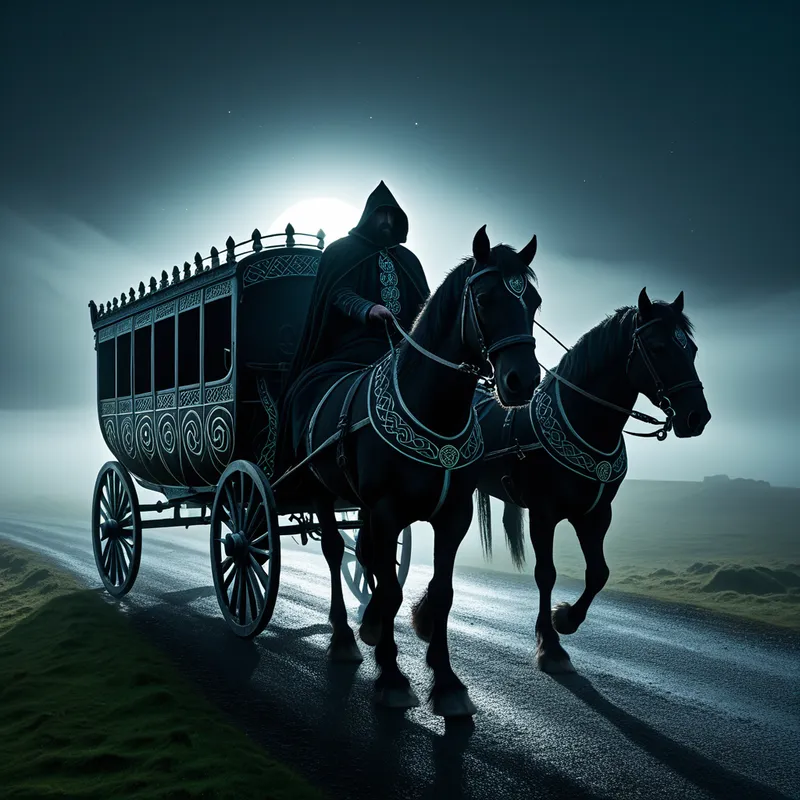
But what a coach. It is blacker than a starless midnight, its panels polished to a liquid obsidian sheen. Upon its doors and sides are carved the endless, looping spirals and knots of the ancient ones, patterns that speak of eternity and binding. It is drawn not by horses of flesh, but by steeds of shadow and memory, powerful and silent, their forms shifting in the gloom. Some say they are headless; others say their eyes are pools of void. Upon the driver’s bench sits the Cóiste Bodhar, the Deaf Coachman. He is cloaked and hooded, a figure of absolute stillness, his face unseen, his hands—pale as bog-wood—gripping the reins. He makes no sound; the coach itself is silent, its dread approach known only by the chill that precedes it and the unnatural sound of its passage.
It does not stop for every dwelling. It moves with a terrible, knowing purpose. It slows before a particular cottage, where an old man lies abed, his breath shallow. Or perhaps before the gate of a young mother, fevered and dreaming. The coach halts. The door swings open of its own accord, revealing an interior of profound darkness, yet somehow inviting, like the deep earth. No command is issued. No hand is extended. But the soul for whom it has come—they know. They rise from their body, a sigh of light and memory, and step across the threshold of the coach. The door shuts with a soft, final click.
Then, with the same inexorable rhythm, the Cóiste Bodhar turns. It does not travel back the way it came. It drives straight on, through hedgerow and stone wall as if they were mist, heading for the ancient sídhe mound on the hill, or the lonely crossroads where the worlds grow thin. And as it passes from sight, the living, who heard its passing in their sleep, wake with a start, a cold certainty in their hearts. They go to the window and see only the empty road, but they know. A journey has been completed. A threshold has been crossed. The Coach has collected its passenger.
Cultural Origins & Context
The myth of the Death Coach is not a single story from a sacred text, but a living whisper passed down through generations in Ireland, Scotland, Wales, and the Isle of Man. It belongs to the rich tapestry of folk belief that thrived alongside, and often beneath, official religion. These tales were told by the hearth, not written in monasteries; their custodians were seanchaí (storytellers) and grandmothers, their canvas the long winter nights.
Its societal function was multifaceted. On a practical level, it was a narrative framework for the inexplicable—the precise timing of a death, heard but not seen. The sound of its wheels was an omen, a psychic weather report forecasting a coming loss. More profoundly, it served as a cultural container for the mystery of death itself. In a worldview where the otherworld was not a distant heaven but a parallel, interwoven reality (Tír na nÓg, An Saol Eile), death was a transition, not an annihilation. The Coach provided the vehicle for that transition. It ritualized the moment, granting it a solemn, mythic dignity. It affirmed that no one makes this final journey alone or unguided; even in death, one is met and escorted. This softened the terror of the unknown, embedding the individual’s fate within a larger, timeless order.
Symbolic Architecture
The Death Coach is a masterful symbol of the psyche’s encounter with absolute inevitability. It is not a monster of chaos, but an emissary of cosmic law.
The Coach does not argue, persuade, or threaten. It simply arrives. It is the embodied "and then" that follows the final period of a life's sentence.
The Coach itself represents the vessel of transition. Its blackness is not evil, but the fertile void, the womb of the unseen world from which all forms emerge and to which they return. The intricate Celtic knotwork on its sides symbolizes the eternal, interconnected pattern of life, death, and rebirth—a pattern the soul is now being rewoven into.
The Headless Horses or Shadow Steeds signify the instinctual, unconscious forces that propel us toward our destiny. They are "headless"—beyond the control of reason, logic, or the conscious ego. They are driven by a deeper, archetypal knowing.
The Deaf Coachman (Cóiste Bodhar) is the ultimate psychopomp. His deafness is crucial; he is impervious to pleas, bargains, or tears. He represents the impartial, impersonal aspect of fate or the Self (in Jungian terms). He is not cruel, but utterly neutral, a function of the universe executing its order. He is the silent conductor of the soul’s necessary departure.
The Journey to the Sídhe Mound encapsulates the Celtic belief in a localized, earthly otherworld. Death is not an ascent to a remote sky, but a descent into the nearby, sacred hill—into the body of the land itself. It symbolizes a return to the ancestral, psychic source.
The Dreamer's Resonance
When the Death Coach rattles through the landscape of a modern dream, it rarely signifies a literal premonition of physical death. Instead, it heralds a profound psychic death. The dreamer is at a non-negotiable threshold.
Somatically, the dream may be accompanied by sensations of chilling dread, paralysis, or a heavy, sinking feeling—the body registering the gravity of an impending ending. Psychologically, the Coach appears when an old identity, a outworn life structure, a long-held belief, or a toxic attachment has reached its expiration date. The ego, comfortable in its familiar "cottage," hears the approach of this archetypal force and trembles. The Coach’s silent, implacable presence forces the recognition: this chapter is over. You must let this part of yourself go. There is no bargaining.
The open door of the Coach is the dream’s central challenge. To step in is to consciously consent to this inner death, to surrender the known for the terrifying promise of the void. The passenger who boards is not the whole dreamer, but a specific complex—the victim, the perpetual child, the rigid perfectionist—whose time has come to be escorted away.
Alchemical Translation
In the alchemy of individuation, the Death Coach myth models the critical stage of mortificatio or nigredo—the blackening, the dissolution. This is not a failure, but the essential first step in transmuting leaden, unconscious existence into golden consciousness.
The Coach’s arrival is the psyche’s ruthless, loving commitment to its own evolution. It terminates what must die so that what is trying to be born can finally breathe.
The modern individual’s "coach" may manifest as a sudden job loss, the end of a relationship, a devastating illness, or a deep depression. These events feel like a spectral, impersonal force shattering our world. The ego, the "resident of the cottage," experiences it as a catastrophic invasion. The alchemical work begins when we can shift perspective: to see this force not as a random attacker, but as the Cóiste Bodhar of our own deeper Self, arriving on schedule to collect the outmoded parts of us that are blocking the flow of life.
The triumph in the myth is not in escaping the Coach, but in recognizing its necessity and surrendering to its journey. The alchemical translation is the conscious agreement to get in. This is the act of letting go—of an old story, a grudge, a self-image. It is a funeral you conduct for a part of yourself. The Coach then carries that dead weight away to the sídhe mound—the inner sanctum, the unconscious—where it can be composted and eventually reborn in new form.
Thus, the myth teaches that every true transformation requires a death. The silent Coachman assures us that this death is not a meaningless erasure, but a guided passage within a sacred, eternal pattern. To hear its wheels approach in your life is to be summoned to your own next becoming. The door is open. The vehicle of your transformation awaits.
Associated Symbols
Explore related symbols from the CaleaDream lexicon: