The Dance of the Cranes Myth Meaning & Symbolism
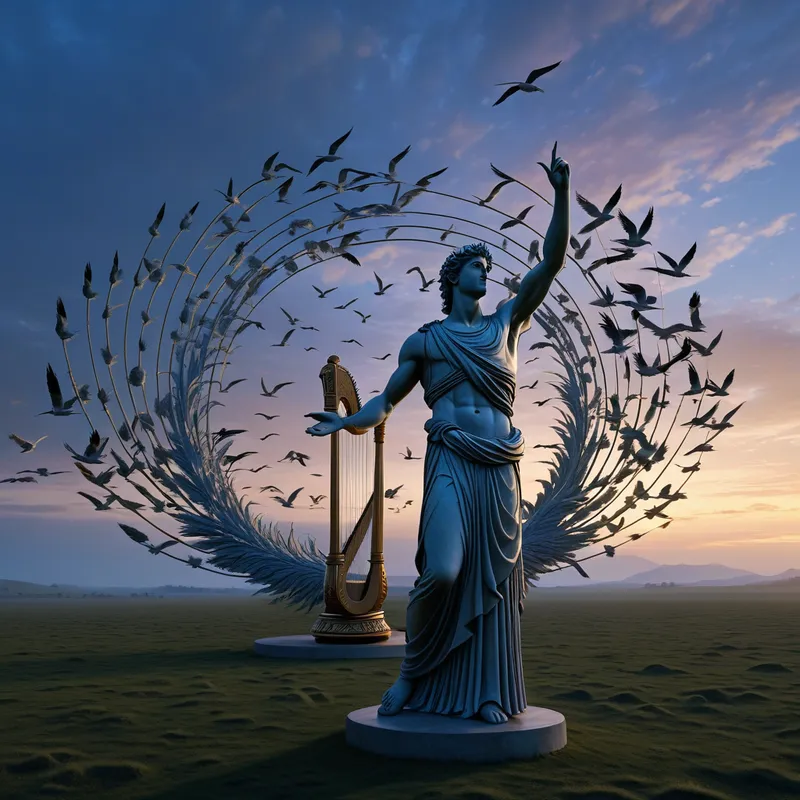
A myth of divine grief where Apollo's mourning for Hyacinthus is transmuted into a celestial, migratory dance of cranes, a pattern of loss and remembrance.
The Tale of The Dance of the Cranes
Hear now a tale not of thunderous war, but of a silence that followed a cry. A tale spun from the golden thread of Apollo’s grief and the dark soil of Sparta.
In the sun-drenched valleys of Lacedaemon, where the Eurotas River whispered secrets to the reeds, the god Apollo found a love that mirrored his own radiance: the mortal prince Hyacinthus. The youth was all the grace of the untamed earth, and together they filled their days with the music of the lyre and the fierce poetry of the discus throw. Their joy was a hymn that made the very air hum.
But the west wind, Zephyrus, burned with a jealous, possessive love. He watched from the crags, his breath growing cold and sharp as a blade. On a day when the sun was a bronze shield in the sky, Apollo and Hyacinthus took to the field. Apollo, with a laugh that was pure light, hurled the heavy discus. It sang through the air, a promise of athletic glory.
And Zephyrus, in that moment, released his breath.
Not a gentle breeze, but a directed, spiteful gale. It caught the discus in its arc and turned it, not as a god redirects fate, but as a spiteful child twists a toy. The bronze edge, now a thing of murderous momentum, flew not into the sun-bleached grass, but straight into the temple of the beautiful Hyacinthus. The sound was not a crash, but a terrible, wet thud. The hymn of their day was severed.
Apollo was at his side in an instant, cradling the dying youth as the life-blood, dark and impossibly red, poured out onto the Spartan earth. The god’s healing arts, which could calm plagues and close the wounds of heroes, were useless. This was a wound spun from divine jealousy, a poison no art could draw out. Hyacinthus’s last breath misted in the air, and his soul fled to the realm of Hades.
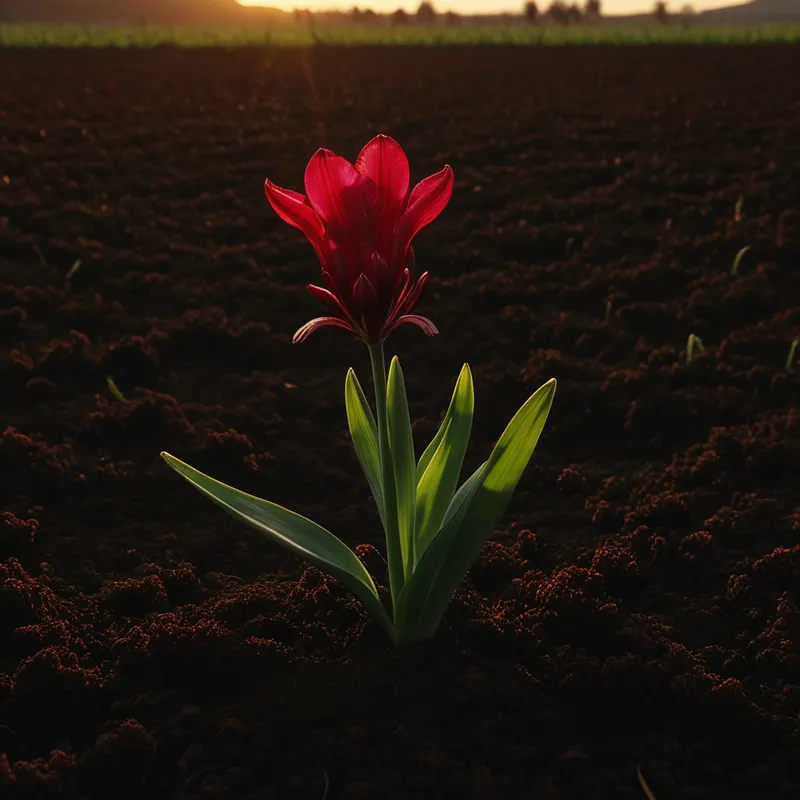
Apollo did not rage. His grief was too vast for thunder. It was a silent, sunless continent within him. He knelt in the bloody dirt, and from where the blood of Hyacinthus had pooled, he commanded a new life to spring—not to replace, but to remember. A slender stalk pushed forth, and from it bloomed a flower of deep, mournful crimson, its petals marked with the tragic sigh, "AI AI"—the letters of lamentation. He named it the hyacinth.
But the god’s sorrow was not yet fully expressed. It needed a movement, a pattern larger than a single bloom. He looked up, and his divine sight pierced the veil of the world. He saw the great flocks of cranes, those majestic, long-necked birds, beginning their arduous migration. Their flight was a struggle against wind and distance, a journey of instinct and survival.
Into this struggle, Apollo poured his art. He did not command the cranes, but he inspired them. He took his own boundless, directionless grief and gave it a shape—a sacred geometry of loss. The cranes, in their V-formations and shifting patterns, began to dance. It was no longer merely a migration; it became the Geranos, the Crane Dance. Their calls became a dirge, their synchronized wingbeats a slow, rhythmic measure of remembrance. They traced Apollo’s sorrow across the vault of the sky, a living, moving monument that turned the raw chaos of loss into an ordered, beautiful, and eternal procession. Where a life was cut short, a dance began, and would repeat, season after season, for as long as birds took to the wind.
Cultural Origins & Context
The myth of Hyacinthus and the originating grief for the Crane Dance finds its roots in the very specific soil of pre-classical Sparta. Unlike the more philosophically inclined Athens, Spartan culture was intensely focused on physical training, martial discipline, and the brutal beauty of the male form. The Hyacinthia was a major annual festival held there, spanning three days and striking a powerful, culturally specific chord. It began with somber rites of mourning for the dead youth, with participants refraining from adornment and singing grief-stricken hymns. This then gave way to a sudden, vibrant reversal: a second day of joyous celebration, feasting, and musical competitions dedicated to Apollo.
This ritual structure—deep mourning violently pivoting to ecstatic celebration—mirrors the Spartan ideal of containing profound emotion within a strict, transformative structure. The myth, and its accompanying festival, served as a cultural vessel for processing the ever-present specter of loss, particularly the loss of young men in battle, which was Sparta’s grim reality. The Crane Dance itself was likely a ritual performance, a mimetic re-enactment of the migratory pattern, weaving the community together in a physical pattern that symbolized both the journey of the soul and the orderly, disciplined response to chaos. It was a story told not just to explain a flower or a bird’s behavior, but to provide a psychic template for turning personal and collective tragedy into an enduring, communal art form.
Symbolic Architecture
At its heart, this is a myth of alchemy—the transmutation of a base, traumatic event into something of elevated, enduring beauty. Hyacinthus represents the beautiful, fragile potential of mortal life, eternally susceptible to the capricious "winds" of fate, jealousy, and accident. Apollo represents the conscious, creative principle that seeks to make meaning from meaningless suffering.
The dance is not an erasure of grief, but its crystallization into a form that can be borne across time.
The discus, an instrument of sport and bonding, becomes the agent of death, symbolizing how the tools of our joy can be twisted by unconscious forces (Zephyrus as the shadow, the possessive, unintegrated emotion) into instruments of destruction. The flower is the first, immediate transmutation: life from death, memory from blood. But the Dance of the Cranes is the higher, more complex transmutation. It moves the expression from the static, earth-bound symbol (the flower) to the dynamic, celestial pattern (the dance). The cranes, in their arduous, cooperative migration, embody endurance, community, and navigation by an inner, sacred map. Apollo’s grief gives that map its specific, beautiful pattern.

The Dreamer's Resonance
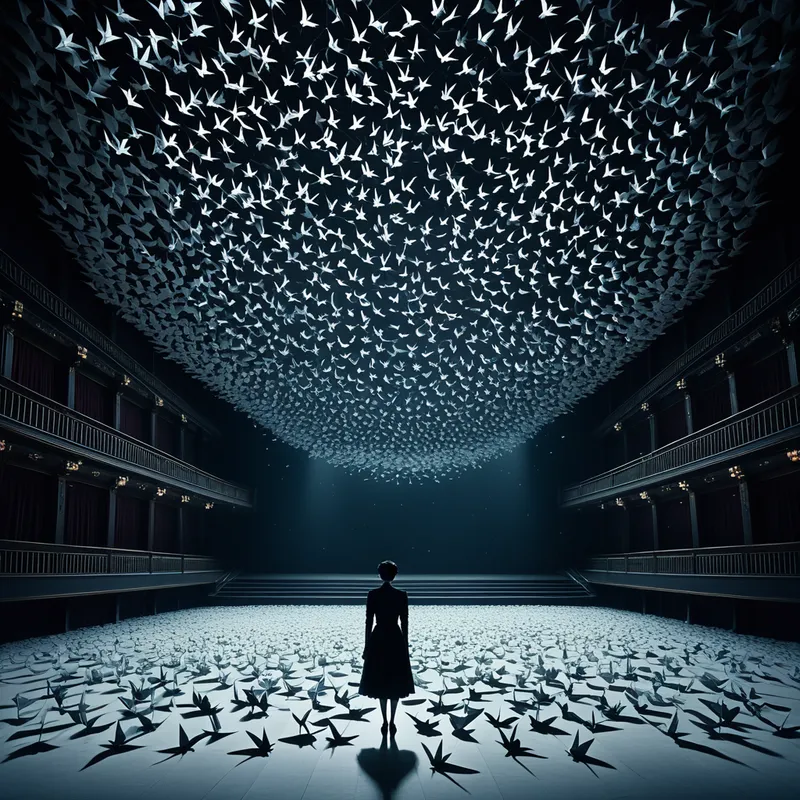
When this myth stirs in the modern unconscious, it often manifests in dreams of intricate patterns, synchronized movements, or witnessing a beautiful, solemn procession. One might dream of finding old, painful letters arranging themselves into a flock of birds on the ceiling, or of being part of a silent, coordinated dance whose steps feel both deeply sad and profoundly right.
Somatically, this points to the body attempting to pattern a recent or old trauma. The psyche is not just replaying the wound (the discus strike), but is actively in the phase of Apollo’s creative grief: it is seeking the form, the dance, that will contain the experience. The dreamer may be processing a loss where they feel they had no agency (the cruel wind of fate), and the unconscious is laboring to transform that passive suffering into an active, meaningful structure—a new routine, a creative project, or a ritual of remembrance. The feeling is often one of melancholic awe, a somatic sense of being part of a larger, necessary order that includes pain as a fundamental thread.
Alchemical Translation
For the individual on the path of individuation, the Dance of the Cranes models the crucial stage following the nigredo, the blackening of despair. The death of Hyacinthus is the nigredo—the shocking, devastating loss of a cherished ideal, relationship, or self-image. The initial mourning, the flower springing from blood, is the albedo, the first whitening where a simple, poignant memory or insight is formed.
But the work is not complete until the citrinitas and rubedo of the dance are achieved. This is where the ego, identified with Apollo the mourner, must take its personal, localized grief and project it onto the larger canvas of the Self. It must find the universal pattern within the personal pain.
The migration is the journey of the soul; the dance is the unique, beautiful signature of your scars upon that journey.
To perform this alchemy is to ask: What is the sacred, repeating pattern that my loss has inscribed upon my life’s journey? How has this tragedy shaped the very formation in which I move through the world? The "Crane Dance" is the individuated structure one builds—not to escape the grief, but to carry it in a way that gives one’s life a deeper, more resonant harmony. It is the creation of a personal liturgy from personal ruin, transforming the random blow of Zephyrus’s wind into a navigational art, allowing one to move forward in formation with one’s own history, bearing the weight of memory not as a burden, but as the very rhythm of flight.
Associated Symbols
Explore related symbols from the CaleaDream lexicon: