The Corybantes Myth Meaning & Symbolism
Frenzied, drumming dancers who guarded the infant Zeus with their clamor, their myth embodies the primal, protective chaos that shields nascent consciousness.
The Tale of The Corybantes
Listen, and hear the rhythm that saved [the world](/myths/the-world “Myth from Tarot culture.”/).
In the time before time was measured, when [the earth](/myths/the-earth “Myth from Hindu culture.”/) was young and raw, a terrible secret was hidden in the heart of a mountain. The great Titan [Kronos](/myths/kronos “Myth from Greek culture.”/), who had swallowed his own children to thwart a prophecy, was deceived. His wife, the cunning Rhea, could bear the loss no longer. When her youngest son was born, she wrapped a stone in swaddling clothes and gave it to her husband, who devoured it without a second glance.
But [the child](/myths/the-child “Myth from Alchemy culture.”/)—the true child, whose name would be Zeus—needed a hiding place. Rhea fled with him across the wine-dark sea, to the wild isle of Crete. There, in a deep, hidden cave on the slopes of Mount Ida, she laid the infant god in a golden cradle. [The cave](/myths/the-cave “Myth from Platonic culture.”/) was alive: the drip of [water](/myths/water “Myth from Chinese culture.”/), the sigh of wind through crevices, the scent of damp earth and myrtle. But this quiet was a vulnerability. Kronos had ears everywhere; silence would betray the secret heartbeat of the new order.
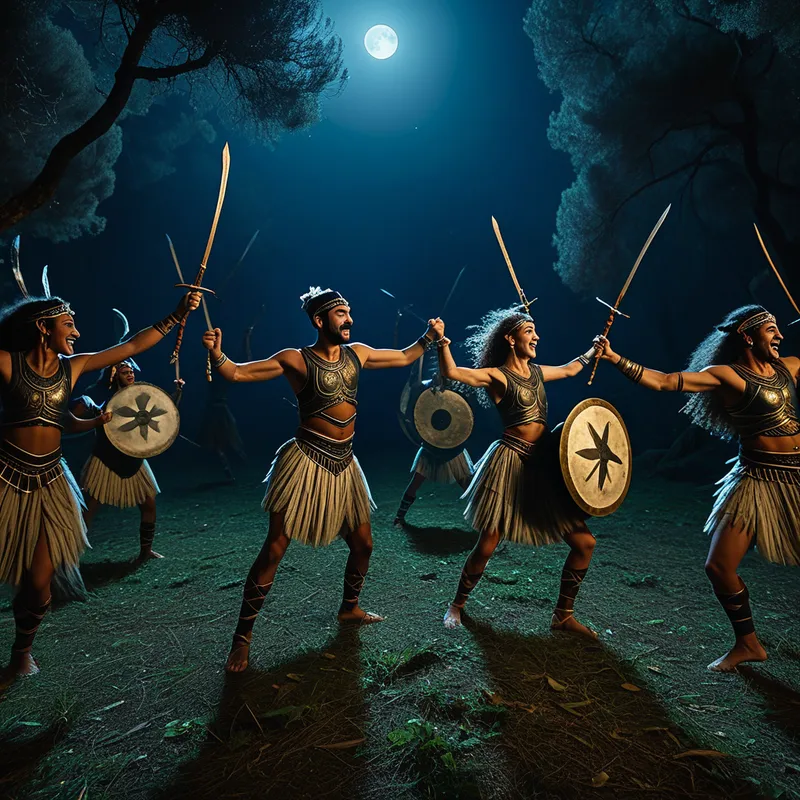
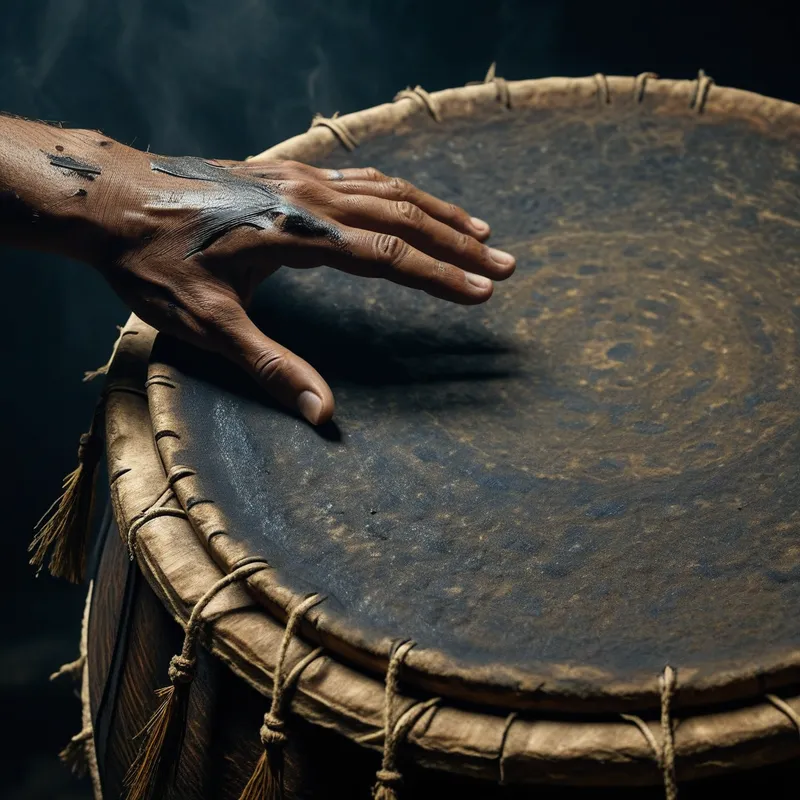
So Rhea summoned her allies. Not serene [nymphs](/myths/nymphs “Myth from Greek culture.”/) or whispering spirits, but the Corybantes. They were the sons of the primordial [Helios](/myths/helios “Myth from Greek culture.”/), or perhaps of Rhea herself—their origin is as wild as their nature. They came not walking, but dancing. Their bodies, painted with ochre and ash, moved with a possessed fury. In their hands they carried swords that flashed like lightning and shields of beaten bronze. But most importantly, they carried the tympanon, the sacred drum, and clashing cymbals.
And so they began. Not a lullaby, but a war-dance for life itself. They stamped their feet upon the earth, a thunderous pulse that shook the roots of the mountain. They beat their drums until the very air vibrated, a constant, roaring wall of sound. They shrieked and chanted, whirling in a frenzied circle around the cradle, their swords striking their shields in a deafening, chaotic cacophony. This was not music to soothe, but noise to obscure—to drown out the infant’s cries, to mask the scent of divinity, to create a sphere of such intense, focused chaos that no searching ear of the Titan could penetrate it. The cave was no longer a silent hiding place; it was the roaring womb of the future. And within that maelstrom of protective fury, the child-god slept and grew strong, nourished by the milk of the goat Amaltheia and guarded by the relentless, rhythmic fury of his wild guardians.
Cultural Origins & Context
The myth of the Corybantes is woven from threads of pre-Olympian, possibly even pre-Hellenic, religious practice. They are often conflated with the Galli of Phrygian origin and the Cretan Kouretes, suggesting a deep, cross-cultural archetype of armed, dancing male devotees of [the Great Mother](/myths/the-great-mother “Myth from Jungian culture.”/). In the Greek context, their story was primarily a aition—a myth explaining the origin of a ritual. The historical Corybantic rites were real, terrifying, and transformative.
These rites were a form of ecstatic mystery cult, often sought as a cure for madness or spiritual malaise. Initiates would be subjected to days of relentless, percussive music, wild dancing, and overwhelming sensory bombardment, orchestrated by priests who embodied the Corybantes. The goal was katharsis—not a gentle cleansing, but a violent purgation. The initiate’s [psyche](/myths/psyche “Myth from Greek culture.”/) was shattered by the chaotic rhythm so it could be reassembled, whole. The myth of their guardianship of Zeus provided the divine precedent and sacred power for this extreme therapeutic practice. It was society’s sanctioned vessel for madness, a way to harness chaotic, primal energy for healing and protection, mirroring the mythic pattern of chaos protecting the seed of cosmic order.
Symbolic Architecture
At its core, the myth presents a profound [paradox](/symbols/paradox “Symbol: A contradictory yet true concept that challenges logic and perception, often representing unresolved tensions or profound truths.”/): [chaos](/symbols/chaos “Symbol: In Arts & Music, chaos represents raw creative potential, uncontrolled expression, and the breakdown of order to forge new artistic forms.”/) as the [guardian](/symbols/guardian “Symbol: A protector figure representing safety, authority, and guidance, often embodying parental, societal, or spiritual oversight.”/) of order, [noise](/symbols/noise “Symbol: Noise in dreams signifies distraction, confusion, and the need for clarity amidst chaos.”/) as the protector of silence, and [frenzy](/symbols/frenzy “Symbol: A state of uncontrolled excitement, agitation, or wild activity, often indicating overwhelming emotions or loss of rational control.”/) as the nurturer of nascent [life](/symbols/life “Symbol: The symbol of ‘Life’ represents a journey of growth, interconnectedness, and existential meaning, encompassing both the joys and challenges that define human experience.”/).
The most vulnerable core of becoming must be shielded not by a wall, but by a whirlwind.
The [infant](/symbols/infant “Symbol: The infant symbolizes new beginnings, innocence, and the potential for growth and development.”/) Zeus represents pure, unmanifest potential—the nascent spark of [consciousness](/symbols/consciousness “Symbol: Consciousness represents the state of awareness and perception, encompassing thoughts, feelings, and experiences.”/), a new ruling principle of the psyche or the world. He is utterly vulnerable. The Corybantes symbolize the raw, instinctual, pre-rational forces of the psyche and the [earth](/symbols/earth “Symbol: The symbol of Earth often represents grounding, stability, and the physical realm, embodying a connection to nature and the innate support it provides.”/). They are not civilized; they are elemental. Their dance is not choreographed; it is eruptive. Their function is to create a [temenos](/myths/temenos “Myth from Greek culture.”/)—a sacred precinct—not through [stillness](/symbols/stillness “Symbol: A profound absence of motion or sound, often representing inner peace, creative potential, or existential pause in artistic contexts.”/), but through dynamic, aggressive [motion](/symbols/motion “Symbol: Represents change, progress, or the flow of life energy. Often signifies transition, personal growth, or the passage of time.”/) and sound. The drumbeat is the [pulse](/symbols/pulse “Symbol: Represents life force, vitality, and the rhythm of existence. It symbolizes connection to one’s own body and the passage of time.”/) of the unconscious itself, the primal [rhythm](/symbols/rhythm “Symbol: A fundamental pattern of movement or sound in time, representing life’s cycles, emotional flow, and universal order.”/) that precedes and underlies all thought.
Psychologically, they represent the necessary, often terrifying, instinctual and emotional reactions that erupt to protect a fragile new development within [the self](/myths/the-self “Myth from Jungian culture.”/). This could be a nascent talent, a budding [awareness](/symbols/awareness “Symbol: Conscious perception of self, surroundings, or internal states. Often signifies awakening, insight, or heightened sensitivity.”/), a creative [idea](/symbols/idea “Symbol: An ‘Idea’ represents a spark of creativity, innovation, or realization, often emerging as a solution to a problem or a new outlook on life.”/), or a step toward individuation that is threatened by the “Kronos” within—the old, devouring patterns of the psyche that seek to maintain control by consuming anything new.
The Dreamer’s Resonance
When the pattern of the Corybantes stirs in the modern dreamer, it seldom appears as literal mythological figures. Instead, one dreams of overwhelming, rhythmic noise—the pounding of industrial machinery that feels both threatening and strangely purposeful, or the insistent beat of a heart or drum that grows to deafening proportions. One may dream of being in the center of a violent storm or a riot, yet feeling an inexplicable sense of safety within the eye of the chaos. There may be dreams of frenzied, non-verbal dancing, where the body moves with an autonomy and power that shocks the dreaming ego.
Somatically, this resonates with processes of deep nervous system regulation and boundary formation. The psyche is mobilizing a primal, polyvagal response—not fight, not flight, but a mobilized, activated state that creates a defensive perimeter. It is the psychological equivalent of a mother bear’s roar. The dreamer is likely in a state where something profoundly new and vulnerable is emerging in their life, and their unconscious is mustering every pre-verbal, instinctual resource to guard it from the inner critic, external pressures, or old, self-sabotaging patterns. The chaos in the dream is not meaningless; it is a purposeful, protective frenzy.
Alchemical Translation
The alchemical journey modeled here is the opus contra naturam—the work against nature, which here means against apparent logic. The rational mind would seek to protect a delicate new development with silence, secrecy, and gentle care. The Corybantine wisdom insists otherwise.
[The first stage](/myths/the-first-stage “Myth from Alchemical culture.”/) is [Nigredo](/myths/nigredo “Myth from Alchemical culture.”/): The Descent into Protective Chaos. The old, ordered conscious attitude must be deliberately disrupted. To shelter the divine child (the lapis, [the philosopher’s stone](/myths/the-philosophers-stone “Myth from Alchemical culture.”/), the nascent Self), one must first summon the drummers. This translates as allowing, even invoking, the raw, chaotic emotions—the anger, the fear, the ecstatic energy—that one normally suppresses. It is giving permission for a “holy madness,” a temporary breakdown of polite [persona](/myths/persona “Myth from Greek culture.”/) to create a sacred, noisy space where the new can incubate.
The alchemical vessel is not a quiet flask, but a pounding heart. Transmutation begins in vibration, not in stillness.
The second stage is Albedo: The Clarification Within the Clamor. Within the relentless dance, a strange stillness emerges at the center. The infant thrives because of the noise, not in spite of it. Psychologically, this is the realization that one’s intense, seemingly disordered feelings are not enemies of growth but its fierce guardians. The chaotic reaction is the boundary. The conscious ego, identified with the infant Zeus, learns to trust the frenzy, to see it as an aspect of the Self’s own deep, protective intelligence.
The final stage is [Rubedo](/myths/rubedo “Myth from Alchemical culture.”/): The Emergence of the Sovereign. The child, nourished and protected by this dynamic tension between chaos and potential, grows to maturity and claims his kingdom. The alchemical gold is a consciousness that has integrated its Corybantic nature. The individual no longer fears their own primal, protective intensities but can wield them with purpose. They understand that to manifest anything truly new and sovereign in one’s life, one must first be willing to make a holy, deafening racket to keep the devouring past at bay. The dance of the Corybantes becomes an inner resource, a rhythm of resilience that guards the sacred, creative core of the being.
Associated Symbols
Explore related symbols from the CaleaDream lexicon: