
The City of Brass
A mythical city of brass and iron in Islamic lore, guarded by jinn and filled with treasures, representing both divine punishment and human ambition.
The Tale of The City of Brass
The tale begins not with a city, but with a quest. A Caliph, sovereign of the faithful, hears whispers of a legend: a metropolis of unparalleled splendor, forged not from stone but from burnished brass and cold iron, lost in the trackless deserts or upon an island amidst a wine-dark sea. He dispatches an expedition, led by a steadfast emir or a cunning traveler, guided by ancient, cryptic maps and the relentless stars. Their journey is an ordeal of thirst and mirage, a passage through a landscape that mirrors the desolation they seek—until they find it.
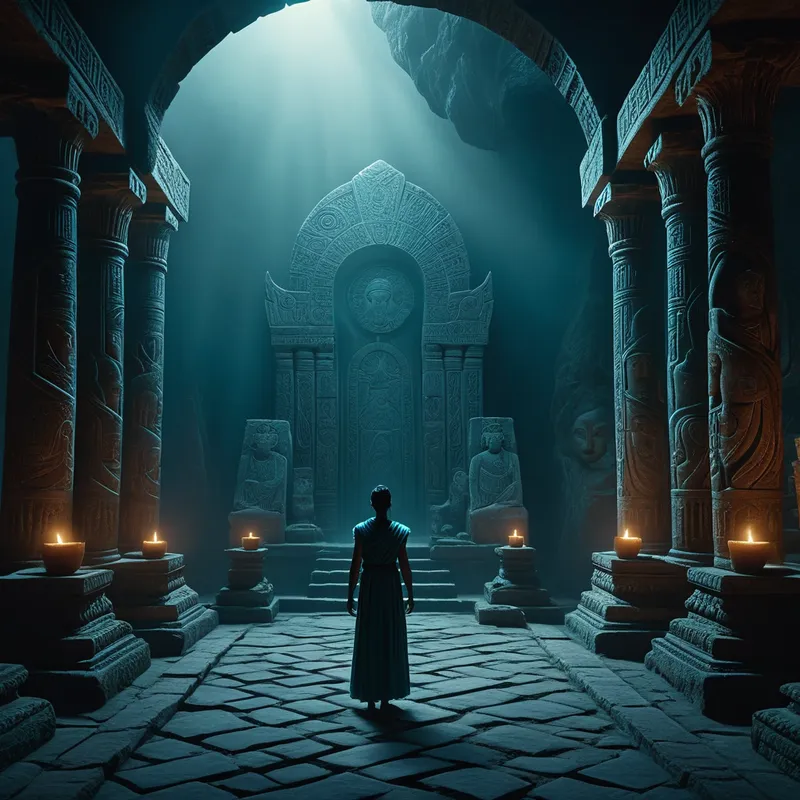
Rising from the sands or the shore, its walls gleam with a dull, sun-baked fire, impervious and silent. No gatehouse stands open, no watchman calls. The company scales the towering walls, their hands meeting not the warmth of living rock but the sterile, sun-scorched metal of artifice. Within, a necropolis of breathtaking grandeur awaits. Streets laid with precious metals run between palaces whose doors are inlaid with ivory and ebony, yet no footstep echoes but their own. In the squares, fountains carved from single emeralds stand dry. Markets are stocked with silks that crumble at a touch and spices whose scent faded centuries ago. It is a museum of jinn-crafted perfection, preserved in a terrible, airless stillness.
The explorers press on, drawn toward the citadel. There, in a throne room of terrifying majesty, they find the source of the silence and the city’s doom. Upon a dais sits a queen or a princess, more beautiful than any living woman, robed in cloth of gold and crowned with pearls. For a moment, hope flares—a ruler preserved! But as they approach, they see the truth. She is not asleep, but dead, perfectly embalmed, a warning inscribed on a tablet of gold before her. The inscription tells her story: a ruler of immense pride and wealth who defied the prophets, who believed her city’s might and her jinn servants made her inviolable to divine decree. In her arrogance, she laughed at the reminders of mortality. And so, a punishment befell the city not of fire or flood, but of cessation. The jinn who built it and served her became its eternal, automated guards—trapped in metallic forms or as whispering spirits bound to the walls, enforcing a solitude that is itself the curse. The life was sucked from the place, leaving only the magnificent shell and the guardian automata.
The tale often ends with the retrieval of some artifact—a guiding brass vessel, a jeweled tablet—and a frantic escape as the city’s dormant defenses stir. The travelers flee, not from a pursuing army, but from the enveloping truth of the place. They return to the Caliph with treasures, but their true prize is the warning: a soul-searing vision of where ambition, divorced from humility before the divine, ultimately leads—not to ruin, but to a perfect, gilded stasis, a kingdom of the dead masquerading as eternal life.
Cultural Origins & Context
The City of Brass is a cornerstone of the ‘Aja’ib (Wonders) literature that flourished in the medieval Islamic world, most famously in tales like The One Thousand and One Nights. It exists at the confluence of Quranic parable, pre-Islamic Arabian lore, and the expansive geographical imagination of a civilization that spanned from Andalusia to the Indus. The city is a narrative embodiment of a central Islamic theme: the fate of those who came before, particularly the ‘Ād and Thamud, ancient tribes destroyed for their arrogance and rejection of God’s messengers. The Quran repeatedly uses their ruined dwellings as signs (ayat) for later generations: “Do they not travel through the earth and see what was the end of those before them?”
This myth also reflects the historical encounter with the material legacies of fallen empires—the Persians, the Byzantines, the Pharaohs—whose colossal ruins whispered of vanished power. The City of Brass translates that historical awe into a supernatural key. Furthermore, it engages with the Islamic cosmology of the jinn. As beings of free will capable of great construction and deception, they are the perfect architects for such a monument to hubris, beings whose power is subverted into building a prison of pride. The city is not merely a human folly; it is a collaborative damnation, a pact between human ambition and supernatural capability that ends in a shared curse.
Symbolic Architecture
The city’s very substance is its primary symbol. Brass and iron are metals of industry, war, and containment—materials that speak of human (or jinn) mastery over the earth. Yet, they are antithetical to life. A city of flesh, wood, and stone breathes, decays, and rebuilds; a city of metal only corrodes in sterile silence. Its architecture is a frozen scream of ego, a permanent record of a moment of ultimate pride.
The walls, seamless and unscalable, represent not defense but encapsulation. The soul that builds walls against divine reminder ultimately builds its own tomb.
Within, the contrast is everything. The unimaginable treasures—the emerald fountains, the ivory doors—are symbols of worldly attainment rendered utterly null. They have no function, no audience, no economy. Their value is purely referential, pointing only to the wealth that once was, making their presence an active agent of despair. The silent, automated jinn guards complete the picture. They are will and power stripped of consciousness, eternally performing duty without purpose, the final state of service to a hollow ideal.
The entombed queen is the still center of this symbolic universe. She is not a skeleton but preserved in lifelike beauty, a horrifying mimicry of the immortality she sought. She achieved a perverse victory over decay, but at the cost of everything that makes life life. She is ambition petrified, a monument to herself.
The Dreamer's Resonance
To encounter the City of Brass in a dream is to confront the psyche’s own monuments to ambition and pride. It is the dream of the magnificent, isolated achievement—the career pinnacle that cost all relationships, the perfected artistic creation that no one sees, the rigidly defended belief system that allows for no new growth. The dreamer wanders the splendid, empty corridors of their own constructed self, marveling at its grandeur while choking on its airlessness.
Psychologically, the city represents a complex in its most crystallized form. It is the ego’s fortress, built to withstand the winds of change, criticism, and the unconscious. Its brass walls are the defenses of rationalization, intellectualization, and pride. The treasures within are the collected proofs of one’s own specialness, awards and memories polished to a high shine but devoid of living meaning. The dream is a profound call from the Self, warning that the psyche, in its drive for order and perfection, can engineer its own living death. The journey to the city is the ego’s exploratory mission; the horrified flight is the first, necessary rupture in the defensive wall, allowing the living waters of the soul to begin, once more, to flow.

Alchemical Translation
In the alchemical opus, the goal is not the creation of gold as mere metal, but the creation of the Lapis Philosophorum, the Philosopher’s Stone—a symbol of spiritual integration and awakened consciousness. The City of Brass presents the ultimate alchemical warning: the creation of a false, sterile stone.
The city is a masterpiece of the opus contra naturam—the work against nature. It is the fixation (coagulatio) pushed to a pathological extreme. All psychic material—the fluid, the mercurial, the living—has been fixed into rigid, metallic forms. The solutio, the dissolving waters, are utterly absent; the fountains are dry. This is the inflation of the ego, believing it has achieved the final, perfect state, unaware that it has only succeeded in encapsulating itself in the materia prima of its own arrogance.
The alchemical process requires the mortificatio—the death and putrefaction of the old state—to release spirit for new life. The City of Brass represents a mortificatio that failed, a death that was not allowed to decompose, resulting in a mummified consciousness, shining and dead.
True alchemical gold is living, radiant, and transformative. The brass of the city is a base metal masquerading as gold, a splendid counterfeit. The quest for the city, then, is the necessary nigredo, the blackening, where the seeker must confront this dazzling false end of the journey to understand that the true treasure is not a place to be found, but a state of being to be nurtured—one that embraces flux, humility, and the sacred.
Associated Symbols
Explore related symbols from the CaleaDream lexicon:
- City — The ultimate human construct of order and ambition, which can become a prison of the spirit when its walls grow too high and its laws too rigid.
- Brass — An alloy of copper and zinc, symbolizing a perfected, hardened artifice; the gleaming result of ambition that has lost its connection to the raw, living earth.
- Punishment — Not merely retribution, but the intrinsic, archetypal consequence that unfolds from an action, here the self-created exile of pride.
- Mirror — The city acts as a dark mirror for the explorer and the dreamer, reflecting back not their face, but the petrified potential of their own unlived hubris.
- Tower — A symbol of aspiration and isolation, here multiplied into an entire metropolis, representing the ego’s attempt to reach the divine through height and separation alone.
- Gold — The true spiritual treasure sought, contrasted with the city’s false gold; it represents integrated value, not hoarded wealth.
- Death — Not as decay, but as stasis; the eternal preservation of a moment of sin, a warning against the desire to freeze life in a perfect, unchanging form.
- Journey — The essential movement toward self-knowledge; the path to the city is as meaningful as the destination, forcing a confrontation with the desolate landscapes of the soul.
- Door — The sealed gates of the city represent both the barrier to forbidden knowledge and the potential threshold to self-confrontation, if one can find the will to breach it.
- Sun — The divine light and judgment under which the city eternally bakes; the source of the glare that makes the brass walls shine, revealing and condemning in the same relentless rays.
- Cup — Symbolic of the vessel meant to receive grace or insight; in the dry city, all cups are empty, representing the spiritual drought that accompanies absolute self-sufficiency.
- Shadow — The entire city is a collective shadow, the disowned pride and ambition of humanity projected outward and given monumental, cursed form.