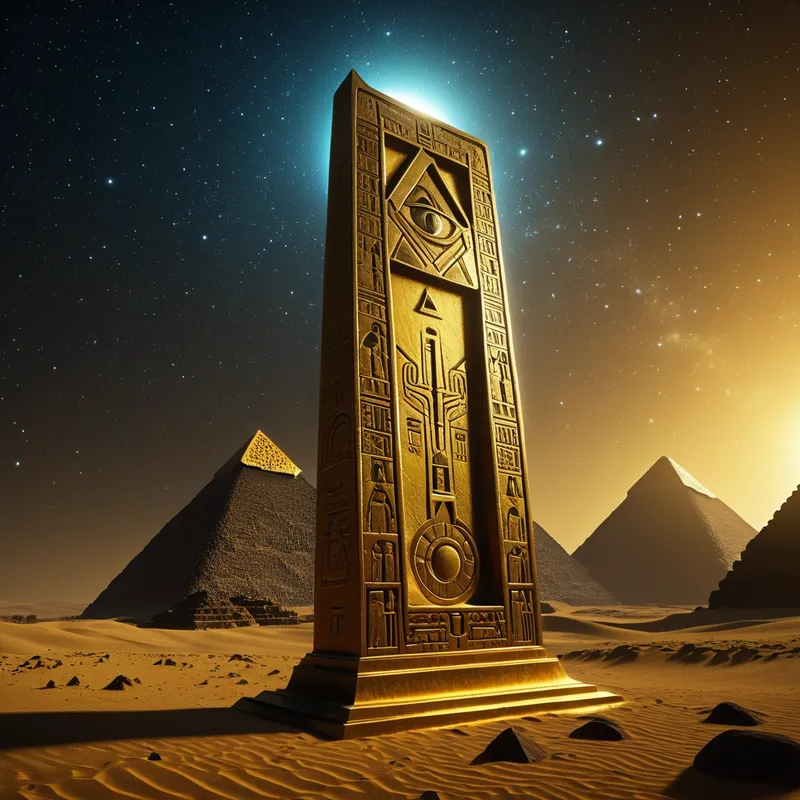
The Cartouche Myth Meaning & Symbolism
The myth of the cartouche is the story of how a simple loop of rope became the sacred vessel for the true name, protecting the soul's identity against oblivion.
The Tale of The Cartouche
Before the world knew its shape, when the sun was a newborn god struggling from the waters of Nun, there was only the Word. Khnum shaped bodies from clay, but it was Thoth, he of the crescent moon and the inked stylus, who gave them the breath of a name. A name was not a sound, but a living thing—a spark of the soul itself, a map of destiny written in the language of the gods.
Yet this sacred spark was perilously fragile. In the winding corridors of the Duat, where the sun barque of Ra fought the serpent Apep each night, whispers could be stolen. Shadows with teeth, the isfet, lurked at the thresholds. Their greatest weapon was not claw or flame, but forgetfulness. To erase a name was to unravel a being from the tapestry of Maat. It was a second, final death—oblivion.
The gods saw this danger. A pharaoh, a living embodiment of Maat on earth, was especially vulnerable. His ren—his true name—was the anchor of the kingdom. Without its protection, the land would fall to chaos, the Nile would run backwards, and the stars would fall from the sky. Nut arched her starry body in worry. Geb felt the tremors of anxiety in the soil.
Then, Isis, the great magician, she who knew the secret name of Ra himself, took action. She did not forge a shield of metal or raise a wall of stone. She took a simple, humble thing: a length of rope, coiled upon itself. She took it to the throne of Horus, the rightful ruler. Together, they performed a rite of profound magic. As Horus spoke the pharaoh’s sacred ren, Isis looped the rope, end to end, creating an unbroken circle. Into that enclosed space, that protected field, the spoken name settled, not as sound, but as solidified light—as hieroglyphs. The rope sizzled and fused, becoming a band of gold. The name was now encirled, bound, and sealed. It was a fortress for the soul, a moat against the void. They called it the shenu, the cartouche.
From that moment, the true name of the king was no longer adrift in the perilous currents of existence. It was held. It was known. And in its knowing, it was made eternal.
Cultural Origins & Context
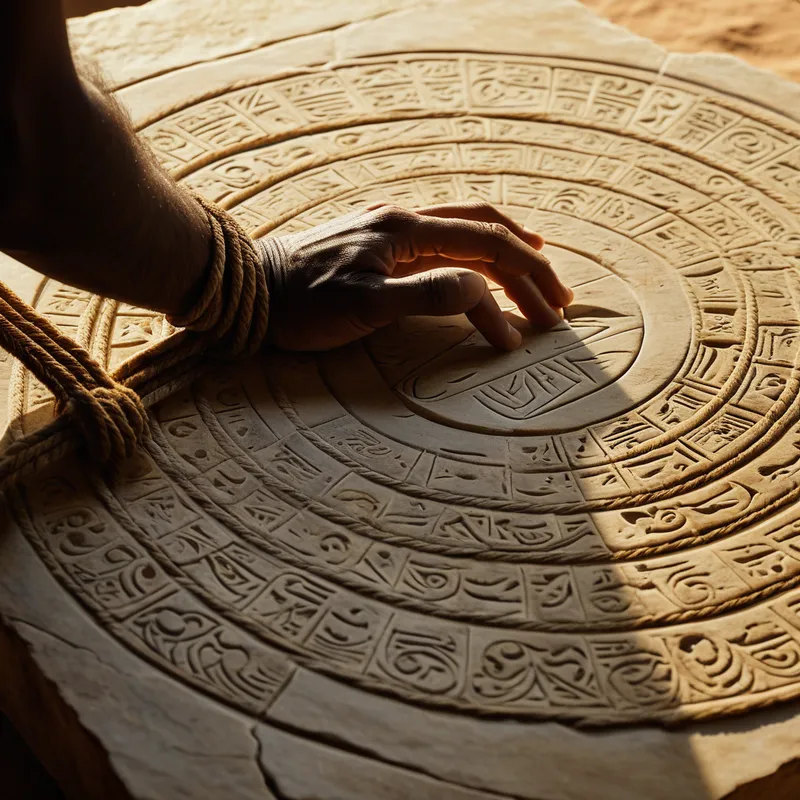
The cartouche, or shenu, was not merely artistic decoration; it was a fundamental technology of eternity in ancient Egyptian thought. Its use began in the Third Dynasty, solidifying by the Fourth, and became the exclusive privilege of royalty—the pharaoh and later, his principal queen. It was the scribe and the ritual priest, agents of Thoth, who were its custodians.
Its societal function was dual, operating on both cosmic and political levels. Practically, it was a royal insignia, stamping authority on monuments, temples, and tombs. Mythologically, it was a divine contract and a protective amulet. By inscribing the king’s name within the cartouche on a temple wall, the kingdom participated in a perpetual ritual of preservation, actively defending the order (Maat) the pharaoh embodied. In the tomb, the cartouche surrounding the name on the coffin or sarcophagus was a critical spell from the Book of the Dead, designed to ensure the name—and thus the soul—was remembered and called upon, thereby granting it sustenance and existence in the afterlife. To destroy a cartouche was the ultimate act of damnation, an attempt at metaphysical assassination.
Symbolic Architecture
At its core, the myth of the cartouche is a profound meditation on the nature of identity and its fragility in the face of time and chaos. The rope, a mundane object, becomes a sacred boundary. The circle it forms is the symbol of the sun, of cyclical time, and of totality—with no beginning and no end.
The self is a story told in the dark. The cartouche is the circle of light in which that story is safely spoken.
The name within is not a label, but the essential self, the ren. The myth acknowledges a terrifying psychological truth: that our sense of “I” can be dissolved, fragmented, or stolen by life’s traumas, by forgetfulness, by the “demons” of depression, anxiety, or societal erasure. The cartouche represents the conscious act of defining and containing the self. It is the ego’s necessary function as a protective membrane, distinguishing “me” from the undifferentiated waters of the unconscious (the Nun). It is the creation of a sacred space where identity can coalesce and become strong enough to endure the journey through the personal Duat—the trials of life, loss, and self-doubt.

The Dreamer’s Resonance
When the symbol of the cartouche appears in a modern dream, it seldom appears as an Egyptian artifact. It manifests as the experience of the myth, not its iconography. One may dream of finding a locket that contains not a picture, but a word that feels profoundly their own. They may dream of drawing a circle in the sand around themselves as a tide of shadow approaches, and finding safety within it. They may see their own signature glowing, or hear their name spoken with unusual clarity and weight in a chaotic, noisy environment.
These dreams signal a critical process of psychic integration and self-definition. The dreamer is in a phase where their core identity is under threat, perhaps from external pressures (a demanding job, a toxic relationship) or internal fragmentation (a life transition, a spiritual crisis). The cartouche dream is the unconscious endorsing the need to establish boundaries, to consciously claim one’s values, passions, and true name—to say “this is who I am” in the face of forces that would blur or erase that definition. It is a somatic signal to fortify the self.

Alchemical Translation
The individuation process, the journey toward psychological wholeness, is mirrored perfectly in the cartouche myth. Initially, the “true name” or authentic self is a latent, unformed potential, vulnerable to being overwhelmed by the persona (the social mask) or the chaotic demands of the inner and outer worlds.
Individuation is not becoming perfect. It is becoming definite. The alchemical gold is the unshakable knowledge of one’s own name.
The “rope” in this alchemical work is the thread of consciousness and intention. The act of “coiling the rope” is the disciplined, patient work of self-reflection, therapy, art, or journaling—any practice that draws a circle of attention around the inner world. Within that protected space, through this work, the fragmented aspects of the self begin to coalesce into a coherent identity. The hieroglyphs being inscribed are the unique constellation of one’s experiences, talents, wounds, and loves, forming a narrative that is authentically one’s own.
The final sealing of the cartouche into gold represents the achievement of a stable, resilient sense of self. This is not a rigid,封闭 ego, but a strong container that can hold the full complexity of the individual without dissolution. It is the point where one can journey through the darkest nights of the soul—confront the shadow, engage with the anima/animus—and not be annihilated, because the core self is known, named, and protected. One carries their own cartouche within, an eternal, self-sustaining record of a life made whole and meaningful.
Associated Symbols
Explore related symbols from the CaleaDream lexicon: