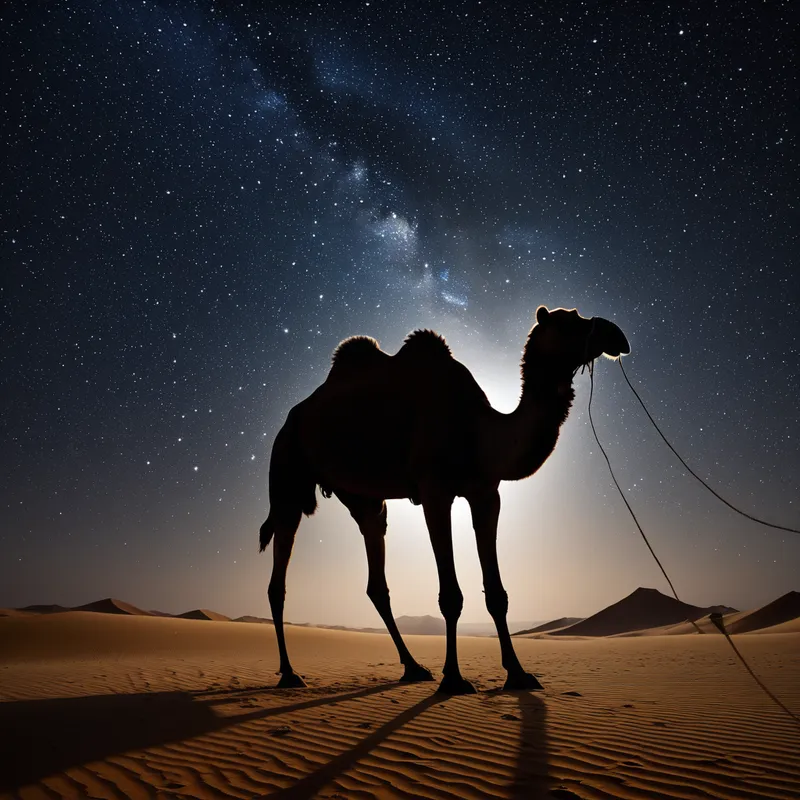
The Camel of the Bedouin Myth Meaning & Symbolism
A Bedouin's life is saved by a camel, forging a sacred bond of mutual survival that becomes a foundational covenant of the desert.
The Tale of The Camel of the Bedouin
Listen, and let the wind from the Empty Quarter carry the truth. In the time when the world was younger and the sands held their breath at night, there was a man of the Bedouin. His name is lost, for he was every man, and his story is the story of all who walk the Rub' al Khali.
He journeyed alone, his beit sha’ar left behind, driven by a restless spirit or a forgotten oath. The sun, Shams, was a hammer of brass. The wind, Simoom, stole the moisture from his lips and the hope from his heart. His waterskin, once fat and cool, hung limp as a dead thing. The landmarks of stone and dune blurred into a single, shimmering prison of light.
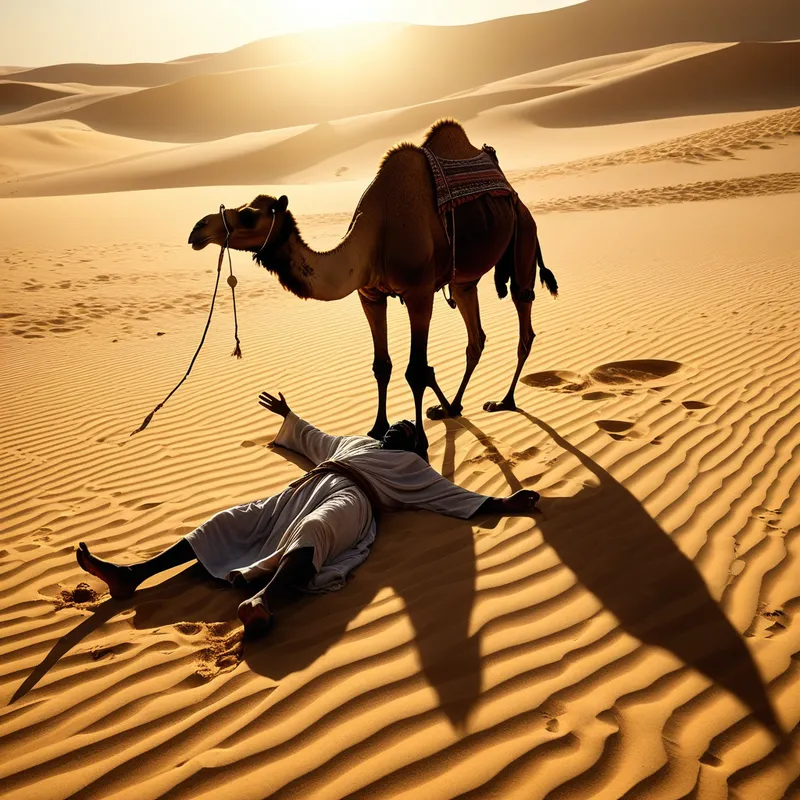
He fell. Not with a cry, but with a sigh that was swallowed by the immense silence. The sand was hot against his cheek. He watched, through a haze, as a mirage of a palm-fringed pool danced and taunted him on the horizon. Death, in that place, does not arrive with a roar, but with a quiet, insistent thirst.
Then came the shadow. It fell over him, cool and vast, blotting out the cruel eye of the sun. A scent of dry hide, of dust, of life. A soft, guttural sound. He felt a nudge, not rough, but persistent, at his shoulder. It was a camel. Not a mirage, but a creature of flesh and sinew, its eyes dark pools of ancient patience. It knelt beside him, its great bulk a wall against the wind.
With the last of his strength, the man pulled himself to the creature’s side, into the shade it provided. The camel remained, a living fortress. As the long hours bled into evening, the camel shifted, and from a fold of its saddle—a remnant of a past rider—a small, forgotten waterskin fell, still holding a few precious mouthfuls. It was not enough to quench, but enough to spark the soul back into the body.
When the stars, the nujum, pierced the velvet sky, the camel rose. The man, strength seeping back into his limbs, rose with it. He did not mount. He placed a hand on its neck, and together, they walked. The camel led, not to a known well, but to a subtle depression in the land, where its sharp senses detected moisture beneath the surface. They dug with their hands and hooves until the earth yielded a muddy seep. Life.
The man looked into the camel’s eye and saw not beast, but savior. He made a vow, not aloud, for the desert hears all, but in the silent language of the heart. “My life is yours, and yours is mine. Your thirst is my thirst, your burden my burden. While I breathe, you will never want for water or forage. While you stand, I will never be without guide or shelter.” It was a covenant. The camel bowed its head, and the bond was sealed in the salt of sweat and the dust of the desert.
Cultural Origins & Context
This tale is not found in a single, codified scripture, but in the oral marrow of Jahiliyyah and early Islamic desert life. It was told in the majlis, by firelight, passed from elder to child as a foundational ethic, not merely a story. Its tellers were the poets and elders of the tribes, for whom the camel, the dromedary, was not livestock but the absolute prerequisite for existence—a mobile source of milk, wool, transport, and wealth.
The myth functioned as the sacred charter for the human-animal relationship at the core of Bedouin survival. It encoded a law deeper than utility: the law of reciprocal survival. It taught that dominion is a fantasy of the doomed; true sovereignty in the desert is a partnership. The camel’s intelligence, endurance, and uncanny ability to find water were recognized as gifts, and with gifts come sacred obligations. The story ritualized the proper treatment of the camel, framing care not as husbandry, but as a religious duty born from a life-debt.
Symbolic Architecture
At its heart, the myth is a blueprint for the psyche’s relationship with its own instinctual, embodied life. The Bedouin represents the conscious ego—proud, directed, but ultimately fragile and prone to fatal overextension. The desert is the vast, unforgiving, yet potentially nourishing realm of the unconscious and the objective world.
The Camel is the symbol of the instinctual psyche. It is the patient, enduring, often overlooked carrier of the soul’s burdens. It knows the hidden paths to survival (water) that the conscious mind cannot logic its way toward.
The covenant is the central psychic act: the ego, saved from annihilation by the instincts it had ignored, must forever after honor them. It is the end of arrogance and the beginning of wisdom.
The camel does not speak in human words, but in actions of profound intelligence—providing shade, offering the forgotten water, leading to the hidden seep. These are the messages from the somatic unconscious: the gut feeling, the sudden memory, the dream image, the intuitive pull that guides when intellect fails. The myth asserts that salvation comes not from fighting the desert, but from heeding the creature who is of the desert.
The Dreamer's Resonance
When this myth stirs in the modern dreamer, it often manifests as dreams of profound exhaustion in a barren landscape, or of being lost. The saving animal may not be a camel; it could be a dog, a horse, or even a mythical beast. The key is the feeling of being found and sustained by a non-rational, instinctual force.
Somatically, this can correlate with a period of burnout, chronic stress, or illness—where the conscious mind has driven the body to collapse. The dream is a compensatory act from the psyche, staging a rescue mission. The appearance of the guiding animal signals the beginning of a necessary regression, a pulling back from over-extension to a place of primal dependency. The dreamer is being shown that their conscious will has become the Simoom wind, desiccating their own soul, and that they must now submit to be led by a deeper, older intelligence within.
Psychologically, it marks the moment when the ego, having hit rock bottom, is forced to acknowledge its debt to the Self. It is the start of a humbling, where one must learn to receive guidance from the very instincts one has spent a lifetime trying to discipline or ignore.
Alchemical Translation
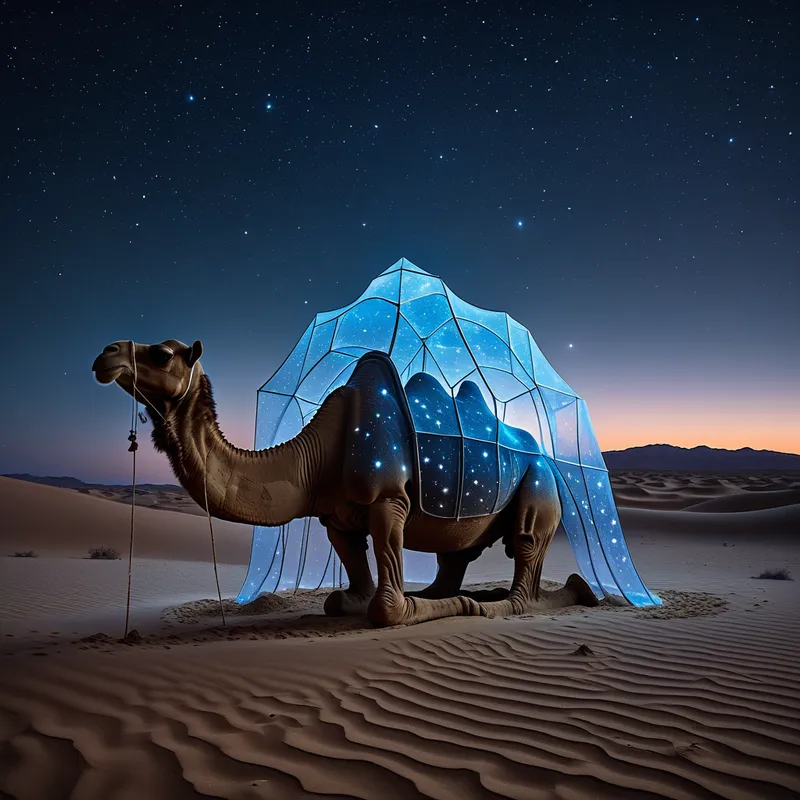
The alchemical process modeled here is the nigredo, the descent into the desert of despair, followed not by a heroic conquest, but by a humble fusion. The camel is the prima materia—the base, animal nature that is also the carrier of the transformative secret.
The transmutation is not of lead into gold, but of a master-slave dynamic into a sacred partnership. The modern individual, identified with mind, ambition, and control (the lone Bedouin), must be broken down by life’s aridity. The instinct (the camel), often repressed or merely used, becomes the savior. The ensuing covenant is the act of individuation.
To honor the covenant is to daily attend to the somatic and intuitive self—to listen to the body’s needs, to respect the limits it sets, to follow the subtle promptings of dreams and synchronicity as one would follow a trusted guide through trackless waste.
The water found together is the aqua vitae, the water of life that flows only when ego and instinct are in alignment. The myth concludes not with the man conquering the desert, but with him and the camel becoming a single, sustainable entity within it. This is the alchemical goal: the creation of the hieros gamos between consciousness and the unconscious, a living system capable of enduring, and even thriving, in the most desolate of psychic landscapes. The camel becomes the embodied spirit of the desert itself, and the man, by covenant, becomes its human heart.
Associated Symbols
Explore related symbols from the CaleaDream lexicon: