The Bone Mother / Ancestral Spirits Myth Meaning & Symbolism
An ancient myth of a primordial feminine spirit who gathers the sacred bones of the dead, singing them back into life as the ancestors and the living world.
The Tale of The Bone Mother / Ancestral Spirits
Listen. The world is young, and the cold is a tooth in the dark. The People move across the land, a heartbeat against the silence. They hunt the great aurochs and the woolly mammoth, and the hunt is good. But the hunt is also death. The red blood soaks the frozen ground, and the feast is fierce and grateful. Then comes the long gnawing—by tooth, by weather, by time. All that remains is a scatter of white bones upon the plain, clean and silent.
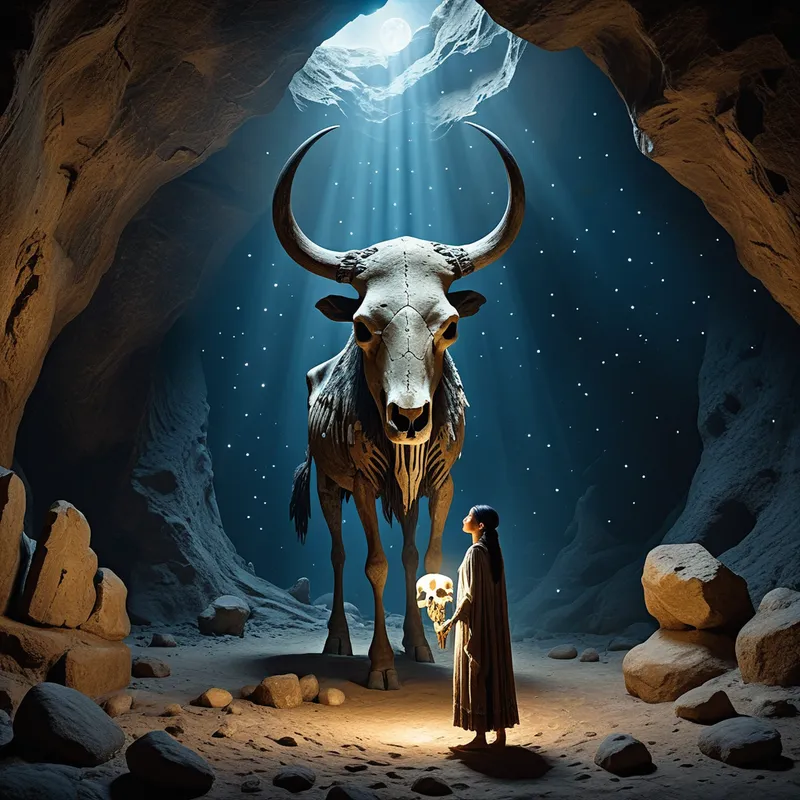
In the deepest cave, where the breath of the earth is warm and the paintings dance in the flicker of fat-lamps, She waits. She is not seen, but She is felt—a presence in the chill that comes before dawn, a sigh in the stillness between heartbeats. She is the Bone Mother.
When the last strip of flesh is gone and the spirit of the beast has fled to the sky, Her work begins. The wind is Her breath, the rain Her fingers. She gathers the scattered bones. Not a single knuckle is lost to Her. She collects them in the secret places: under the roots of the oldest tree, in the hollow of a limestone cliff, in the sacred dark at the back of the cave.
There, in absolute darkness, She sings. It is not a song with words, but a vibration that hums in the marrow of the stone itself. It is the sound of sap rising, of stars turning, of a seed cracking open underground. She sings to the bones.
And the bones remember. They remember the thunder of the herd, the taste of grass, the hot rush of blood. The song stirs the memory of life within the white architecture of death. The bones begin to gleam with a soft, internal light. They shift. They click together, not as a skeleton, but as something new. From the great skull of the aurochs may grow the first stands of forest. From the delicate ribs of the hare may spring a clear, chattering stream. From the mighty vertebrae of the mammoth rise the hills themselves.
But the song does not only remake the world; it remakes the People. For when a person dies, their body treated with ochre and laid in the earth, the Bone Mother comes for them, too. She gathers the essence of their being—their courage, their laughter, their knowledge of where the berries grow—and she sings this into the bones of the newborn. The infant’s first cry is an echo of that ancestral song. Thus, the dead are not gone. They are in the wind that brings the storm, in the strength of the hunter’s arm, in the story told by the fire. They are the Ancestral Spirits, woven back into the tapestry of life by the silent, ceaseless song of the Bone Mother.
Cultural Origins & Context
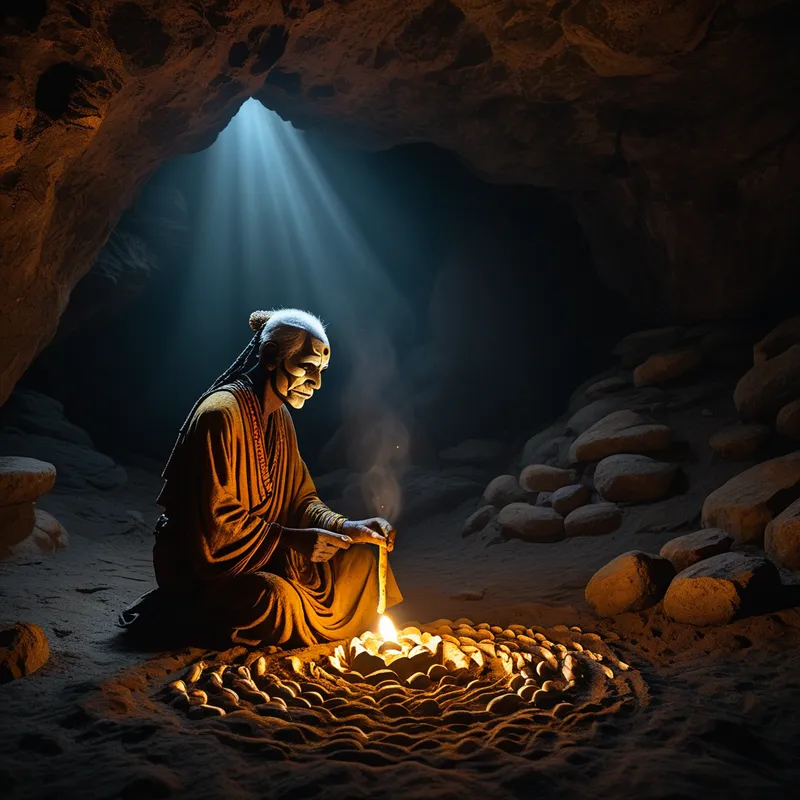
This mythic pattern is not the property of a single tribe, but a psychic bedrock of the human Paleolithic experience, spanning tens of thousands of years across Europe, Asia, and beyond. It was not written, but enacted and felt. The myth lived in the ritual treatment of the dead—the careful burial with red ochre (the color of blood and life), the placement of tools and ornaments for the journey. It lived in the ritual pit where bones of many animals were ceremonially deposited, sorted, and sometimes even arranged.
The tellers of this tale were the shamans, the dreamers who traversed the spirit world. They experienced the Bone Mother in trance states, induced by rhythm, sensory deprivation in deep caves, or visionary plants. Their art on cave walls—the superimposed animals, the hand stencils, the part-human, part-beast figures—are maps of this cosmology. The societal function was profound: it was a metaphysics of recycling that denied the finality of death. It ensured ecological responsibility (the animal’s spirit would return if treated with respect) and provided psychological continuity, binding the individual to the lineage of the ancestors and the living body of the world.
Symbolic Architecture
The symbolism here is foundational, dealing with the primary alchemy of existence: the transformation of death into life.
The bone is the ultimate truth of the body, the lasting architecture after all softness is stripped away. It represents the essential, non-negotiable core of a being—its fundamental pattern.
The Bone Mother is the archetypal function that attends to this core. She is not the goddess of fertility in the blossoming sense, but of regeneration from the ground up, from the mineral state. She is the psychopomp who doesn’t guide souls to a distant afterlife, but back into the immanent cycle of here and now. Her “song” is the invisible ordering principle, the Self, that re-organizes fragmented psychic material (the scattered bones of a trauma, a lost potential, a forgotten talent) into a new, viable structure.
The Ancestral Spirits symbolize the psychic inheritance—both the burdens and the blessings—that are passed down unconsciously. They are the instincts, the familial complexes, the cultural narratives that are “in our bones.”
The Dreamer’s Resonance
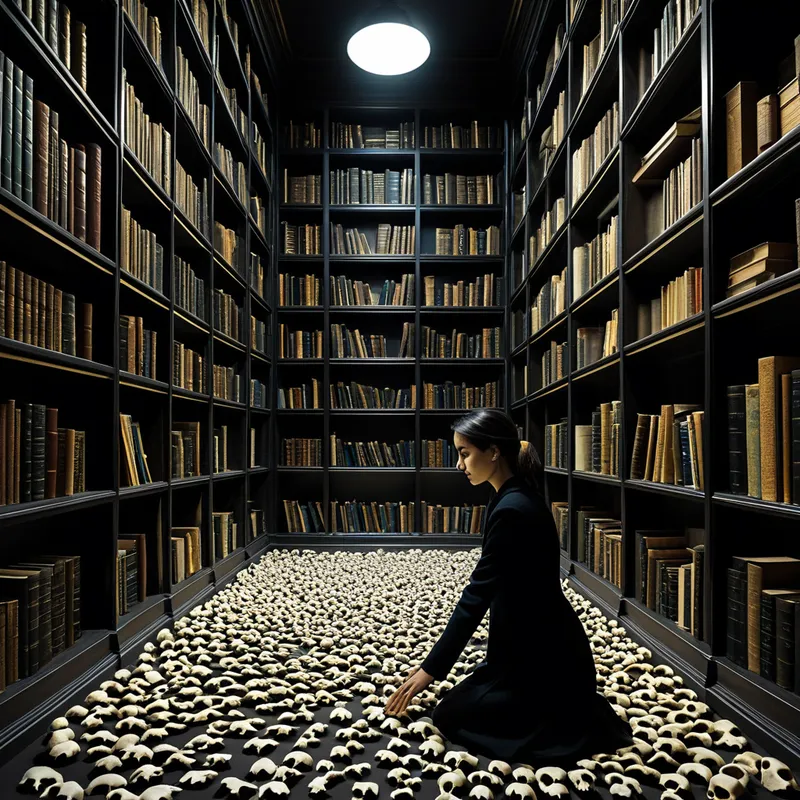
When this myth activates in the modern psyche, it often surfaces in dreams of excavation and reassembly. The dreamer may find themselves in a basement, attic, or archaeological dig, sorting through boxes of old, white objects—bones, teeth, china, or bleached wood. There is a somatic sense of necessary work, often quiet and meticulous.
This dream pattern signals a profound process of psychic integration. The “scattered bones” are dissociated aspects of the self, forgotten memories, or inherited family traumas that have been stripped of their emotional flesh and left as inert, factual relics. The dream ego is being called to the role of the Bone Mother—to gather these fragments with respect, to hold them in the dark vessel of attention (the sacred cave of the unconscious), and to listen for the song that will reveal their place in a new wholeness. It is the dream of moving from analysis (identifying the bones) to synthesis (hearing the song that re-animates them).
Alchemical Translation
The individuation process modeled here is the opus contra naturam—the work against nature’s decay. The natural course is for death to lead to dissolution and forgetfulness. The alchemical work is to gather the disjecta membra (the scattered limbs) and perform the sacred operation that leads to the lapis philosophorum, the stone of wholeness.
For the modern individual, this translates to the courageous work of ancestral healing and deep self-reclamation. It begins with the nigredo: confronting the “bones” of one’s history—the cold, hard facts of personal and familial suffering, the stripped-down patterns of behavior that repeat across generations. This is the gathering in the dark.
The song is the loving, attentive consciousness we bring to these fragments. It is the act of witnessing without flinching, of holding the paradox that this bone of grief is also the seed of resilience.
The rising of new life from the old bones is the albedo and rubedo—the whitening and reddening. It is the moment a core wound, once understood and integrated, transforms from a source of weakness into a pillar of character. It is when an inherited fear, once consciously held, becomes a well of empathy. The Ancestral Spirits are no longer haunting ghosts, but internalized guides. The individual realizes they are not a solitary self, but a living congregation, a walking ecosystem of influences, singing the old song forward in a new, unique key. They become, themselves, a vessel for the Bone Mother’s eternal work.
Associated Symbols
Explore related symbols from the CaleaDream lexicon: