The Black Hat Ceremony Myth Meaning & Symbolism
A myth of a wrathful deity's dance, where a sacred black hat transforms demonic chaos into enlightened, protective power through ritual mastery.
The Tale of The Black Hat Ceremony
Listen. In the time before time was measured, when the mountains of Sumeru were young and the winds carried the whispers of bodhisattvas, a great disturbance shook the fabric of reality. From the deepest crevices of ignorance, from the collective shadows of unawakened minds, a force of pure, undirected chaos arose. It was not evil, but raw, untamed power—the psychic turbulence of fear, aggression, and primal attachment given form. It threatened to unravel the delicate web of compassion and wisdom that the enlightened ones had woven.
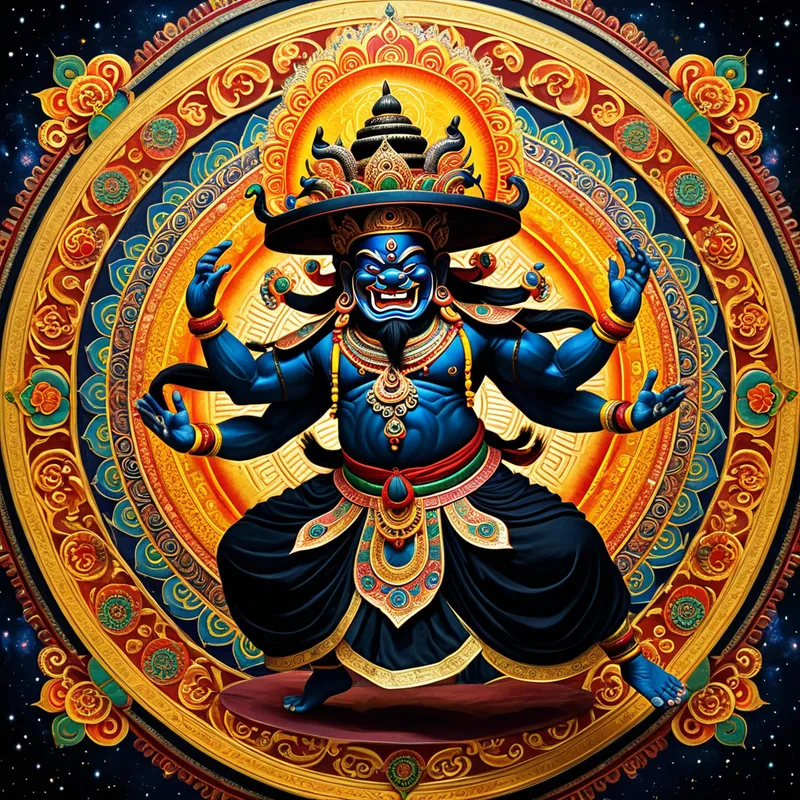
The air grew thick with the scent of ozone and iron. The earth trembled. In the celestial realms, the protectors stirred. Among them stood [Mahakala](/myths/mahakala “Myth from Tibetan Buddhist culture.”/), the Great Black One. His form was terrifying, a symphony of sacred wrath: dark as a moonless night, adorned with a garland of freshly severed heads symbolizing the conquest of ego, dancing upon a corpse that represented the death of illusion. In his six arms, he wielded the tools of transformation: the curved flaying knife of discriminating wisdom, the skull-cup of profound experience, the trident of unwavering focus. Yet, for this particular demonic tumult, a new instrument was required.
The dakinis, the sky-dancing wisdom holders, convened. Their hair, black as the void and charged with the electric energy of pure awareness, streamed behind them like banners of the night sky. With a sacred purpose, they began to weave. Not with thread, but with intention. Not with cloth, but with the very substance of transformative power. They wove their hair into a hat—a crown of absolute commitment. It was not a hat of mourning, but of potent, focused darkness, the kind from which all light is born.
They presented it to Mahakala. As the crown of woven dakini hair settled upon his head, a profound alchemy commenced. The chaotic, demonic energy that swirled like a maelstrom did not flee from him; it was drawn to the hat. The black weave became a vortex, a sacred receiver. The formless rage of the world was siphoned into this structured vessel. Mahakala did not destroy the chaos; he metabolized it. He began to dance—the Cham dance of ultimate reality. Each stomp of his foot pinned a mara of delusion to the earth. Each swirl of his robes wove the chaotic energy into the mandala of enlightened order.
The ceremony was not a battle, but a sublime digestion. The black hat was the crucible. Through the precise, ritualized movements—the measured turns, the deliberate gestures, the resonant chants and the blast of the kangling—the raw stuff of the shadow was cooked, transformed, and redistributed. What emerged was not peace, but a dynamic, fierce, and impeccable protection. The chaos, now mastered, became the guardian at the gate. The ceremony concluded not with silence, but with the humming stability of a universe brought back into sacred alignment, its darkness now serving as the unshakable foundation for light.
Cultural Origins & Context
This myth is deeply embedded in the ritual life of Tibetan Buddhism, specifically within the practices of the Kagyu lineage, where the Black Hat Ceremony, or Shanak, is a central rite. It is historically linked to the Tulku Dusum Khyenpa, and is performed by the Gyalwang Karmapa. The ceremony is not merely a theatrical re-enactment but a sadhana—a means of generating the deity and his enlightened activity in the world.
Passed down through unbroken oral and textual lineages from master to disciple, the myth and its corresponding ritual serve a crucial societal function. It is a public demonstration of the core tantric principle: that the most defiled and terrifying aspects of existence are not to be rejected, but are the very fuel for enlightenment. The ceremony, often performed for the health of the land and the stability of the world, publicly models the process of confronting and transforming collective fear and aggression. It reassures the community that the forces of chaos are not ultimate, but can be met, contained, and alchemized into protective, enlightened power by a realized mind.
Symbolic Architecture
The myth’s power lies in its dense symbolic [architecture](/symbols/architecture “Symbol: Architecture in dreams often signifies structure, stability, and the framing of personal identity or life’s journey.”/). The demonic tumult represents the unintegrated [shadow](/symbols/shadow “Symbol: The ‘shadow’ embodies the unconscious, repressed aspects of the self and often represents fears or hidden emotions.”/)—the personal and collective [reservoir](/symbols/reservoir “Symbol: A contained body of water representing stored resources, emotions, or potential, often signifying controlled or suppressed aspects of the self.”/) of rage, fear, lust, and aggression we disown and project [outward](/symbols/outward “Symbol: Movement or orientation away from the self or center; expansion, expression, or externalization of inner states into the world.”/). Mahakala is not the repressor of this [shadow](/symbols/shadow “Symbol: The ‘shadow’ embodies the unconscious, repressed aspects of the self and often represents fears or hidden emotions.”/), but its masterful integrator. He is the [archetype](/symbols/archetype “Symbol: A universal, primordial pattern or prototype in the collective unconscious that shapes human experience, behavior, and creative expression.”/) of the awakened mind that can consciously engage with the darkest contents of the psyche without being identified with or destroyed by them.
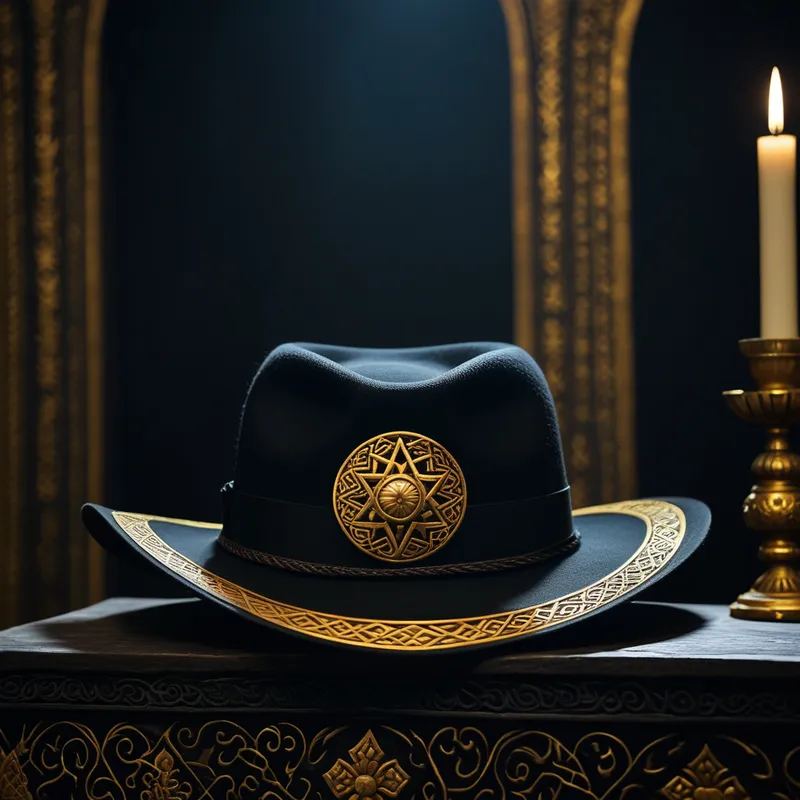
The black hat is the ultimate symbol of conscious containment. It is the mind trained in meditation, the ritual structure, the sacred vessel that receives the formless and gives it transformative form.
The weaving of the hat from dakini [hair](/symbols/hair “Symbol: Hair often symbolizes identity, power, and self-expression, reflecting how we perceive ourselves and how we wish to be perceived by others.”/) is profoundly significant. Hair symbolizes untamed, instinctual power. The dakinis, representing dynamic wisdom, weave this raw power into a structured [crown](/symbols/crown “Symbol: A crown symbolizes authority, power, and achievement, often representing an individual’s aspirations, leadership, or societal role.”/). This signifies that enlightenment is not the annihilation of our instinctual [nature](/symbols/nature “Symbol: Nature symbolizes growth, connectivity, and the primal forces of existence.”/), but its conscious organization into a [vehicle](/symbols/vehicle “Symbol: Vehicles in dreams often symbolize the direction in life and the control one has over their journey, reflecting personal agency and decision-making.”/) for [compassion](/symbols/compassion “Symbol: A deep feeling of empathy and concern for others’ suffering, often involving a desire to help or alleviate their pain.”/). The dance itself is the process of [integration](/symbols/integration “Symbol: The process of unifying disparate parts of the self or experience into a cohesive whole, often representing psychological wholeness or resolution of internal conflict.”/)—each [movement](/symbols/movement “Symbol: Movement symbolizes change, progress, and the dynamics of personal growth, reflecting an individual’s desire or need to transform their circumstances.”/) a precise psychological [operation](/symbols/operation “Symbol: An operation signifies a process of change or transformation that often requires deliberate effort and planning.”/) that transmutes chaotic [emotion](/symbols/emotion “Symbol: Emotion symbolizes our inner feelings and responses to experiences, often guiding our actions and choices.”/) into enlightened [activity](/symbols/activity “Symbol: Activity in dreams often represents the dynamic aspects of life and can indicate movement, progress, and engagement with personal or societal responsibilities.”/).
The Dreamer’s Resonance
When this myth stirs in the modern dreamer’s psyche, it often manifests as dreams of confronting overwhelming, formless darkness or chaotic, aggressive forces. One might dream of a swirling black vortex threatening to consume everything, or of a terrifying, shadowy figure that cannot be outrun. The somatic experience is one of dread, tightness in the chest, and a racing heart—the physiology of the uncontained shadow.
This dream pattern signals that the psyche is attempting to initiate a “Black Hat Ceremony” of its own. The chaotic force in the dream is not an external monster, but a surge of disowned psychic material—perhaps long-buried rage, primal fear, or a sense of powerlessness—breaking into consciousness. The dream is the first stage of the ritual: the chaotic energy has arisen and must be met. The absence of the hat or the dance in the dream indicates the dreamer’s current lack of an internalized container—the meditative awareness or psychological framework—to process this material. The dream is a call to develop that vessel.
Alchemical Translation
For the modern individual on the path of individuation, the myth models the complete alchemical cycle of psychic transmutation. The first stage, nigredo, is the recognition and confrontation with the personal shadow—the “demonic tumult” of our own repressed aspects. This is often a dark, chaotic, and painful period of disillusionment.
The second stage is the creation of the vas or vessel: the “black hat.” This is the conscious construction of a container through therapy, mindfulness, creative practice, or disciplined self-reflection. It is the ego making a commitment to hold and observe, rather than to act out or repress.
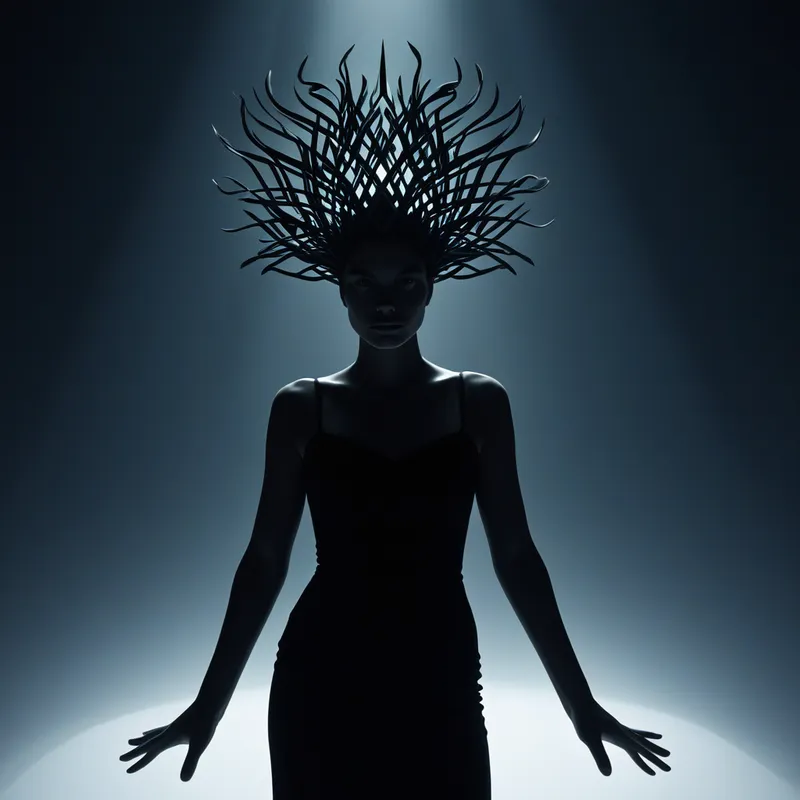
The alchemical work occurs not by avoiding the blackness, but by wearing it as a sacred crown, transforming the lead of the shadow into the gold of authentic power.
The final stage is the Cham dance itself—the active, daily process of integration. It is the practice of taking a reactive emotion like anger, placing it in the “hat” of mindful awareness, and through the “dance” of conscious choice, transmuting it into the protective energy of clear boundaries or the compassionate energy of fierce advocacy. The goal is not to become a peaceful, shadowless being, but to become like Mahakala: a fully integrated consciousness where the dark, powerful energies of the psyche are mastered and placed in service of one’s deepest purpose and the protection of one’s inner and outer world.
Associated Symbols
Explore related symbols from the CaleaDream lexicon:
- Ritual — The structured, intentional performance that transforms raw chaos into sacred order, mirroring the ceremonial dance that alchemizes shadow into enlightened power.
- Shadow — The unintegrated, chaotic psychic material—fears, rages, desires—that the Black Hat Ceremony specifically engages with and transforms into a protective force.
- Dance — Represents the dynamic, active process of psychic integration, where each movement is a deliberate step in mastering and re-ordering inner turmoil.
- Crown — Symbolizes the mastery and conscious assumption of power, specifically the transformative power that comes from integrating one’s darkest aspects, as embodied by the black hat.
- Chaos — The raw, undifferentiated energy of the unconscious that arises as the “demonic tumult,” serving as the essential fuel for the alchemical process of the ceremony.
- Order — The enlightened state achieved through the ritual, where chaos is not destroyed but woven into a stable, protective mandala of psychic structure.
- Weaving — The act of creating the black hat from dakini hair, symbolizing the conscious structuring of instinctual, raw power into a vessel for transformation.
- Mountain — Represents the unwavering, stable ground of enlightened awareness upon which the chaotic dance takes place, and which remains unmoved by the turmoil.
- Vortex — The function of the black hat itself, which draws in and contains chaotic energy, acting as a sacred focal point for transformation.
- Thunder — The sound of the chaotic force and the transformative power of the ritual, representing the shocking, awakening impact of confronting the shadow.
- Protection — The ultimate result of the ceremony; not a passive safety, but an active, fierce guardianship born from mastered inner darkness.
- Mask — The wrathful visage of Mahakala, which is not a disguise but a revelation of the true, transformative face of compassion that engages directly with suffering and evil.