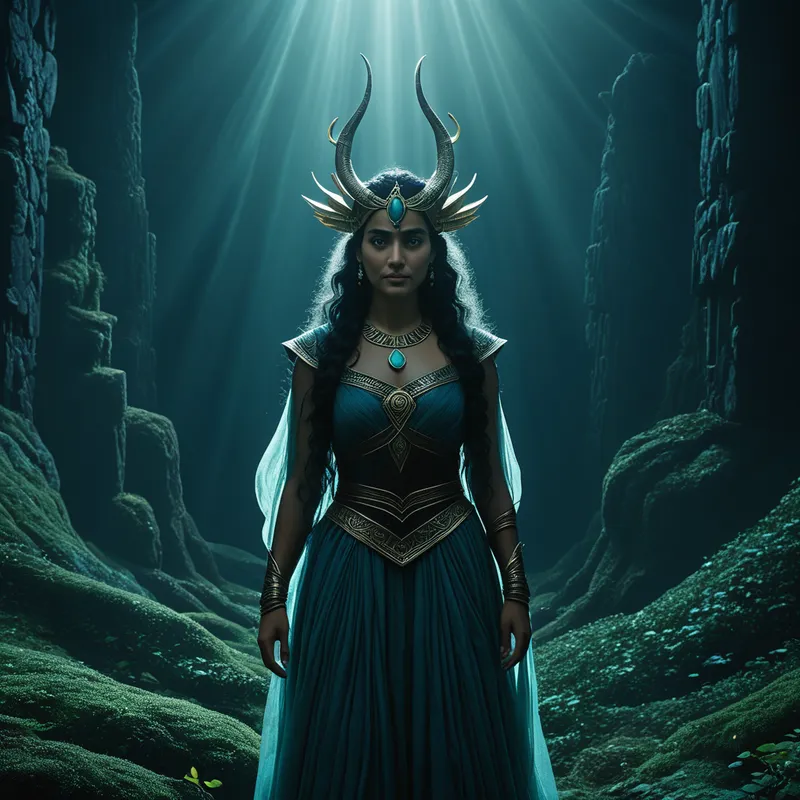
The Bardo Realms
The transitional states between death and rebirth in Tibetan Buddhism, where consciousness navigates visions and opportunities for liberation.
The Tale of The Bardo Realms
The tale begins not with a birth, but with an ending. The last breath is drawn, the body’s warmth recedes, and the known world dissolves. This is the moment of entering the Bardo, a realm of pure potentiality where the soul, stripped of its physical anchor, embarks on a profound and perilous forty-nine-day journey.
In the first phase, the Chikhai Bardo, the Clear Light of Reality dawns. It is a radiance so vast and unconditioned that it can induce terror in the unprepared. This is the primary opportunity for liberation—to recognize this luminous emptiness as one’s own true nature, the Dharmakaya. For most, the sheer intensity of this naked reality is too much; the mind, habituated to form, recoils in fear. With that recoil, the light fades, and the second phase, the Chönyid Bardo, unfolds.
Now, the dream of a lifetime becomes the reality of the afterlife. The psychic contents of the deceased’s mind—all latent tendencies, virtues, and fears—project outward as a spectacular and terrifying panorama. For seven days, a succession of peaceful deities manifest: radiant Buddhas of five colors, emanating from the heart-center of reality. They appear not as external saviors but as mirror-reflections of the mind’s own pure potential. Their light is inviting, a path to wisdom. Yet, if met with ignorance or aversion, they vanish.
Then, for the next seven days, the wrathful deities emerge. These are not demons but the same enlightened energies in dynamic, transformative form. They have bulging eyes, flaming hair, and wear garlands of skulls—the terrifying face of compassion that seeks to shatter stubborn illusion. Their roaring chants are the sound of reality itself, demanding recognition. To flee from them is to flee from one’s own liberated fury.
Having failed to recognize the deities, the consciousness, now desperate for an identity, stumbles into the Sidpa Bardo, the bardo of becoming. Here, the karmic wind blows with hurricane force, propelling the being toward rebirth. The being experiences a phantom body and perceives visions of future parents in union, drawn by desire or aversion. This is the critical juncture of choice, governed by past actions. A moment of clarity, a memory of spiritual practice, can steer the consciousness toward a favorable rebirth. More often, the pull of habit—the magnetic attraction of unresolved rage, clinging attachment, or deep ignorance—determines the destination: the realm of gods, jealous titans, humans, animals, hungry ghosts, or hell-beings.
The journey culminates on the forty-ninth day. A choice is made, a womb is entered, and the light of the Bardo is swallowed by the darkness of a new conception. The wheel turns once more.
Cultural Origins & Context
The Bardo teachings are the heartwood of Tibetan Buddhism, most famously systematized in the text known as the Bardo Thödol, or The Tibetan Book of the Dead. While popularly presented as a guide for the deceased, it is, in its truest context, a manual for the living. Its origins are traced to the terma tradition, revealed by the treasure-revealer Karma Lingpa in the 14th century.
This mythology is not speculative eschatology but a precise map of consciousness derived from centuries of yogic and meditative introspection. It is grounded in the core Buddhist doctrines of impermanence, karma, and the empty, luminous nature of mind. The Bardo is the ultimate teaching on impermanence, showing that even death is not a solid state but a process. It is a psychological and cosmological framework designed to prepare the practitioner to navigate the ultimate transition with awareness, transforming the greatest fear into the greatest opportunity.
The rituals surrounding death in Tibetan culture—the readings of the text, the visualizations, the guiding of the consciousness by a lama—are all applications of this map. They create a sacred container, both for the deceased and the community, affirming that death is a communal spiritual event, not a private medical one.
Symbolic Architecture
The Bardo is a masterful symbolic architecture of the psyche in transition. Its structure mirrors the process of dreaming, psychosis, and profound psychological transformation, where inner contents become overwhelming outer realities.
The peaceful and wrathful deities are not external judges but the psyche’s own archetypal structures of wisdom and method, of compassion and its fierce, dismantling energy. To recognize them is to achieve reintegration at a cosmic level.
The forty-nine days symbolize a complete cycle of purification, mirroring the seven-week period of formative development in the womb. The entire journey is a grand mirror held up to the soul: every vision, every terror, every enticing light is a reflection of one’s own mental and moral architecture. The Bardo is the ultimate karmic feedback system, where past actions (karma) and present awareness (rigpa) collide to determine the future.
The critical point in the Sidpa Bardo, where one is drawn to the lights of the six realms of rebirth, is the symbolic enactment of psychological compulsion. We are perpetually being “reborn” into states of mind—of pride, jealousy, desire, ignorance—based on what we unconsciously find familiar and comforting, even in its suffering.
The Dreamer's Resonance
To the modern dreamer, the Bardo is the most profound myth of the inner landscape. It resonates because it describes experiences we glimpse in fragments: the life-review in a near-death experience, the terrifying or beatific visions in fever dreams or deep meditation, the feeling of being pulled by unseen forces toward life choices that feel fated.
It gives form to the formless transition. In therapy, when a patient describes the dissolution of an old identity—a career, a relationship, a long-held belief—they are navigating a minor Bardo. The initial shock and disorientation (Chikhai), the confrontation with repressed emotions and new, frightening aspects of the self (Chönyid), and the gradual, often anxious, movement toward a new way of being (Sidpa) mirror the post-mortem journey. The myth teaches that in these liminal spaces, what we perceive as external threats or saviors are, in truth, aspects of our own psyche seeking recognition or integration. The goal is not to survive the transition unchanged, but to awaken within it.
Alchemical Translation
Psychologically, the Bardo is the alchemical nigredo—the dissolution of all that was fixed and known. The body is the prima materia that must be broken down so the essence of consciousness can be refined. The peaceful deities represent the latent, unactualized virtues within the personal unconscious, while the wrathful deities symbolize the purging fires of the shadow, necessary to burn away the dross of ego.
The Clear Light is the unus mundus, the undifferentiated ground of being from which both psyche and cosmos arise. To “achieve liberation in the Bardo” is the psychological achievement of ego-death in life—the moment when one stops identifying solely with the personal narrative and rests in the witnessing awareness that contains it.
The entire process is an allegory for individuation. We are always between states, between who we were and who we are becoming. The terrifying projections are the contents of the personal and collective unconscious rising to be made conscious. To flee from them is to remain in repetition; to turn and face them is to transmute lead into gold, transforming psychic trauma into wisdom and moving toward a more conscious, integrated rebirth in this life.
Associated Symbols
Explore related symbols from the CaleaDream lexicon:
- Death — The necessary dissolution of form that precedes transformation, the gateway to the Bardo’s profound journey of reckoning and potential.
- Mirror — The essential nature of the Bardo, where every deity and demon is a reflection of the mind’s own latent karma and pure awareness.
- Bridge — The Bardo itself, a precarious span of consciousness connecting the shore of one life to the next, demanding balanced passage.
- Light — The Clear Light of Reality that dawns at death, representing pure, unconditioned consciousness and the ultimate opportunity for liberation.
- Dream — The ontological state of the Bardo, a hyper-real projection of mental contents where the dreamer must awaken within the dream to be free.
- Transformation Cocoon — The forty-nine-day Bardo period as a liminal, pupal stage where the consciousness is metabolized and reshaped for its next existence.
- Buddhist Lotus — Symbolizing purity arising from mud, it mirrors the potential for enlightenment to blossom even from the chaotic, desire-driven Sidpa Bardo.
- Door — Each phase of the Bardo presents a new door: to liberation with the deities, or to rebirth in the six realms, each opened by recognition or karmic habit.
- River — The relentless, karmic current that carries the consciousness through the Bardo’s visions toward the ocean of rebirth.
- Shadow — The wrathful deities are the ultimate symbolic expression of the Shadow, the fierce, terrifying aspect of the psyche that must be embraced for wholeness.
- Rebirth — The inevitable outcome for the unliberated consciousness, the cyclical re-entry into form driven by craving and aversion.
- Consciousness — The sole traveler and substance of the Bardo, the luminous, empty ground that experiences its own projections as reality.