The Banjo's Ancestry Myth Meaning & Symbolism
A myth where a grieving mother's love and a master carver's skill birth the first banjo, a vessel for memory that sings the soul across the water.
The Tale of The Banjo's Ancestry
Listen. The story begins not with joy, but with a silence so deep it swallowed the village whole. It was the silence that follows the last wail of a mother who has outlived her child. Her name was Amina, and her son, a boy of swift laughter and quicker feet, had been taken by the river—not in malice, but in the river’s own ancient, indifferent turning.
Amina’s grief was a physical country. She walked its borders every day, from the empty sleeping mat to the doorframe where he no longer leaned. The village’s comforting sounds—the pound of yam, the gossip at the well—fell against her like rain on stone. She was becoming a monument to absence.
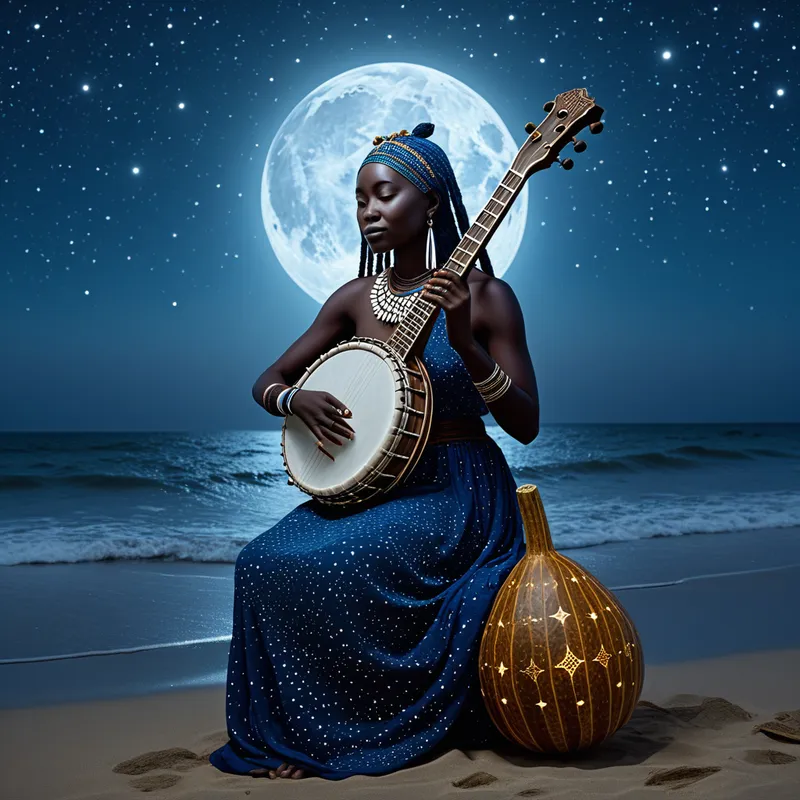
One evening, in the bruised purple light before true dark, she went to the place where the river grasses whispered. She carried a dried calabash, one her son had once used to collect water. She held it to her chest, as if it were the curve of his sleeping back. And she began to hum. It was not a song with words, for words had fled. It was the sound of wind through reeds, the low moan of the earth itself.
As she hummed into the open mouth of the gourd, a miracle of acoustics occurred. The hollow chamber caught her breath, deepened it, gave it a resonance that seemed to come from the world’s very core. The sound echoed back to her, no longer just her voice, but a voice answered.
This did not escape the notice of Baba Kofi, the old carver who knew the soul of wood. He had watched Amina’s transformation from woman to wraith. He heard the new sound emanating from her and the gourd—a sound that was both lament and a strange, aching comfort. He was visited by a vision in his sleep: a vessel that could hold a spirit, with a neck to reach for the heavens and strings to bridge the worlds.
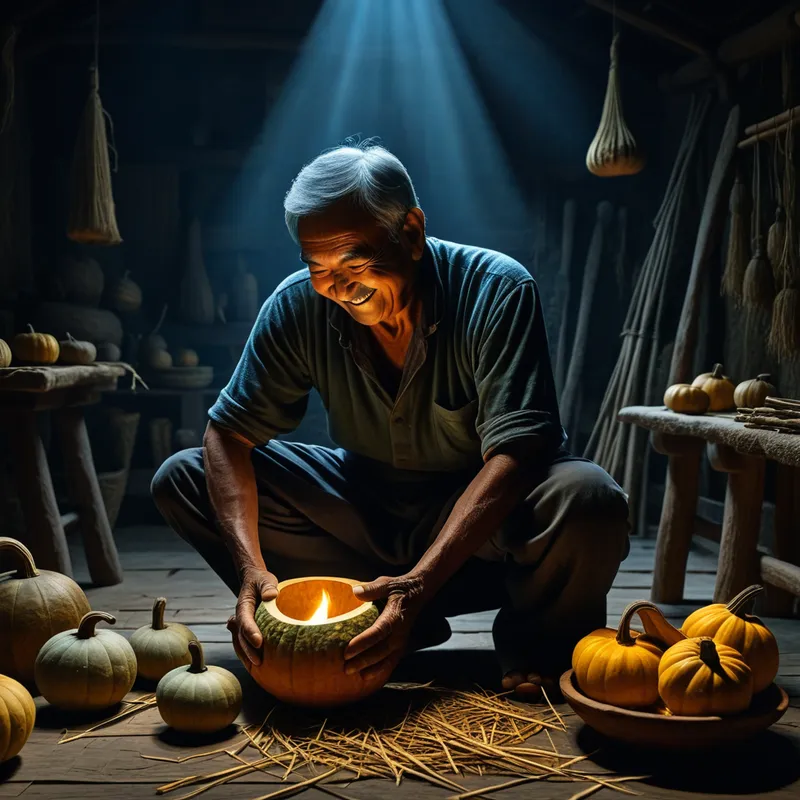
At first light, he went to the sacred Ceiba tree and made offerings. He selected a branch that had been struck by lightning—wood touched by the sky’s fire. With painstaking care, he carved a long, graceful neck and attached it to a chosen gourd, scraping its interior until it was smooth as a prayer. For the skin, he took the hide of a goat that had been a sacrifice of peace, stretching it taut over the gourd’s mouth.
Then came the strings. He would not use gut or vine. He went to Anansi, the keeper of stories and weaver of webs, and asked for a thread strong enough to bear the weight of memory, yet sensitive enough to tremble at a breath. Anansi, understanding the purpose, gave him strands spun from moonlight and resilience.
Baba Kofi brought the assembled object to Amina at the riverbank. He placed it in her arms. “This,” he said, his voice rough with awe, “is for the song that has no end. This is for the voice that must cross the water.”
Amina, her fingers finding the strings, plucked one. A note rang out, clear and lonely as a single star. She plucked another, and then another. She was not playing a tune; she was tracing the contours of her son’s smile, the rhythm of his running steps, the echo of his voice calling “Mama.” The notes became a conversation. The thump of the plucked string against the skin head was the steady beat of a heart, of a drum, of feet dancing in the dust. The melody that wove above it was the spirit itself—aching, beautiful, alive.
The village heard it. They did not hear a dirge, but a testimony. They heard memory made audible. They heard sorrow alchemized into something that could be held, shared, and carried. They heard the first banjo. And they understood: this was not an instrument of forgetting, but of fierce, active remembering. It was a canoe built not for the body, but for the soul, to sing its way across the great waters of time and separation, forever connected to the shore of love from which it came.
Cultural Origins & Context
This story is not found in a single, canonical text, but is woven from the threads of many West African cosmologies and the lived experience of the African diaspora. It is a myth of synthesis, born at the crossroads of tradition and catastrophic disruption. In West African cultures, from the Senegambia region to the Congo, music is not mere entertainment; it is a vital technology of spirit, a means of communication with ancestors, a vehicle for history, and a core component of communal identity. Instruments like the xalam, kora, and various gourd-resonated chordophones provided the physical and symbolic blueprint.
The myth of the banjo’s ancestry, as it has been passed down through oral tradition, spirituals, and the deep talk of elders, functioned as a profound act of cultural preservation and psychic survival. Enslaved Africans, stripped of material heritage, carried this story in the hold of the ship alongside their breath. In the brutal new world, the act of making a gourd banjo—finding a calabash, carving a neck, sewing a skin head—was a ritual re-enactment of this myth. It was a declaration: We remember the source. We can still create the vessel. The song has not ended.
The story was told by griots, by grandmothers, by musicians in the twilight hours. Its societal function was multifaceted: it was a lesson in transforming inexpressible trauma into a tangible, shareable beauty; it was an explanation for the banjo’s uniquely poignant, crying-and-laughing voice; and most importantly, it was a metaphysical map. It asserted that the music they created in bondage was not born of that bondage, but was an ancient, resilient technology of the soul, adapted to navigate a new and terrible ocean.
Symbolic Architecture
At its heart, this myth is about the alchemy of absence into presence. The calabash is the primary symbol—the empty vessel. It represents loss, the void left behind, the hollow in the chest. Yet, in its very hollowness lies its potential. It becomes a resonator, a chamber that can give form and amplification to the formless breath of spirit.
The most profound creativity often begins not with inspiration, but with a devastating emptiness that demands to be filled with meaning.
The neck, carved from lightning-struck wood, symbolizes the axis mundi—the connection between the earthly realm of grief (the gourd) and the transcendent realm of spirit and memory (the tuning pegs, the sky). It is the ladder the soul climbs. The skin head is a membrane, a liminal space between worlds. It is the drum of the heart and the ear of the ancestor, vibrating with the impact of lived experience.
The strings from Anansi are crucial. They are the threads of narrative, of lineage, of connection. They are what the player “talks” with. Anansi’s role signifies that this instrument is also one of wit, survival, and coded communication—a tool for the trickster who must navigate an oppressive world. The resulting music is not pure, unadulterated joy; it is the complex, syncopated texture of a people holding profound sorrow and irrepressible vitality in the same hand.
The Dreamer's Resonance
When this myth activates in the modern dreamscape, it often surfaces during periods of profound loss, creative blockage, or a feeling of cultural or personal disconnection. The dreamer may find themselves:
- Holding an empty gourd or vessel that feels achingly significant, trying to understand what it is for.
- Hearing a distant, plaintive melody that seems to come from underwater or behind a veil, stirring deep, nameless longing.
- Attempting to string an instrument with impossible materials—threads of water, beams of light, their own nerves—fumbling to make a connection that feels vital.
- Standing on a shore, holding something crafted, needing to send it across a dark body of water toward a faint, familiar light on the other side.
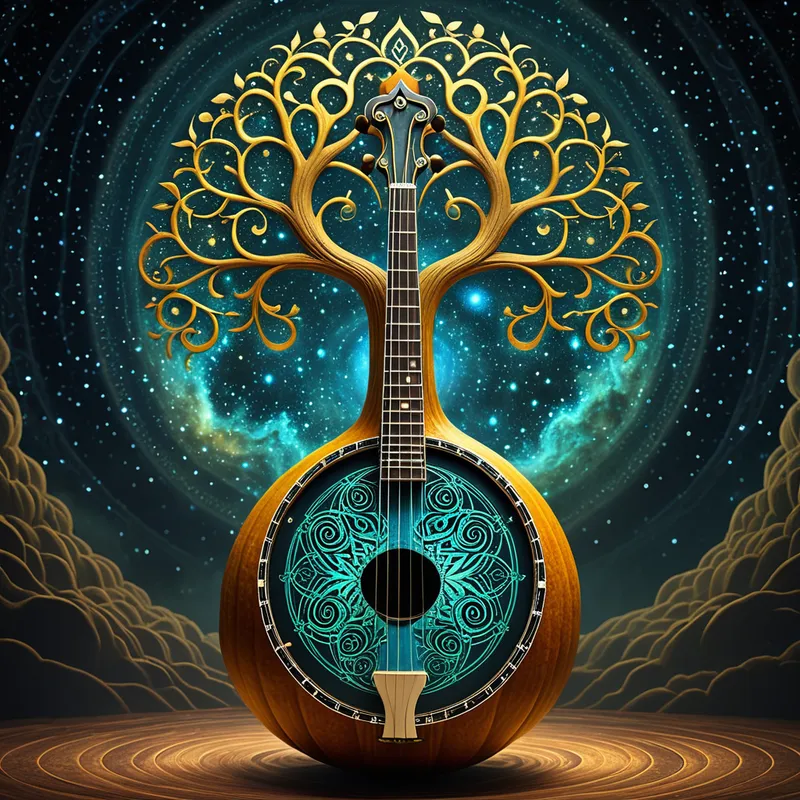
Somatically, this is the process of giving voice to the unspeakable. The psyche is working to build a “container” (the banjo) for emotions or memories that feel too vast, too painful, or too fragmented to hold in conscious thought. The dream is the workshop where the soul, playing the roles of both Amina and Baba Kofi, labors to construct a psychic instrument. The tension felt in the dream is the tension of the string being stretched into place—the painful but necessary act of drawing a line of consciousness through the chaos of grief or forgetting, so that it may finally vibrate and be heard.

Alchemical Translation
The myth models the individuation process—the journey toward psychic wholeness—as a creative act born of necessity. It maps the transformation of the prima materia of raw, personal suffering into the lapis philosophorum of authentic voice and purpose.
First, there is The Hollowing (the Calabas): The conscious ego suffers a rupture—a loss, a failure, a disillusionment. This creates the necessary emptiness, the vas hermeticum or hermetic vessel, in which the great work can begin. One must fully inhabit this emptiness, as Amina did her grief, without rushing to fill it with distractions.
Second, The Crafting (the Work of Baba Kofi): This is the conscious, disciplined application of skill and tradition to the raw material of the Self. It is seeking out the “lightning-struck wood” of one’s unique experiences (traumas and triumphs) and shaping them into a structure (a philosophy, a practice, an art). It is stretching the “skin” of one’s vulnerability taut so it can become a receptive membrane.
Individuation is not about becoming perfect, but about becoming resonant—crafting a self that can truly vibrate with the full spectrum of your experience.
Third, The Stringing (the Gift of Anansi): This is the integration of the trickster, the shadow, the adaptive intelligence. It is weaving the threads of one’s personal narrative, including the shameful, clever, or hidden parts, into the functional whole. These strings are what connect the hollow of one’s past (the gourd) to the tuning of one’s future (the pegs).
Finally, The Playing (Amina’s Song): The culmination is not a static state of “healed,” but an active, ongoing practice. It is the moment the individual takes up their own uniquely crafted instrument—their integrated psyche—and begins to play their own life’s melody. The song acknowledges the bass note of sorrow, but is not dominated by it. It is a complex, rhythmic, living conversation between what was lost and what is forever remembered, between the individual soul and the collective waters it must navigate. To have fashioned from your deepest sorrow the very instrument of your soul’s expression—this is the ultimate alchemical triumph promised by the banjo’s ancestry.
Associated Symbols
Explore related symbols from the CaleaDream lexicon: