The Ashanti Creation Story Myth Meaning & Symbolism
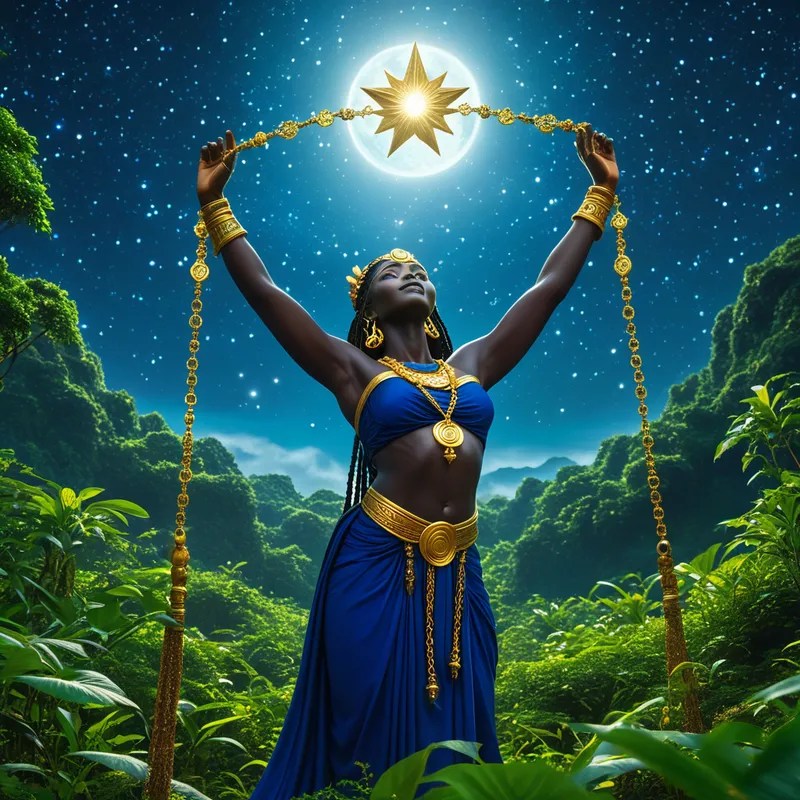
The Sky God Nyame lowers his children to Earth, ruled by Asase Yaa, establishing a sacred covenant between humanity and the living world.
The Tale of The Ashanti Creation Story
In the beginning, there was Nyame, whose being was the vast, star-strewn firmament. He was the source of all things—rain, sun, moon, and the breath of life. And below, there was Asase Yaa, the great, fertile body of the world, patient and waiting. Between them stretched an immeasurable gulf of silent, empty air.
Nyame, in his celestial solitude, fashioned the first humans. He shaped them not from dust, but from the very essence of his own divine spirit. They were his children, perfect and shining, dwelling with him in the sky, in a realm of pure spirit and eternal light. But a longing stirred in Nyame’s heart—a creator’s desire to see his children grow, to struggle, to become. The pristine perfection of the sky offered no soil for such growth.
So Nyame wrought a chain of gold, a luminous tether spun from sunlight and intention. He called his children to the edge of the starry realm. “Below you lies Asase Yaa,” his voice echoed like distant thunder. “She is your mother. Her body will nourish you, her forests will shelter you, her rivers will quench you. Go to her. Live upon her. Honor her.”
With a mixture of trepidation and promise, the first man and woman grasped the golden chain. Nyame began to lower them, hand over hand, into the great abyss. They descended through veils of cloud, past the silent watch of the moon, down towards the waiting green embrace of the Earth. The air grew thick and sweet with the scent of damp soil and blooming things. They felt the pull of the world, a gravitational call from the heart of Asase Yaa herself.
Their feet touched the earth—not with a crash, but with a sigh of belonging. The soil was warm and alive. They released the chain, and it shimmered, dissolved, and was drawn back into the heavens, leaving no physical trace, only a memory of connection. They were home, yet forever separated from their first home. This was the primal covenant: they were of the sky, but their destiny was of the earth. They were divine in origin, but mortal in form, tasked to cultivate, to build, to love, and to return their bodies to the earth that sustained them. The sacred pact was sealed: Nyame would watch from above, providing rain and light, while Asase Yaa would hold them from below, providing sustenance and final rest. The world of humanity had begun, suspended between heaven and earth, forever children of both.

Cultural Origins & Context
This myth is the soul-narrative of the Ashanti people, one of the most influential cultures of West Africa. It was not written in a book but woven into the very fabric of society, passed down through the sacred office of the Okyeame (the spokesperson or linguist) and elders around evening fires. The story was recited during festivals, at the enstoolment of a new chief, and in rites of passage, grounding the people’s identity, laws, and ethics in a cosmic order.
Its function was profoundly societal and ecological. It established the divine right of chiefs (as descendants of the first humans), explained the origin of the sacred Golden Stool (said to have descended from the sky), and, most importantly, encoded an environmental ethic. By stating humans were lowered to the Earth and are children of the Earth (Asase Yaa), it framed the natural world not as a resource to be owned, but as a sacred mother to be respected. Farming rituals, the prohibition of farming on Thursdays (Asase Yaa’s sacred day), and burial practices all stem from this foundational belief in a living, conscious Earth.
Symbolic Architecture
The myth presents a profound symbolic [architecture](/symbols/architecture “Symbol: Architecture in dreams often signifies structure, stability, and the framing of personal identity or life’s journey.”/) of [separation](/symbols/separation “Symbol: A spiritual or mythic division between realms, states of being, or consciousness, often marking a transition or loss of connection.”/), [relationship](/symbols/relationship “Symbol: A representation of connections we have with others in our lives, often reflecting our emotional state.”/), and imperfect incarnation.
The golden chain is not a ladder to climb back to perfection, but an umbilical cord that is meant to be severed for life to truly begin.
Nyame represents transcendent [spirit](/symbols/spirit “Symbol: Spirit symbolizes the essence of life, vitality, and the spiritual journey of the individual.”/), [consciousness](/symbols/consciousness “Symbol: Consciousness represents the state of awareness and perception, encompassing thoughts, feelings, and experiences.”/), and the [father](/symbols/father “Symbol: The father figure in dreams often symbolizes authority, protection, guidance, and the quest for approval or validation.”/) principle—the [source](/symbols/source “Symbol: The origin point of something, often representing beginnings, nourishment, or the fundamental cause behind phenomena.”/) of individual [soul](/symbols/soul “Symbol: The soul represents the essence of a person, encompassing their spirit, identity, and connection to the universe.”/) and [purpose](/symbols/purpose “Symbol: Purpose signifies direction, meaning, and intention in life, often reflecting personal ambitions and core values.”/). Asase Yaa represents immanent [nature](/symbols/nature “Symbol: Nature symbolizes growth, connectivity, and the primal forces of existence.”/), the unconscious, and the [mother](/symbols/mother “Symbol: The symbol of ‘Mother’ represents nurturing, protection, and the foundational aspect of one’s emotional being, often associated with comfort and unconditional love.”/) principle—the [matrix](/symbols/matrix “Symbol: A dream symbol representing the fundamental structure of reality, consciousness, or the self. It often signifies feelings of being trapped, controlled, or questioning the nature of existence.”/) of [body](/symbols/body “Symbol: The body in dreams often symbolizes the dreamer’s self-identity, personal health, and the relationship they have with their physical existence.”/), instinct, and [community](/symbols/community “Symbol: Community in dreams symbolizes connection, support, and the need for belonging.”/). Humanity’s descent is the archetypal [journey](/symbols/journey “Symbol: A journey in dreams typically signifies adventure, growth, or a significant life transition.”/) of [spirit](/symbols/spirit “Symbol: Spirit symbolizes the essence of life, vitality, and the spiritual journey of the individual.”/) into matter. We are not fallen angels, but planted seeds. The “flaw” or “imperfection” is not sin, but the very [condition](/symbols/condition “Symbol: Condition reflects the state of being, often focusing on physical, emotional, or situational aspects of life.”/) of earthly existence: limitation, growth, decay, and the [tension](/symbols/tension “Symbol: A state of mental or emotional strain, often manifesting physically as tightness, pressure, or unease, signaling unresolved conflict or anticipation.”/) between our heavenly aspirations and our earthly needs.
The act of lowering is an act of love and release by the [creator](/symbols/creator “Symbol: A figure representing ultimate origin, divine power, or profound authorship. Often embodies the source of existence, innovation, or personal destiny.”/). It is a divine trust, placing his perfect children into an imperfect, dynamic world so they may evolve through experience. The myth beautifully avoids a “fall from grace” narrative, instead offering a “descent into becoming.”

The Dreamer’s Resonance
When this myth stirs in the modern psyche, it often manifests in dreams of suspension, descent, or finding footing. You may dream of being lowered in an elevator into a lush, dark forest, or of climbing down a fragile rope from a cold, abstract space into a warm, chaotic garden. These are somatic dreams of incarnation.
The psychological process is one of grounding a lofty ideal or a spiritual insight into the messy reality of daily life. It is the struggle of the artist to give form to a vision, the healer to apply wisdom to a wound, or the individual trying to live their values in a complex world. The dream may evoke anxiety (fear of letting go of the chain) or profound relief (feet finally touching solid, nurturing earth). It signals a necessary descent from the head (Nyame’s sky) into the body and the earthly realm of relationship and action (Asase Yaa’s domain).
Alchemical Translation
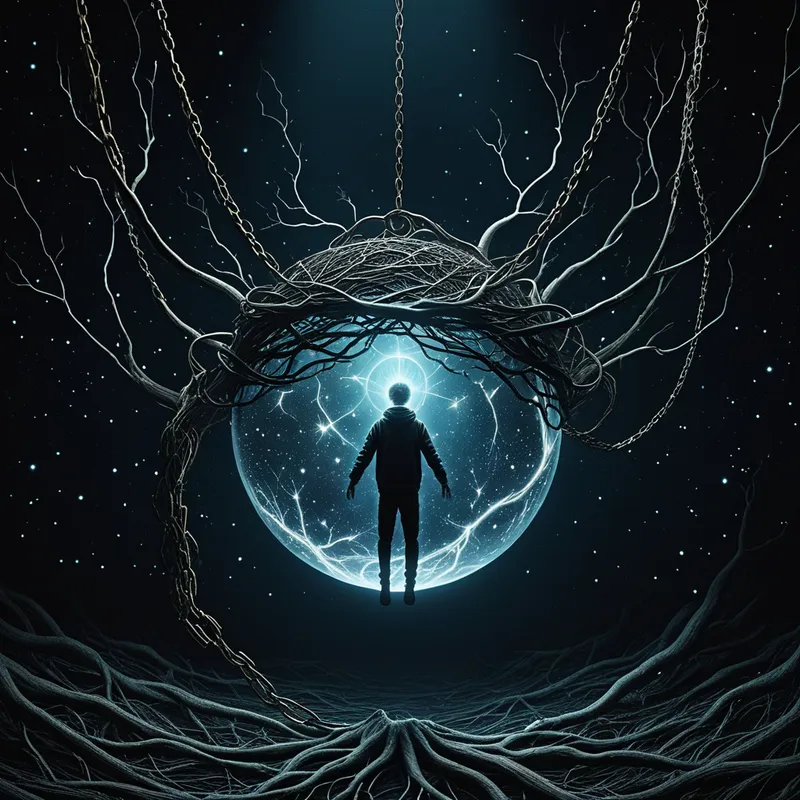
The alchemical journey of individuation mirrors this myth precisely. It is the process of the conscious ego (the sky-born spirit) descending into and integrating the vast, often dark, richness of the personal and collective unconscious (the earthy body of Asase Yaa).
The goal is not to escape the earth and return to a pure spiritual state, but to become the living bridge where heaven and earth consciously meet.
The first stage is separation: recognizing our unique consciousness (our “sky” nature). The second is the descent: the often painful confrontation with shadow, instinct, family patterns, and bodily existence—the “lowering” into full selfhood. The third is grounding: finding our purpose and place within the community of life, honoring the “earth” that sustains us. The modern individual must forge their own “golden chain” of meaning—a tether to their origins and values—while having the courage to let go and fully inhabit their earthly life. The triumph is a soul that is both rooted and radiant, fully human, acknowledging its divine source without denying its mortal, earthy home.
Associated Symbols
Explore related symbols from the CaleaDream lexicon:
- Sky — Represents Nyame, the realm of spirit, origin, consciousness, and the father principle from which human life descends.
- Earth — Represents Asase Yaa, the receptive, nurturing, and mortal matrix of life, the mother principle that receives and sustains the descended spirit.
- Chain — The golden tether of connection and descent, symbolizing the divine origin of humanity, the covenant between sky and earth, and the fragile link between spirit and matter.
- Goddess — Embodied in Asase Yaa, representing the divine feminine as the living, conscious planet, the source of fertility, sustenance, and final rest.
- God — Embodied in Nyame, representing the divine masculine as transcendent source, law-giver, and the bestower of soul and destiny.
- Separation — The core dynamic of the myth: the necessary distancing from pure origin to enable growth, experience, and individual becoming in the earthly realm.
- Root — Symbolizes the deep, organic connection humanity forms with the Earth Mother after descent, the anchoring of life and identity in the physical world.
- Journey — The eternal human condition as modeled by the descent: we are beings on a passage from a spiritual origin through an earthly experience.
- Covenant — The sacred, unspoken pact established by the myth: Nyame provides rain and order, humanity honors and cares for Asase Yaa, and Asase Yaa provides life and final sanctuary.
- Mother — The archetypal role of Asase Yaa as the womb and tomb, the ultimate source of all nourishment and the receiver of all that returns.
- Father — The archetypal role of Nyame as the progenitor and releaser, who gives life and then grants the freedom for that life to unfold on its own terms.
- Gold — The substance of the chain, representing the divine, incorruptible nature of our origin and the highest value of the spiritual covenant that connects us to the source.