The 401 Orisha
A deep dive into the 401 Orisha of Yoruba mythology, exploring their vast pantheon, hidden hierarchies, and spiritual significance beyond the major deities.
The Tale of The 401 Orisha
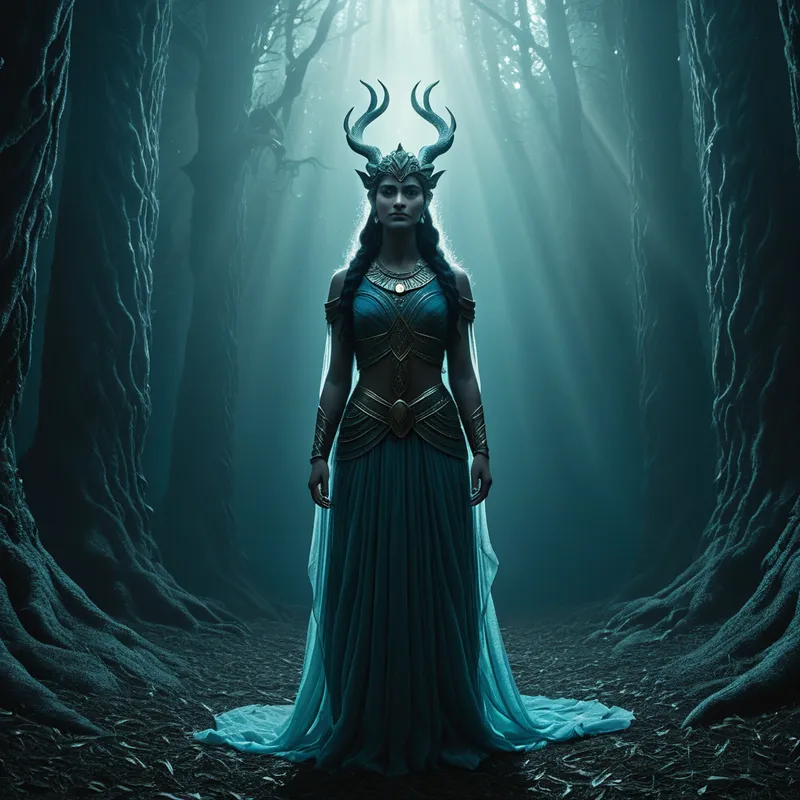
In the beginning, there was the One, the Supreme Source, [Olodumare](/myths/olodumare “Myth from Yoruba culture.”/). From its infinite will flowed the primordial sea of consciousness, and from that sea, the very first forces of existence emerged. These were the Irunmole, the primordial Orisha, who descended from heaven on a chain to shape the raw earth. They are the ones whose names echo through time: [Obatala](/myths/obatala “Myth from Yoruba culture.”/) the sculptor of human form, [Oduduwa](/myths/oduduwa “Myth from Yoruba culture.”/) who spread the land, Eshu the guardian of thresholds, [Orunmila](/myths/orunmila “Myth from Yoruba culture.”/) the witness of destiny.
But the story does not end with these great architects. As [the world](/myths/the-world “Myth from Tarot culture.”/) grew complex, so too did the divine forces required to sustain it. For every mountain, there was a spirit of its stone; for every stream, a consciousness in its current; for every craft, a genius in its practice; for every human emotion, a divine reflection. From the breath of Olodumare and the actions of the primordial ones, a vast family of divine energies multiplied. They are said to be 401 in number—not a literal census, but a sacred numeral signifying an uncountable, all-encompassing multitude. It is a number that whispers of completeness, of the divine presence in all things.
These are the Orisha who dwell in the specific over the general. They are the deity of the particular hill behind your village, the spirit of the iron in the blacksmith’s forge, the consciousness within the silk-cotton tree that has stood for ten generations. Some have names known only in one town, their worship a whispered tradition in a single family compound. Others are so specialized they are invoked only for a single, precise aspect of life—the Orisha who ensures the yam seedling breaks the soil, or the one who governs the moment of reconciliation after a bitter quarrel.
They exist in a fluid, living hierarchy, not of power, but of proximity and function. The great Orisha are like radiant suns, and the 401 are the [constellations](/myths/constellations “Myth from Various culture.”/) that form around them, the individual points of light that make up their greater body. They are the messengers, the attendants, the localized manifestations, the forgotten children of the divine whose roles are no less essential for being small. Together, they form the spiritual ecosystem, a web of sacred responsibility where nothing, absolutely nothing, is without a guardian, a witness, a divine counterpart.
Cultural Origins & Context
The concept of the 401 Orisha emerges from the deep, forest-rooted wisdom of the Yoruba people of West Africa. It is a theological framework born from an animist worldview that perceives consciousness and life force (Ase) in all phenomena. This is not a polytheism of discrete, separate gods, but a monotheistic pluralism: one supreme source (Olodumare) manifesting through innumerable channels of sacred energy (Orisha).
The number 401 is profoundly symbolic. In Yoruba numerology, 400 signifies an immense, nearly uncountable multitude (like saying “thousands” in English). Adding the one (+1) represents the unity from which the multitude springs—Olodumare itself, or the completeness of the system including the source. Thus, “401 Orisha” poetically means “all the Orisha that exist,” acknowledging both their vast diversity and their fundamental unity. It is an open-ended system, allowing for the inclusion of deified ancestors ([Egungun](/myths/egungun “Myth from African Diaspora culture.”/)), deified natural forces, and even the adoption of new spiritual forces encountered over time, all while maintaining the integrity of the core structure.
This cosmology was preserved and evolved through the trans-Atlantic diaspora—in the Lucumí tradition of Cuba, the Candomblé of Brazil, and the Santería/Regla de Ocha of the Caribbean. Here, the 401 found new homes in new plants, new rivers, and new social realities, demonstrating the adaptive, living nature of the tradition. The concept underscores that the divine is immanent, intimately involved in every granular aspect of creation, from the cosmic to the utterly mundane.
Symbolic Architecture
The 401 Orisha represent the symbolic [architecture](/symbols/architecture “Symbol: Architecture in dreams often signifies structure, stability, and the framing of personal identity or life’s journey.”/) of a conscious [universe](/symbols/universe “Symbol: The universe symbolizes vastness, interconnectedness, and the mysteries of existence beyond the individual self.”/). They are the psychic [blueprint](/symbols/blueprint “Symbol: A blueprint represents the foundational plan or design for something, often symbolizing potential, structure, and the mapping of one’s inner self or future.”/) through which the undifferentiated sacred becomes differentiated meaning. Each Orisha is a complex [symbol](/symbols/symbol “Symbol: A symbol can represent an idea, concept, or belief, serving as a powerful tool for communication and understanding.”/) in itself—a [constellation](/symbols/constellation “Symbol: Represents guidance, destiny, and the navigation through life, symbolizing the connections between experiences and paths.”/) of attributes, colors, numbers, [natural elements](/symbols/natural-elements “Symbol: Primordial forces representing the unconscious, life cycles, and spiritual connection to the earth and cosmos.”/), and ethical principles. Collectively, they form a holistic map of [reality](/symbols/reality “Symbol: Reality signifies the state of existence and perception, often reflecting one’s understanding of truth and life experiences.”/), where no domain of experience is left orphaned from the divine.
This [pantheon](/myths/pantheon “Myth from Roman culture.”/) is not a [static](/symbols/static “Symbol: Static represents interference, disruption, and the breakdown of clear communication or signal, often evoking feelings of frustration and disconnection.”/) list but a dynamic network of relationships. [The hierarchy](/symbols/the-hierarchy “Symbol: A structured system of ranking, power, and social order, often representing authority, status, and one’s position within a group or society.”/) among them is often described as familial (parents, children, siblings) or courtly (kings, queens, warriors, messengers), reflecting [human](/symbols/human “Symbol: The symbol of a human represents individuality, complexity of emotions, and social relationships.”/) social structures to model spiritual interactions. This relational model provides a symbolic [language](/symbols/language “Symbol: Language symbolizes communication, understanding, and the complexities of expressing thoughts and emotions.”/) for understanding the interplay of forces within [the self](/myths/the-self “Myth from Jungian culture.”/) and the world. Conflict between Orisha, like the famed rivalry between [Shango](/myths/shango “Myth from African Diaspora culture.”/) (fire, [thunder](/symbols/thunder “Symbol: A powerful natural sound symbolizing divine communication, sudden change, or emotional release in arts and music contexts.”/)) and Oya (wind, [tempest](/symbols/tempest “Symbol: A violent storm representing chaos, emotional upheaval, or transformative forces in nature and psyche.”/)), mirrors the internal and external conflicts between [passion](/symbols/passion “Symbol: Intense emotional or physical desire, often linked to love, creativity, or purpose. Represents life force and deep engagement.”/) and change, rage and transformation.
The 401 are the divine fractal—the pattern of the whole repeated in every part. In the specific devotion to one small Orisha of a local stream, the devotee honors the entire cosmology, for that stream contains the essence of all waters, and all waters connect back to the primordial sea of Olodumare.
This structure is a profound psychological truth: the Self (Olodumare) is unknowable in its totality, but we encounter its aspects (the Orisha) through the specific textures of our lives—our talents, our challenges, our geographies, our lineages. The pantheon is a mirror of the soul’s multiplicity.
The Dreamer’s Resonance
For the dreamer navigating the inner landscape, the 401 Orisha offer a profound resonant framework. They provide archetypal containers for the multitude of voices, drives, and energies that constitute the [psyche](/myths/psyche “Myth from Greek culture.”/). One does not simply have “anger”; one may have the fiery, righteous, kingly anger of Shango, or the swift, cutting, transformative anger of Ogun. A creative impulse might be the careful, orderly artistry of Obatala or the intuitive, market-savvy creativity of Oshun.
Engaging with this concept invites a move away from a monolithic ego and towards a dialogical self. The dreamer learns to identify which “Orisha” is dominant in a given situation, which is being neglected, and which are in conflict. A period of stagnation might signal the need to honor Oya, the spirit of change and the cemetery, to clear the old. A lack of boundaries could call for the firm, protective energy of Ogun. The 401 teach that psychological health is not the silencing of these inner divinities, but the establishment of right relationship and balance (Itutu) among them.
It is an invitation to see one’s life as a sacred ecosystem. The forgotten orisha—the small talents, the subtle fears, the specific memories tied to place—are as vital to the soul’s wholeness as the dominant archetypes. To remember the 401 is to remember the sacredness of the detail, the divinity in the overlooked corners of our own being.
Alchemical Translation
The alchemical process here is one of multiplication and synthesis. [The prima materia](/myths/the-prima-materia “Myth from Alchemical culture.”/)—the raw, unconscious unity of the Self—is first multiplied into the 401 distinct substances (the differentiated Orisha). This is the [separatio](/myths/separatio “Myth from Alchemical culture.”/), the necessary division that allows for conscious examination and relationship. The devotee, the seeker, works with these individual forces through prayer, ritual, and ethical living, refining each one.
The ultimate goal, however, is not to remain in fragmentation. It is the [coniunctio oppositorum](/myths/coniunctio-oppositorum “Myth from Alchemical culture.”/), [the sacred marriage](/myths/the-sacred-marriage “Myth from Various culture.”/), performed not between two, but among the multitude. Through the application of sacred wisdom (Orunmila’s guidance) and the transformative power of Ase, the many are consciously re-integrated. The 401 streams flow back into the one ocean. The individual learns to hold multiplicity within unity, to be a vessel through which the specific energies of the divine can flow without identifying exclusively with any single one.
This is the alchemy of the community as well as the soul. The 401 model validates specialization—the farmer, the healer, the artist, the leader—while insisting on the essential interdependence of all roles for the health of the whole. The spiritual work is to recognize the Orisha in the other, completing the circle of sacred exchange.
The final translation is from mythology to metaphysics: the many are the One in expression. To honor the spirit of a single stone is to honor the principle of solidity, endurance, and foundation, which is itself an aspect of the ultimate reality. The part truly contains the whole.
Associated Symbols
Explore related symbols from the CaleaDream lexicon:
- Spirit — The essential life force and consciousness that animates all things, from the supreme creator to the smallest stone, mirroring the Ase present in every Orisha.
- [Water](/myths/water “Myth from Chinese culture.”/) — The primordial element from which life and consciousness emerged, representing the source of all the Orisha and the fluid, adaptable nature of [the pantheon](/myths/the-pantheon “Myth from Greek culture.”/).
- Forest — A dense, living network of interconnected beings, symbolizing the vast, complex, and organic hierarchy of the 401 Orisha where every entity has its place.
- Circle — The symbol of completeness, unity, and the cyclical nature of existence, reflecting the meaning of the number 401 and the interconnected whole of the divine system.
- Temple — The sacred space, whether a grove, a shrine, or the human heart, where communion with the divine aspects occurs and the Orisha are honored.
- Root — The deep, ancestral, and cultural foundations from which the understanding of the 401 Orisha grows, providing stability and nourishment to the living tradition.
- Mask — The specific form, attribute, or manifestation through which the formless divine essence is perceived and engaged, as each Orisha is a “mask” of Olodumare.
- Dance — The dynamic, embodied ritual through which the energies of the Orisha are invoked, expressed, and harmonized, reflecting the living relationship with the divine.
- Destiny — The individual path and purpose (Ori) that is shaped by and interacts with the multitude of spiritual forces represented by the Orisha.
- The Tradition — The living, evolving body of wisdom, practice, and community that carries, interprets, and transmits the knowledge of the sacred multitude across generations.