Tartan Patterns Myth Meaning & Symbolism
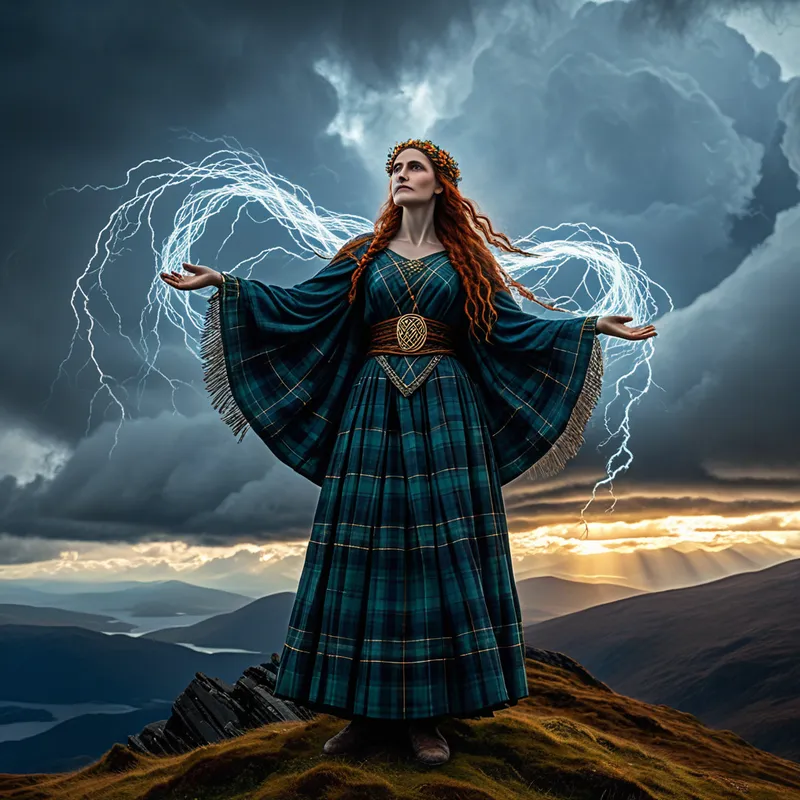
The Weaver Goddess, An Cailleach, creates the first tartan from the threads of the land, binding clan, fate, and identity into a sacred, living pattern.
The Tale of Tartan Patterns
In the time before memory, when the world was raw and singing with newness, the land we now call Alba was a tapestry of chaos. Mountains roared as they rose from the deep; rivers carved their paths in furious, silver tears; and the forests were a wild, green shout against the sky. There was power, immense and untamed, but no harmony. The people, the first children of the stone and the mist, wandered in small, fearful bands. They knew the voice of the river and the sigh of the pine, but they did not know each other. They had no story that bound them to the land, and the land had no story that recognized them.
Then came An Cailleach, the Old One, the Weaver of Seasons. She did not walk the land so much as the land was her body. Her hair was the long, grey grass of the moor; her eyes, the deep, still lochs. She saw the discord and felt a sorrow as vast as the winter sea. The people were threads adrift, and a tapestry cannot hold if its threads have no warp to bind them.
On the summit of Beinn na Cìche, the Mountain of the Breast, she raised her arms. From the north, she pulled a thread of iron-grey, spun from the heart of the storm cloud. From the west, she drew a thread of deep green, plucked from the heart of the ancient yew. From the east, she summoned a thread of burnt orange, the last ember of the autumn sun caught in peat. From the south, she gathered a thread of pure white, the wool of the first cloud that ever slept on a hill.
With a breath that was both wind and word, she stretched these threads upon the loom of the horizon. But a loom needs a frame. So, she took the straight, true pine and made the warp—the vertical lines, unchanging, the bones of the pattern. These were the laws of the tribe, the straight paths of duty and kinship.
Then, with fingers that could cradle a snowflake or split a mountain, she began to weave the weft. This was the dance. The grey thread of storm crossed the green of the forest, and where they met, a new shade was born—the blue-grey of distant rain on the hills. The orange of fire crossed the white of cloud, and it became the soft gold of barley at harvest. Each intersection was a meeting, a decision, a moment in time. The pattern began to emerge: a crossing, a check, a repeat.
But the work was not done. The first man to see it, a hunter named Fionn the Keen-Eyed, watched from a lower crag. He saw not just colors, but a map. He saw the grey of his own mountain pass, the green of his forest hunting grounds, the brown of his river’s peat-stained water. The pattern spoke to him. It said, This is you. This is your place.
An Cailleach called him forward. "Take this thread," she said, handing him a strand the color of dried heather, unique to his valley. "Weave it into the pattern. Claim your line in the story."
Tentatively, Fionn took the thread. As he guided it across the loom, a miraculous thing happened. Where his thread crossed the established warp, it did not obscure the pattern; it deepened it. It created a new set of intersections, a new harmony within the whole. His thread became part of the eternal design, yet his crossing made it singular. From the great, original pattern—the Mother Sett—a new, distinct pattern was born. She named it for him and his people. It was their clann, their identity, woven into the very fabric of creation.
One by one, the other wandering bands came. Each was given a thread from their own place—the blue of a specific loch, the red of a particular ironstone. Each wove their line, creating their own unique sett from the universal loom. The chaos of the land found order. The loneliness of the people found kinship. They were no longer threads adrift, but part of a living, breathing, sacred pattern—the first tartan.
Cultural Origins & Context
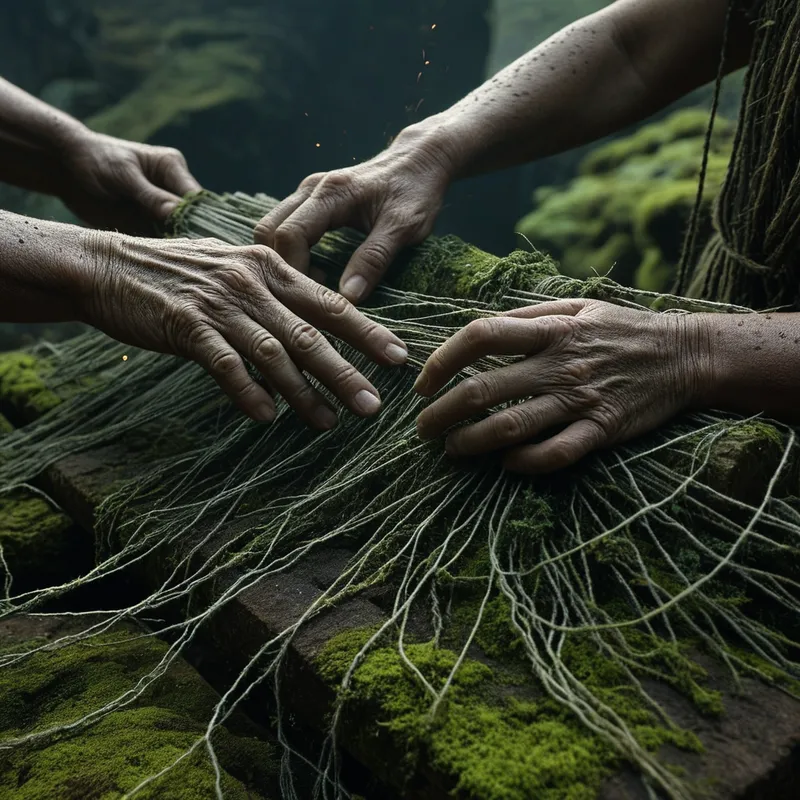
The myth of the woven tartan is not found in a single, ancient manuscript. It is a seanchaidh's tale, a story whispered by the fireside to explain a profound cultural reality. Historically, tartan patterns (or setts) in Scotland were deeply tied to geography long before they were rigidly associated with specific family names. Weavers used local plants, mosses, and minerals to create dyes, meaning the patterns were literally born from the landscape—the "threads of the land" in the most literal sense.
This myth served a crucial societal function. In a culture where oral history and kinship ties were paramount, the tartan was a wearable genealogy and a territorial map. The story of An Cailleach’s loom provided a divine origin for this practice, elevating the craft of weaving from a practical task to a sacred act of participation in the cosmic order. It explained why you could "read" a person's origin from their cloth, and it embedded the values of the clan—the unchanging warp of law and lineage, crossed by the dynamic weft of individual action and fate.
Symbolic Architecture
At its heart, the myth presents a powerful symbolic system for understanding identity and belonging. The tartan is not a monolithic block of color, but a complex grid born from intersection.
The self is not a solid stone, but a living pattern—a point where the eternal warp of ancestry meets the unique weft of personal experience.
The Warp (the vertical threads) represents the givens of existence: our ancestry, our culture, the physical laws of nature, the unconscious structures of the psyche. They are the long, straight lines—the "thou shalts" and "thou art"s that form the backbone of identity. The Weft (the horizontal threads) is the trajectory of a single life. It is our choices, our actions, our personal journey through time. It crosses the warp again and again.
The magic, the identity, is created at the Intersection. Each crossing is a moment where fate (warp) meets free will (weft). The resulting color—the unique shade that appears nowhere else in exactly the same way—symbolizes the individual soul. You are the product of every intersection of your lineage and your choices. The complete Sett (pattern) is the fully realized individual or clan, a harmonious whole made of countless decisive crossings.
An Cailleach, as the Creator, represents the unifying principle of the Self, the psychic force that seeks to weave the disparate threads of the personality (the complexes, the archetypes) into a coherent, meaningful whole.

The Dreamer's Resonance
To dream of tartan patterns, especially of weaving, unraveling, or being trapped within them, speaks to a profound psychological process underway. It is often a dream of individuation in relation to the collective.
Dreaming of finding your unique thread and weaving it suggests a conscious engagement with your heritage and personal destiny. You are actively seeking to understand how your life choices intersect with your given circumstances to create a pattern that is authentically yours.
Conversely, dreaming of a tartan unraveling can signal an identity crisis. The old patterns of family expectation, cultural norms, or professional identity are coming apart. This is not necessarily negative; it is often the necessary deconstruction before a more authentic pattern can be woven.
A dream of being bound or constrained by a tight tartan may point to a feeling of being over-identified with a collective role—the "perfect daughter," the "company man"—where the warp of expectation has completely stifled the creative weft of the individual spirit. The psyche is signaling a need to introduce a new color, to cross the lines differently.
Alchemical Translation
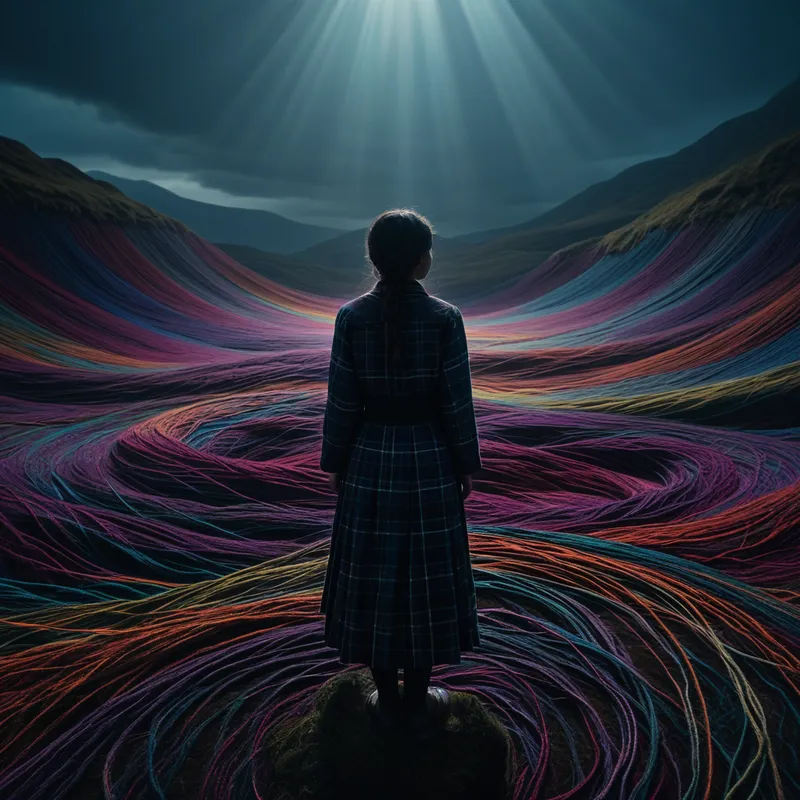
The myth models the entire alchemical process of psychic transformation, or individuation. The prima materia—the chaotic, raw state of the unexamined life—is the un-woven landscape and the scattered people.
The opus is the lifelong work of crossing the thread of one's conscious life with the timeless threads of the unconscious, creating the unique philosopher's stone of the individual personality.
Calcinatio (burning to ash) is seen in the gathering of the elemental threads—storm, forest, fire, cloud. It is the reduction of complex realities to their essential, symbolic colors. Solutio (dissolution) occurs as the threads are placed on the loom, losing their isolated nature. Coagulatio (coagulation) is the weaving itself, the formation of the new, solid pattern from the dissolved elements.
The crucial stage, Coniunctio (the sacred marriage), is represented by every intersection of warp and weft. It is the marriage of opposites: conscious and unconscious, personal and ancestral, temporal and eternal. The moment Fionn weaves his own thread is the moment of Individuation—the creation of something new that is both part of the universal pattern and utterly distinct.
Finally, the myth does not end with one perfect pattern. It ends with the invitation for all to weave. This is the stage of Multiplicatio, the proliferation of the achieved wisdom. The alchemical gold is not hoarded; it is the principle of creative self-realization that can be replicated in endless, beautiful variations. The modern individual’s task is to find the loom of their own awareness, acknowledge the warp threads of their psyche and history, and consciously, courageously, throw the shuttle of their life across it, creating a pattern worthy of the great, original weave.
Associated Symbols
Explore related symbols from the CaleaDream lexicon: