Talos Myth Meaning & Symbolism
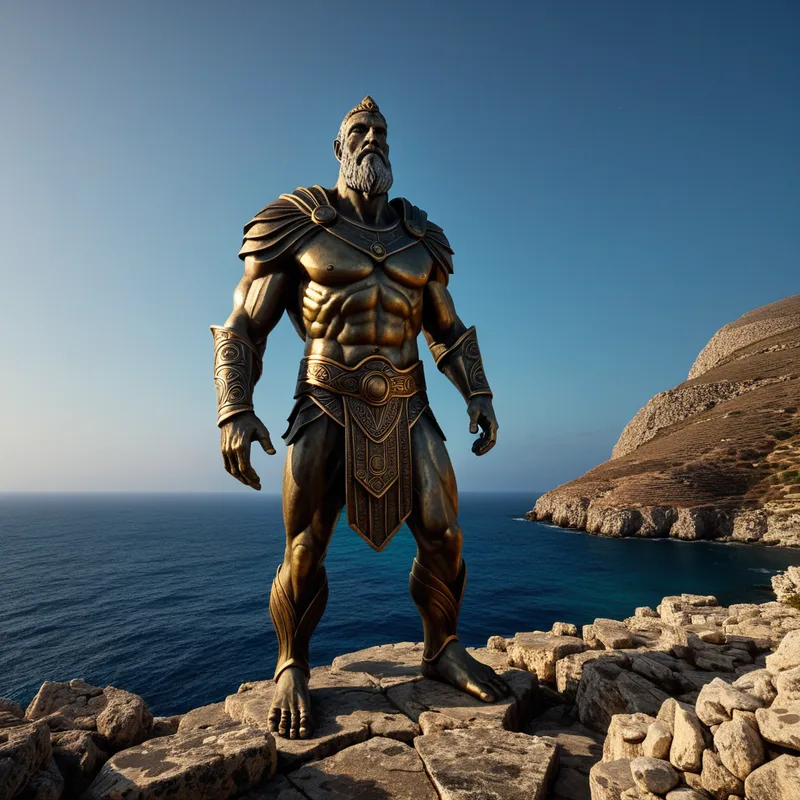
The myth of Talos, a bronze giant forged by the gods to guard Crete, whose life-force was contained in a single, vulnerable vein.
The Tale of Talos
Hear now the tale of the unblinking guardian, the bronze-clad dream of the gods made manifest. In the age when heroes sailed on quests divine and [the earth](/myths/the-earth “Myth from Hindu culture.”/) still remembered the touch of the Titans, the island of Crete slept under a watchful eye that never closed.
This eye belonged to Talos. Not born of woman, but wrought in the divine forge of [Hephaestus](/myths/hephaestus “Myth from Global/Universal culture.”/) himself. Some say he was a gift from the gods to [Minos](/myths/minos “Myth from Greek culture.”/); others whisper he was the last survivor of the Bronze Race of men. His body was hollow bronze, yet within coursed not blood, but [ichor](/myths/ichor “Myth from Greek culture.”/)—the golden life-fluid of the gods, gifted by Zeus himself. His sole task: to circle the island’s sacred shores three times each day, a living, moving wall. His gaze was fire, his embrace death to any foreign ship that dared approach.
For generations, he walked. The sun baked his metal skin. [The sea](/myths/the-sea “Myth from Greek culture.”/) spray salted his limbs. He was [the law](/myths/the-law “Myth from Biblical culture.”/) of the shore, immutable as the cliffs. Until the day the Argo appeared, its sail a white scar on [the horizon](/myths/the-horizon “Myth from Various culture.”/), bearing [Jason](/myths/jason “Myth from Greek culture.”/) and his weary band of heroes. They sought only [water](/myths/water “Myth from Chinese culture.”/), respite from the relentless sea, but Talos saw only intrusion. From his high perch, he bellowed a sound like tearing metal. He broke great rocks from the headland and hurled them at the ship, the waves churning into froth as the heroes cried out in terror.
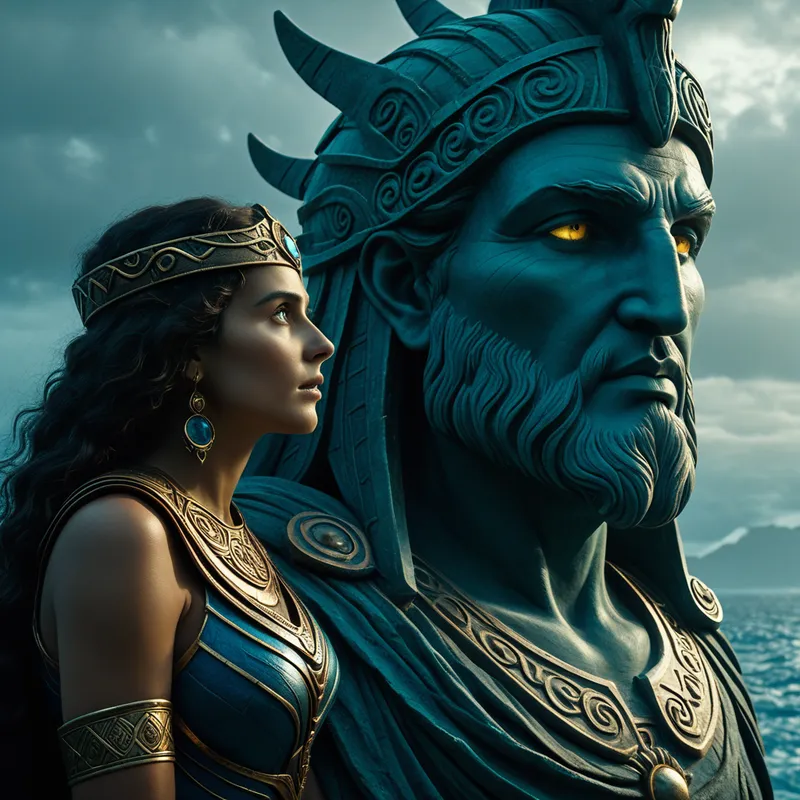
[The Argonauts](/myths/the-argonauts “Myth from Greek culture.”/) were mighty, but their spears rang harmlessly against the divine bronze. Despair took them. Then, from among them, stepped [Medea](/myths/medea “Myth from Greek culture.”/). Her eyes, dark as the deepest earth, saw not a monster, but a mechanism. She knew the secret of all things wrought: every creation has its flaw, every power its pin. She called out, not with a warrior’s challenge, but with the honeyed voice of a siren, singing of sleep, of rest, of the great weariness of an eternal vigil.
Talos paused. The words seeped into the silence of his centuries. Medea whispered of his one weakness, the secret sealed in his ankle: a single bronze nail, a stopper, holding back the ichor in a solitary vein. She sang of release. Perhaps in that moment, the ghost of mortality within the god-forged shell stirred. As he leaned down, curious, vulnerable, a single arrow from the hero Poeas found its mark. The nail was struck. Not with a mighty blow, but with a precise, almost surgical tap.
The ichor did not gush; it wept. A slow, golden stream, like molten sunlight, began to flow from the ankle of the giant. Talos did not roar in fury, but stood, a mountain coming to terms with its own landslide. He took one step, then another, towards the sea. The divine fluid, his life and his purpose, drained onto the thirsty rocks. With a final, grinding sigh that echoed across the island, the great guardian of Crete collapsed at the water’s edge, his bronze form cooling forever, becoming one with the shore he had protected for an age. The sea washed over him, and the island was left unguarded.
Cultural Origins & Context
The myth of Talos is woven from several threads of ancient Greek thought, primarily preserved in the epic poem Argonautica by Apollonius of Rhodes and referenced by others like Plato. He is a creature of the periphery, both geographically and conceptually. As the guardian of Crete, he represents the boundary between the ordered, known world of the Greek cultural sphere and the chaotic, unknown beyond. His myth served as an etiological tale, explaining perhaps the end of Crete’s thalassocracy, or sea-power, and its vulnerability.
He is a figure of ambiguous origin—gift of the gods, last of the Bronze Race, or a masterpiece of Hephaestus—which speaks to his role as a cultural artifact. He embodies the Greek fascination with the line between the living and the artificial, the divine and the manufactured. Told by bards and poets, the story functioned as a thrilling episode in the saga of Jason, but also as a profound meditation on the nature of guardianship, the cost of absolute security, and the inherent vulnerability in all systems of power, no matter how seemingly invincible.
Symbolic Architecture
Talos is the ultimate [symbol](/symbols/symbol “Symbol: A symbol can represent an idea, concept, or belief, serving as a powerful tool for communication and understanding.”/) of the armored [psyche](/myths/psyche “Myth from Greek culture.”/). He represents the formidable, seemingly impervious structures we build to protect the soft, vital core of our being—our [identity](/symbols/identity “Symbol: Identity represents the sense of self, encompassing personal beliefs, cultural background, and social roles.”/), our [heart](/symbols/heart “Symbol: The heart symbolizes love, emotion, and the core of one’s existence, representing deep connections with others and self.”/), our [soul](/symbols/soul “Symbol: The soul represents the essence of a person, encompassing their spirit, identity, and connection to the universe.”/) (the ichor). His triple daily circuit is the [ritual](/symbols/ritual “Symbol: Rituals signify structured, meaningful actions carried out regularly, reflecting cultural beliefs and emotional needs.”/) of hyper-vigilance, the exhausting, repetitive patrol of the defenses we maintain against perceived threats: intimacy, [vulnerability](/symbols/vulnerability “Symbol: A state of emotional or physical exposure, often involving risk of harm, that reveals authentic self beneath protective layers.”/), change, or the unknown.
The guardian must eventually become the prison. The wall that keeps the world out also immures the self within.
His bronze [body](/symbols/body “Symbol: The body in dreams often symbolizes the dreamer’s self-identity, personal health, and the relationship they have with their physical existence.”/) is the [persona](/symbols/persona “Symbol: The social mask or outward identity one presents to the world, often concealing the true self.”/) taken to an extreme: flawless, imposing, impersonal, and cold. It is the [career](/symbols/career “Symbol: The dream symbol of ‘career’ often represents one’s ambitions, goals, and personal identity in a professional context.”/) identity we become, the rigid ideology we defend, the emotional [numbness](/symbols/numbness “Symbol: A state of reduced or absent physical sensation, often symbolizing emotional disconnection, psychological defense, or spiritual stagnation.”/) we cultivate as [armor](/symbols/armor “Symbol: Armor represents psychological protection, emotional defense, and the persona presented to the world. It symbolizes both safety and the barriers that separate us from vulnerability.”/). The single vein, sealed by a nail or pin, is the symbol of the fatal flaw, the hamartia, in this grand design. It is the repressed vulnerability, the secret wound, the one point of access to the authentic self that the entire edifice is built to conceal. It is often located in the [ankle](/symbols/ankle “Symbol: The ankle is often associated with flexibility and support in one’s life journey, and reflects both physical and metaphorical grounding.”/), a place of mobility and [connection](/symbols/connection “Symbol: Connection symbolizes relationships, communication, and bonds among individuals.”/) to the [earth](/symbols/earth “Symbol: The symbol of Earth often represents grounding, stability, and the physical realm, embodying a connection to nature and the innate support it provides.”/), hinting that the weakness is fundamentally about our grounded humanity.
Medea represents the cunning of the unconscious, the [trickster](/symbols/trickster “Symbol: A boundary-crossing archetype representing chaos, transformation, and the subversion of norms through cunning and humor.”/) intelligence that knows how to bypass rational defenses. She does not attack the armor but speaks to the weariness within it, appealing to the buried longing for rest, for an end to the endless labor of protection. The draining of the ichor is not a violent [death](/symbols/death “Symbol: Symbolizes transformation, endings, and new beginnings; often associated with fear of the unknown.”/), but a [dissolution](/symbols/dissolution “Symbol: The process of breaking down, dispersing, or losing form, often representing transformation, release, or the end of a state of being.”/), a return of [the divine spark](/myths/the-divine-spark “Myth from Gnostic culture.”/) to its [source](/symbols/source “Symbol: The origin point of something, often representing beginnings, nourishment, or the fundamental cause behind phenomena.”/), leaving only the hollow, inert form behind.
The Dreamer’s Resonance
When the pattern of Talos stirs in the modern dreamscape, it often manifests as dreams of immense, silent automatons; vast, empty fortresses; or a sense of being trapped within a powerful but unfeeling metallic body. The dreamer may feel like an observer within their own armored life, watching themselves go through motions of protection that have lost all meaning.
Somatically, this can correlate with chronic tension, a rigid posture, or conditions like fibromyalgia, where the body itself becomes a fortress of pain. Psychologically, it signals a critical juncture in what Jung called the shadow integration process. The Talos-complex is a dominant shadow aspect: the Over-Protector. The dream is an indication that this archetypal defense mechanism, once necessary for survival, has outlived its purpose and is now preventing growth. The draining of the ichor in the dream may feel like a terrifying loss of power or identity, but it is the psyche’s attempt to initiate a necessary collapse, to liquefy a structure that has become petrified.
Alchemical Translation
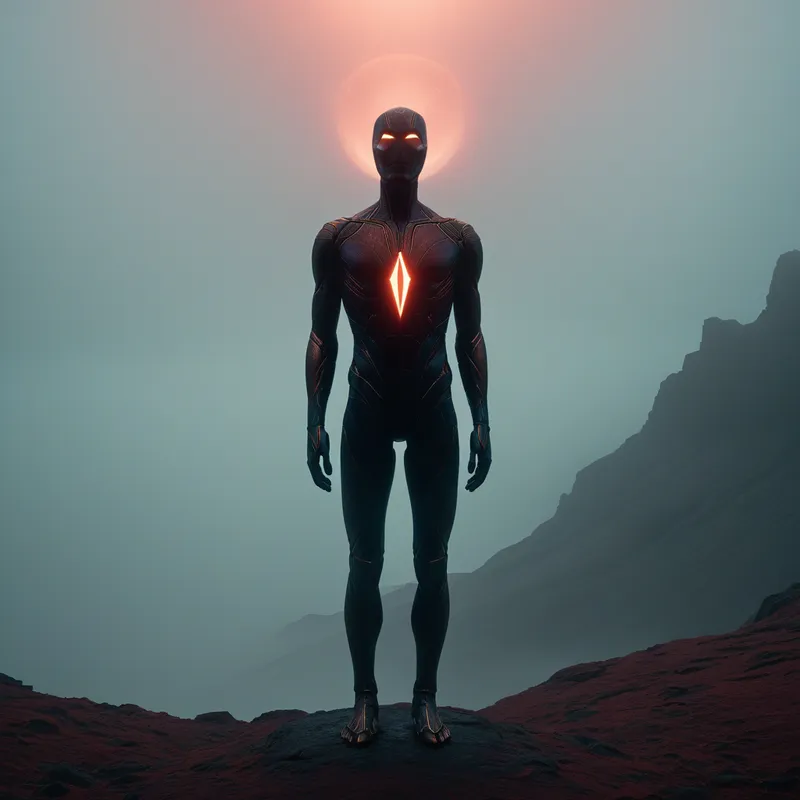
The myth of Talos is a stark map for the alchemical stage of [Nigredo](/myths/nigredo “Myth from Alchemical culture.”/), the blackening, the necessary dissolution. The process of individuation—becoming one’s whole, authentic self—requires the deconstruction of the Talos-like ego structures we mistake for our true selves.
The journey begins with the recognition of the “bronze giant” within: identifying the over-developed, armored [persona](/myths/persona “Myth from Greek culture.”/). The hero’s task is not to strengthen this armor, but, like Medea, to engage it with cunning self-awareness, to listen for its weariness. The “arrow of Poeas” is the precise, conscious insight that locates the single vein—the core vulnerability, the childhood wound, the repressed tenderness—that the entire personality has been organized to protect.
The alchemical gold is not found in the perfection of the armor, but in the conscious, willing sacrifice of it. The ichor must flow.
Striking the nail is an act of sacred vulnerability. It allows the divine life-force, which was locked in service to a rigid, external function (protection), to be liberated. The collapse of the giant is not a failure, but a transformatio. The bronze body returns to the earth and sea, its elements recycled. The ichor—the essential Self—is freed from its metallic prison. For the modern individual, this translates to the often-painful but liberating process of letting a rigid identity die: leaving a soul-crushing job, ending a relationship based on control, surrendering a belief system that no longer serves life. The goal is not to be left empty, but to be left real. The guardian falls so that the human, in all its vulnerable, fluid, and authentic glory, may finally begin to live.
Associated Symbols
Explore related symbols from the CaleaDream lexicon: